Uprooted Palestinians are at the heart of the conflict in the M.E Palestinians uprooted by force of arms. Yet faced immense difficulties have survived, kept alive their history and culture, passed keys of family homes in occupied Palestine from one generation to the next.
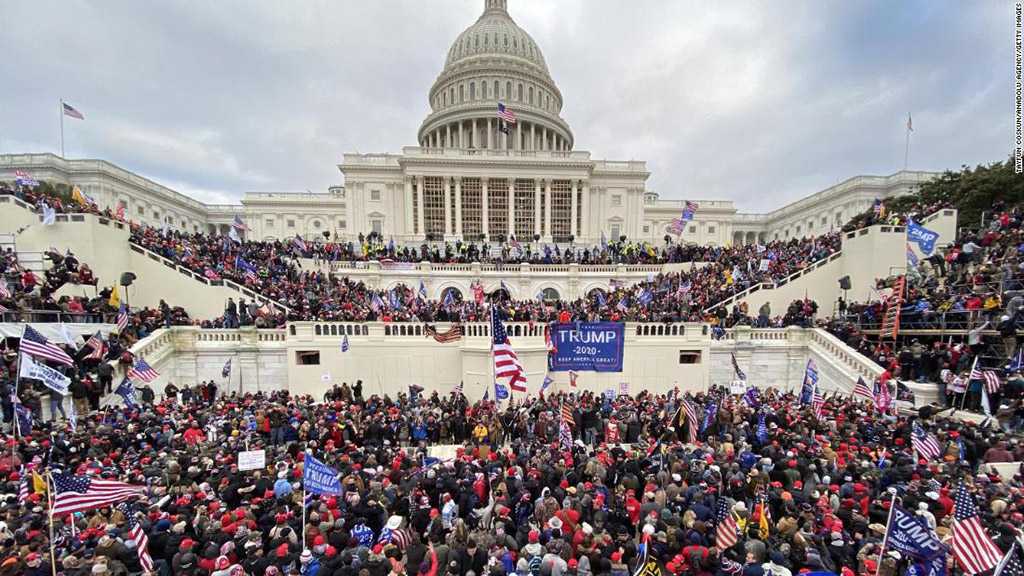
Two more police officers who responded to the Jan. 6 riot at the US Capitol have died by suicide, bringing to four the number of suicides by officers who guarded the building during the attack by Trump supporters.
Washington DC police Officer Gunther Hashida was found dead in his home, the District of Columbia’s police department said on Monday. He died on July 29, one week before his 44th birthday, according to his obituary.
Hashida joined the District of Columbia’s Metropolitan Police Department [MPD] in May 2003, according to media.
US House Speaker Nancy Pelosi hailed Hashida as a “hero” who “risked his life to save our Capitol, the Congressional community and our very Democracy” in a written statement.
Just hours after the MPD confirmed Hashida’s death, department spokesman Hugh Carew said in a statement that another Metropolitan Police Officer who responded to the Capitol riot, Kyle DeFreytag, was found dead on July 10.
DeFreytag’s cause of death was also suicide, Carew said. The suicide was not reported until Monday.
MPD chief Robert Contee wrote in a message to the department last month that, “I am writing to share tragic news that Officer Kyle DeFreytag of the 5th District was found deceased last evening. This is incredibly hard news for us all, and for those that knew him best.”
MPD Officer Jeffrey Smith and US Capitol Police Officer Howard Liebengood also committed suicide in the days after the riot.
Hundreds of former president Donald President supporters stormed the Capitol building that day to stop Congress from certifying Democratic President Joe Biden’s election win.
Four people died on the day of the violence. More than 100 police officers were injured.
A Capitol Police officer, Brian Sicknick, who had been attacked by protesters, died the following day.
The Capitol riot led to Trump’s second impeachment trial. More than 500 people have been arrested for their roles in the violence.
Last week, four police officers told a House of Representatives special committee that they were beaten, threatened, taunted with racial insults, and thought they might die as they struggled to defend the Capitol against the mob.
Republican House Minority Leader Kevin McCarthy dismissed the investigation regarding the Jan.6 Capitol attack, insisting that “Republicans will not be party to their sham process and will instead pursue our own investigation of the facts.”
Trump also described the House investigation as “a fake and highly partisan” political move.
Trump has been accused by his critics of inciting his supporters to violence by peddling what they call “the big lie”, a baseless claim that Biden won the presidency through a stolen election.
Pelosi portrayed the violence, in which rioters clashed with police and sought to hunt down lawmakers, including Pelosi, as an attempt to “overthrow” the government.
Daily Beast: The U.S. will escalate sanctions against the Russian government for hacking American government networks during the 2016 election, the Treasury Department said Thursday. But, in announcing the sanctions, the government went even further than Special Counsel Robert Mueller’s probe in connecting the dots between the Trump campaign and Russian intel agencies.
The statement outlined the pipeline as this: President Trump hired Paul Manafort to run his campaign, who then asked Rick Gates to come aboard. The pair then provided an old colleague, Konstantin Kilimnik, with internal campaign polling and strategy information. Kilimnik then handed it to Russian intelligence officials.
“Additionally, Kilimnik sought to promote the narrative that Ukraine, not Russia, had interfered in the 2016 U.S. presidential election,” the statement said.
It took a long time to connect the dots because Kilimnik was not interviewed by Mueller, and Manafort lied about the affair, The Washington Post reports. It’s still unclear whether Trump knew about the sharing of information, and what Russia did with the information.
Konstantin Kilimnik (Kilimnik) is a Russian and Ukrainian political consultant and known Russian Intelligence Services agent implementing influence operations on their behalf. During the 2016 U.S. presidential election campaign, Kilimnik provided the Russian Intelligence Services with sensitive information on polling and campaign strategy. Additionally, Kilimnik sought to promote the narrative that Ukraine, not Russia, had interfered in the 2016 U.S. presidential election.
In 2018, Kilimnik was indicted on charges of obstruction of justice and conspiracy to obstruct justice regarding unregistered lobbying work. Kilimnik has also sought to assist designated former President of Ukraine Viktor Yanukovych. At Yanukovych’s direction, Kilimnik sought to institute a plan that would return Yanukovych to power in Ukraine.
The missing piece to the Trump/Russia puzzle has always been how the Russians knew where to target their efforts to help Trump. The Russians knew which voters to target because Trump told them. The Trump campaign was a joint effort by Trump and Russia to cheat to win an election.
The truth is out, and nothing is stopping Trump from being prosecuted.
VT Editors is a General Posting account managed by Jim W. Dean and Gordon Duff. All content herein is owned and copyrighted by Jim W. Dean and Gordon Duff
Lawrence Davidson is professor of history emeritus at West Chester University in Pennsylvania. He has been publishing his analyses of topics in U.S. domestic and foreign policy, international and humanitarian law and Israel/Zionist practices and policies since 2010.
All right! Let’s hear it for Joe Biden! Our new president is leading us in the direction of domestic sanity, and there are even hints of progressive potential in his evolving agenda. Under his leadership, we might soon master the Covid-19 plague and dig ourselves out of our near-depression economic straits. This is terrific!
Some good news when it comes to foreign policy as well. You’ll remember that in Trump’s determination to “make “American great again” (MAGA), the former president decided that international organizations and cooperation were impediments to national greatness. Thus, he systematically withdrew from a number of alignments and also scorned international law. This approach appears to have been part of a MAGA scheme to subvert international order. Its nihilistic undertones were highlighted by the creepy leaders who seemed to warm Trump’s heart. He found men such as the Saudi Crown Prince, Mohammed bin Salman, along with a long list of dictators ranging from Rodrigo Duterte in Philippines to Abdel Fattah el-Sisi inEgypt, to be really congenial. There was also Trump’s warm admiration for the Russian leader Vladimir Putin.
President Biden has saved us from this sort of delinquency. He is now operating under new and saner marching orders: “diplomacy is back” and multilateralism is in. The U.S. has recommitted to the international effort to slow down global warming and has rejoined the World Health Organization. Biden has ended all participation in the immoral Yemen civil war and, so it is reported, told the Russians to keep their invasive cyber-fingers to themselves.
At this point you might have the urge to celebrate what appears to be a full 180-degree turn from Donald Trump’s demented worldview. But hold on, that is not quite the case. Sadly, but perhaps not surprisingly, it appears that a residual lawlessness can be found in at least one the Biden’s foreign policies. We can recognize it in the game he is playing with Iran.
Part II—Scuttling the JCPOA
Recall that in 2015 then-President Obama invested a lot of political capital, not to mention putting forth a remarkable display of good sense, in helping to negotiate a multilateral agreement with Iran. This is known as the Joint Comprehensive Plan of Action (JCPOA), and it was multilateral because it included not just the U.S. and Iran but also the permanent members of the United Nations Security Council: the United States, the United Kingdom, Russia, France, and China as well as Germany (collectively referred to as the P5+1). Basically, the agreement stated that, under a regime of international monitoring, Iran would forgo any development of nuclear weapons and convert its nuclear facilities to peacetime pursuits. In exchange, the P5+1 would lift all nuclear-related economic sanctions, freeing up tens of billions of dollars in oil revenue and the release of frozen assets. It was a rare display of effective diplomacy and it worked—until Obama’s successor, Donald Trump, unilaterally scuttled the deal.
Trump withdrew from the agreement in early May 2018. By January 2020 he had increased the number of Iran-related sanctions to over one thousand. In 2019, Trump was suggesting that if Iran wanted to enter into new negotiations with the U.S., he would consider lifting some of the sanctions. Iran refused to begin the negotiating process over again with Trump. On 15 January 2021, five days before leaving office, Trump added new sanctions. Why did he display such maliciousness? Besides a bizarre hatred for anything Obama had achieved, and the disdain for international cooperation which supposedly stood in the way of his MAGA fantasies, there are other factors. Trump is a truly amoral schemer (we might think of him as a modern-day lawless Borgia). And so he almost naturally fell in with amoral regimes with active domestic lobbies in the U.S. (such as Saudi Arabia and Israel), as well as a “pay to play” approach for the votes and donations of Americans who have a grudge against or fear of Iran. Here we can name not only the Zionists, but also the wealthy Iranians who took refuge in the U.S. after Iran’s 1979 revolution. Many of these are Iranian monarchists who want to see regime change in Iran through the return of a shah (king).
Under the circumstances, the Iranian government reaction has been understandable: they see themselves as the aggrieved party. They had negotiated the JCPOA in good faith. They had met the conditions of the agreement to the satisfaction of international monitors. The other side had failed to respond as promised. Not only had the U.S. broke the agreement without cause, but it had then blackmailed its European allies into breaking their commitments under the agreement. This was done by the Trump administration declaring that any party that broke Washington’s sanctions against Iran would themselves be sanctioned.
After a year or so, Iran, noting that it was the only party paying attention to the deal and that the sanctions still applied, began to slowly back away from the nuclear agreement’s provisions. However, it was not until January 2020 that the Iranians announced they would no longer limit their number of centrifuges and thus their capacity to enrich uranium. Even then it was not the obscene number of American sanctions or the gross failure of the Europeans to abide by their promises that finally “broke the camel’s back.” It was Trump’s ordering of the murder of Iranian General Qassem Soleimani in Baghdad on 3 January 2020—essentially an act of war, and certainly one in violation of international law.
Part III—Joe Biden, the Bad Stuff
Now Trump is gone and we have Joe Biden, who, by the way, has not done the right thing and affirmed that his administration would rejoin the Iran nuclear deal. Instead he declared that “I will offer Tehran a credible path back to diplomacy. If Iran returns to strict compliance with the nuclear deal, the United States would rejoin the agreement as a starting point for follow-on negotiations” (my emphasis). Later he said that the subsequent negotiations would involve the Islamic Republic’s “violations of human rights and Iran’s role in the regional conflicts.” On its face, this is not an invitation to return to a stabilizing status quo ante, or even a supposed “credible path back to diplomacy.” It is a take-it-or-leave-it demand. This position is remarkably similar to that of Trump posturing for new negotiations back in 2019. And since, as of 7 February 2021, Biden has refused to lift sanctions on Iran—has refused to cease driving that country into poverty—these are no longer Trump’s sanctions. Biden now owns this horror show. Here are some of Biden’s fatal steps.
It was about nine days into the new administration that Biden’s officials began to reference foreign policy and Iran. First appeared Jake Sullivan, Biden’s national security adviser, who told the U.S. Institute of Peace that “a critical early priority has to be to deal with what is an escalating nuclear crisis as they [Iran] move closer and closer to having enough fissile material for a weapon.” One wonders if Sullivan got his start in advertising, because his description is a purposeful mischaracterization of the situation. The descriptor “escalating nuclear crisis” is a woeful exaggeration. If there is any “crisis” at all, it is because Washington has failed to meet its commitments under the 2015 agreement. The Iranians have repeatedly made it clear that they have no interest in nuclear weapons. And, one can imagine the only thing that could change their mind is an existential outside threat. To date, the only ones that pose such threats are allies of the U.S.: Israel and Saudi Arabia.
Then stepped up Tony Blinken, Biden’s new secretary of state, to continue the new administration’s maneuvers. To wit, Blinken stated “Tehran must resume complying with the 2015 Iran nuclear deal before Washington would do so.” This sort of statement is a rather childish, you-go-first challenge. Blinken then explained that if Iran returns to the deal, Washington would seek to build what Blinken called a “longer and stronger agreement” that would deal with other “deeply problematic” issues. He did not name these, but Biden for his part has drawn attention to Iran’s development of ballistic missiles and its support for proxy forces in countries such as Iraq, Syria, Lebanon and Yemen.
It took the Iranians no time at all to recognize this gambit for what it is, an effort to enlarge restrictions on Iranian military capacity beyond the scope of the original 2015 agreement. Almost immediately, Iran’s foreign minister, Mohammad Javad Zarif, responded that the U.S. position was not practical and will not happen and then added in an op-ed in Foreign Affairs,“once a party leaves an agreement, then that party has no authority demanding others’ compliance to that agreement.”
The Iranians did come back with a more doable proposal to deal with the “who goes first” dilemma. Teheran proposed a timed, mutual U.S. and Iranian return to the original agreement. In an interview with CNN, the Iranian foreign minister said “both countries should synchronize their JCPOA-related moves under the supervision of the European Union”—in other words, achieve the goal with a step-by-step coordinated process. The Biden administration said no to Zarif’s offer, and sane minds, noting the rejection, could hear eerie Trump-like snickering in the surrounding ether.
Part IV—Conclusion
We have already asked why Trump decided to act in such a malicious manner toward Iran. Now we can ask why Joe Biden has decided to mimic his predecessor and continue a callous, hard-line approach to that same country. As it turns out, the answer is not all that different. Biden is subject to the same lobby pressure from groups to which he has a demonstrated sympathy. Among these are some of the well known suspects mentioned above, but first and foremost are Israel and its Zionist supporters (a rundown of these can be found in a full-page ad in the 5 February 2021 New York Times).
We can also add one other grouping to this list—various civil rights organizations who would use the moment to pressure Teheran to increase the level of civil liberties allowed in the country. However, as Behrooz Ghamari Tabriz, writing in Counterpunch notes, “It is a hard sell for those who are genuinely concerned with the question of human rights to ask the American government to be the agent of that change. So long as our government supports the region’s most oppressive regimes, it is hard to imagine that it has any moral authority or political capital to spend on issues of human rights in Iran.”
It is hard to know what exactly is going on inside Joe Biden’s head on this issue. We can assume that it is nothing really analytical. His administration’s actions have, so far, run counter to the other precedents he is laying down in the areas of international cooperation and leadership. They also go against logic. One can imagine no better way to move the Iranians toward nuclear weapons capability than the policies now being pursued. Until Biden acts, in terms of Iran, in the interests of achievable nuclear restraint and stability, that is in the real interests of the country he leads, rather than this or that interest group, he will carry around the residual chains of Donald Trump’s miserable legacy.
Biden Election May Be Illegal, as Four Basic Legal Principles Ignored
1, The People’s Right to Fair Elections.
2, The Law and the State Cannot Condone Fraud. 3, Civil vs. Criminal law.
4, Checks and Balances, Due Process.
5, Difficulties and Solutions. General Discussion. Highlights Discussion. Conclusions and Proposals. Pence’s Letter.
by Citizens Against Fraudulent Elections, 2020-21
Highlights
1. The Right to Fair Elections.
– The People have an inalienable right to a fair and true election, and this right overrides legal formalities.
– If this right is denied them in the first instance, they have the right to demand it in a repeat election.
– Scientific certainty is based on repeatable results, not on opinion and hearsay back and forth.
– Runoffs with anti-fraud safeguards are the only clear way to eliminate fraud beyond a reasonable doubt.
– Allegations of major irregularities and counter-arguments are conjectures without conclusive proof either way.
– A disputed election, resolved by a runoff, is similar to a mistrial, which is remedied by a retrial.
– The decisions on January 6th to certify doubtful results are likewise to be viewed as mistakes to be corrected.
– When a thing is broken, the remedy is to fix it, not just discuss it or let it be.
– The Trump campaign should have done more to emphasize the need for repeat elections, to show their good faith, confidence in the mandate of the people, and support for citizen democracy.
– Runoff elections are the only constitutionally valid solution; see 4, Checks and Balances below.
2, It is an impossibility for the law, and an offense for an individual or an institution, to condone fraud.
– Neither civil nor criminal law may give protection for crimes, such as fraud.
– Every citizen who has knowledge of crimes has the right and the duty to expose and oppose them.
– By assenting to or facilitating fraud, one becomes an accomplice thereto.
– Vice President Pence clearly stated to Congress his concerns about irregularities, illegalities and integrity of the election.
– Yet he then gave the election into the hands of Congress, which is controlled by the party suspected of fraud.
– Thus — if there was indeed fraud — Pence knowingly facilitated its completion.
– This self-contradiction cannot have the color of law.
– His proper course was an estoppel — to refuse to move forward until the disputed electoral results were cleared, and brought from the realm of suspected criminal matters to bona fide civil ones.
3, The Distinction between Civil and Criminal Law.
– A fraudulent matter must first be made whole before it can be the subject of the normal civil procedure.
– Civil laws apply to bona fide matters. Crimes such as fraud fall outside this scope.
– Civil laws, such as the Constitution, are not expected to specify procedures for criminal matters, much as in a contract for payment for goods in cash, it is understood that the notes may not be counterfeit.
– The Supreme Court improperly dismissed the fraud complaint by the State of Texas; standing is a principle in civil matters, while fraud is a criminal matter which it is everyone’s duty to report. By its dismissal, the Court failed in its fundamental duty to oppose fraud on a constitutional scale.
4, Checks and Balances, Due Process
– The two-party system has no place in the Constitution; “faction” was seen as a great evil by the Framers.
– Because of the party system, the Constitutional rules for handling objections to electoral votes tend to result in a violation of due process:
– The decision to accept the vote was given to the Democratic party that controls Congress, while it was also the object of the fraud allegations – making it judge, jury and defendant all in one.
– With the Republicans as plaintiffs and the Democrats as defendants, Congress was cast in the multiple roles of plaintiff, defendant, judge and jury, and could not justly be an arbiter for the people. It had to recuse itself.
– Such gross violations of due process are the antithesis of the Constitutional principle of checks and balances, and cannot be the intent of the framers of the Constitution.
– Amendment IX states, “The enumeration in the Constitution, of certain rights, shall not be construed to deny or disparage others retained by the people.” This certainly includes the people’s right to due process and fair elections!
– Moreover, as noted in (2), no law can be legitimately applied to facilitate fraud. The written law cannot override natural law, nor be applied in contradiction to the intent of the law, nor to perpetrate an injustice.
– Congressional approval of the electoral results on January 6th was invalidated by these violations of due process and of Constitutional checks and balances.
– For VP Pence to reject the disputed votes and throw the election to the 12th Amendment would have also been invalid, by making the Republicans both plaintiff and judge.
– The appointment of the President of the Senate (the Vice President) to count the electoral college votes is not a mere formality, but is a check or brake against fraud. To count or to halt the count is essential to his function. To hold the count in abeyance pending verification is his legitimate duty.
– If it is argued that the Vice President of the Senate should have little power, then should he have the power to allow a violation of due process?
– In a fraudulent or disputed election, the system breaks down at the state and county level, yet this threatens the integrity of the highest federal office, the Presidency. The party system is embedded at all levels.
– The 12th Amendment provides a check against a faction within individual states overriding the will of the majority of states.
5, Difficulties to Overcome and Possible Solutions.
– Fraud Allegations Far in Excess of the Reported Margin of Victory
– Practical and Political Difficulties of Post-election Forensics: Where are the Impartial Experts and Judges?
– The Evils of Faction: Partisanship at all Levels of Government, and in the Media
– Powers of the Supreme Court: SCOTUS Frequently Rules on State Electoral Procedures
– Mandate Hand Ballot Runoffs in Districts with Improbably High Voter Participation before Proceeding to Statewide Runoffs.
– Looking Ahead: Self Auditing Tallies, an Effective Remedy against Electoral Fraud
General Discussion
When there are serious allegations of fraud, there need to be repeat elections, and until then, there is a duty not to certify doubtful results.
Efforts to question the count in court were inconclusive, and could be viewed as an end-run. It needed to go back to the people first.
The 12th Amendment provides for checks and balances between the power of the States and of Congress in selecting the President.
It’s an awful feeling for a team to lose. It’s also a time to review what mistakes were made.
What the Republicans had to do starting in November was to campaign strongly for a rerun of the presidential race in the contested states. Popular opinion could have supported that, because it’s only fair play and the fair way to handle any disputed contest.
If the states refused, then the House would have the necessary justification to invoke the 12th Amendment, where the Vice President rejects the tally of the Electoral College and the House decides the outcome, by each state delegation casting one vote. This provision is one of the checks and balances in the Constitution. The Republic is a confederation of sovereign states, which elect a President, and the 12th Amendment is a protection against a faction gaining control of the vote in a few large states, overriding the will of a majority of the states. As America splits into urban and rural regions, we may need to start taking this Amendment seriously.
Nonetheless, the VP and the Republican state delegations found it difficult to invoke the 12th, because it would look too much like a coup — one fraud against another. It needed to be underpinned by showing eagerness to buttress the fraud allegations by putting the vote to the test again. It is also politically risky to depend on seldom-used provisions. A winning strategy needs to be robust and popularly seen to be rightful.
Trump and Pence had to persistently ask for a new vote with anti-fraud provisions, one without mail-in ballots, also due to time constraints. Too great a delay affects our national security — can we afford a prolonged constitutional crisis? The President and can’t force states to hold runoff elections, of course, the states should do it themselves. It’s all about political legitimacy.
There was a lot of speculation about what the Constitution says, but even the highest laws only apply to bona fide results, not to protect fraud. And there is no way one could prove the true result beyond a reasonable doubt by audits or investigations or lawsuits, especially with voting machines. It was too close, the allegations too great. The only way to ascertain the will of the people in those States is to let them vote again, with proper safeguards, such as proposed by the Carter-Baker Commission and by Rep. Tulsi Gabbard. With millions of votes to audit, fraud is not easy to prove or punish after the fact. Ordinary auditing methods are not at all suited to discovering fraud.
On January 6, VP Pence said it should be decided by the people’s representatives (of which he is one), instead of asking it to be put first to a fair and fraud-free vote by the people themselves.
Here is what he could have announced to Congress instead:
1. The protection of the laws does not apply to fraud. Underlying every law there is a presumption of bona fides — a basic legal principle.
2. That he as VP cannot accept those electoral votes in dispute until there are secure and trustworthy run-off elections, because this is the only way to prove the validity of the outcomes beyond a reasonable doubt.
3. The presidential election result is postponed until action is taken by a sufficient number of states to verify 270 indisputable electoral votes.
4. The runoff should be with hand ballots only, on presentation of official photo identification. No voting machines and no mail-ins. Because any significant variance between hand ballots and mail ballots will again be suspect, mail-in ballots can only confuse the effort to confirm the true will of the people.
5. Pence could have suggested forming a bipartisan Electoral Commission to organize the runoff elections. Runoff elections were the only way. You can’t discover the truth of the matter when you start from bad data.
This option was little discussed. Michael Flynn called for it, in overly military style, when he suggested that Trump could declare martial law, and force a rerun of elections in swing states, but this was seen as undemocratic and unconstitutional. More diplomatically, by insistently calling for runoffs, Trump would be seen as the defender of democracy and the Constitution, forcing the states to show that they feared the outcome, while he was confident of victory. Thus the Republicans might have acquired the moral authority to invoke the 12th Amendment, or at the very least, postpone the certification of the electors, until the runoff issue was decided.
This is not the last time we’ll see attempts to steal elections in our Republic. Let this be a lesson for learning how to eliminate electoral fraud.
Discussion of Highlights
1, The People’s Right to Fair Elections.
In the 2005 report of the Commission on Federal Election Reform, Chairmen Jimmy Carter and James Baker called for safeguards to make sure every real vote counts — and only every real vote. Strict voter ID requirements, restrictions on mail-in voting, maintaining accurate voter registration lists, allowing election observers to monitor the count, and ensuring the accuracy of voting machines were among the 87 recommendations.
According to FrontPageMag.com, “Beginning more than a year ago, Democrats filed nearly 300 lawsuits in dozens of states[7] — most notably all of the key battleground states — in an effort to change election laws and regulations in ways that would benefit Democrat candidates. For example, they sought to: (a) extend the statutory deadlines by which mail-in ballots could be submitted, postmarked, or received by election authorities; (b) permit people to vote earlier than ever before, in some cases as many as 50 days prior to Election Day; (c) eliminate signature, signature-verification, and witness requirements for mail-in ballots; (d) void state laws that disallowed ballot harvesting by third parties; (e) terminate photo-ID requirements for in-person voting; (f) introduce provisions that would allow for the “curing” of mail-in ballots that contained errors or omissions; and (g) require state election officials to send unsolicited mail-in ballots to every person listed as a registered voter, even though such lists have long been notoriously inaccurate.[8] … Though the Democrats did not get everything that they wanted, they got most of it.”
The article, “Yes, It Was a Stolen Election — You’d have to be blind not to see it,” also lists many of the fraud allegations, and statistical indicators that raise doubts about the results. Have these claims been debunked? Reuters tackled the report on vote spikes that switched the vote on election night, for example, it notes that this happened in Wisconsin when Milwaukee County “reported its 170,000 absentee votes, which were overwhelmingly Democrat” – not too reassuring. Their verdict is inconclusive and speculative. FactCheck.org published “Nine Election Fraud Claims, None Credible,” saying the alleged anomalies in counting practices are normal. They also refuted a report that Dominion voting machines are designed to allow fraud.
Yet the evidence on ballot-harvesting and paid vote-buying is irrefutable. How widespread was it? A Texan named Raquel Rodriguez was just arrested for vote-buying after she told Project Veritas all about it on video. And according to Judicial Watch, “In 378 U.S. counties, voter registration rates exceed 100% of the adult population.”
We do not have the hard numbers we need to confirm such close results. Scientific knowledge relies on empirical, observable evidence from repeatable experiments or trials, and this is what we propose.
What to do if there are unfounded claims of fraud? There is skepticism in many quarters about the allegations of fraud made in the 2020 election. Certainly there needs to be a check against frivolous claims of fraud, and this should not be hard to do. First of all runoff elections are already required in many states when the vote is close, although not usually with added fraud safeguards. Secondly, it is possible to focus high-integrity runoff voting tests first on one or more counties, districts or precincts that display the greatest irregularities, to assess the likelihood that fraud may have tipped the statewide outcome. More on this in (5) below.
2, The Law and the State Cannot Condone Fraud.
In his January 6th opinion on his constitutional duty, Pence did note serious concerns about election fraud, but seemed to have no idea what to do about it, or was afraid to tackle it.
It is the duty of every official, indeed every citizen, to assist in exposing fraud, and not to aid and abet it. The law does not give protection to fraud, nor can it be used to do so.
These are basic and fundamental principles, which need not be repeated explicitly in each piece of legislation.
Some legal scholars might overlook the fact that all laws, including the Constitution, are written to govern normal, bona fide matters, and do not digress upon the special case of fraud. There is no need to try and tease out any special provision for fraud from the Constitution, as it is a charter of civil law. One must simply apply common law and common sense principles to fill the “gap” which is no gap in the law: it is a space for us to take action needed to restore the matter to a bona fide basis.
According to theconversation.com, Pence faced “a choice between fidelity to the Constitution and fidelity to Trump.” Stating a problem as a dilemma is a perfect way to exclude other, better choices. There is also fidelity to truth, and fidelity to the people. There is a third way between rejecting and accepting the doubtful electoral votes. It is finding the truth about the real will of the voters.
Pence should have delayed certification until such time as the Supreme Court or the States took action to ensure the election was fair. The 12th Amendment foresees the process of certification lasting as long as March 4th.
Having noted fraud concerns, Pence mistakenly excused himself from any right or duty to do anything about them. He acted improperly by abdicating responsibility and turning over the count to the Congress, which was certain to reject all objections, since it requires a majority of both houses to sustain them, and the Democrats could and did vote them down.
Pence’s references to the election of 1876 cited a very bad precedent, one that showed the need for run-off elections, and the fact that Congress and even Supreme Court justices will vote on party lines. (See the Endnote on the Election of 1876, and the Appendix, Pence’s Letter to Congress of January 6th, 2021.)
3, The Distinction between Civil and Criminal Law.
In the civil law of contracts, for instance, there is no need to state that when payment is in cash, counterfeit bills are not honored. This is understood. Counterfeiting is a crime governed by the criminal code, which is separate from the civil code. The Constitution is essentially a civil code. We cannot expect it to provide procedures for dealing with fraud. This rests with the citizens, representatives and officers who have a fundamental responsibility to take the necessary measures to prevent the success of a fraudulent election. Yet when the representatives are themselves suspected beneficiaries of fraud, they are not competent to rule on the matter.
The Supreme Court improperly dismissed the electoral fraud complaint by the state of Texas. The Court ruled that Texas had no standing, but standing is a criterion of civil litigation. Fraud is a crime, and in criminal law, to report wrongdoing to the authorities is not only a universal right, it is every citizen’s duty. To condone the cover-up of a crime is to facilitate it, making one effectively an accessory. The Supreme Court should reverse its decision on the Texas complaint and consider it together with that of President Trump.
4, Checks and Balances, Due Process.
Since one party controls both houses of Congress, and many statehouses as well, there needs to be certainty, or at least bipartisan agreement, that the vote was fair before Congress can exercise its prerogative of denying objections and approving electoral results. The framers of the Constitution regarded “Faction” as an evil, and were opposed to any role at all for political parties, which tend to be corrupt cartels for the control of political power.
Is Trump being punished as an outsider to a corrupt two-in-one party system? He supposedly lost while increasing his total vote over 2016, yet the Republican Party did quite well. “May the best cheater win” — is that the motto?
In the fraud allegations, the plaintiff was the Republican Donald Trump, and the defendant or suspected perpetrator was in essence the Democratic Party. Since the Democrats controlled the House, letting them dismiss the accusations against themselves was a gross violation of due process. For Pence merely to decertify state results would likewise have violated due process, because it would go to a Republican judge (the House delegations with one vote per state) finding for the Republican plaintiff. This lack of due process would violate the principle of checks and balances. It would allow any party that controlled the office of Vice-President and a majority of house delegations to overturn elections, even by unsubstantiated allegations of fraud.
If, however, the contested states refused to remove the cause for complaint in good faith and beyond a reasonable doubt, by holding repeat elections with anti-fraud safeguards — this would be akin to contempt of court. The Vice President would then be justified in rejecting their votes, or the Supreme Court could order compliance.
5, Difficulties to Overcome and Possible Solutions.
Although the conduct of elections at the state level is a power reserved to the states, the Supreme Court has frequently ruled on these matters, and might order the states in dispute to guarantee fair repeat elections, along the lines recommended by the Commission on Federal Election Reform. In the past, SCOTUS rulings on state conduct of elections have mostly expanded the vote. This has gone too far, when ghosts can outvote the citizenry. For a fair election, one must consider quality and accuracy, as well as quantity.
There is a fairly simple way to ensure that votes are not switched during the count. Each ballot is numbered and the voter receives a stub with the number on it. Text files of all the ballot numbers and the way each ballot was voted can be posted online, with totals by precinct and district. Anyone will be able to check online that their ballot was counted as cast: a simple, open-source, self-auditing vote tally system. This system can be combined with Tulsi Gabbard’s bill H.R.1946 requiring paper receipts for voting machines.
An open-source tally by ballot number will protect against authentic votes being changed, but not against ghost voting. The only way to ensure voters exist is for them to physically present and identify themselves at the poll station. Because of Covid19, the Carter Center suggested in 2020 that “where safeguards for ballot integrity are in place,” such as prohibitions on ballot harvesting, mail-in votes could be relatively fraud-free, but we need a higher degree of probity now. https://www.cartercenter.org/news/pr/2020/united-states-050620.html
We can anticipate that a mandate for a runoff election with hand ballots only will be attacked, among other things, as a risk of spreading Covid 19. Yet essential services and stores are open, and what could be more essential than electoral integrity? The risk can be mitigated in various ways, such as appointment scheduling, social distancing for walk ins, and staying open more than one day if needed.
The fake vote question can be addressed by sampling: hand-ballot runoffs in a few areas with the abnormally highest ratio of votes to the number of registered voters. If the new results under these controlled conditions are very close to the original tally, both in total numbers and the voting preference, then fraud is unlikely — especially if the percentage spread between candidates in the sample does not change much, or not enough to reverse the margin of victory in the original vote.
Was there significant fraud? It depends who you ask, and the opinions follow party lines. Pence thought there was. Trey Trainor, the chairman of the Federal Election Commission, thought so too. The mainstream media and social media giants ridicule the idea.
There are practical problems with a remedy in the courts. The volume of data involved — millions of votes — makes it difficult to apply forensic methods, and also to convince people of the outcome. The best remedy for a botched performance is to do it right the second time. If the new, fraud-proof tally still gives Biden victory, then the fears of fraud will be unsubstantiated. We will also have established an important new precedent for reliably testing electoral integrity. If the new tally changes the outcome, then it may be time to overturn the election result, and to investigate and press charges against those responsible for fraud, even treason.
Conclusions and Proposals.
The certification of the election on January 6th was unconstitutional, because it followed procedures that apply only to bona fide election results. The protections of the laws do not extend to fraud. There must first be reasonable assurance that the results are free of any significant fraud.
The certification also violated due process, since it gave the decision into the hands of the party suspected of fraud.
Thus the election certification was a mistrial. If fraud took place on the scale alleged, then the election was also a mistrial. The remedy in both cases is a retrial.
The Ninth Amendment is an escape clause stipulating that the provisions of the Constitution shall not be construed to deny the rights retained by the people — such as the right to due process and fair elections.
The people and the federal government are principals, who have delegated the election of their officials to the states, who are their agents. The principal always has the right to have the work done to the standards of probity. What must prevail is the realization that if work has been done wrong, it must be put right.
Three branches of government have evidently failed to ensure our right to fair elections: the Congress, certain states, and even the Executive, in the person of the Vice-President.
The branch that can repair the loss now is the Supreme Court judiciary. It can mandate new elections in cases where there are major allegations of fraud and a narrow apparent margin of victory.
It may do this on its own, or by a number of its justices joining a bipartisan Electoral Commission together with Congress, as was done in 1876, but with one major difference. Rather than trying to adjudicate the outcome itself, the Commission should identify precincts or states that are most in need of repeat voting.
For this purpose, the Federal Election Commission should publish a tabulation by precinct for the contested swing states, comparing the results between 2016 and 2020, giving percentages of voter turnout, and of votes for each party and presidential candidate, broken down by in-person, mail-in and absentee ballots, in order to confirm or allay the suspicions raised, and to identify which precincts are most in need of repeat voting.
To expedite matters, it is best to use hand ballots only. Extra measures are needed against vote buying and for monitoring and secrecy of voting, especially in the trial precincts.
Going forward, Congress should pass the anti-fraud measures recommended by Tulsi Gabbard, the Carter-Baker Commission on Federal Election Reform, and for the open-source, self-auditing vote tally system proposed here.
Endnote on 1876
It is hard to imagine a worse precedent than the election of 1876 to support Pence’s plea for the primacy of “the people’s representatives” in interpreting the will of the people themselves, without any delay for fraud investigations. In 1876, Democrat Samuel Tilden won the popular vote with a lead of 3%, but with allegations of fraud on both sides, it was impossible to tell who had really won in the Electoral College. The two parties made a backroom deal, giving the Presidency to the Republican Rutherford Hayes, in exchange for concessions like removing the last remaining Federal troops from the South.
A 15-member bipartisan Electoral Commission of 10 members of Congress and 5 Supreme Court Justices was set up to adjudicate the returns from the four contested states. In a series of 8-7 decisions, voting strictly on party lines, they gave all four states to Hayes, handing him a one-vote margin in the Electoral College. The Republican Justice Bradley on the Commission cast the deciding votes. His opinion on the matter is thus hardly impartial. Pence quotes Bradley as saying the role of President of the Senate is only “ministerial.” A minister is an important office, certainly enough for a duty which every citizen has, that is to prevent fraud. Indeed, the President pro tempore of the Senate presided over the Electoral Commission that Bradley sat on in 1876. By precedent, Pence could have presided over a commission working to resolve the disputes of the election of 2020.
As a precedent also, the election debacle of 1876 supports our thesis here: that Congress cannot be entrusted with the adjudication of an election under a two-party system; that attempts to correct the count through investigations into fraud generally prove frustrating and futile; and that runoffs in states with a very close vote should have been instituted as the solution then and there. We can do it now.
Appendix. Text of VP Pence’s Statement to Congress, January 6th, 2021
THE VICE PRESIDENT WASHINGTON
January 6, 2021
Dear Colleague:
Today, for the 59th time in our Nation’s history, Congress will convene in Joint Session to count the electoral votes for President of the United States. Under our Constitution, it will be my duty as Vice President and as President of the Senate to serve as the presiding officer.
After an election with significant allegations of voting irregularities and numerous instances of officials setting aside state election law, I share the concerns of millions of Americans about the integrity of this election. The American people choose the American President, and have every right under the law to demand free and fair elections and a full investigation of electoral misconduct. As presiding officer, I will do my duty to ensure that these concerns receive a fair and open hearing in the Congress of the United States. Objections will be heard, evidence will be presented, and the elected representatives of the American people will make their decision.
Our Founders created the Electoral College in 1787, and it first convened in 1789. With the advent of political parties, the Electoral College was amended in 1804 to provide that Electors vote separately for President and Vice President. Following a contentious election in 1876, with widespread allegations of fraud and malfeasance, Congress spent a decade establishing rules and procedures to govern the counting of electoral votes and the resolution of any objections.
During the 130 years since the Electoral Count Act was passed, Congress has, without exception, used these formal procedures to count the electoral votes every four years.
Given the controversy surrounding this year’s election, some approach this year’s quadrennial tradition with great expectation, and others with dismissive disdain. Some believe that as Vice President, I should be able to accept or reject electoral votes unilaterally. Others believe that electoral votes should never be challenged in a Joint Session of Congress.
After a careful study of our Constitution, our laws, and our history, I believe neither view is correct.
The President is the chief executive officer of the Federal Government under our Constitution, possessing immense power to impact the lives of the American people. The Presidency belongs to the American people, and to them alone. When disputes concerning a presidential election arise, under Federal law, it is the people’s representatives who review the evidence and resolve disputes through a democratic process.
Our Founders were deeply skeptical of concentrations of power and created a Republic based on separation of powers and checks and balances under the Constitution of the United States.
Vesting the Vice President with unilateral authority to decide presidential contests would be entirely antithetical to that design. As a student of history who loves the Constitution and reveres its Framers, I do not believe that the Founders of our country intended to invest the Vice President with unilateral authority to decide which electoral votes should be counted during the Joint Session of Congress, and no Vice President in American history has ever asserted such authority. Instead, Vice Presidents presiding over Joint Sessions have uniformly followed the Electoral Count Act, conducting the proceedings in an orderly manner even where the count resulted in the defeat of their party or their own candidacy.
As Supreme Court Justice Joseph Bradley wrote following the contentious election of 1876, “the powers of the President of the Senate are merely ministerial… He is not invested with any authority for making any investigation outside of the Joint Meeting of the two Houses… [I]f any examination at all is to be gone into, or any judgment exercised in relation to the votes received, it must be performed and exercised by the two Houses.” More recently, as the former U.S. Court of Appeals Judge J. Michael Luttig observed, “[t]he only responsibility and power of the Vice President under the Constitution is to faithfully count the Electoral College votes as they have been cast,” adding “[t]he Constitution does not empower the Vice President to alter in any way the votes that have been cast, either by rejecting certain votes or otherwise.”
It is my considered judgment that my oath to support and defend the Constitution constrains me from claiming unilateral authority to determine which electoral votes should be counted and which should not.
While my role as presiding officer is largely ceremonial, the role of the Congress is much different, and the Electoral Count Act of 1887 establishes a clear procedure to address election controversies when they arise during the count of the vote of the Electoral College. Given the voting irregularities that took place in our November elections and the disregard of state election statutes by some officials, I welcome the efforts of Senate and House members who have stepped forward to use their authority under the law to raise objections and present evidence.
As presiding officer, I will ensure that any objections that are sponsored by both a Representative and a Senator are given proper consideration, and that all facts supporting those objections are brought before the Congress and the American people. Those who suggest that raising objections under the Electoral Count Act is improper or undemocratic ignore more than 130 years of history, and fail to acknowledge that Democrats raised objections in Congress each of the last three times that a Republican candidate for President prevailed.
Today it will be my duty to preside when the Congress convenes in Joint Session to count the votes of the Electoral College, and I will do so to the best of my ability. I ask only that Representatives and Senators who will assemble before me approach this moment with the same sense of duty and an open mind, setting politics and personal interests aside, and do our part to faithfully discharge our duties under the Constitution. I also pray that we will do so with humility and faith, remembering the words of John Quincy Adams, who said, “Duty is ours; results are God’s.”
On January 6 a huge assembly of Donald Trump’s supporters (“Make America Great Again,” MAGA) assembled in Washington. Their purpose was to greet the initiation of a Congressional investigation into the contested presidential election of 2020. The members of the US Congress were turning a major new page in history. They were initiating their own evaluation of a massive fraud that in my estimation will always undermine the credibility of the 2020 vote.
Just as the congressional process was beginning to unfold, hundreds or possibly thousands of individuals entered the Capitol Building in a process running rife with many unanswered questions. Without any sober second thoughts, however, a huge media operation instantaneously roared into action. The well-orchestrated media chorus went to work blaming the whole episode on the alleged provocation by Donald Trump. The conclusion of Trump’s speech to a live audience that approached a million people verged into the opening moments of Congressional proceedings.
The current rush to judgment by the already thoroughly discredited mainstream media (MSM) is very reminiscent of the hours following the 9/11 debacle. In 2021 as in 2001, the media presented a full interpretation of a symbolically potent episode without any proper investigation whatsoever.
Within literally days of the 2001 episode, the US Armed Forces were invading Eurasia on the basis of what was subsequently well demonstrated to be a false interpretation of 9/11. In the current episode, those who have good reason to want a diversion from a Congressional investigation into election 2020 are calling for Trump’s head. The push is to exploit the episode to disgrace Trump and pull him from the presidency in ignominy before January 20.
Those advancing a quick way of pushing aside the well-documented proof of election fraud happen to be the main beneficiaries of the dominant interpretation of the Capitol Hill episode of 1/6/21. Whether in media, government or so-called law enforcement, these beneficiaries have almost no credibility when it comes to dealing with the substance of false flag events. Indeed, for false flag events to be successful the media and police must collaborate in the misrepresentations of what really happened in order to advance surreptitiously the desired political objectives.
As mainstream media becomes even more of a bandwagon of anti-Trump propaganda than it was throughout the 2020 election, it is important for conscientious citizens to step back a bit. Only by looking at events with the benefit of some distance is it possible to know what is really going on. It is important to evaluate the 1/6/21 episode with a healthy degree of skepticism; to consider all available evidence from a variety of perspectives.
Both Michael Snyder and Jon Rapport have come up with commentaries that include important evidence showing that police encouraged MAGA people to enter the Capitol Grounds and possibly the Capitol Building as well. Further evidence is presented that ANTIFA people were very active outside and inside the Capitol Building. MAGA people in real time actually identified and condemned as ANIFA plants those pictured doing aggressive property damage. Antifa refers to a group that were centrally involved in the rioting, looting and burning that took place all summer in many urban centers including Chicago, New York, Minneapolis, Seattle and Portland.
Global Research Daily: The News Behind the News
-
*Dangerous Crossroads: Beijing Reacts to US/NATO “Nuclear Sharing”
Expansion. China is Described as a “Threat”*
*By Drago Bosnic, August 07, 2026*
NATO ...
Kabbalistic Balance
-
Kabbalistic Balance August 6 2026 ___________________________________ More
Vids! +BN Vids Archive! HERE! ___________________________________ Support
The Br...
Report on Beth Israel vigil 07-04-26
-
*1A Rights under combined attack from local government plus media*
Ann Arbor City Council is at it again. Right before the long 4th of July
weekend, they ...
-
Hello all,
It is with great sadness that I share with you the passing of our beloved
sister, Mother, and Grandmother, the individual that you all knew ...
Best Horror Podcast
-
Best Horror Podcast Introduction: Horror podcasts […]
The post Best Horror Podcast appeared first on Copper Shock Horror Podcast.
Ikhras Endorses Muntadhar Al-Zaidi
-
“Oh parties of banditry and sectarianism and corruption, we have come and
our goal is to destroy you.” Ikhras formally endorses Muntadhar al-Zaidi,
Iraqi j...
Prince Charles: Foreign Jews behind bloodshed in ME
-
In May, 2017, British Crown Prince Charles declined an invitation from
Zionist entity’s president Reuven Rivlin‘s to attend the 100th anniversary
of the no...
Palestinian Women – One for All, All for One
-
Honouring All Palestinian Women by Honouring Three: Hanin Zoabi, Ahed
Tamimi, Samah Sabawi Vacy Vlazna “Palestinian women have always stood side
by side ...
US’s Saudi Oil Deal from Win-Win to Mega-Lose
-
By F. William Engdahl Who would’ve thought it would come to this? Certainly
not the Obama Administration, and their brilliant geo-political think-tank
neo-...
-
*Mordechai Vanunu wins human rights prize of Brazilian Press Association *
* http://www.alternativenews.org/english/index.php/features/updates/7038-mordechai...
Abdul Aziz Rantissi:
"My ultimate wish, my God, is to attain martyrdom,"...God granted him his wish on April 17, 2004, at the hands of Israeli assassins.