Uprooted Palestinians are at the heart of the conflict in the M.E Palestinians uprooted by force of arms. Yet faced immense difficulties have survived, kept alive their history and culture, passed keys of family homes in occupied Palestine from one generation to the next.
Commander of the Islamic Revolution Guard [IRG] Quds Force, Brigadier General Esmail Ghaani said the Americans must either leave the region with humiliation or they will be forced to flee under conditions worse than what they experienced in Afghanistan.
“As already said, we once again tell the Americans that you should leave the geographical region around us … taking with you the humiliation you are facing; otherwise, you will be expelled in a way much worse than [what you experienced in] Afghanistan and you will be forced to flee,” Brigadier General Ghaani said during a commemoration ceremony in the southern Iranian city of Shiraz on Thursday.
“This is your inevitable fate,” Ghaani noted. “You should know that gone is the time when you did whatsoever you wished; the time of hit-and-run strikes is over and if you hit, you will have to wait and receive the response in the harshest way possible.”
The IRG commander said after 20 years of fighting in Afghanistan, the Americans had no choice, but to concede to negotiations and even then, they committed crimes and acts of treachery during the negotiations, and created problems for the Afghan people.
“The Americans established a government in Afghanistan in a matter of 20 years, [and created] a government that could not resist for 20 days [against the onslaught of the Taliban] and they even failed to fly their own people out of the Kabul airport,” Ghaani said.
Stressing that the US defeat in Afghanistan was the “biggest defeat” for the Americans in the last century, the senior Iranian commander said, “After the Americans… suffered defeat in Afghanistan last year, they raised many marginal and secondary issues so that the world would not realize what disgrace they experienced there.”
The US invaded Afghanistan in October 2001 following the September 11, 2001 attacks. American forces occupied the country for about two decades under the pretext of fighting against the Taliban. But as the US forces left Afghanistan, the Taliban stormed into Kabul, weakened by continued foreign occupation.
The Taliban wrested control of Afghanistan in August after a fierce offensive facilitated by a flash withdrawal of all of the United States’ forces from the country that had been announced by Washington back in April.
The government of Afghanistan rapidly collapsed on August 15, with President Ashraf Ghani fleeing the country in the face of lightning advances of the Taliban.
The group has pledged to allow the formation of a broad-based and representative government. Concerns, however, remain given its drawn-out history of violence.
أعلنت كلٌّ من أميركا وبريطانيا وأستراليا في 15 أيلول 2021 عن إقامتها لحلفٍ أمنيٍ باسم «أوكوس»، ودارت عقب هذا الإعلان نقاشات موسّعة حول مدى ما يمثل هذا الحلف من تحول في «الجغرافيا السياسية»، ودارت تباعاً لذلك نقاشات حول قيمة هذه الخطوة من الناحية الإستراتيجية. وقد تَشكَّل شبه إجماع على كون هذه الخطوة تُعد بمثابة تبدلٍ رئيسٍ في «الجغرافيا السياسية» العالمية، فهي تمثل تحولاً عملياً في أولوية السياسة الخارجية الأميركية نحو منطقة «الإندو باسيفيك»، التي تُعد المجال الحيوي للصين، ناهيك عن كونها خطوةً أميركية ملموسة ضمن محاولاتها لعرقلة تقدم الصين في المجالات الاقتصادية والتقنية والتنموية عموماً. تطرّقت عدة مقالات بارزة إلى أهمية هذا الحلف وإلى ما يمثله في «الجغرافيا السياسية»، فمثلاً أكد أستاذ العلاقات الدولية البروفيسور «ستيفن والت» على أن سبب نشوء هذا الحلف وطريقة تشكيله يكشفان عما يتجه إليه العالم في قابل الأيام، وقالت مجلة «ذي إيكونوميست» في غير مقال بأن إقامة هذا الحلف تحاكي محطات تاريخية من قبيل زيارة الرئيس الأميركي الأسبق نيكسون إلى الصين في سبعينيات القرن الماضي، وبأن حلف «أوكوس» يعيد تشكيل المشهد الإستراتيجي في منطقة «الإندو باسيفيك» برمّته.
لكن، رغم إجماع الآراء على أهمية ما يمثله هذا التحالف الأمني الثلاثي في السياسة الدولية، يبقى النقاش مفتوحاً حول ثقل هذا الحلف في الميزان الإستراتيجي، وإذا ما كان يُعد تبدلاً حقيقياً في ميزان القوى في مواجهة الصين في منطقة «الإندو باسيفيك». كان أبرز ما تمخّض عن حلف «أوكوس» توقيع أستراليا على عقد شراء ثماني غواصات حربية أميركية الصنع تعمل بالدفع النووي، وذلك عوضاً عن اثنتي عشرة غواصة حربية تعمل بالوقود التقليدي، كانت أستراليا قد تعاقدت على شرائها من فرنسا سابقاً، قبل إلغاء العَقْد لمصلحة عَقْد «أوكوس» الأميركي.
وتتميز الغواصات النووية الدفع عن نظيراتها التقليدية بأنها أسرع بنحو خمسة أضعافٍ، أي بنحو عشرين عُقدة بحرية للغواصات النووية الدفع في مقابل أربع عُقَد بحرية للغواصات التقليدية الدفع، وكذلك تتميز الغواصات النووية بأنها ذات قدرة عالية على الإبحار لمسافاتٍ بعيدةٍ، ومددٍ زمنيةٍ طويلةٍ، دون الحاجة إلى التزوُّد بالوقود، فمن الممكن القول بأن الغواصات النووية قادرةٌ عملياً على مواصلة العمل طالما توفّر لطاقمها الغذاء، ما يجعل من هذه الغواصات أداةً مثاليةً في عمليات فرض الحصار البحري على الدول، علماً بأن كلاً من مخزون الغذاء على متن الغواصة، وعدد الأيام التي يستطيع الطاقم قضاءها قبل أن يعتريهم الإرهاق، هما أمران ثابتان بمعزل عن نوع الوقود الذي تستخدمه الغواصة.
وتُعد الغواصات النووية أداةً فعالةً في عمليات الرصد والتجسّس أيضاً، وذلك بسبب قدرتها على الإبحار بصمت، ما يُصعِّب عملية اكتشافها وتعقبها من قبل الخصم. لكن في المقابل، وبناءً على معايير «برنامج ترايدنت النووي» البريطاني، تحتاج القوات البحرية إلى ثلاث غواصاتٍ بالحد الأدنى لضمان وجود غواصةٍ واحدةٍ في عمق البحر، وهذا يخفض القدرة العملانية للبحرية الأسترالية من ثلاث إلى أربع غواصات ، كانت لتحققها الصفقة الفرنسية، لتصير غواصتين أو ثلاثاً في أفضل الحالات حسب ما تُؤمِّنه صفقة «أوكوس» الأميركية، ونستذكر هنا جملة الأدميرال «هوراشيو نيلسون» حينما قال: الكثرة فقط هي التي تُبيد. ويجادل البروفيسور هيو وايت، أستاذ الدراسات الإستراتيجية في الجامعة الوطنية الأسترالية، في مقال عن صفقة غواصات «أوكوس» النووية، بالقول إذا ما كان هدف أستراليا الانضمام إلى أميركا في حرب عسكرية ضد الصين، فعندها يكون خيار الغواصات النووية منطقياً، ويتابع، لكن أستراليا ليست قادرة على خوض حرب ضد جيش التحرير الشعبي الصيني وحيدةً، وبدون تواجد أميركي عسكري في منطقة «الإندو باسيفيك»، أما في حال وجود أميركا في المنطقة، فلا فرق عندها بين إذا ما كانت الغواصات الأسترالية نووية أم تقليدية، ويُفهم من حديثه بأنه في هكذا حرب ضد دولة نووية كبرى كالصين، يقع العبء الأكبر على عاتق أميركا، فهل من شأن غواصتين – أو ثلاث في أحسن الحالات – قلب موازين القوى بشكل جوهري في بحر الصين الجنوبي؟
وزيادةً على ذلك، كان يفترض أن تتسلّم أستراليا الغواصات الفرنسية بحلول عام 2030، بينما تحتاج الغواصات النووية الأميركية حتى عام 2040 على أقل تقدير لتكون جاهزة، وحتى ذاك الحين، على الأرجح أن تكون الصين قد حسمت لمصلحتها قضية تايوان، التي تعدها أميركا أمراً رئيساً في مشروع مناهضتها للصين، ناهيك عن أنها ستكون قد عزّزت تواجدها بشكل واسع بالفعل ضمن مجالها الحيوي.
أما إذا كان الحديث عن حلف «أوكوس» الأمني بصفته الشق العسكري من إستراتيجية أميركية أوسع لمناهضة الصين، فهكذا إستراتيجية يلزمها بالضرورة أولاً جانب اقتصادي، ولا سيما كون المنافسة الأميركية مع الصين تتركز على صعود هذه الأخيرة كعملاق اقتصادي عالمي، وثانياً، يلزمها تحالفات أميركية صلبة ذات مغزى وفعالية. ونجد بأن أول تداعيات حلف «أوكوس» كان إغضاب فرنسا، أحد حلفاء أميركا في «الناتو»، ووصف وزير الخارجية الفرنسي سياسة الرئيس الأميركي جو بايدن بالسياسة «الترامبية»، لكن بدون «تويتر»، وعدَّها «طعنة في الظهر» ممن يفترض كونهم حلفاء لفرنسا، ووصل الأمر إلى استدعاء فرنسا لسفيرَيها في أميركا وأستراليا للتشاور. وكانت ردة فعل الفرنسيين مفهومة، سيما أن صفقة الغواصات التي خسرتها كانت تُقدر بأكثر من 65 مليار دولار أميركي.
وأثار إقامة حلف «أوكوس» تساؤلاتٍ جدية لدى أعضاء حلف شمال الأطلسي عن موقع «الناتو» في الإستراتيجية الأميركية في مرحلة مناهضة الصين، حيث أقام الأميركيون هذا الحلف الثلاثي من وراء ظهر الأوروبيين، ذلك خلا بريطانيا التي كانت شريكة أميركا في تحالفها الجديد، ولا سيما أن الإعلان عن تحالف «أوكوس» جاء مباشرةً عقب الانسحاب الأميركي من أفغانستان، الذي لم تنسّق فيه أميركا مع شركائها لا من أوروبيين ولا من غيرهم.
وأما في الجانب الاقتصادي، فكان معبِّراً ما كتبته مجلة «ذي إيكونوميست»، حيث عنونت: وأخيراً أميركا تُبدي جديةً في مناهضة الصين في آسيا، لكنّ تقوية التحالفات العسكرية ليست وحدها أمراً كافياً، لتمضي بالقول إن علاقة أميركا بالصين يلزمها أكثر من مجرد استعراضٍ للقوة، وإنه ينبغي على أميركا تضمين إستراتيجيتها جوانب أخرى، من قبيل التعاون مع الصين حول التغيّر المناخي ضمن قواعد للتنافس الاقتصادي، وهنا فالسياسة الأميركية لا تزال تعاني. وقد كان لافتًا قيام الصين بتقديم طلب انضمامٍ إلى «اتفاق الشراكة الشاملة والتقدمية عبر المحيط الهادئ» بعد يوم واحد فقط على إعلان إقامة حلف «أوكوس»، هذا الاتفاق التجاري الذي يمثل المنطقة التجارية الحرة الكبرى في العالم، والذي انسحبت منه إدارة الرئيس الأميركي دونالد ترامب في عام 2017، ما أشار إلى عقليةٍ أميركيةٍ تجاريةٍ انعزاليةٍ، ولا يبدو أن أياً في أميركا يخطط إلى العودة إلى هذا الاتفاق بما في ذلك إدارة الديمقراطيين الراهنة، رغم تصريحات جو بايدن الانتخابية عن «تصحيح» ما قامت به إدارة دونالد ترامب، وعن نيته إعادة تقوية الشراكات الأميركية مع دول العالم. ويُعد تقديم الصين لطلب الانضمام هذا تعبيراً عن توجهاتها الاقتصادية، ويمكن إدراجه في سياق مناكفة أميركا، رغم الشكوك حول إمكانية قبول طلب الصين في هذه المرحلة من قبل الدول الأعضاء في «الشراكة عبر المحيط الهادئ».
إذاً، بنظرةٍ شاملةٍ لحلف «أوكوس» من جميع زواياه، نجد أنه يمثل تبدلاً عميقاً في «الجغرافيا السياسية»، كونه يعبر عن احتلال مناهضة الصين لرأس أولويات السياسة الخارجية الأميركية لسنوات قادمة، لكنه يظل خطوة عسكرية منقوصة «نصف إستراتيجية» كما وصفته مجلة «ذي إيكونوميست»، فعزّزت أميركا بهذه الخطوة العسكرية التحالف القائم أصلًا مع أستراليا، التي تُعد قزماً إذا ما قورنت بالصين سواءً أكان بعدد السكان أم بالقوة العسكرية، ناهيك عن كون أستراليا تعتمد بشكلٍ رئيسٍ على الصين في الجانب التجاري.
مما لا شك فيه أن أميركا قد حقّقت ربحاً تجارياً من بيع الغواصات النووية الباهظة الثمن، لكنه يبدو قصير الأمد في مقابل تعثرٍ إستراتيجيٍّ طويل الأمد، نتيجة إثارتها مجدداً للشكوك حول مصداقيتها، وعن مراعاتها لمصالح حلفائها، سواءً أكانوا من «الناتو» أم من الدول الأخرى. فهل كانت إذاً أستراليا «بقرةً حلوباً» أخرى تم ابتزازها في حلف «أوكوس»؟ حيث استبدلت أستراليا صفقة فرنسية بأخرى أميركية تفوقها مرة ونصف مرة في القيمة، من أجل حيازة عتادٍ عسكريٍ مشكوك في حاجتها إليه، حسب ما خلص إليه البروفيسور «هيو وايت» بالقول: عند الأخذ في الحسبان مجموع العوامل المرافقة لتشغيل الغواصات النووية، تفوز الغواصات تقليدية الدفع بكل تأكيد، فيا ليت أدارت أستراليا تعاقداتها بقليل من المنطق.
وهل خضعت حكومة «موريسون» إلى تهديد البروفيسور الأميركي المعروف وأستاذ العلوم السياسية «جون ميرشايمر»، حيث كان قد خاطب نخبة من الإستراتيجيين الأستراليين خلال ندوة بعنوان «هل تستطيع الصين النهوض بسلام»، أقيمت في عام 2019 في أستراليا، قائلاً: يرى البعض أنه يوجد هناك بديل، السير مع الصين عوضاً عن أميركا، وفي هذا الخيار أقول – إذا قرّرتم السير مع الصين فعليكم فهم أنكم ستغدون أعداء لنا، وبأنكم تختارون العداء مع الولايات المتحدة الأميركية، فالحديث هنا يخصّ منافسةً أمنيةً حادةً، فإما أن تكونوا معنا وإما أن تكونوا ضدّنا، فإذا اخترتم الصداقة مع الصين، فهذا لن يجعلنا سعداء، وعليكم عدم الاستهانة بغضبنا حينما لا نكون سعداء، وما عليكم إلا سؤال فيديل كاسترو عن ذلك.
صعود الصين، عودة روسيا ونهاية فكرة تصدير الديمقراطية الأمريكية – البروفيسور جون ميرشايمر
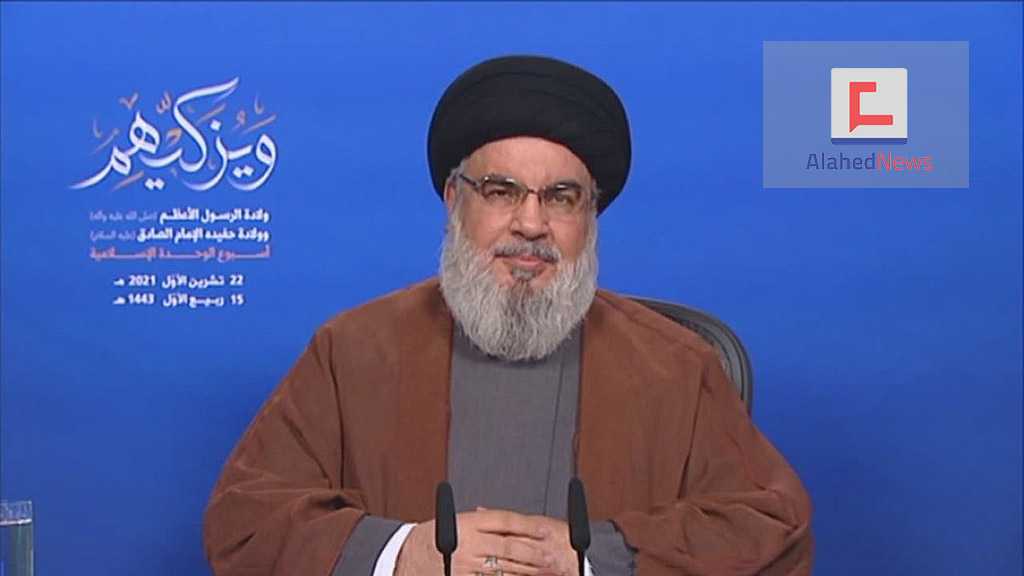
Speech of Hezbollah’s Secretary General His Eminence Sayyed Hassan Nasrallah tackling a range of political developments on the occasion of the birth anniversary of Prophet Muhammad [PBUH] and his grandson Imam Jaafar Sadiq [AS], and the Muslim Unity Week.
I seek refuge in Allah from the accursed Satan. In the name of Allah the Most Gracious the Merciful. Praise be to Allah, Lord of the Worlds, and prayers and peace be upon our Master and Prophet, the Seal of Prophets, Abi al-Qassem Muhammad Bin Abdullah and his good and pure household and his good and chosen companions and all the prophets and messengers.
May the peace, mercy, and blessings of God be upon you all.
In the coming days, God willing, we will welcome a very dear, precious, and great occasion, which is the anniversary of the birth of the Greatest Messenger of God, the Seal of the Prophets, and the Master of Messengers, Muhammad bin Abdullah [PBUH]. I congratulate all Muslims in the world and all Lebanese on this great and solemn occasion in advance. God willing, on this occasion, we will hold a proper and appropriate celebration in a few days, and therefore, I will leave talking about the celebrant and the occasion itself until then.
With regard to the topics, I divided them into two part. One part I will talk about today, and the second I will talk about it, God willing, during that celebration.
I will begin with tonight’s topics. I will speak about the first topic as briefly as possible, appropriate, and unobtrusive.
1- The elections:
The country today is busy preparing for the electoral law, the dates of the elections, the administrative procedures related to the elections, and the natural prelude to entering the stage of the electoral atmosphere as well as having the elections on time.
Regarding the elections, I want to emphasize several points:
i- Holding the elections on time
We have already talked about this and emphasized it on more than one occasion. In any case, there still remain those who try to spread confusion by blaming a certain party, including us sometimes, of planning to extend and postpone the elections, etc. This is all baseless talk. We affirm, insist, and call for the elections to be held on time within the constitutional deadline. To be fair and according to our follow-up with all the parliamentary blocs, parties, and political forces, we believe that no one – so as not to make baseless accusations like some opponents do – whether implicitly or openly is planning or preparing to push matters towards the postponement of the parliamentary elections and the extension of the current Parliament. Therefore, let us put this issue behind us and let everyone engage in holding the parliamentary elections on time, and we are certainly one of those.
ii- The expatriate vote
We agreed to the current law, which was voted on in 2018 and followed in the 2018 elections, as a result of the discussions, and in all sincerity, taking our allies into account. We agreed to a number of things in that law. In the joint parliamentary committees, whether formally or informally, a discussion took place some time ago, and some parliamentary blocs asked to reconsider or demanded a reconsideration. Some of our deputies expressed a position based on an existing reality. This same discussion existed in 2018 and became more intense at the time than it was in the past. This issue was the expatriate vote.
Today, when we want to prepare electoral campaigns or for people who want to run for office or be elected, there is no equal opportunity, whether in conducting electoral campaigns, in candidacy, or even by going to the polls to exercise free elections, specifically with Hezbollah. There will be other political forces whose situation may be less sensitive, but Hezbollah’s situation abroad, in some European countries, in North America, in the Gulf, and some other Arab countries is known. There is no possibility for preparing an electoral campaign, candidacy, or elections. In fact, this is a point of appeal, and we had mentioned to our allies that with regard to Hezbollah, we would not submit an appeal.
But someone can file an appeal regarding the elections in terms of unequal opportunities. The brothers raised the issue from this angle, and an atmosphere emerged in the country that there were those who wanted to prevent the expatriates from voting. Extensive debates were held over this and there was no problem. We discussed the issue once again and came up with the following conclusion. It was expressed by our deputies at the last meeting of the joint committees. But I’d like to mention it here to close discussions on it.
We, once again, discussed and evaluated it. This is what we had to say. Regardless of how many countries in which expatriates or residents will take part in the parliamentary elections – they usually participate in presidential elections – and if there are countries that participate in parliamentary elections, this may be present and perhaps their number may be few, but in any case, as long as the injustice befalls specifically us, we do not have a problem.
This means that we, Hezbollah specifically, will be oppressed. We will not be allowed abroad or have the right to campaign, announce candidacy, or the freedom to vote. This even applies to our supporters. But as long as the injustice pertains to us and there is a national interest and it allows the Lebanese residing outside Lebanese to feel that they are partners and bear responsibility, we have no problem with that. We will overlook this observation, and that is why our brothers amended and said that we support the principle of expatriate voting, in principle. We divided the issue.
Now, there is a detail that whether the expatriates or those residing outside the Lebanese territories will vote according to the constituencies in Lebanon or elect the six representatives that are said to be allocated for the elections abroad. If they are going to vote according to the constituencies in Lebanese, we have no problem with that. And if voting on the six representatives will be confirmed, we are open to discussions when it’ll be discussed in Parliament. However, if the topic is not discussed, there is a law. So, work according to the law. Hence, we consider this matter closed.
And we hope, God willing, from our brothers, our expatriates and people residing outside the Lebanese territories to register and take part in the elections. They are welcome, and we hope that they will have the real opportunity to frankly express their opinion.
iii- Voting at the age of 18
With regard to the issue of [voting at] the age of 18, I honestly tell all the Lebanese people and young people between the age of 18 and 21 that this matter is only raised to be used locally. It is always raised at a time close to deadlines, and time does not help. Although it was brought up at a time way ahead of deadlines, something strange happened. Since 1992 when we first took part in the parliamentary elections, we’ve been known to have strongly supported giving young people at the age of 18 the right to vote.
Whenever you talk with political forces, you find that everyone is in favor. Yet, you go to the Parliament and it gets dropped. There is something strange in this country. We not only raised this in our speeches, slogans, and political and electoral programs, but we also seriously worked and fought hard for it. In March 2009, the Loyalty to the Resistance bloc proposed a constitutional amendment law to reduce the voting age to 18 since this needs a constitutional amendment. In March 2009, it was voted unanimously. This was before the 2009 elections. The constitutional amendment needs two-thirds of the members of the parliament. The government also voted unanimously on this proposal. It was returned to the parliament after the parliamentary elections in the February 2010 session. The session was attended by more than 100 deputies, out of which only 34 deputies voted on the project, mainly the Amal Movement, Hezbollah, and some other blocs. The rest of the blocs abstained, and it fell through. There is really something strange about this country.
If you now make an opinion poll for the parliamentary blocs and the political forces, they all tell you: yes, this is their natural right, and they must elect, etc. Of course, I heard a strange two days ago saying that young people need to be prepared and educated. What is this talk!
In Lebanese, children as young as five or six years old talk politics! You are talking about 18-year-olds. These need educating, preparation, school programs!!! What is this nonsense?!
Anyway, we once again call, the expatriates have the right to vote. All people should demand this right and respect it. If they are wronged somewhere like us, let us go beyond this oppression. With regard to the issue of voting at the age of 18, there is no injustice to anyone. If this right is not given, this is injustice to all Lebanese youth who are being deprived of the right to participate in the parliamentary elections only for purely partisan and personal reasons, not for national or real reasons..
iv- The MegaCenter
Also, related to the elections is the MegaCenter. We have no problem so that no one later says that Hezbollah is preventing this from happening. From now, we do not have a problem. You want to adopt the megacenter, go ahead. You don’t want the megacenter, also go ahead. You want to adopt the magnetic card, we don’t mind. Whether the Ministry of the Interior wants to adopt it or not, let it go ahead. What do you want us to vote with? The identification card? We’ll use it to vote. An excerpt of the civil registry? We’ll use it to vote. We’ll use whatever you want. We do not have a problem. Just hold the elections on time and don’t come up with excuses for not holding the elections on their constitutional dates. The rest of the matters related to the elections, nominations, alliances, the electoral program, and reading the electoral scene will be discussed at their right time, God willing.
2- The electricity file:
In fact, I should have started talking about this file, but I deliberately did not start with it because this file contains some annoyance. Hence, I opted to start with the elections.
In the past few days, they told the Lebanese that fuel has run out, the factories will stop working, and the country will go into complete darkness. Save us. What should we do? Now, they’ve found a temporary solution. They found some with the Lebanese army, and the army instructed to take advantage of what it has to overcome this stage. Of course, We thank the leadership of the Lebanese army for this kind humanitarian step.
But the question remains: Today, this issue should be an absolute priority for the current government. Basically, when the cry came out, it was necessary – this is our personal suggestion – that the government hold an extraordinary session, not a two- or three-hour session, but one that remains from dawn to dusk to find a solution. What does it mean that the country has entered complete darkness? This does not only mean that the country is in complete darkness because of power outage, the country is in a state of clinical death because here we are talking about hospitals, cooperatives, everything having no electricity. Despite this, what has been happening in the country? Instead of calling for a serious, radical, and real treatment, as usual, the Lebanese blamed each other for being responsible, insulted and cursed each other, and insulted one another. All of this does not bring electricity.
Eventually, responsibilities must be determined. But usually in the prevailing Lebanese way, people enter the labyrinth, with more grudges, insults, and swearing emerge. And you’ve seen social media in the past two days.
Since the government holds its session every Wednesday, the priority on the table must be the issue of electricity. What I want to call for tonight is for you to see what you want to do regarding electricity. Find a solution or put the country on the path to a solution, not that pump it with painkillers, i.e., take an advance from the central bank and buy fuel with it for power plants to generate electricity for a few hours. Does this solve the problem? How many days and weeks will this last? The issue needs a radical solution. There are contracts that exist. Make up your mind, say yes or no, but address the issue in any way.
Today, a sum of money was sent to the Lebanese government – the Lebanese state. One billion and one hundred million dollars is in the hands of the Lebanese government. If we want to speak as a matter of absolute priority, take advantage of this amount or part of it and primarily and radically address the issue of electricity – building new power plants, addressing the problem of existing plants. The matter is in your hands. There are many offers from various countries in the world, from the East and the West. You do not want from the East, from the West, then, unless there is an American veto.
If the Americans are forbidding you, tell the Lebanese people frankly: O Lebanese people, we are terrified and unable to bring in European companies because the Americans will be angry with us and have forbidden us from doing so.
In this way the people will express their opinions – whether or not they’d like to live in darkness and in humiliation with no electricity, as the Lebanese used to live in humiliation with the lack of gasoline and diesel. We’ll act depending on the outcome. I know, for example, in Iraq – this is a common and well-known thing there – that the Iraqis have an electricity problem. When they tried to reach an understanding with some European countries, the Americans intervened forcefully and prevented them. So, is there a veto here in Lebanon, an American veto preventing that?
As for the Iranians, there was an old offer. Today, there is a new offer. Two days ago, when His Excellency the Minister of Foreign Affairs of the Islamic Republic of Iran was in Beirut, he reconfirmed that we are ready to build two plants and provide a certain, large, and respectable quantity. Respond to him.
Ask for an exception since America is your friend. To us, they are our enemy, and we expect anything from our enemies. But they are your friends and allies. You trust them and consider them moral and humanitarian who possess human values and law. Ask them for an exception.
Iraq got an exception. Afghanistan under the rule of the Ghani government had an exception – it used to import many things from Iran. Other neighboring countries have exceptions. You ask for an exception. I learned a rather funny thing that was in fact published in the media – when one Lebanese official was by told by the Iranian foreign minister to ask for an exception as the other countries, the official replied to him, saying: I hope you will ask for the exception. It’s a very funny thing. Imagine a Lebanese official telling the Iranians who have enmity with the Americans to do so. There is an ongoing war between them and the Americans, and I him: you ask the Americans for an exception so that you can build us, for example, power plants, or so you can sell us fuel for the power plants, or so you can sell us gasoline or diesel. What a way of taking responsibility?
Anyway, regarding this issue along with all the people, we will raise the voice. The government, the President of the Republic, and the Prime Minister must determine the agenda. But we are among the people who have the right to demand that electricity be at the top of the agenda, or they should allocate an emergency and urgent special session and work for a real radical treatment for this issue. If the issue remains a matter of throwing accusations and scoring points and who disrupted, we will get nowhere.
Hezbollah or others may have raised this suspicion in the past. For the first time, I would like to raise a suspicion. I’m one of those people who has a feeling that somewhere there might be a certain game. Let me say how. It’s the same with what happened gasoline, diesel, and food stuff. The state knows that at some point it will have to lift the subsidies. Everyone tells you that there is no solution except the International Monetary Fund, and the IMF will ask for the subsidies to be lifted, and no one dares to take the responsibility of lifting the subsidy.
They’ll let the people fight, race to cooperatives, and queue at gas stations for petrol, diesel, etc. After a month, two, or three, they’ll start shooting each other, cursing one another, and wielding knives at each other. Then, they will call for the subsidies to be lifted just to be saved and accept the fact that the price of gasoline is 500,000LBP.
If the subsidies are lifted, the problem of the humiliating queues will be solved. Therefore, if you notice and you can go back to the media when we saw the humiliating queues, the voices called for the subsidies to be lifted. This action was serving this. Whether this was intentional and planned or not needs to be verified.
When talking about the subject of electricity, privatization and selling some state assets and some public sectors, including the electricity sector, are always mentioned. The electricity sector is always being eyed for privatization.
There is a fear I would like to raise today. I do not want to accuse anyone. It is very unclear to me, to be honest, that somewhere – within the government or outside it or whether they belong to the opposition or not – they want the electricity sector in Lebanon to collapse. Then, the state would be helpless and unable to solve the problem. Hence, there would be no solution except through privatization. Then, the Lebanese people would not want to live in darkness, so they’d demand to solve this problem with privatization. This is the real fear. We must pay attention to this subject.
From this subject, I will delve into the third point which is related to diesel, gasoline, and the like. I once again make appeal to the various political forces and leaders in Lebanon – brothers, go and check with your allies and friends. I repeat and say that whatever we are capable of doing with our allies and friends, we will do. What can Iran do more than this? They are already telling you that they are prepared to sell you gasoline, diesel, and fuel and build power plants and metro stations. They want to cooperate with you and offer you facilities. This is a solution.
The Syrians told you they do not have a problem. Bring Egyptian gas and electricity from Jordan. I will offer you the facilities you want. If there is anything else, I am at your service as well. These are our allies.
As for your allies, we have not seen them do anything. You have not done anything. Talk to someone to make you an exception. Talk to someone to help the Lebanese. If your allies told you that Hezbollah is part of the Lebanese people, then exclude Hezbollah and bring help for the rest of the Lebanese areas. Act responsibly, not maliciously.
Until now, we still hear that, for example, they brought diesel from Iran. They brought it across the border into Syria, so 1, 2, 3, 4, 5. We hear it every other Sunday, etc. Here is another example of the level of responsibility in the country. A politician reached a conclusion that the power cut stated happening when diesel was brought in from Iran as the power plants broke down. You all know. It is all known. He did not know that the state’s electricity plants run on fuel, and what was brought from Iran was diesel. There is no relation between diesel, fuel, and electricity plants. In any case, this is the level that exists in the country.
This is a call for the last time. Budge a little. Move a little, and don’t be malicious. What is your main role other than criticizing, insulting, and accusing? Do something positive for your people and your country.
3- Gasoline and diesel:
I moved to the third topic, in which I will talk about what happened with us and what will happen concerning diesel and gasoline.
So far, we consider ourselves still in the first phase. Of course, a number of ships have arrived so far, and we are gradually moving them to Lebanon. We consider that the first phase will continue until the end of October. During the first phase, we did two things, and we will continue with them.
The first thing we said is that there is a group that we will gift them diesel for a month and a group that we will sell diesel to. We did not put the diesel at the stations and said, “People, please. Who wants to buy can come.” Meaning that we are doing more than the goal. We said that the goal is to secure this material for these pressing and urgent cases, and we do not want to compete or block the way for companies and stations that sell diesel. In the end, we will give to a group and the rest can buy from the stations. By doing so, we are not cutting off people’s livelihood. We adopted this approach, and we will indeed continue until the end of October as a first phase.
Within this first phase, there are two points I would like to add.
1- We had announced a gift or donation for a group for a period of one month. That period has ended. There is a quantity that has arrived and another that is on the way, and it will reach them, God willing. What I would like to announce today is that we will renew this gift. This gift is for the same group and will be for an additional month, for a second month.
I will again mention the institutions belonging to this group: government hospitals, nursing homes, orphanages, centers for people with special needs, official water institutions, water wells belonging to municipalities, provided they are a poor municipalities, and fire brigades in the Civil Defense and the Lebanese Red Cross. After the end of the first month, I announce today that we will provide the quantity they need from this material as a gift and assistance, God willing, for a second month.
2- Regarding the groups, I would like to announce that this material would also be sold to the fishermen. This addition comes following many revisions that have been made. We’ve already started and not just starting. This happened in the last period. The fishermen has been added to the segments to which this material can be sold to. The same institutions that we talked about before will remain – private hospitals, pharmaceutical laboratories, mills, bakeries, etc. We will complete the first phase by working with the same [entities] we worked with last month.
When we reach the second phase, which starts from the beginning of November, we will add heating for families. We and our brothers are studying the standards because the most important thing is to abide by the standards. During the past month, there were cases that included people not belonging to the group that this material can be sold to contacted us. These people are very dear to us and we love to be of service to them. However, we had a serious commitment to the standards and the groups. If we did not abide, it will be chaotic, and, therefore, we would not be able to serve the groups that we considered a priority.
Today, we have the issue of heating that needs to be studied, and it is a very big topic. For example, among the entities that it will be sold to are private hospitals, bakeries, mills, laboratories, etc. We considered that establishments and companies operating generators are the largest segment, and they, in fact, are the ones that need the largest amount. But when we bring in the issue of heating, there is no comparison because here you are talking about Lebanese families in areas where there is cold and frost.
This requires different controls, standards, and a distribution mechanism that we are studying. God willing, before the beginning of November, we will talk about this issue, I or one of my brothers, and it will be announced in detail. Also because of winter, we may add new entities. This, too, is being evaluated and studied – first of all because of the high demand that happened. The volume of requests in all Lebanese regions was very large. I’d say it was greater than expected, yes, greater than expected. It is very large in all areas. This is on the one hand.
On the other hand, winter season is coming, and of course, the demand for diesel will increase exponentially – we had made diesel a priority. This means that we have decided to continue with diesel being the priority. We postponed bringing gasoline. Even if we get gasoline, we will exchange it for diesel with the merchants because the priority now is to provide the fuel oil in the way that it is secure. Thank God, now, in one way or another, the queues of humiliation are over. Gasoline is available at the stations, albeit at a high price. Our main concern was to get rid of the queues of humiliation. Now, these queues are over. Gasoline is available. We do not believe now, as a result of the large file, that we should work on all the entities. We have to focus our priority on diesel, especially since we are a few weeks away from winter season.
I will conclude this whole file. We heard people say, leave the Lebanese state buy its own gasoline and diesel from Iran. We support this talk. This is our demand. Let the Lebanese government ask the Americans for an exception, while the Lebanese companies buy. We guarantee that they will get facilities from Iran to buy diesel, gasoline, and fuel from Iran, etc. At that point, we will withdraw from this file. We will leave the file completely. We will not buy, nor bring ships, nor transport to Baniyas, nor bring from Baniyas to Baalbek. We will leave the matter completely. Go ahead, take responsibility. Open this door. This only needs some courage and boldness. Many countries neighboring Iran have exceptions – exceptions in buying gasoline, diesel, oil derivatives, and many other materials. Go ahead, work on this matter. This is one of the doors – you consider that we are violating sovereignty. Good, then help us so that we do not violate sovereignty. Go ahead, ask for an exception and open this door.
4- The Beirut Port [blast] investigation:
I would like to recall what I used to say since the beginning – we want and support the investigation. I honestly say and tell you that even if the families of the martyrs and the wounded abandoned the investigation, we, Hezbollah, will not abandon the investigation. We consider ourselves among those who were affected not only in terms of martyrs, wounded, and homes, but we were also affected morally, politically, and media wise. Taking humanitarian considerations towards the families of the martyrs, we want the truth and accountability. Politically and morally, we, as Hezbollah, want the truth and we want accountability. There is no discussion regarding this topic. It is not cutting of the road in front of the investigation nor is it to end or cancel the file. Never. Whoever says this is unfair. We want to reach a result. What is really required is justice. What the former judge did is clear. He was biased and politicized. We spoke loudly about this and gave advise. The man rose and asked with legitimate suspicion and left. The man made a legitimate request and left. However, instead of benefiting from all the mistakes and the observations made to the previous judge, the current judge continued with the same mistakes. He ignored these remarks and did worse. The current judge’s work is politically motivated and biased. His work is being politicized and has nothing to do with the truth and justice.
Before I conclude, I would like to address the families of the martyrs – if you expect to uncover the truth with this judge, you will not. If you expect that this judge will bring you justice, even at the level of an indictment, you will not get it. The work of this judge is politically motivated. He is exploiting the blood of the martyrs, the wounded, the tragedy, and the calamity to serve political goals and political targeting.
1- We previously talked about the evidence, but now I would like to highlight the issue more because we have reached a point that can no longer be tolerated.
Let us simply talk logically. Is this interference in the affairs of the judiciary? But first off, tell me this is a judiciary so that I can agree with you whether this is interference or not. This is not a judiciary. This is a politically-motivated job. As long as it is a politically-motivated job, allow me to say a couple of words. What do science and justice say? They say there was an explosion. Hence, look for the responsibilities. This is a problem that I will return to shortly.
I would like to ask the current judge – disregard the previous judge. Since the arrival of the ammonium nitrate ship to Lebanon’s Beirut Port to Lebanon, there have been two presidents: President Michel Suleiman and His Excellency President Michel Aoun. His Excellency, President Michel Aoun has said on more than one occasion – a transparent man – “I knew on this day and I followed up this way. I am ready for the judge to come and listen to me.”
Did you listen to him? You are a judge who works as the judiciary, did you listen to His Excellency the President and took his statement? He is the one telling to go to him. What are you afraid of?
Did you ask President Michel Suleiman? Did you listen to him? did you ask him – you were the president of the republic when this ship came and entered, did you know? What did you do? Regardless of whether he was responsible or not. You did not ask him, and you did not listen to His Excellency the President even though he invited you.
Since the day the ship entered Lebanon in November 2013, there have been multiple prime ministers. You, the judge, quickly belittled Prime Minister Hassan Diab and thought you can accuse him, summon him, etc.
One question. Did you ask former heads of government? Did you listen to them? I’m not telling you to summon them. Did you go to them? Did you sit with them? Did you ask them even a question about their knowledge of the subject? What did they do if they had knowledge? Were they responsible or not? You did not do any of this. You quickly went to Prime Minister Hassan Diab. Can you tell me that the explosion took place during the premiership of PM Hassan Diab? Why did you go after the former ministers and not the current ministers? I am not defending people who are our friends only. Among them are our friends and those who are not our friends. The people I’m telling you to investigate include some of our friends. Why did you not ask the ministers in the current government who were in office when the explosion occurred? Instead, you went to the former ministers. Why not all the former ministers? Did you ask all the finance ministers? Did you summon them all and investigated with them? Did you investigate and ask the ministers of works who were in office in November 2013? The current Minister of Works is also our friend. The ministers of interior who were in office in November 2013 until today is also our friend. The ministers of defense as well as the ministers of finance and works are also the ministers of guardianship. Did you investigate with the ministers of defense? Non, you didn’t. Did you ask the ministers of justice? No, you didn’t. Did you ask all the heads of the security and military services? No, you did not. I tell you no because they really did not ask them. he asked some of them, but not all of them. What do they call this? You are going after specific agencies, specific ministers, and a specific prime minister is clearly [political] targeting. Does the issue need a little understanding in order to see that there is clearly targeting? There is political targeting. This is the first point. We’ve spoken about this in the past. We also warned you. Do not be biased and politicized. Or else, we will demand you leave. Then he continues working as if nothing happened. On the contrary, he rose even more and behaved as if he was the ruler with regard to this file. This is the first point.
2- The main subject in the explosion:
The whole thing is incomprehensible. Yet, you skipped it. Basically, it is like what many Lebanese say. I am not saying anything new. The basic principle, O honorable judicial investigator, is that you go and tell the families of the martyrs before you incite them against the politicians. You have to tell these families that you sit with every other day who brought the ship, who let the ship dock, who gave permission, who left the materials in hangar 12, and who gave approval. You are not doing any of these. You are tackling another matter which comes in second place which is negligence. You are making a big deal out of this for settling political scores. O brother, tell the Lebanese people. If you don’t want to tell the Lebanese people, at least tell the families of the martyrs. And you, our people and our loved ones, the families of the martyrs, go and demand. This is your right to demand. Ask him how your children were killed? You, an investigative judge, do not want to tell them because this does not serve the politicization that you are working on. So, what did you turn to? To negligence. You are making a bigger deal out of negligence – the one who is charged with negligence should receive the most severe penalties.
I’m not asking for anything. I am only asking why he is disregarding and neglecting the first part of the issue. Why is the truth not told to the Lebanese? The judicial secrecy is the issue. It is not about someone killing another person. This is a catastrophe that has befell the country, and the country is heading towards a catastrophe if this judge continues working in this way. Therefore, the matter needs a different approach.
3- Bias:
The judges, who were involved and whose responsibility wss greater than that of the presidents of the republic, are responsible. I do not know. I am not a judge to rule on this matter. The responsibility of judges is greater than that of heads of government, ministers, and heads of the security services because the judges are the ones who allowed this material to enter and to be stored. The rest are all procedural. The two judges or the judges are the first to be responsible. O families of the martyrs, ask this judge. Ask him about those judges whose responsibility is unquestionable.
There might be a discussion about the responsibility of the prime minister, a specific minister, and the security apparatus. But there is no discussion that these judges are responsible. What did you do to them? You did nothing. You filed a lawsuit against them in court, the High Judicial Council and the Discriminatory Public Prosecution, and to appoint a special court. Great! You do not want to summon the judge, issue an arrest warrant for him, or imprison him because he is a judge. The judiciary wants to protect itself. However, you want to summon a respectable prime minister like Hassan Diab, subpoena him, issue an arrest warrant against him, and throw him in prison. Is this a state of law? Is this a state institution? Does this country have morals? The law says that judges go to court. The constitution says that presidents and ministers go to the presidents’ court. In the case of the presidents and ministers, why don’t you accept. You consider this your right and transcend all constitutional principles and attack people? However, in the case of the judges, the law says that they go to the High Judicial Council. Answer us so that we know whether what is happening is right, just, and fair or is political targeting?
4- The last part in this file:
When presidents, ministers, and representatives feel that they have been wronged, who do they turn to? They tell you – this specific judge is biased. He is attacking us and is unfair with us. He want to arrest us unjustly. He is impatient with formal matters as in talking with us and our lawyers. We are being wronged. Who do we turn to? In a state of law and institutions, the law must answer. They turned to a judicial body, and we see that this judicial body did not take its time to study the case, did not discuss, nor summon, nor investigate. It returned the request saying it’s outside of their jurisdiction. Whose jurisdiction is it? So, guide us. You say the law and the state of institutions, O Higher Judicial Council, answer. Bring the prime minister who will be summoned for arrest, the ministers, and others who may be caught up in lawsuits. Where are they being wronged? If there is no jurisdiction for so and so and so, who has jurisdiction then? This needs a solution and an answer. In any case, we have big problems. We consider that what is happening is a very bad situation. It will not lead to the truth and justice, but it will lead to injustice and to concealment of the truth. This does not mean that we are demanding that the investigation be closed. Not at all. We want an honest and a transparent judge, who works on a clear and transparent investigation based on rules, an investigation in which there is no bias. He must continue the investigation and this matter should not stop at all.
First, we want an answer. Where would an oppressed person and a person with suspicions seek refuge in this country?
Another thing, the issue is no longer a personal matter, the issue has repercussions at the national level and on the country. Today, I am appealing to the High Judicial Council. What is happening has nothing to do with the judiciary, nor with justice, with fairness, nor with the truth. You must find a solution to the matter. The Supreme Court does not want to resolve the issue. The Council of Ministers is required to resolve this issue. It referred this issue. It will be raised in the Council of Ministers. We will speak and others too. This matter cannot continue this way. There is no possibility for it to continue this way, especially in the next few days. Therefore, among the institutions, the High Judicial Council should meet and see how to address this issue. We are talking to you and on behalf of many people in this country. We are a large segment in this country, and we have the right to be heard. We have the right to be given an answer. We have the right to demand in the Council of Ministers. It is our right that the Council of Ministers discuss this issue and take a stance. In all honesty, I tell you this matter must not continue this way.
As for the rest of the points of discussion, I wanted to talk about the demarcation of the maritime borders, the disputed area, the new negotiations, the Israeli steps, and other files. We will talk about all this, God willing, during the occasion in a few days.
I just want to conclude with two points. I must, morally and ethically, talk about them.
The first point is the bombing that took place in Kunduz, a few days ago, in Afghanistan, in a mosque during Friday prayers, which led to dozens of martyrs and wounded. Of course, this is a painful matter. Any person, Muslim or not, will ache when he sees elderly people and children being killed, just because they were praying in a mosque. This is very sad and very painful.
Despite the distance, we also share with our family and loved ones and these oppressed families their grief and pain. We express our sorrow for what happened and condemn it. But what’s most important is that Daesh committed this crime and claimed responsibility. I say the Wahabi terrorist organization Daesh.
I hope from all our friends, companions, and the media in our axis, if they accept from me, to call it the Wahhabi terrorist organization. Because what Daesh is doing is the result of this school of thought that accuses the other of being an infidel. One can accuse the other of being an infidel, but he does not spill one’s blood and take his money and honor. A doctrinal disagreement, a certain person says that so-and-so is an infidel and does not believe in a specific cause. But what is more dangerous than takfir [accusing another Muslim to be an apostate] is spilling blood and taking someone else’s money, honor, and social public safety. It is this school of thought that led to these results throughout the world, especially in our Arab and Islamic world.
The one who also bears the responsibility is America. Before the Americans left Afghanistan and on more than one occasion, I mentioned to you in the media and in speeches that we and others have information that the Americans are moving Daesh from the east of the Euphrates and from the Al-Hol camp. They even transferred some from Iraq to Afghanistan. At that time, many were wondering what the Americans wanted from Daesh in Afghanistan? Of course, at the time, even when they transferred them to Afghanistan, Daesh did not carry out a single operation against the American forces there. Rather, they fought those who were fighting the Americans, including the Taliban. But today, the goal has appeared more, to be sure.
I am an enemy of the Americans and I am accusing them. A few days ago, Turkey’s foreign minister, who is an ally of the Americans but has a problem with them, also said that the Americans had moved Daesh from the east of the Euphrates and eastern Syria to Afghanistan. That’s the Turkish foreign minister, a country that is not a small one in the region. He is a friend of the Americans. This is well known. Why did the Americans take Daesh to Afghanistan during the year they were negotiating with the Taliban in Doha to withdraw?
They were preparing for a post-withdrawal phase. What is the post-withdrawal phase? It is preparing for a civil war in Afghanistan. They had two tools. The first tool was the Afghan state and the Afghan army, which they spent hundreds of billions of dollars on. This collapsed, but the alternative was ready, which was Daesh. Today, Daesh’s work in Afghanistan is to drag the country into a civil war. They carried out operations against non-Shiites in Jalalabad and Kabul. But targeting the mosque in Kunduz, where Shiite Muslims pray, is also to create a state of internal tension that will lead to a civil war in Afghanistan.
The Americans are responsible. The American policies, the American administration, the American army, the CIA, and all those who are working on the issue of Daesh and Afghanistan, we also hold them responsible for the innocent blood that was shed in Afghanistan. The responsibility of the current authorities – whether the world recognizes them or not – now that it is an authority that exists in Afghanistan, is to protect these citizens regardless of their affiliation to any religion or sect.
There is another matter that I must talk about from a moral standpoint, even though it has been a while since it transpired. An incident took place a while back in Palestine where a group of security services affiliated to the Palestinian Authority arrested, beat, and tortured martyr Nizar Banat, a Palestinian brother, a resistance fighter, and a thinker who had brave and courageous positions, which led to his martyrdom.
Of course, one may ask why are you talking about this now and that this story is old? At that time, although we saw that all the Palestinian factions took a position, we preferred to wait because the issue was not very clear, and we considered that it could be an internal affair. But today, it is my duty to pay tribute, even for a few minutes, to this resistant martyr, mujahid, thinker, and bold, brave, and oppressed martyr Nizar Banat. I am one of the people who during the previous period – I mean during his life and not after his martyrdom – I usually and for security reasons do not have internet, but every once in a while, the young men give me recorded summaries, I listen and watch what this person said, how he spoke, and how he expressed a position?
At various times, I listened and gave time to Brother Nizar. I was very impressed by his clarity, his pure thought on the issue of resistance, the issue of “Israel”, the issue of the situation in the region, the position on the axis of resistance, the conflicts in the region, and targeting the axis of resistance. I was amazed by his courage – he lives in the West Bank and it is possible that he might be attacked, arrested, or killed at any moment. Of course, I had in mind that the “Israelis” would kill him and not anyone from the PA. In fact, I would like to say a couple of words first to shed light on this bold, courageous, clear, authentic, and strong figure as well as his position on the issue of resistance, the Palestinian cause. He had courage until his martyrdom. Secondly, as this is the first time I am talking about the subject, we share with honorable family, all his family members, his loved ones, his friends, and his companions the pain and the unending grief. I know that to them this matter has not ended.
The third point is to demand justice and truth from the Palestinian Authority, the Palestinian judiciary, and all the Palestinian people for martyr Nizar must. Time will not stop this, and this blood must not be wasted just because those who have wronged him or committed crimes against him belong to a certain security apparatus. This is regarding martyr Nizar. I wanted to talk about him.
I said at the beginning of the speech that in a few days we will have a great and very dear occasion, which is the anniversary of the birth of the greatest Messenger of God. Of course, celebrations and commemorations take place in different regions of the Islamic world. But in the past years, what must also be noted with admiration and pride is how the dear and oppressed Yemeni people are commemorating this occasion. We are talking about the areas under the control of what they call the Sana’a government, meaning in the areas where Ansarullah is present. Huge crowds gather in all governorates and cities at the same time.
The whole world saw how they’ve been commemorating the birth of the Messenger of God Muhammad during the past two years despite the war, destruction, difficult economic conditions, difficult living conditions, rampant diseases, great dangers, and siege. But it is really amazing the way they commemorate this occasion, and as a Muslim, I tell you that I feel ashamed. Despite the circumstances and situation, these people mark the occasion in such a way, while we, the rest of the Muslims in different parts of the world, how do we commemorate this anniversary even though our circumstances are much better than theirs, even if there are some difficulties.
First, salutations to the dear and oppressed Yemeni people, who love and adore the Messenger of God, for what they will do during the next few days.
I consider the way the Yemenis mark [this occasion] as an argument for all of us as Muslims in the Islamic world.
In the past few years, we used to hold celebrations. It is possible that during the last two years, we’ve eased down on celebrations a little because of the coronavirus. This year, we want to hold a decent and respectful celebration. That is why starting from now I invite the lovers of the Messenger of God to make the marking and celebration of this year’s occasion appropriate and to the level of their love, adoration, and loyalty to the Messenger of God.
May God give you wellness. We’ll talk about the rest later, God willing, if God keeps us alive. May God’s peace, mercy and blessings be upon you.
US foreign policy is by no means becoming less ideological. Liberal ideology in its newest left-liberal form is turning from a means of expansion into an instrument for consolidating the “collective West”, defining “us and them” and splitting the international community into opposing blocs, writes Valdai Club expert Dmitry Suslov.
US foreign policy is undergoing an important transition. The US withdrawal from Afghanistan drew a final and symbolic line under the period of its foreign policy, which began not on September 11, 2001, but in the early 1990s — what’s commonly called the “post-Cold War” period. In the early 1990s, intoxicated by the “victory in the Cold War” declared by George Bush Sr., the United States, being confident of the “end of history” and not meeting any resistance from outside in the context of the emerging “moment of unipolarity”, embarked on a course to transform everything else in the world in accordance with its values. These included the universalisation of the collective West and the spread of the American-centric “New World Order”. It was then that the goal of American policy towards Russia and China became their liberal-democratic transformation in accordance with Western patterns and integration into the American-centric world as junior players. US policy objectives regarding so-called “Rogue countries” (that is, those who stubbornly did not want to go over to the “right side of history”) became regime change.
That policy reached an impasse in the second half of the 2000s; since then the United States has been mired in a deep foreign policy crisis, due to the fact that the world had “suddenly” stopped developing in line with the American ideological guidelines. Russia and China refused to be transformed in accordance with Western patterns and integrate into the American world order as junior players, and attempts to democratise Iraq, Afghanistan and the Middle East generally failed. It was obviously not possible to extend the American-centric world order to the entire international system, and this order itself gradually began to burst at the seams.
Barack Obama tried to find a way out of this crisis by changing the instruments of American foreign policy, but maintaining the paradigm of spreading the American-centric world order to the rest of the world. The “reset” of relations with Russia and the Trans-Pacific Partnership (Washington hoped that China would eventually be forced to join the TPP) were, in fact, the latest attempts to “draw” Moscow and Beijing into the American-centric world order. Supporting the Arab Spring and fighting Arab dictators was the latest attempt to transform the Middle East. Both attempts failed again.
The first president of the United States to abandon the paradigm of transforming the rest of the world in accordance with American values was Donald Trump. Under his administration, for the first time since the Cold War, the US didn’t initiate any new military interventions, openly declared its refusal to spread democracy by military means, and made a fundamental decision to leave Afghanistan by signing an agreement with the Taliban (banned in Russia). It announced that henceforth, US foreign and defence policy would be focused primarily on the confrontation with Washington’s global rivals and adversaries, namely China and Russia. However, both the American elite and the establishment of most of the US allies mistakenly perceived Trump and his policies as a temporary aberration, after which a “return to normal” US policy (as it was after the end of the Cold War) should occur. Trump’s turnaround did not seem real or final to many. However, their projections were all in vain.
Biden’s historical significance lies in the fact that, despite being flesh and blood part of the traditional American establishment, having removed Trump from the White House, and receiving the support of elites and the “deep state”, he not only did not abandon the foreign policy of Trump, but also saw it to its conclusion. In doing so, he gave it a much more systemic and complete character. The main ways in which Biden’s foreign policy differs from that of Trump are that the United States has increased the importance of combating transnational threats (primarily climate change), and also changed its rhetoric towards its European allies, making it more sympathetic. On most fundamental issues, however, continuity prevails.
The abandonment of the paradigm of universalisation of the American-centric world order is in no way a signal of the readiness of the United States to form a joint multipolar world order with non-Western centres of power, primarily with China and Russia. The fundamentals of American foreign policy — the commitment to primacy and ideological messianism — remain unchanged: they are the result of the nature of the American state as an ideological project and its position as the most powerful player in its environment. The history of US foreign policy does not know the joint formation of a multipolar world order and participation in it; the American ideology simply excludes this.
As a result, a new paradigm of American foreign policy is already being shaped. Its defining priority is the fight against global rivals, this time China and Russia, and attempts to build a new bipolarity, where one pole would be the “world of democracies” led by the United States, and the other pole would be the “world of authoritarians” with the leading roles played by China and Russia. From attempts to universalise the American-centric world order, the United States has moved to its consolidation and defence, and from the “post-Cold War” era to the era of a new global confrontation.
US foreign policy is by no means becoming less ideological. Liberal ideology in its newest left-liberal form is turning from a means of expansion into an instrument for consolidating the “collective West”, defining “us and them” and splitting the international community into opposing blocs.
By rejecting the old, failed foreign policy paradigm and adopting a new one, Biden has been able to lead America out of the foreign policy crisis of the past decade and a half. The fiasco in Afghanistan was associated with an incorrect assessment of how long the Ghani government would hold out after the withdrawal of American troops. However, this dramatic narrative should not be misleading: Washington was well aware that this government would fall and that the Taliban would inevitably come to power (within between several months and two years), but nevertheless decided to leave.
The new global confrontation is intended to restore meaning, order and self-confidence to American foreign policy. With its help, the United States seeks to rally allies and partners around itself, consolidate the “collective West” and strengthen its leadership, and, perhaps, even mitigate its internal problems — to try and glue back together a divided American society, albeit partially, and reduce the polarisation of the political elite.
Of course, the practice of American foreign policy is more complex and multidimensional than the rhetoric about a new global confrontation between democracies and autocracies.
First, the world does not fit into the Procrustean bed of a new ideological confrontation. As in the previous Cold War, in the fight against global adversaries, the United States needs to partner with a number of non-democratic countries (for example, Vietnam). Many of the official US allies are authoritarian (including most allies in the Middle East, including Turkey), and Washington is unlikely to abandon these alliances, even though relations with some of them have deteriorated. Loyal NATO allies such as Poland also face serious problems with democracy. However, most importantly, an increasing number of countries, including democracies, do not want to join the US-China or US-Russia confrontation on the side of one of the powers, and are striving to pursue an increasingly independent foreign policy. An illustrative example is South Korea, which, being an ally of the United States and a democracy, in every possible way avoids being drawn into anti-Chinese policies.
Therefore, it is already reasonable to raise the question of how soon the United States will enter a new foreign policy crisis associated with its inability to achieve a new global demarcation along ideological lines and rally around itself most of the “free world” in opposition to China and Russia. Where, in this case, will the American foreign policy strategy develop? But these are questions of a more distant future.
Second, an important priority of the Biden administration is the fight against transnational challenges, primarily climate change, which requires cooperation with global opponents of the United States and non-democratic countries in general. So far, the Biden administration has been trying to combine its geopolitical rivalry with Moscow and Beijing with cooperation with them regarding climate change and other global challenges. It is difficult to say whether such a combination works. Moreover, Russia and China are invited to cooperate on the basis of the Western agenda, not a joint agenda, and at the same time the United States is using the same climate agenda to discredit Moscow and Beijing, exposing them as “climate spoilers” that refuse to reduce carbon emissions on a larger scale.
Third, the Biden administration makes it clear that China, perceived as the only rival capable of undermining American global primacy today, is a much more important and strategic adversary than Russia, and the Pacific region is a much higher priority region than Europe.
It is precisely at the containment of China and the consolidation of the anti-Chinese coalition that the United States is trying to throw its main forces, sometimes to the detriment of its policy of consolidating the Atlantic community and containing Russia. The history of the creation of AUKUS and NATO’s decision to designate China in its future strategic concept (planned to be adopted in 2022) as a threat to the security of the alliance, along with Russia, speak of the same thing: Europe is interesting for the Biden administration not only as a springboard and an ally for containment Russia, but also as an assistant in the fight against China.
Equally, it is the desire of the United States to focus maximum resources and attention on the fight against China, as well as to weaken the tendency towards further rapprochement between Moscow and Beijing, which has led to their mutual strengthening, including the military strengthening of China. That is the main reason why the Biden administration is now aiming to stabilise the confrontation with Russia, and to prevent its further escalation. While maintaining the existing deterrent tools (sanctions, information war, support for the current governments in Ukraine and Georgia and their Euro-Atlantic orientation, etc.), Washington, nevertheless, has not provided a qualitative increase in support for Kiev and Tbilisi and seeks to prevent what could lead to a new escalation of the military conflict in the Donbass or in the South Caucasus.
However, while confrontation with Russia is not an equal priority of US foreign policy versus confrontation with China, it remains and will remain an important issue. The United States has neither the desire nor the ability to overcome or at least significantly reduce the confrontation with Russia at the cost of its own concessions, and will strive to make it more passive.
There is no possibility of reducing confrontation on the part of the United States, primarily due to its domestic political restrictions:
In recent years, a strong anti-Russian consensus has developed there. US policymakers perceive Russia as both a geopolitical and an ideological adversary that seeks to undermine the position of the United States around the world, strengthen its main strategic rival (China), as well as undermine the American political system, and undermine America’s faith in democracy and liberal values. This perception and the need to combat it is one of the few issues on which there is almost complete agreement in the polarised political system of the United States.
In the context of this polarisation, which has turned many foreign policy topics into instruments of domestic political struggle, any positive step towards Russia becomes a pretext for accusations of treason, and anyone who takes this step pays a high price. This limitation has been observed since the time of Barack Obama, but since then, its scale has increased many times over.
Since the adoption of the Countering America’s Adversaries Through Sanctions Act (CAATSA) in 2017, no administration has been able to significantly reduce the scale of anti-Russia sanctions.
In addition, NATO will try to maintain the Russian-American confrontation; the anti-Russian focus has sharply increased since the failure in Afghanistan. Finally, in the wake of the Afghanistan fiasco, the United States simply cannot afford to diminish support for countries directly involved in the conflict with Russia, such as Ukraine and Georgia. In order to reduce reparation damage and convince allies and partners of the reliability of American commitments, the Biden administration must show in every possible way that, although it is ready to turn away from “unnecessary” satellites, by no means will it abandon those that play an important role in the fight against global adversaries. The visits of US Secretary of Defense Lloyd Austin to Georgia and Ukraine in October 2021 confirmed this very task.
The lack of any desire to improve relations with Russia is primarily due to the perception of Russia as a weakening power, which, in the opinion of the US, will in the foreseeable future be forced to seek cooperation with the West from the position of a vassal due to either a large-scale internal crisis or a geopolitical clash with China as a result of the growing asymmetry between Russia and the PRC (something the majority in the American mainstream stubbornly believe in).
As a result, the Biden administration’s policy towards Russia is essentially to wait and see as Russia returns to the western orbit while continuing the confrontation, but minimising the damage associated with this confrontation, that is, preventing it from creating an immediate threat to American security.
Thus, given the impossibility and unwillingness of the United States to reduce the intensity of the confrontation with Russia, let alone to overcome it, it is quite possible to conclude that the global confrontation with China and Russia has indeed become, and will remain in the near future, a new core and organising principle of US foreign policy. It will serve as the basis for the development of their national interests, determining the scale of their presence and the nature of their obligations in different regions of the world. One reservation: containing China and consolidating allies and partners against it will remain a higher priority than containing Russia.
In practical terms, this means that the United States will strive to increase its presence, range of partners and military-political commitments in Asia and strengthen relations with those countries it considers important in containing China (the creation of AUKUS and Biden’s statement that Washington will provide military assistance to Taiwan in the event of a military invasion by the PRC is a direct confirmation). It also intends to maintain its presence in Europe and support for Ukraine and Georgia as countries playing a central role in the geopolitical struggle with Russia at the current level. Additionally, it will seek to weaken the US presence and commitments in countries and regions that Washington does not consider central or important to the fight against China and Russia.
The latter include, for example, the Middle East. Washington does not see this region as an arena for fighting global opponents and therefore can afford to reduce its military presence and political role there. The US was guided by the same logic toward Afghanistan: they knew that the “vacuum” left there by their departure would not be filled by either Beijing or Moscow.
So, for Russian-American relations, the new paradigm of US foreign policy creates the preconditions for the formation of a model resembling a controlled or stable confrontation, when the parties are not interested in further escalation or in overcoming it through their own concessions.
And You Remain Impossible to Erase
-
There you are, the inspiring Imam, forever present in the conscience of the
honorable and the hearts of the loyal.
Father Dave Smith, Pray For (Mufti) Dr. Hassoun
-
Abducted by the terrorist regime in Syria in 2025, Sheikh Hassoun has been
sentenced to life in prison I spoke with Father Dave Smith, an Australian
Anglic...
The eight heads were only the beginning
-
“Over 1,200 Human Heads And Multiple Human Fetuses Discovered In A
Warehouse In Detroit“ (Books Behind Borders):Despite everything authorities
had already ...
Jewish Supremacy Over The Goy
-
Jewish Supremacy Over The Goy August 26 2026
___________________________________ More Vids! +BN Vids Archive! HERE!
___________________________________ Sup...
Report on Beth Israel vigil 08-15-26
-
*Charlie Kirk and JFK*
John F. Kennedy was assassinated under questionable circumstances on
November 22, 1963, and Charlie Kirk fell on September 10 of la...
On The Road To International Anarchy
-
ON THE ROAD TO INTERNATIONAL ANARCHY— An Analysis (14 August 2026) by
Lawrence Davidson Part I — The Turn Toward […]
-
Hello all,
It is with great sadness that I share with you the passing of our beloved
sister, Mother, and Grandmother, the individual that you all knew ...
Best Horror Podcast
-
Best Horror Podcast Introduction: Horror podcasts […]
The post Best Horror Podcast appeared first on Copper Shock Horror Podcast.
Ikhras Endorses Muntadhar Al-Zaidi
-
“Oh parties of banditry and sectarianism and corruption, we have come and
our goal is to destroy you.” Ikhras formally endorses Muntadhar al-Zaidi,
Iraqi j...
Prince Charles: Foreign Jews behind bloodshed in ME
-
In May, 2017, British Crown Prince Charles declined an invitation from
Zionist entity’s president Reuven Rivlin‘s to attend the 100th anniversary
of the no...
Palestinian Women – One for All, All for One
-
Honouring All Palestinian Women by Honouring Three: Hanin Zoabi, Ahed
Tamimi, Samah Sabawi Vacy Vlazna “Palestinian women have always stood side
by side ...
US’s Saudi Oil Deal from Win-Win to Mega-Lose
-
By F. William Engdahl Who would’ve thought it would come to this? Certainly
not the Obama Administration, and their brilliant geo-political think-tank
neo-...
-
*Mordechai Vanunu wins human rights prize of Brazilian Press Association *
* http://www.alternativenews.org/english/index.php/features/updates/7038-mordechai...
Abdul Aziz Rantissi:
"My ultimate wish, my God, is to attain martyrdom,"...God granted him his wish on April 17, 2004, at the hands of Israeli assassins.