Uprooted Palestinians are at the heart of the conflict in the M.E Palestinians uprooted by force of arms. Yet faced immense difficulties have survived, kept alive their history and culture, passed keys of family homes in occupied Palestine from one generation to the next.
It certainly looks like a domino that has been put in position poised to fall waiting for others to take their places in the line.
With America withdrawing from Afghanistan abruptly after some 20 years, one big question is being discussed throughout the strategic sphere by those both in big institutions and laying on their couches – is the American loss in Afghanistan the first domino to fall in the eventual collapse of the Global Hegemon? After all, Afghanistan is the “graveyard of empires” probably because it is an expression that sounds nice and because the Soviets fell apart a few years after losing to the locals. So this must be the “beginning of the end” right?
Well, we should never be so quick as to jump onto narrow narratives without looking at the big picture. Side-by-side images of the Americans and their allies fleeing Vietnam and Afghanistan by helicopter are flooding Facebook, posted by those in the Alternative Media who take great joy in any loss by the 21st century’s “Evil Empire” but they seem to forget that just a few decades after losing in Vietnam the United States won the Cold War and took dominance over the planet.
Image: Strategic meme-of-the-year material for 2021.
No single event no matter how photogenic it is, is not going to be a sign of the grand demise of the “Sole Hyperpower”. It really took from the beginning of WWI till the end of WWII for the British to truly fall apart as a geopolitical force. The Soviet Union fell much quicker, but it is very widely believed that Perestroika (or the The Reykjavik Summit) was the real first white flag that devolved into the breakup of the union years later. The Roman Empire was a vastly slower burn than either of these two modern behemoths.
This means we should not be debating if Afghanistan is the first “domino” to fall, but instead we should really take a look at what the rest of the dominos falling would look like. At this point we can surely put together a rough picture of what the next tiles to fall would look like, i.e. what other major failures/events would really be signs of the Monopolar World meeting its demise? The following are a few humble offerings as to what these dominos could be…
Abandoning the Maidan Regime in the Ukraine
The unexpected surrender and soon to be total fall of Kabul has certainly resonated in another city that starts with the letter K. If Washington is finding it necessary to abandon a twenty-year Nation-Building project that they have invested vast sums of money and manpower into, that means that back-burner Kiev could be cut loose in the near future, putting the fate of the region in the hands of the Russians.
Image: We all know who secures Ukrainian “independence”.
The Maidan has been a major roadblock for Russia. As Brzeziński wrote, “It cannot be stressed enough that without Ukraine, Russia ceases to be an empire, but with Ukraine suborned and then subordinated, Russia automatically becomes an empire” and Washington has done an absolutely fantastic job of turning the region into an “anti-Russia” as Putin recently called it.
If the Maidan project were to be abandoned, it would become another quite massive domino. Washington giving up on Kiev, resulting in that current political entity probably being divided up, mostly going to Moscow, would symbolize either the USA’s inability to stop the rise of the Russians or their begrudging acceptance of it.
Taiwan, Hong Kong and/or South Korea
The Trump-era State Department Democracy storm that was inflicted on Hong Kong has seemed to fade away, but a total abandonment of the thorns in the side of the Chinese Dragon would also result in another domino being placed into position.
Image: Not State Department = No Professional Protest Organizers in China.
Bailing on Hong Kong activists or failing to maintain Taiwan’s independence would certainly present a strong sign of weakness and inability from the standpoint of Washington. Furthermore, although China has never had a passionate love for the North Koreans, having South Korea as essentially an American beachhead right next door has been a cause of concern for decades for Beijing. The South Korean economy on paper looks amazing and their cities dazzle with progress but what would be the effects of Ameria giving up on them? Is South Korea able to stand as a great nation, or is it really only successful thanks to the American umbrella? The answer to that would reveal itself within two weeks of an America-free Korean Peninsula.
Simply put, if Washington gives up on Hong Kong, Taiwan and/or South Korea it is another sign of the end for sure as China would be more or less rid of these weak points that have been exploited against it for decades.
A Loss of Control Over the “Bigs”
Big Tech, Big Pharma, Big Agro and so on, have dutifully served Washington’s interests despite their theoretically international nature. But we should never forget that large for-profit entities are quite “whoreish” and will serve whichever master they need to. If Washington cannot control the Bigs as it used to, this would be another domino.
To a small extent this is happening in Hollywood where the Chinese market’s (and its official and unofficial) demands are having a major impact. But if it comes to a point that Hollywood is only making a chunk of the world’s blockbusters rather than nearly all of them it would be the end of the total unobstructed Soft Power dominance of this American institution. Or even worse, if Hollywood can be bought out from under America then a new global narrative could be spun quite quickly.
If the Hegemon fades, the leadership of the Bigs will feel increasing pressure from the Russians, Chinese and Arabs to give up the whole “gay thing” and portray these societies in a positive light whether through bribery or threats of force. Apple may be “designed in California” but if need be they would surely bail for greener pastures rather than living a life of poverty loyal to a failed America.
Mexico, Lakotastan and African-America
The United States has done a fantastic job of fostering independence movements within its rivals while making diverse masses “American” at home. However, as with the Soviets and the British, waves of breakaway republics and successful secessionist movements would be a very big domino indeed.
The Soviets tried to create an African workers uprising in America in the 60’s and failed miserably, but BLM could get out of control, or in the case of a dying USA, could become used by foreign powers. An Afro-American Maidan would certainly be another sign of doom.
The rise of an independent Native-American state like the Lakota Indians’ lands would be yet another tile being stood into place, opening the door for further break-away attempts.
When the Mexicans lost the Mexican-American war they lost the chance to become the dominant power on the continent. Few remember, but the destiny of this New World was not just given to the Americans wrapped in a box. If the Mexicans had won the war they would be the ones with access to the Atlantic (via the Gulf of Mexico) and the Pacific simultaneously, not Washington. It would have been very possible for them to secure the entire West Coast. A Mexico that would begin to take action as an independent actor would certainly be another sign of serious trouble for Washington. Thus far, on the North American continent “there can be only one” but perhaps that isn’t necessarily going to always remain the same “one”.
The death of the Dollar or collapse of the Federal Reserve
If the dollar were to collapse, or there were serious problems at the Federal Reserve, as have been predicted for many years due to insane national debt, this would of course be the biggest domino of all. The West has been able to accumulate bafflingly massive debt with no consequences because of the dominance of Washington. It is very hard to call in a debt from the toughest kid school surrounded by his henchmen. But when the big bully stops growing, and loses his buddies, all of a sudden getting your $5 back with a few whacks from a baseball bat becomes viable.
Image: If you are powerful enough no one can call in your debts.
No one can call in the debt of a Global Hegemon, but Regional Powers have to balance their checkbook. A decrease in power could lead to the national debt prophecy coming true in our lifetimes which would be probably the largest domino of all.
In conclusion
Is Afghanistan “the first domino to fall” in the death of the American Empire? This cannot be proven, but it certainly looks like a domino that has been put in position poised to fall waiting for others to take their places in the line. Other major defeats would be required to say for sure that this “New American Century” is over, not even making it to the one-fourth mark. It is really the other potential signs of the end that are of most concern not squabbling over Afghanistan’s domino status. So the big question is, if Washington is losing its Monopolar World Order, then where will be the next grand retreats?
The legendary Chinese success story goes hand-in-hand with the evolution of the Communist Party of China (CPC) and China’s Communist Revolution that began in 1945. The foundation of the CPC on 1 July 1921 signaled the end of some 200 years of China’s oppression by foreign powers, to western invasions and exploitation, grabbing China’s territories and especially her rich natural resources – and to gain trading advantages, including from the riches of China’s resources and crafts.
Background and History About two centuries ago, foreign interferences were dominated by illegal Opium Trade that eventually culminated in two Opium Wars. In the 18th and 19th centuries Western countries, mostly Great Britain, exported opium grown in India to China. In turn, the Brits used the profits from opium sales largely to buy Chinese luxury goods, like porcelain, silk, and tea. These goods were in high demand in the west.
Much of this opium export was illegitimate and created widespread addiction throughout China, causing serious social and economic calamities. The wars were triggered by China’s attempting to suppress the trade, that grew tremendously from about 1820 onwards. In early 1839 the Chinese government confiscated and destroyed more than 20,000 chests of opium (chest = about 63.5 kg) — some 1,400 tons of the drug—that were warehoused at Canton, Guangzhou Province by British merchants. By 1838 imports had grown to some 40,000 chests annually.
In July 1839, British sailors killed a Chinese villager. The British government refused to turn the accused over to be judged in Chinese courts. The Brits did not wish its subjects to be tried in the Chinese legal system, and refused to turn the accused men over to the Chinese courts.
This conflict prompted the first Opium War (1839 – 1842), fought between the UK and the Qing dynasty (1644 to 1912), with the British objective to legalize the opium trade. This did not happen, which led to the Second Opium war (1856 – 1860), also called the Anglo-French war. But China did not win the wars and the nefarious addiction-causing trade continued for several more decades.
China’s British-forced war-concession to the winner, was to hand over the island of Hong Kong to British administration. In addition, China had to legalize the opium trade and concede a number of trading ports to the Brits, as well as opening travel for foreigners into China and granting residencies for Wester envoys to China. And an important concession for a predominantly Buddhist country was that China had to grant freedom of movement to Christian missionaries throughout China.
The wars and the resulting multiple concession of China, prompted an era of unequal treaties between China and foreign imperialist powers, aka, the UK, France, Germany, the United States, Russia and Japan. China was forced to concede many of her territorial and sovereignty rights. These encroachments on Chinese sovereignty weakened and eventually brought down the Qing dynasty, leading to a revolution on October 10, 1911, bringing the Kuomintang (KMT) to power. They are also referred to as the Chinese National Party and founded the Republic of China on 1 January 1912.
The founder of the KMT and initial ruler of China after the 1911 revolution, Sun Yat-sen attempted to modernize China along western lines and values – which was not accepted by the Chinese people. The next couple of decades of KMT rule were rather chaotic times, during which Sun Tat-sen was unable to control China which fractured into many regions controlled by warlords. To strengthen its position and to gain back control of the country, the KMT was seeking alliance with the new fledgling Communist Party, forging the first United Front, but was still unable to control all of China. After Sun Yat-sen died in 1925, Chiang Kai-shek (1887–1975) took over and became the KMT strong man.
——–
The creation of the Communist Party of China on 1 July 1921, was deeply marked by the preceding history. One of the CPC’s key objective was that China would never again be dominated by wester colonial powers. The CPC became a force to be reckoned with, as it grew stronger by increased solidarity forged throughout communities and regions of China which all pursued the same goal – independence from foreign colonization and exploitation and the creation of a sovereign communist China, with a sovereign socialist economy.
With the support of the west, notably the UK and the United States, the KMT-led government of the Republic of China (ROC) entered in 1927 into a civil war with the forces of the CPC. The war was intermittent, but basically played out in two major phases, until 1949. The first phase can be described as a war of attrition. It lasted until 1937, when due to the Japanese invasion of China, KMT-CPC hostilities were put on hold. Instead, a KMT-CPC alliance fought and defeated the Japanese. This was also called the War of Resistance against Japanese Aggression(1937–1945).
The KMT – CPC civil war resumed with the victory over the Japanese forces, and entered its second, but most violent and decisive final phase from 1945 to 1949. This phase is also called the beginning of the Chinese Communist Revolution, during which the CPC gained the upper hand and finally defeated the Kuomintang on the Chinese mainland.
The leader of KMT (1928 – 1975), Chiang Kai-shek, fled the mainland and established himself and the KMT in what was originally called by her Portuguese discoverers in 1542, Ilha Formosa (“beautiful island”), located north of the Philippines and the South China Sea, some 180 km off the Southeastern coast of China.
In 1895 Formosa became “Taiwan” meaning “foreigners” referring to the early Chinese settlers on the island. Today Taiwan is again integral part of China, since the Treaty of San Francisco (WWII Allied Forces Peace Agreement with Japan, signed on 8 September 1951), when Japan ceased its occupation of Taiwan, returning the island back to China.
Though an integral part of China, Taiwan is still occupied by the KMT Regime, calling it the Republic of China or ROC, the name taken over from KMT’s reign over mainland China until their defeat by the CPC in 1949, which also marked the beginning of the new communist People’s Republic of China (PRC).
This internationally illegal control of Taiwan by the KMT has been going on since 1949, but especially for the last 50 years, when on 25 October 1971, the United Nations General Assembly recognized the PRC, led by the CPC, as “the only legitimate representative of China to the United Nations” and removed the representatives of the Chiang Kai-shek ROC regime of Taiwan from the United Nations. Nevertheless, today still 15 nations, including the Vatican, of the 193 UN member nations recognize Taiwan as the official China. Many of them would like to switch to the officially recognized CPC-led mainland China, but are coerced, predominantly by the US and the UK, not to do so.
Over the past several decades, the United States, the UK and other western allies have continually sought to destabilize China by interfering in Taiwan, meaning in China’s internal affairs. The latest such events include the US weapons sale for US$ 5 billion to Taiwan in December 2020, and earlier this year, the U.S. Ambassador to the Pacific Island of Palau (Palau being one of the states recognizing Taiwan), became the first US envoy to travel to Taiwan in an official capacity, since Washington cut formal ties with Taipei in favor of Beijing in 1979.
In addition, the US is promoting closer relations with Taiwan through the so-called Taipei Act, signed in April 2020, calling for strengthening trade relations and diplomatic ties between the US and Taiwan to bring Taiwan closer into “international space”, meaning politically distancing the island territory from the mainland.
This and other interferences of the US in China’s internal affairs, are attempts at disrupting peaceful co-existence with China. They include the US-provoked trade war with Beijing, during the last almost 4 years; the stationing of about 60% of the American Navy in the South China Sea; the Washington orchestrated interference in Honk Kong, seeking independence from Beijing; and wildly falsified accusation of Human Rights abuses of the Uyghurs in the officially known as the Xinjiang Uyghur Autonomous Region, in Northwestern China; as well as similar claims in Tibet.
Thanks to the steadfast leadership of President Xi Jinping of the People’s Republic of China and of the Communist Party of China, these interferences are being dealt with carefully by Beijing, always trying to find diplomatic and non-belligerent solutions. China is a master in following the paths of non-aggression, while constantly creating and moving peacefully forward – always with the goal of achieving a multipolar world, where people of different nations, regions, races, roots, cultures and believes can prosper peacefully together. —— Present – and Vision for the Future Since the foundation of the Communist Party on 1 July 1921, China strove for total independence, and never surrendered to foreign invasions or attempts to influence China’s internal, as well as foreign relations policies. What the CPC has attained over the past 100 years is truly remarkable. It comprises not only maintaining internal solidarity, but also and foremost, people’s trust in the government, moving peacefully forward, becoming food, health and education-wise autonomous and self-sufficient and, not least, lifting 800 million people out of poverty. No other nation in the world has achieved such extraordinary objectives for their people’s well-being.
The CPC has today 91 million members. It is by far the largest single party in the world. In addition, thanks to her leadership, starting with Mao Tse Tung in 1949 and today by President Xi Jinping, China, with a population of 1.4 billion people, has become the second largest economy in the world in absolute terms, and since 2017 already the largest, assessed by the only real measure – the Purchasing Power Parity (PPP). This is an indicator of how much people can buy for their money. Within a few years, China is expected to surpass the currently largest economy, the United States, also in absolute terms.
This is, of course, representing a threat for the country that has declared itself as THE Empire of the world, controlling all vital essentials, like energy, food supply and the international monetary system – though faltering, but still dominated by the US-dollar. The self-styled empire is already crumbling. And Washington knows it. Its strongest asset, the US-dollar, is gradually being dismantled. The US-currency has been widely used throughout the world, almost exclusively, to buy vital goods and services, like energy, food and communication services, as well as for other international trade, but it is losing its weight in the international arena.
The reasons for this are both political and economic. On the economic front, the US have created by their 1913 Federal Reserve Act, a fiat currency without any backing, a currency of which the flow and money mass can be expanded at will. This allowed and still allows Washington to “print” money as per necessities, i.e. to finance extensive wars and conflicts around the globe and to accumulate debts that the US Treasury and Federal Reserve (the totally privately owned US Central Bank), will never be able to pay back.
The US-dollar has absolutely no backing whatsoever. When Washington abandoned in 1971 their self-designed so-called gold-standard (Bretton Woods Conference, 1944), the US-dollar became de facto the “new gold standard”, since the gold standard was based on the value of the US-dollar (US$35 / troy ounce, about 31 grams), instead of on a basket of currencies. Since everybody needed US dollars for their reserves, this gave the US Treasury free range to increase its money supply almost infinitely.
When the US, also at the beginning of the 1970s, negotiated with Saudi Arabia, head of OPEC (Organization of Petroleum Exporting Countries), that all hydrocarbons, petrol gas and coal, should be traded in US-dollars, it gave the US another dollar boost – printing freely dollars in abundance, because the entire world needed US-dollars to buy hydrocarbon energy. Even today about 84% of all energy consumed worldwide consists of hydrocarbons (2019 Forbes).
As a counter-measure, the US promised the House of Saud to always protect Saudi Arabia, and proceeded almost immediately building numerous military bases in Saudi Arabia, from which they are now waging different wars in the Middle East.
Due to this phenomenon of freely generating new US-dollars, creating new debt, the US is by far the most indebted country in the world, with currently US$ 49.8 trillion debt, compared with a 2020 GDP of about US$ 21 trillion (Debt – GDP ratio 2.3 = 237% debt over GDP).
There is another important component of US debt, called by the General Accounting Office (GAO), “Unfunded Liabilities”, US$ 213 trillion (all figures 16 April 2021: US Debt Clock – https://www.usdebtclock.org/current-rates.html). These exceptionally high ratios have undoubtedly also to do with incurred covid-debt.
Unfunded liabilities are debt obligations that do not have sufficient funds or assets set aside to pay them. These liabilities generally refer to the U.S. government’s debt-service (unpaid interest on debt), or pension plans and their impact on savings and investment securities, as well as health-insurance and social support coverage for soldiers returning from wars.
These astronomical debt figures and an unbacked fiat currency are even further reducing worldwide confidence in the US-dollar. It is clear, the US debt will never be paid-off. The Federal Reserve Chair, Allan Greenspan (1987 – 2006), once answered to a journalist’s question, when will the US pay back her debt: Never. We just print new money. So, spoken, so it was and so it is. —–
Today and for the last about 10 years the US-dollar has no longer a hydrocarbon trade monopoly, nor are other international contracts primarily established in US-dollars as used to be the case a couple of decades ago. China, Russia, Iran, Venezuela and others have stopped using the US-dollar and are trading in local currencies and increasingly in Chinese yuan.
Why? – Countries’ treasurers around the world started realizing that the dollar is a highly volatile fiat currency, based on nothing, as shown by the above figures. Equally important for the loss of trust in the US-currency is that dollar-denominated international assets and the US banking system are frequently used by Washington to impose draconian, illegal economic sanction on countries that do not follow Washington’s dictate, including blocking countries’ foreign placed reserve assets. These economic and political realities are signaling the end of the US-dollar hegemony.
The trend of diminishing trust in the US-dollar may increase when China rolls out her digital Renminbi (RMB = people’s money) or international Yuan (the terms RMB and Yuan are used interchangeably) which may be used for international trade without touching the international US-dominated SWIFT transfer and US banking system. The Chinese currency being backed by a strong and solid Chinese economy, confidence in the Chinese currency is growing rapidly. Already today, the Chinese currency’s use as an international reserve asset is increasing quickly.
While the US Federal Reserve (FED) is also contemplating a new digital currency, it is not clear to what extent it can be detached from the current dollar and its debt burden. In any case, with US international trade waning, and Chinese trade rapidly increasing, it will be very difficult, if not impossible, for a declining empire to catch up with China.
For example, in the first quarter of 2021, Chinas foreign trade (exports and imports) soared by 29.2%, with Exports jumping 38.7% from the year before, while imports climbed 19.3 percent in yuan terms, according to the General Administration of Customs (GAC).
If anything, these developments – plus the fact that China has been highly successful in overcoming the covid-crisis – within less than 6 months – and putting her industrial apparatus back on line, are testimony for a solid CPC leadership, a sound Chinese economy and fiscal policy. China is the world’s only major economy reporting economic growth in 2020, amounting to 2.3% according to the Wall Street Journal. It is what China calls “Socialism with Chinese Characteristics” – a feature demonstrating a spirit of constant creation and evolution of the CPC. These facts will further enhance international trust in the Chinese economy, as well as in the Chinese way of seeking a more equal, more egalitarian and more just multipolar world, where nations may keep their national sovereignty over their internal and external political inclinations, their culture, national resources, monetary policies and foreign relations – and live peacefully together. —- CPC and the Chinese Vision
The New Silk Road, or Belt and Road Initiative (BRI), is President Xi Jinping’s brilliant brainchild. It’s based on the same ancient principles as was the original Silk Road, adjusted to the 21st Century, building bridges between peoples, exchanging goods and services, research, education, knowledge, cultural wisdom, peacefully, harmoniously and ‘win-win’ style. On 7 September 2013, President Xi presented BRI at Kazakhstan’s Nazarbayev University. He spoke about “People-to-People Friendship and Creating a better Future”. He referred to the Ancient Silk Road of more than 2,100 years ago, that flourished during China’s Western Han Dynasty (206 BC to 24 AD).
Referring to this epoch of more than two millenniums back, President Xi pointed to the history of exchanges under the Ancient Silk Road, saying, “they had proven that countries with differences in race, belief and cultural background can absolutely share peace and development as long as they persist in unity and mutual trust, equality and mutual benefit, mutual tolerance and learning from each other, as well as cooperation and win-win outcomes.”
President Xi’s vision may be shaping the world of the 21st Century. The Belt and Road Initiative is designed and modeled loosely according to the Ancient Silk Road. President Xi launched this ground-breaking project soon after assuming the Presidency in 2013. The endeavor’s idea is to connect the world with transport routes, infrastructure, industrial joint ventures, teaching and research institutions, cultural exchange and much more. Since 2017, enshrined in China’s Constitution, BRI has become the flagship for China’s foreign policy.
BRI is literally building bridges and connecting people of different continents and nations. The purpose of the New Silk Road is “to construct a unified large market and make full use of both international and domestic markets, through cultural exchange and integration, to enhance mutual understanding and trust of member nations, ending up in an innovative pattern with capital inflows, talent pool, and technology database”.
BRI is a global development strategy adopted by the Chinese Government. Already today BRI has investments involving more than 150 countries and international organizations – and growing – in Asia, Africa, Europe, the Middle East and the Americas. Since the onset of BRI in 2013, BRI investments have exceeded US$ 5 trillion equivalent.
BRI is a long-term multi-trillion investment scheme for transport routes on land and sea, as well as construction of industrial and energy infrastructure and energy exploration – as well as trade among connected countries. Unlike WTO (World Trade Organization), BRI is encouraging nations to benefit from their comparative advantages, creating win-win situations. In essence, BRI is to develop mutual understanding and trust among member nations, allowing for free capital flows, a pool of experts and access to a BRI-based technology data base. At present, BRI’s closing date is foreseen for 2049 which coincides with the People’s Republic of China’s 100th Anniversary. The size and likely success of the program indicates, however, already today that it will most probably be extended way beyond that date. It is worth noting, though, that only in 2019, six years after its inception, BRI has become a news item in the West. Remarkably, for six years, the west was in denial of BRI, in the hope it may go away. But away it didn’t go. To the contrary, many European Union members have already subscribed to BRI, including Greece, Italy, France, Portugal – and more will follow, as the temptation to participate in this projected socioeconomic boom is overwhelming.
The BRI, also called Belt and Road, or One Belt One Road, is not the only initiative that will enhance China’s economy and standing in the world.
After decades of western aggressions, denigrations and belligerence towards China, in a precautionary detachment from western dependence, China is focusing trade development and cooperation on her ASEAN partners. In November 2020, after 8 years of negotiations, China signed a free trade agreement with the ten ASEAN nations, plus Japan, South Korea, Australia and New Zealand, altogether 15 countries, including China.
The so-called Regional Comprehensive Economic Partnership, or RCEP, covers some 2.2 billion people, commanding some 30% of the world’s GDP. This is a never before reached agreement in size, value and tenor.
The RCEP’s trade deals will be carried out in local currencies and in yuan – no US dollars. The RCEP is, therefore, also an instrument for dedollarizing, primarily in the Asia-Pacific Region, and gradually moving across the globe. Moving away from the dollar-based economies may be an effective way to stem against the western “sanctions culture”. China is soon rolling-out her new digital Renminbi (RMB) or yuan, internationally, as legal tender for inter-country payments and transfers. The digital RMB is primed to become also an international reserve currency, thereby further reducing demand for the US-dollar.
Orientation towards China’s internal economic development – so-called horizontal instead of vertical growth – is a strategy to develop local Chinese internal production and infrastructure to build up and enhance Chinese internal capacities and markets and bringing about wellbeing and a better equilibrium between China’s vast hinterland and China’s prosperous eastern coastal areas.
The future belongs to China After two thousand years of western “white supremacy”, relentless exploitation, colonization, discrimination and outright enslavement of other colored people, other cultures, throughout the world, the time has come to turn the wheel – and to veer the future of mankind into a more peaceful, more just and more egalitarian world.
During the next hundred years and under the leadership of the Chinese Communist Party – China will guide the East into the era of the Rising Sun – prosperity and good health for all.
This new epoch will strive for a multi-polar world, with win-win trade relations, and bringing about new environmental, social and technological challenges, but also a new awakening for a social consciousness and solidarity. A key instrument for achieving major goals for human wellbeing is the Belt and Road Initiative, providing a steady flow of new ideas, creations, cultural exchange and mutual learning. The future focus may be on:
Renewable sources of energy, based mainly on hydro- and solar power, developed with cutting edge technologies, i.e. capturing solar power with a process of photosynthesis, producing high efficiency energy yields;
Increasing green areas in urban centers to bring about a balance of natural CO2 absorption and Oxygen production, aiming at zero pollution;
Protecting the world’s rain forests and water resources;
Keeping natural resources and public services – health, education, food supply, water and sanitation services, electricity, and public transport – in the public domain;
Promoting biological and multi-crop agriculture;
Developing Artificial Intelligence (AI) to help increase production and transport efficiency and to serve humanity; and
Adopting public banking as the primary means of socioeconomic development funding, Leading humanity to building a community with a shared future for mankind.
—–
Peter Koenig is a geopolitical analyst and a former Senior Economist at the World Bank and the World Health Organization (WHO), where he has worked for over 30 years on water and environment around the world. He lectures at universities in the US, Europe and South America. He writes regularly for online journals. He is also the author of Implosion – An Economic Thriller about War, Environmental Destruction and Corporate Greed; and co-author of Cynthia McKinney’s book “When China Sneezes: From the Coronavirus Lockdown to the Global Politico-Economic Crisis” (Clarity Press – November 1, 2020).
Peter Koenig is a Research Associate of the Centre for Research on Globalization and a Non-resident senior fellow of Chongyang Institute for Financial Studies at Renmin University of China
The origin of modern banking can be found in the early days of the gold trade. In the Middle Ages, goldsmiths accepted deposits of gold in return for paper notes, which could be exchanged for the deposits at a later date. Because these paper notes were more convenient for commercial use than physical metal, they were usually not redeemed for gold right away. The goldsmiths noticed their customers’ deposits could be used in the meantime to generate interest and began surreptitiously lending out the savings of their depositors. Over time fractional reserve banking developed from this tendency of lending out money in excess of the actual reserves being held.
Goldsmith became banker, and from this early monetary system, banking families emerged. Prior to the existence of modern financial institutions, these houses were the entities which could be relied upon for large amounts of credit. A reputable surname gave confidence to depositors that their gold was in good hands, and from the intergenerational accumulation of wealth grew large pools of loanable capital. As nobles required weapons and pay for their armies, the conflicts of medieval Europe were fueled by families such as the Medici, Fuggers, and Welsers. Today, it is the Federal Reserve which finances America’s enormous military and conquests abroad.
To truly understand banking, the concept of free markets must be cast aside. Just as oil is a strategic resource for the real economy capitalist, gold and silver are strategic resources for the financial capitalist. Physical bullion is the basis from which all other lines of credit extend; we know this because the same central banks which publicly proclaim gold to be a barbarous relic still feel the need to maintain enormous hordes in their vaults.
As in oil markets, pricing is not influenced primarily by a large number of producers and buyers but by concentrated cartel dynamics. So while we witness yet another energy battle between OPEC and Russia unfold, it should be understood that similar dynamics are at play in the upper echelons of the monetary world as bankers seek to fix prices and control physical bullion flows in a manner which is beneficial to their interests.
A key difference from oil is that while the pump leads to the refinery and the refinery to the end-user, bankers do not generally like to part with their gold. Accordingly, markets have been designed so that prices are determined not by physical delivery but by the trading of unbacked or fractionally backed “claims” on the underlying metal: certificates, ETFs, and futures. We can be certain that there is not enough physical bullion to cover all these paper metal claims, just like the medieval goldsmith did not hold his deposits in full.
These paper markets set the price, although bars rarely leave the vault
Where is the vault? While Fort Knox claims the largest holdings, the price is set by the London Bullion Market Association and CME Group which together account for around 70% and 20% of global trading volume respectively. The London Bullion Market began in 1850, when N. M. Rothschild and Sons and several other banking families created a cartel to oversee the operations of the global gold market, including the establishment of the “London good delivery” list which created trading standards for size, dimensions, shape and fineness of bullion; today trading on London markets requires a high purity and being between 350-450 ounces.
This domination of the world’s gold market was not achieved through peaceful means: look into the forces behind the conquest of Transvaal’s gold mines, for it bears a direct parallel to America’s invasions of oil-rich nations today. Another similarity with oil markets is that military interventions have a habit of “liberating” the target nation of their gold: just ask Muammar Gaddafi.
The price of such a strategic resource could not be determined by an open market, thus alongside good delivery standards the “gold fix” was established in 1919 and was held in the offices of New Court until 2004, when its operations were passed on to a cartel of bullion banks such JP Morgan and HSBC. Ever since, these banks have been investigated and convicted countless times of manipulating and spoofing the prices.
How do we know that there isn’t enough gold to cover physical deliveries? Back in the 1970s the dollar was under a lot of pressure and Western banks maintained secret gentlemen’s agreements not to request delivery of bullion. In 1971 Dutch central bank chief Jelle Zjilstra ignored these formalities and planned to convert $600 million of the Dutch dollar reserves to gold, prompting Federal Reserve chair Paul Volcker to fly out to the Netherlands and warn him: “you’re rocking the boat.” Shortly after Zijlstra refused Volcker’s pressure and continued with the purchase, the US decoupled from the gold standard.
Abandonment of the gold standard risked a reduction in dollar demand, so Nixon enlisted Wall Street scion Gerry Parsky to negotiate with oil exporting Arab nations. After discussion, the Saudi state agreed to sell oil priced exclusively in dollars and to invest the proceeds of oil sales in America.
To those who say dismissively that the dollar is now backed by “nothing,” I say it is backed by oil and the threat of the US military.
Look at the somber fates of those that tried to ditch the dollar for gold or the Euro: Libya in a state of permanent civil war; starving Syrians picking through landfills in search of food only miles from occupied wheat fields.
So maintaining confidence in our reserve currency requires the undermining of confidence in gold, as its reemergence would unnecessarily democratize the international monetary order. Confidence is undermined first by price suppression, which is accomplished by the manipulation of precious metals futures markets. While it would be hugely wasteful for a private individual or consortium to manipulate such a market with their own money, that is where the unlimited fiat available at central bank trading desks come in: and we know central banks are secretly trading precious metals futures due to leaked documents from CME Group.
Leo Melamed, chairman of CME Group and the putative father of modern commodity futures markets noted in his book Escape to the Futures that CME’s Globex system was inspired by the original London gold fix:
Sandner, Kilcollin and I were in London with the chairman of the Rothschild Bank seeking his advice on how to bring the “gold fix” to Chicago. From the heated debate that followed one would have concluded that Kilcollin knew more about the subject than the legendary Rothschilds, the people who had founded the concept ages before.
What we can see from this is that strategic commodities such as gold and oil are far from a free market: recall my previous article The Empire is Losing the Energy War which described how the Saudi state functions as a price-suppression weapon against Russia’s oil exports. This global commodity suppression schema allows the importation of the planet’s finite resources at a fraction of the true cost in return for theoretically unlimited currency. Recall Fed governor Kevin Warsh’s comments in December of 2011 when gold hit an all time high that banks were:
“finding it tempting to pursue financial repression- suppressing market prices that they don’t like”
There are signs, however, that the thin pool of physical bullion which exists to maintain confidence in paper markets is drying up. In March of 2020, CME Group had to relax its own requirement of 100oz bars to allow 400oz London good delivery bars to be shipped from overseas and used for trade settlement. Some would say: if price suppression exists then why has the gold price gone up over the last few years?
The middle ground between setting the price to very low or very high levels, say, $100 or $10,000, is that the prices are set high enough to minimize outflows from vaults, while at the same time using futures to hammer down the prices at psychologically important levels and initiating margin calls on those who are long gold using leverage. Those who have watched gold for a long time can attest to the sudden and inexplicable drops which originate in the futures market and which occur every time the gold price appears *just* ready to break out.
It’s a very complicated charade for the bullion bank cartel. Allow the price per ounce to go too low and you risk running out of the gold necessary to facilitate markets. At the same time, if the price rises too high it attracts international attention and risks gold reemerging in monetary policy. Notice how as soon as the supply shortages became apparent in March 2020 the bankers were forced to reset gold from $1230 to over $2000 in order to stem the outflows of physical delivery.
Putin is intentionally exacerbating this drought of physical gold in Western banks by expanding the Russian central bank’s purchases of gold. For the past few years Russia has been the number one global purchaser of bullion, having spent over $40 billion to bring Moscow’s reserves to the highest level in history: a sum close to the annual military budget because it is a strategic asset.
Just last week, Russia’s gold reserves passed its dollar reserves for the first time reaching a sum of $583 billion, highlighted by the central bank as part of Putin’s de-dollarization agenda. Given that purchases have grown at roughly 15% per year we can predict that even if the price does not rise, the value of these holdings will be around $1 trillion in three years. Read the anxious commentary about these purchases in Bloomberg and Forbes, and remember the nervousness in the business press when Germany demanded its gold back in 2013, which would only exist if behind-the-scenes physical gold flows were disjointed and there was internal muttering in the financial world as to whether the demand could be fulfilled.
To any who doubt that this is an overt move, in the pre-WW2 monetary system the mass accumulation of gold was well understood among central bankers as an aggressive act intended to starve competitor states of their ability to create credit. For example, French and American hoarding resulted in hyperinflation for Germany and forced Britain’s pound sterling off the gold standard.
Russia’s acquisition of precious metal is a direct threat to the financial system. How funny that the system is so fraudulent that it is an act of aggression to simply demand in physical form what one has paid for in full on an open market; an act which the designers of the system cannot protest lest they reveal their own bankruptcy. Just as it did in the 1920s, the hoarding of gold in the East will eventually limit the West’s ability to extend credit, it is simply unfolding on a longer time frame.
So why is a tiny stock like GameStop causing billionaire Leon Cooperman to cry on CNBC, and why is the SEC threatening small-time investors?
Simply, the financial markets are being revealed as a highly illiquid house of cards. Retail investors from Reddit began trolling short-sellers by rapidly buying small stocks and causing hedge funds to blow up from expensive margin calls. The losses are now estimated at around $70 billion, and as these small-time investors funnel their unemployment and stimulus checks into their aggressive trades they have fought wealthy investors in a more effective way than Occupy Wall Street ever did. They have now turned their eyes to the small and illiquid silver market…
Look at the fate of the Hunt brothers fortune: they were oil billionaires who tried to exercise their legal right to take physical delivery of a large volume of silver futures contracts and had CME pull the rug out from under them before it could be achieved. CME Group defeated the Hunt brothers by instituting Silver Rule 7 which limited the dollar amount of physical silver that an individual investor could buy. But how will that stop the hordes of young low net worth traders who are now telling one another to purchase physical bullion and intentionally strain the rigged silver market?
This arcane financial system is doomed to fail because it is based on ever-higher and more unstable abstractions of underlying wealth: CDOs squared and cubed, dark pool derivatives markets totaling trillions of dollars, and so on: all of which depends on the financial sector sucking as much money as possible out of a shrinking global economy through securitization. Now that people are demanding the underlying assets themselves, change is beginning.
What an interesting timeline: where Russia and unemployed youths have come to the same conclusion for how to defeat the banks.
The Ister is a researcher of financial markets and geopolitics. Author of The Ister: Escape America
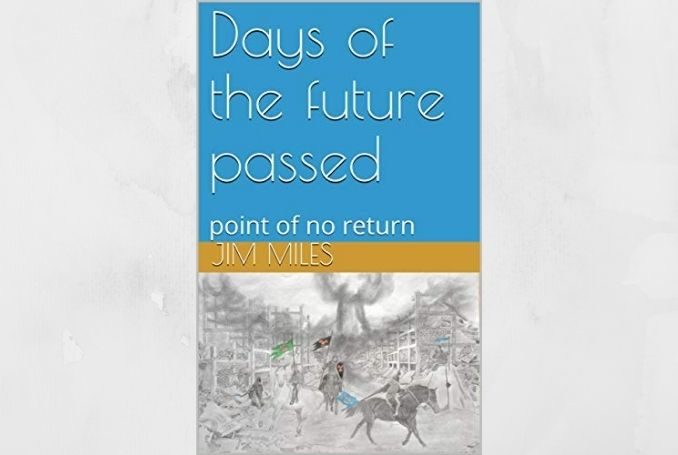
The United States has throughout its existence demonstrated all the features of ‘empire’, from the original settlers using the Papal Doctrine of Discovery (1542) through to the current propaganda of the global war and terror, now changing to defense doctrines against Russia and China. My new work, “Days of the Future Passed – Point of No Return” presents the broad outlines of what this represents to the international scene from inception through to today’s ongoing empirical adventures.
The two main constants have been economic influence and military influence. The two are highly integrated and always have been even from before Independence, through the conquest of much of North America, where sometimes the soldiers led the way, and sometimes the settlers led the way, but neither being far apart from the other. Today the economy of the US empire is highly dependent on the military mindset of the US supporting its economic adventures overseas, the bottom line being support for the global reserve currency, the fiat ‘petrodollar.’
Three other ideas enter into this picture. An additional military factor is the threat of nuclear war, an event only a hair trigger action away from ultimately ending all of our problems. The current increase in propaganda rhetoric against Russia and China makes a nuclear scenario unfortunately all too realistic. Added to this, climate change is affecting our chances at long term safety and overall survival, much of it caused by our consumer oriented economy based on fossil fuels – control of the latter being of paramount importance for the US dollar and thus the US military. Add to all that the current Covid-19 pandemic, and the empire appears to be slowly losing its grip on its desired hegemony, but not without threatening much of the rest of the world.
“Days of the Future Passed – Point of No Return” argues that we have passed some tipping points for which there will be no return to normal, within economics, the environment, and the military industrial complex. Ideas for solutions are easy, their implementation is not as the inertia of empire is not easily restrained or controlled.
Excerpt
2020 – Tipping Points
It may not be evident yet, but in another ten or twenty years, the year 2020 may also be looked on as a pivotal year in global interactions – geopolitical, environmental, and financial – all of which are highly interrelated.
Imagine the lowly teeter-totter, a playground piece not as common as it used to be. The teeter-totter is aptly named as many a child, and many an adult has stood above the bar that makes the plank teeter and totter, trying to maintain balance but also testing how far they can go before touching down on one side or the other. Now imagine that teeter-totter is poised on the edge of a cliff, where one side can touch down and avoid the unknown drop, and the other side obviously is the drop from which there is no recovery to equilibrium.
It is a simple metaphor, but it illustrates for several sectors of our lives, we have allowed ourselves to drop into the unknown.
The unknown is simply the future. This future is to be determined by a declining global economy becoming saturated with massive US money printing to prop up the banksters and corporate CEOs. It will be determined by the disregard domestically and in foreign affairs for the supposed ‘rule of law’ but more importantly international law and true justice for all people. The changes to our environment are at the moment relatively slow but are becoming irreversible under current trends. Finally, the massive military investments on a global scale for both nuclear and conventional weaponry threatens everyone with a very delicate balance of power.
….Under the Trump presidency, combined with the economic impact of the virus and actions to contain it (for better or worse, not a point of discussion here), the US has assuredly reached a point where its huge national debt can never be repaid. Combine this with the main source of income and wealth in the US no longer being production, but financialized services simply creating money at the stroke of a keyboard and the economy is surviving precariously on the whim of people servicing the US$.
Put simply, the US survives on the Federal Reserve Bank (a consortium of private banks) pumping money into the economy. With much of the economy based on debt, and interest rates kept necessarily low in order to service the debt, the strength of the US$ as a global reserve currency – the petrodollar – is jeopardized.
….This year there have been several accounts of how the climate/environment is showing signs of tipping into conditions where there can be no reversals to ‘normal’ without serious changes to our atmospheric inputs: Greenland’s ice sheet melts more than it accumulates in snowfall each year by a significant amount; the Amazon has reached the status where it can no longer regenerate itself after a series of droughts; the forest fires in Siberia, Australia, and California demonstrate the overall pattern of global warming; each succeeding month has set record new global highs.
….The main feature here is that the combination of China and Russia have created a multi-polar world whether the US is willing to admit it or not. Russian resources, defensive military achievements, and a renewed domestic scene under the direction of the much-vilified Vladimir Putin have combined with China’s increasing defensive measures in the Western Pacific, its Belt and Road initiative throughout Asia and extending elsewhere, and the economic power that China has achieved as the largest economy in the world (on purchasing power and domestic market basis).
Above all, both China and Russia have stated they no longer support the hegemony of the US$ as the global reserve currency. They cannot replace it themselves, but they can operate outside of it, and they can support alternate global systems such as a ‘basket’ of reserve currencies, and their own digital exchange systems. That is what truly scares the US as it sees its own debt problems trap it into hyperinflation while other countries start to shift away from supporting the US$. That could mean war, hybrid for sure, but it could also go kinetic.
– Jim Miles is a Canadian educator and analyst who examines the world through a syncretic lens. His analysis of international and domestic geopolitical ideas and actions incorporates a lifetime of interest in current events, a desire to preserve and conserve our natural environment and stop the commodification of the environment. He has been active as a critical writer in opposition to the US empire and its militarization of most aspects of domestic and international affairs. Miles’ work has been published globally and has appeared on a variety of websites including Palestine Chronicle, Axis of Logic, Countercurrents, and Global Research. He has appeared on RT News and The Tyee concerning events in Palestine/Israel. This is his first book and effectively summarizes many years, indeed a lifetime, of interest in international geopolitical and environmental affairs. He contributed this article to the Palestine Chronicle.
As I laid out in my last article published on the Saker, false solutions to a crisis of global proportions are being promoted in the form of a “Great Global Reset” which aims at creating a new economic order under the fog of COVID. This emerging “new order”, as it is being promoted by Mark Carney, George Soros, Bill Gates and other minions of the City of London is shaped by a devout commitment to depopulation, world government and master-slave systems of social control.
By attempting to tie the new system of “value” to economic practices which are designed to crush humanity’s ability to sustain itself in the form of “reducing carbon footprints”, “sustainable green energy”, cap and trade, carbon taxes and green infrastructure bonds, humanity is being set up to accept a system of governance onto our children and grandchildren which will subject them to a dystopic world of fascism the likes of which even Hitler could not have dreamed.
The misanthropic philosophy underlying the Great Reset is not new but go back thousands of years and although this fact of world history has been intentionally obscured, the revolution that established a new nation in 1776 represented a total rejection of this system.
The Dual Nature of the USA as a Force in World History
While many people find it easy to dismiss the USA as an intrinsically evil empire which always strove to replace the British Empire as the hegemon of the earth, there is a much richer historic fight at play which America’s emergence as a new nation in 1776 exemplified and which I recently outlined in the lecture below.
As I will demonstrate in this essay, the revolution of 1776 was never about tea parties, taxes or the “right to defend property” as may revisionist historians have lyingly written over many generations.
It was rather an international affair that gave rise to a system of political economy which placed value NOT upon the worshiping money but rather upon the inherent powers of creative reason located in the minds of all citizens. This potentially infinite resource (or “the resource that creates all other resources”) is only expressed IF a nation’s citizens are given the opportunities, means, hope and inspiration to express them. Abraham Lincoln stated this principle beautifully when he said:
“All creation is a mine, and every man, a miner. The whole earth, and all within it, upon it, and round about it, including himself, in his physical, moral, and intellectual nature, and his susceptibilities, are the infinitely various “leads” from which, man, from the first, was to dig out his destiny… Man is not the only animal who labors; but he is the only one who improves his workmanship. This improvement, he effects by Discoveries, and Inventions.”
The means developed by leading figures of the revolution, to be used by government with the aim of actualizing those powers of mind included practices of national banking, public credit, selective protectionism and increasing the productive powers of labor via investments into internal improvements, infrastructure and scientific progress.
This is the system which the ruling oligarchy is currently frightened may be brought back online under the conditions of a breakdown crisis should Trump maintain his position as President, and due to the fact that it has been so entirely obscured from history books, some words are worth devoting to its existence now.
The Origins of the American System
During the crisis of 1783-1791, The newly established American republic was an agrarian economy in financial ruins with no means to pay off its debts or even the soldiers who fought for years in the revolutionary war. It was only a matter of time before the fragile new nation would come undone and be reabsorbed back into the fold of the British Empire.
The solution to this unsolvable crisis was unveiled by Washington’s former Aide de Camp and now Treasury Secretary Alexander Hamilton (1755-1804) who studied the works of the great dirigiste economists like France’s Finance Minister Jean-Baptiste Colbert, and introduced a four-fold solution:
Consolidate all unpayable state debts into a singular federal debt secured by the issuance of new bonds. This was done via his 1790 Report on Public Credit.
Tie these new bonds to internal improvements like roads, canals, academies and industrial growth which would create a qualitatively new form of debt that would permit the nation to produce its way out of poverty which would lead to “the augmentation of the active or productive capital of a country”. In this sense Hamilton distinguished bad debt from good debt using the important guiding principle that the “creation of debt should always be accompanied with the means of extinguishment.” [to illustrate this more clearly: think of a farmer taking on a debt in order to feed a gambling addiction vs investing his loan into new farm supplies and a tractor.] The thrust of this conception was found in his Report on the Subject of Manufactures of 1791.
Guide that new national power over finance by a system of national banks subservient to the Constitution and the General Welfare (instead of a system of central banks under the British model that ensured nation states would forever be subservient to the laws of usurious finance). This was illustrated in Hamilton’s 1790 Report on a National Bank and his 1791 On the Constitutionality of a National Bank.
Use protective measures where necessary to block foreign dumping of cheap goods into the nation from abroad which essentially makes it more profitable to purchase industrial goods and farm products locally rather than from abroad. Hamilton also promoted federal incentives/bounties to encourage private enterprises to build things that would be in alignment with the national interests.
The Matter of Mind over Money
Hamilton’s idea for the national bank was premised on the unification of private profit with the wellbeing of the whole nation in order to overcome the dichotomy of state vs individual rights which has plagued so much of philosophy and human history.
In opposition to the Jeffersonian crowd promoting British Free Trade which presumed that manufacturing and a strong federal government were evils to be avoided, Hamilton wrote that there is “a general principle inherent in the very definition of Government and essential to every step of the progress to be made by that of the United States; namely—that every power vested in a Government is in its nature sovereign, and includes by force of the term, a right to employ all the means requisite, and fairly applicable to the attainment of the ends of such power; and which are not precluded by restrictions & exceptions specified in the constitution; or not immoral, or not contrary to the essential ends of political society.”
Hamilton added that this power must exist “to give encouragement to the enterprise of our own merchants, and to advance our navigation and manufactures.”
Throughout all of his works, Hamilton is clear that value is not located in land, gold, money, or any arbitrary value favored by followers of the British School like Adam Smith, Bentham, or Mill. In defending the growth of manufactures and internal improvements, Hamilton states that “to cherish and stimulate the activity of the human mind, by multiplying the objects of enterprise, is not among the least considerable of the expedients, by which the wealth of a nation may be promoted.”
The Overthrow of the American System
Although City of London-affiliated traitors in America like Aaron Burr established the speculative Bank of Manhattan which started Wall Street, killed Alexander Hamilton in 1804, and derailed many of Hamilton’s grand designs, the system was never completely destroyed despite the decades of attempts to do so.
In 1824, the great German economist Frederick List came to America with the last surviving leader of 1776 Marquis Lafayette as part of an international effort to revive the sabotaged plans to create a world of sovereign republics modelled on the American experience of 1776.
While this effort failed with Lafayette’s supplication to the scheme of re-instating a French King in 1830 rather than declare himself the President (as I outlined in my recent paper on the Congress of Vienna), List studied Hamilton’s system and was the first to codify it as the American System of Political Economy (1827). This was the system which List transported to Germany by driving rail development, industrial growth, protectionism under the German Zollverein which finally blossomed under the rule of Chancellor Otto von Bismarck. List’s system was also studied, translated and applied in Russia by many “American System economists” with the greatest being the Transport Minister and Prime Minister Sergei Witte who oversaw the trans Siberian railway’s completion and envisioned a line eventually connecting the Americas to Russia via the Bering Straits.
In America, the clash between American vs British Systems defined all major conflicts from 1836 when a racist tool named Andrew Jackson killed the 2nd National Bank (along with thousands of Cherokee) and brought the nation under the heal of British Free Trade, speculation, and cotton plantation economics. Following the IMF’s protocols that would be imposed onto victim nations 150 years later, Jackson cancelled all internal improvements in order to “pay the debt” and deregulated the banking system which resulted in the growth of over 7000 separate currencies issued by an array of state banks rendering the economy chaotic, bankrupt and prone to mass counterfeiting.
The defenders of the American System during this period (led by Whigs such as John Quincy Adams, Matthew Carey and Henry Clay) played a rear-guard action hoping for an opening to occur at some point. When that opening finally arrived with the victory of Whig President William Harrison in 1840 a glimmer of hope was felt. Harrison swept to power with a mandate to “revive the national bank” and enact Clay’s American System of internal improvements but sadly the new leader found himself dead in a matter of only 3 months with legislation for the 3rd national bank sitting unsigned on his desk. Over his dead body (and that of another Whig president only 10 years later), the slave power grew in influence enormously.
It wasn’t until 1861 that a new president arose who successfully avoided assassination attempts long enough to revive Hamilton’s American System during a period of existential crisis of economic bankruptcy and foreign sponsored civil war. Unlike the British system of free trade which forced its adherents to worship money, the American system of Franklin and Hamilton always placed value on the creative powers of reason of the citizens which distinguished our species as unique among all creation.
What did Lincoln Actually Face?
Beyond the dangers of secession, Lincoln had to contend with the Wall Street financiers, international bankers and Anglo Canadian operatives who worked tirelessly to sabotage the president’s ability to acquire the funds necessary to execute the war.
To make matters worse, the state of economic affairs was impossibly unmanageable with thousands of recognized bank notes in the USA and over 1496 banks each issuing multiple notes. Under this highly de-regulated system made possible by the 1836 killing of the national bank and the passage of the 1846 Independent Treasury Act which prevented the government from influencing economic affairs, every private bank could issue currencies with no federal authority. With such a breakdown of finances, no national projects were possible, international investments were scarce and free market money worshipping ran rampant. Manufacturing collapsed, speculation took over and the slavocracy grew in influence between the 1837’s bank panic and 1860.
The City of London was obviously not interested in allowing the USA to get out from under water, and with the gold-backed pound sterling, ensured the manipulation of gold prices and orchestrated the buyout of US gold reserves. When Lincoln sought loans to execute the war, whether from Wall Street or International banking houses, the loans were granted only at excessive interest rates of 20-25%.
Russian Ambassador to London de Brunow reported to Moscow of England’s desire to break the Union writing in January 1861:
“The English government, at the bottom of its heart, desired the separation of North America into two republics, which will watch each other jealously and counterbalance one the other. Then England, on terms of peace and commerce with both, would have nothing to fear from either; for she would dominate them, restraining them by their rival ambitions.”
“In January 1862, Gallatin [head of the NY Associated Banks] presented the bankers’ ultimatum to the Treasury: 1) pay for the war effort through a massive increase of direct taxation of the population; 2) deposit all U.S. government gold in the private New York banks and make those banks the sole (monopoly) agent for the marketing of U.S. government debt (primarily bonds sold in London); 3) suspend the “sub-treasury laws” (government regulation of banks); and 4) withdraw all government-issued paper currency so that only gold and private bank notes would circulate as currency.”
Although 150 years of revisionist historians have obscured the real Lincoln and the true nature of the Civil War, the martyred president was always an opponent to slavery and always situated himself in the traditions of the American System of Hamilton describing in 1832 a policy which he later enacted 30 years later: “My politics are short and sweet, like the old woman’s dance. I am in favor of a national bank. I am in favor of the internal improvement system, and a high protective tariff. These are my sentiments and political principles.”
From this period in the Congress where he became a leading ally of John Quincy Adams, and played a leading role in opposition to the unjust US-Mexican War, Lincoln committed himself consistently to ending not only systems of slavery but also all hereditary power structures internationally which he understood were inextricably connected saying during an 1858 debate with the slavocracy’s Judge Douglas:
“That is the issue that will continue in this country when these poor tongues of Judge Douglas and myself shall be silent. It is the eternal struggle between these two principles – right and wrong – throughout the world. They are the two principles that have stood face to face from the beginning of time, and will ever continue to struggle. The one is the common right of humanity and the other the divine right of kings.“
The means needed to break both systems of empire and slavery were located in the American System of political economy.
Lincoln Revives the American System
Putting this economic policy into action during the height of the war occurred in a 3-step operation which began with Banking and Currency Acts in 1862 and 1863. These acts established placed the thousands of local state banks under a federal charter with federal supervision for the first time in decades. By imposing a 10% tax on state bank notes, private independent state banks shrank from 1466 in 1861 to only 297 by 1865 and over 1630 national banks took their place.
The Bank Act of 1863 established reserve requirements for the first time, and also capped the interest rates in order to destroy usury within the nation itself. In order to eliminate international interference and manipulation from Wall Street financiers, the Bank Act also forced 75% of all bank directors to reside in the state in which the bank was located and all directors had to be American citizens.
The most important step in this fight was the sovereign control of credit issuance which according to Article 1 section 8 of the US constitution can only be affected through the US treasury (an important lesson for anyone serious about ending the privately run Federal Reserve controls over national finance today). Following this constitutional principle, Lincoln issued a new form of currency called Greenbacks which could only be issued against US government bonds. These began being issued with the 1862 Legal Tender Act.
Nationally-chartered banks were now obliged to deposit into the federal treasury totalling at least one third of their capital in exchange for government notes issued by the Mint and Treasury (in order to qualify for federal charters needed to avoid the tax on state bank activities, banks found themselves lending to the government which gave Lincoln an ability to avoid the usurious loans from London and Wall Street.)
New bonds were issued under this scheme called 5:20 bonds (due to their 5-20 year maturation), which citizens purchased as investments into their nations’ survival. These bonds which united “personal self interest” with the general welfare of the nation provided loans to manufacturing as well as served as the basis for the issuance of more Greenbacks. Organized by Lincoln’s ally Jay Cooke (a patriotic Philadelphia banker), the 5-20 bonds were sold in small denominations to average citizens who then had a vested interest in directly participating in saving their nation. Between 1862-1865 these bonds accounted for $1.3 billion. Lincoln described the success of this new approach to finance saying:
“The patriotism of the people has placed at the disposal of the government the large means demanded by the public exigencies. Much of the national loan has been taken by citizens of the industrial classes, whose confidence in their country’s faith and zeal for their country’s deliverance from present peril has induced them to contribute to the support of the government the whole of their limited acquisitions. This fact imposes peculiar obligations to economy in disbursement and energy in action.”
These measures were accompanied by a strong protective tariff to grow American industries as well.
By the beginning of 1865, $450 million in Greenbacks were issued making up over half of all currency in circulation. Greenbacks and 5-20 bonds financed not only the arming, feeding and payments to soldiers, but also the often-overlooked large scale industrial and rail programs begun during the peak of the war itself… namely the trans continental railway (started in 1863 and completed in 1869 linking for the first time in history a continent from east to west). This was financed through grants and subsidies made possible by the greenbacks which increased government spending power by 300%!
In his 1865 essay How to Outdo England Without Fighting Her, Lincoln’s economic advisor Henry C Carey stated: “The ‘greenback’ has fallen on the country as the dew falls, bringing with it good to all and doing injury to none.”
Unfortunately, the subversion of Lincoln’s American System began quickly with Lincoln’s murder. Rather than impose full reconstruction of the defeated south after the war as Lincoln planned, a new war was waged against Greenbacks led by the City of London and its American agents in Wall Street which ultimately subverted American productive credit with the 1875 Specie Resumption Act. This act killed the greenbacks and tied the republic’s currency to gold submitting the nation to London’s speculative controls while contracting the means of credit from large-scale long-term infrastructure projects.
Some Uncomfortable Questions Regarding Lincoln’s Murder
The story has been told of Lincoln’s murder in tens of thousands of books and yet more often than not the narrative of a “single lone gunman” is imposed onto the story by researchers who are either too lazy or too corrupt to look for the evidence of a larger plot.
How many of those popular narratives infused into the western zeitgeist over the decades even acknowledge the simple fact that John Wilkes Boothe was carrying a $500 bank draft signed by Ontario Bank of Montreal President Henry Starnes (later to become Montreal Mayor from 1866-1868) when he was shot dead at Garrett Farm on April 26, 1865?
How many people have been exposed to the vast Southern Confederacy secret service operations active throughout the civil war in Montreal, Toronto and Halifax which was under the firm control of Confederate Secretary of State Judah Benjamin and his handlers in British intelligence?
How many people know that Boothe spent at least 5 weeks in the fall of 1864 in Montreal associating closely with the highest echelons of British and Southern intelligence including Starnes, and confederate spy leaders Jacob Thompson and George Sanders?
Demonstrating his total ignorance of the process that controlled him, Booth wrote to a friend on October 28, 1864: “I have been in Montreal for the last 3 or 4 weeks and no one (not even myself) knew when I would return”.
Exposing the 19th Century Deep State
After Lincoln was murdered, a manhunt to track down the intelligence networks behind the assassination was underway that eventually led to the hanging of four low level co-conspirators who history has shown were just as much patsies as John Wilkes Boothe.
Days later, President Johnson issued a proclamation saying: “It appears from evidence in the Bureau of Military Justice that the … murder of … Abraham Lincoln … [was] incited, concerted, and procured by and between Jefferson Davis, late of Richmond, Va., and Jacob Thompson, Clement C. Clay, [Nathaniel] Beverly Tucker, George N. Sanders, William C. Cleary, and other rebels and traitors against the government of the United States harbored in Canada.”
Two days before Booth was shot, Secretary of War Edwin Stanton wrote: “This Department has information that the President’s murder was organized in Canada and approved at Richmond.”
Knowledge of Canada’s confederate operations was well known to the federal authorities in those days even though the majority among leading historians today are totally ignorant of this fact.
George Sanders remains one of the most interesting figures among Booth’s handlers in Canada. As a former Ambassador to England under the presidency of Franklin Pierce (1853-1857), Sanders was a close friend of international anarchist Giuseppe Mazzini- the founder of the Young Europe movement. Sanders who wrote “Mazzini and Young Europe” in 1852, had the honor of being a leading member of the southern branch of the Young America Movement (while Ralph Waldo Emerson was a self-proclaimed leader of the northern branch of Young America). Jacob Thompson, who was named in the Johnson dispatch above, was a former Secretary of the Interior under President Pierce, handler of Booth and acted as the top controller of the Confederacy secret service in Montreal.
As the book Montreal City of Secrets (2017), author Barry Sheehy proves that not only was Canada the core of Confederate Secret Services, but also coordinated a multi pronged war from the emerging “northern confederacy” onto Lincoln’s defense of the union alongside Wall Street bankers while the president was fighting militarily to stop the southern secession. Sheehy writes: “By 1863, the Confederate Secret Service was well entrenched in Canada. Funding came from Richmond via couriers and was supplemented by profits from blockade running.”
The Many Shapes of War from the North
Although not having devolved to direct military engagement, the Anglo-Canadian war on the Union involved several components:
Financial warfare: The major Canadian banks dominant in the 19th century were used not only by the confederacy to pay British operations in the construction of war ships, but also to receive much needed infusions of cash from British Financiers throughout the war. A financial war on Lincoln’s greenback was waged under the control of Montreal based confederate bankers John Porterfield and George Payne and also JP Morgan to “short” the greenback.
By 1864, the subversive traitor Salmon Chase had managed to tie the greenback to a (London controlled) gold standard thus making its value hinge upon gold speculation. During a vital moment of the war, these financiers coordinated a mass “sell off” of gold to London driving up the price of gold and collapsing the value of the US dollar crippling Lincoln’s ability to fund the war effort.
Direct Military intervention Thwarted: As early as 1861, the Trent Crisis nearly induced a hot war with Britain when a union ship intervened onto a British ship in international waters and arrested two high level confederate agents en route to London. Knowing that a two-fold war at this early stage was unwinnable, Lincoln pushed back against hot heads within his own cabinet who argued for a second front saying “one war at a time”. Despite this near miss, London wasted no time deploying over 10 000 soldiers to Canada for the duration of the war ready to strike down upon the Union at a moment’s notice and kept at bay in large measure due to the bold intervention of the Russian fleet to both Atlantic and Pacific coasts of the USA. This was a clear message to both England and to Napoleon III’s France (who were stationed across the Mexican border) to stay out of America’s war.
Despite Russia’s intervention, Britain continued to build warships for the Confederacy which devastated the Union navy during the war and which England had to pay $15.5 million to the USA in 1872 under the Alabama Claims.
Terrorism: It is less well known today than it was during the 19th century that confederate terror operations onto the north occurred throughout the civil war with raids on Union POW camps, efforts to burn popular New York hotels, blowing up ships on the Mississippi, and the infamous St Albans raid of October 1964 on Vermont and attacks on Buffalo, Chicago, Sandusky, Ohio, Detroit, and Pennsylvania. While the St Albans raiders were momentarily arrested in Montreal, they were soon released under the logic that they represented a “sovereign state” at conflict with another “sovereign state” with no connection with Canada (perhaps a lesson can be learned here for Meng Wanzhou’s lawyers?).
Assassination: I already mentioned that a $550 note was found on Boothe’s body with the signature of Ontario Bank president Henry Starnes which the failed actor would have received during his October 1864 stay in Montreal. What I did not mention is that Booth stayed at the St Lawrence Hall Hotel which served as primary headquarters for the Confederacy from 1863-65. Describing the collusion of Northern Copperheads, anti-Lincoln republicans, and Wall Street agents, Sheehy writes: “All of these powerful northerners were at St. Lawrence Hall rubbing elbows with the Confederates who used the hotel as an unofficial Headquarters. This was the universe in which John Wilkes Booth circulated in Canada.”
In a 2014 expose, historian Anton Chaitkin, points out that the money used by Boothe came directly from a $31,507.97 transfer from London arranged by the head of European confederate secret service chief James D. Bulloch. It is no coincidence that Bulloch happens to also be the beloved uncle and mentor of the same Teddy Roosevelt who became the president over the dead body of Lincoln-follower William McKinley (assassinated in 1901).
In his expose, Chaitkin wrote:
“James D. Bulloch was the maternal uncle, model and strategy-teacher to future U.S. President Theodore Roosevelt. He emerged from the shadows of the Civil War when his nephew Teddy helped him to organize his papers and to publish a sanitized version of events in his 1883 memoir, The Secret Service of the Confederate States in Europe. Under the protection of imperial oligarchs such as Lord Salisbury and other Cecil family members, working in tandem with Britain’s military occupation of its then-colony Canada, Bulloch arranged English construction and crewing for Confederate warships that notoriously preyed upon American commerce.”
The Truth is Buried Under the Sands of History
While four low level members of Booth’s cell were hanged on July 7, 1865 after a four month show trial[1], the actual orchestrators of Lincoln’s assassination were never brought to justice with nearly every leading member of the confederate leadership having escaped to England in the wake of Lincoln’s murder. Even John Surrat (who was among the eight who faced trial) avoided hanging when his case was dropped, and his $25 000 bail was mysteriously paid by an anonymous benefactor unknown to this day. After this, Surrat escaped to London where the US Consuls demands for his arrest were ignored by British authorities.
Confederate spymaster Judah Benjamin escaped arrest and lived out his days as a Barrister in England, and Confederate President Jefferson Davies speaking to adoring fans in Quebec in June 1867 encouraged the people to reject the spread of republicanism and instead embrace the new British Confederation scheme that would soon be imposed weeks later. Davies spoke to the Canadian band performing Dixie at the Royal Theater: “I hope that you will hold fast to their British principles and that you may ever strive to cultivate close and affectionate connections with the mother country”.
With the loss of Lincoln, and the 1868 death of Thaddeus Stevens, Confederate General Albert Pike established restoration of the southern oligarchy and sabotage of Lincoln’s restoration with the rise of the KKK, and renewal of Southern Rite Freemasonry. Over the ensuing years, an all out assault was launched on Lincoln’s Greenbacks culminating in the Specie Resumption Act of 1875 tying the US financial system to British “hard money” monetarism and paving the way for the later financial coup known as the Federal Reserve Act of 1913[2].
While the Southern Confederacy plot ultimately failed, Britain’s “other confederacy operation launched in 1864 was successfully consolidated with the British North America Act of July 1, 1867. The hoped-for extension of trans continental rail lines through British Columbia and into Alaska and Russia were sabotaged as told in the Real Story Behind the Alaska Purchase of 1867.
Instead of witnessing a new world system of sovereign nation states under a multipolar order of collaboration driven by international infrastructure projects as Lincoln’s followers like William Seward, Ulysses Grant, William Gilpin and President McKinley envisioned, a new age of war and empire re-asserted itself throughout the 20th century.
It was this same trifold Deep State that contended with Franklin Roosevelt and his patriotic Vice President Henry Wallace for power during the course of WWII, and it was this same beast that ran the assassination of President Kennedy in 1963. As New Orleans District Attorney Jim Garrison demonstrated in his book On the Trail of the Assassins (1991), Kennedy’s murder was arranged by a complex assassination network that brought into play Southern secret intelligence assets in Louisiana, and Texas, Wall Street financiers, and a strange assassination bureau based in Montreal named Permindex under the leadership of Maj. Gen. Louis Mortimer Bloomfield. This was the same intelligence operation that grew out of MI6’s Camp X in Ottawa during WWII and changed its name but not its functions during the Cold War. This is the same British Imperial complex that has been attempting to undo the watershed moment of 1776 for over 240 years.
It is this same tumor in the heart of the USA that has invested everything in a gamble to put their senile tool Joe Biden into the seat of the Presidency and oust the first genuinely nationalist American president the world has seen in nearly 60 years.
The Case of Trump and the Potential Return of the American System
Like Lincoln, President Trump faces many threats today both within his own neocon-infested administration as well as within the British run deep state that has taken over the Democratic party since the 1963 murder of JFK.
But in spite of these problems, he is undeniably the first president to publicly invoke the American System of Lincoln by name since the assassinated President McKinley in 1901. His recent Republican party convention speech of August 27 repeatedly invoked Lincoln’s name while calling for a newly reconstituted party without the Bush dynasty poison (the Bush family completely boycotted the convention). During the speech Trump stated:
“The Republican Party, the party of Abraham Lincoln, goes forward united, determined and ready to welcome millions of Democrats, independents and anyone who believes in the greatness of America and the righteous heart of the American people.”
In an earlier 2017 Kentucky speech Trump invoked the “American model” and said “this is the system our Founders wanted. Our greatest American leaders — including George Washington, Hamilton, Jackson, Lincoln — they all agreed that for America to be a strong nation it must also be a great manufacturing nation.”
A Parting Thought From Lincoln
Contemplating the international scope of the Civil War which has more relevance for today’s imperilled age than anyone may have expected 160 years ago, Lincoln stated in 1862:
“Fellow citizens, we cannot escape history. We of this Congress, and this administration, will be remembered in spite of ourselves. No personal significance, or insignificance, can spare one or another of us. The fiery trial through which we pass, will light us down, in honor or dishonor, to the last generation. We say we are for the Union. The world will not forget that we say this. We know how to save the Union. The world knows we know how to save it. We even here–hold the power and bear the responsibility. In giving freedom to the slave, we assure freedom to the free–honorable alike in what we give and what we preserve. We shall nobly save, or meanly lose, the last, best hope of earth. Other means may succeed–this could not fail. The way is plain, peaceful, generous and just–a way which, if followed, the world will forever applaud and God must forever bless… If we do this we shall not only have saved the Union, but we shall have so saved it, as to make, and to keep it forever worthy of the saving. We shall have so saved it, that the succeeding millions of free happy people the world over shall rise up and call us blessed, to the latest generations.”
The four conspirators that faced the gallows included Mary Surratt, Lewis Powerll, George Atzerodt, and David Herold. ↑
The entire principle of the American Credit System as embodied by Lincoln’s Greenback, is that it is driven not by the highly volatile prices of gold or silver but rather to the powers of productivity of the nation as a whole (see: ongoing scientific and technological rates of progress that render debt’s incurred by a national bank self-extinguishing). For more on this system, read the writings of Alexander Hamilton located here.↑
Voltaire, actualité internationale, n°186
-
Outre ce site internet gratuit, nous publions une lettre confidentielle en
PDF, Voltaire, actualité internationale. Chaque jeudi soir ou vendredi
matin, vo...
The man bankrupting America
-
“Go F*** Yourself, Scott: A Full Background Check on The Man Bankrupting
America, Human Skin Tag, Scott Bessent.“ (Blundell).In the same week,
different US...
Occult Utopia Of Jewish Golden Age
-
Occult Utopia Of Jewish Golden Age September 6 2026
___________________________________ More Vids! +BN Vids Archive! HERE!
________________________________...
And You Remain Impossible to Erase
-
There you are, the inspiring Imam, forever present in the conscience of the
honorable and the hearts of the loyal.
Father Dave Smith, Pray For (Mufti) Dr. Hassoun
-
Abducted by the terrorist regime in Syria in 2025, Sheikh Hassoun has been
sentenced to life in prison I spoke with Father Dave Smith, an Australian
Anglic...
Report on Beth Israel vigil 08-15-26
-
*Charlie Kirk and JFK*
John F. Kennedy was assassinated under questionable circumstances on
November 22, 1963, and Charlie Kirk fell on September 10 of la...
On The Road To International Anarchy
-
ON THE ROAD TO INTERNATIONAL ANARCHY— An Analysis (14 August 2026) by
Lawrence Davidson Part I — The Turn Toward […]
-
Hello all,
It is with great sadness that I share with you the passing of our beloved
sister, Mother, and Grandmother, the individual that you all knew ...
Best Horror Podcast
-
Best Horror Podcast Introduction: Horror podcasts […]
The post Best Horror Podcast appeared first on Copper Shock Horror Podcast.
Ikhras Endorses Muntadhar Al-Zaidi
-
“Oh parties of banditry and sectarianism and corruption, we have come and
our goal is to destroy you.” Ikhras formally endorses Muntadhar al-Zaidi,
Iraqi j...
Prince Charles: Foreign Jews behind bloodshed in ME
-
In May, 2017, British Crown Prince Charles declined an invitation from
Zionist entity’s president Reuven Rivlin‘s to attend the 100th anniversary
of the no...
Palestinian Women – One for All, All for One
-
Honouring All Palestinian Women by Honouring Three: Hanin Zoabi, Ahed
Tamimi, Samah Sabawi Vacy Vlazna “Palestinian women have always stood side
by side ...
US’s Saudi Oil Deal from Win-Win to Mega-Lose
-
By F. William Engdahl Who would’ve thought it would come to this? Certainly
not the Obama Administration, and their brilliant geo-political think-tank
neo-...
-
*Mordechai Vanunu wins human rights prize of Brazilian Press Association *
* http://www.alternativenews.org/english/index.php/features/updates/7038-mordechai...
Abdul Aziz Rantissi:
"My ultimate wish, my God, is to attain martyrdom,"...God granted him his wish on April 17, 2004, at the hands of Israeli assassins.