Showing posts with label Balkan. Show all posts

Saturday, 10 April 2021

Russia and the EU; The Ukraine Card

Russia and the EU; The Ukraine Card April 08, 2021

by Ghassan and Intibah Kadi for the Saker Blog

A tug-of-war game in Europe has been a strong feature of dramatic events in the region and further afield ever since the Roman Empire plus the Church split up. Which was the cause and which was the effect is subject to debate, but the split was much deeper than one that was political; the spiritual aspect of it is not to be overlooked.

The authors are not experts on this aspect of history and will therefore not dwell too much, but it suffices to say that Catholic Easter can come before Passover, even though Jesus celebrated Passover before His Crucifixion. But this anomaly does not happen in the Julian Calendar that the Orthodox Church adheres to till today; and the Orthodox community doesn’t shy away from presenting this contradiction in the Georgian Calendar that Catholicism follows.

But this article is not about the over millennium-and-a-half-old disagreement between the Western and Eastern Churches. It is about the current rift between Russia and Western Europe.

But to what extent does much of the current rift find its roots in religion? No region in the world has in recent times experienced the repercussions of this ancient divide as much as the Balkans when the former federation of Yugoslavia split, on Catholic/Orthodox religious lines, that ironically bear a huge resemblance to the borders between those of the Roman and the Byzantine Empires. The exploitation of potential cracks in the two main spheres of Islam by the Western power-block, along with its useful non-Western allies, is not to be discounted. It is easy to apply a simplistic view of the divide of the East and West upon such criteria alone, but religious difference always plays an important role, albeit psychologically. In Europe, historical factors also include that of the influence of the Ottoman Empire, the conversion of many East Europeans to Islam, divisions within the Western Church resulting in drastic conflicts and, fast forward to the much later phenomenon of the Soviet era and the lasting implications of its legacy in neighbouring countries, then the picture becomes more complex.

No matter what is said by those countries that Russia had influence over in the post-World War II period, there is no excuse for their denial of the fact that that it was Russia, albeit under the banner of the Red Army, that liberated all of Eastern Europe, including former East Germany and all of Berlin from the Nazis. Among the allies in WWII, Russia made the biggest sacrifices, more sacrifices than all of those of the allies combined, losing tens of millions of its people, with estimates reaching up to forty million. No other nation came close to this calamitous human loss; not even Germany itself.

Yet, Russia is denied all of the accolade in winning the fight against Nazi Germany. Was it its communist USSR status that turned it into the underdog in Western written history or, was it its Orthodox heritage juxtaposed to that of a powerful-global reaching Vatican and also a ‘Christian West’, intent on subduing and dominating, all with the trappings of grabbing resources and spoils?

Clearly, Western Europe, no matter what facts on the ground exist, seems intent on expressing, in public at least, an incurable sense of apprehension, mythology and propagation of fiction when it comes to Russia. Add to this a European obedience to the dictates of America and its power-brokers in attempts to cripple Russia with sanctions, an obedience mostly gained through threats of negative consequences and blackmail if not adhered to. Not only is this broad-spectrum demonization, at least publicly, expressed by European politicians and its so-called ‘elites’, but also among most of the population of Western Europe.

One of the authors often uses popular songs of the West and their lyrics to express specific mental mindsets in certain blocks of time and space. In 1980, British musician, Sting, wrote a song titled Russians. It was meant to be a message of peace in which Sting wondered, with obvious sympathetic sarcasm, about the state of anti-Russia propaganda, and whether some people in the West regarded Russians as robotic communist mindless machines and questioned if they loved their children like all other humans. The lyrics exemplify the popular perceptions in the West of the people and nation of Russia, even to the extent that they would ask such a bizarre question about the love of children.

And, despite the changes in Russia since the dismantling of the Soviet Union which is what the West planned for, and the emergence during the Yeltsin period of ‘bandit capitalism’ – as if that doesn’t exist elsewhere- the negative perceptions persisted, and to add to that, a palpable sense of glee at the chaos and collapse occurring in Russia. Some say, Yeltsin was wracked with guilt later on and ensured a leader who could pull the country out of this disaster; Vladimir Putin, tripping up the West’s plan with many future surprises in store. To this day, the eyes of the Western public are re-directed from any ills that their own powers may be involved in and sharply turned towards this convenient ‘bogey-man’. There was no Hollywood spin to show a ‘rehabilitated’ Russia as Putin quickly turned things around after the Yeltsin period, restoring the nation and the Federation to one of healthy self-esteem, pride, strength and a resolve to regain its place in the world, gradually rendering what the West had seen as a great ‘coup’ over Russia, to a victory that backfired.

Those in the West are at a loss to accurately elaborate on the actual cause of the current escalation with Russia and, that is because the facts don’t stack up in their favour in the honesty box when it comes to manufacturing conflict. Their exploitation of any religious divide has to an extent been successful, but more so about ensuring the encircling of Russia with hostile nations or turning around some governments of traditional Orthodox allies. There is no racial based explanation to the escalation and history of it other than Russian culture being generally one of inclusiveness and diversity, something the West has failed in and in fact abused. Russia, an old culture with at least one thousand years of existence in a paradigm of interdependence with diverse cultures and ethnicities, spanning a massive section of the largest continent that reaches the Black, Caspian, Baltic, Bering Seas, those to the north and east, and all the way to the North Pacific Ocean; how can modern day Europe and the West compare to that?

For the old West, Europe, now mostly gathered into the entity known as the EU, their animosity cannot be explained by unresolved issues with the old Soviet Union. Nor can it be based on beliefs of clear and present dangers and threats posed by the existence of Russia. EU leaders are surely cognisant of the fact that it was NATO that broke the agreement between Gorbachev and the West and that NATO incrementally has been intimidating and threatening Russia’s security by positioning missiles in former Warsaw Pact nations, encircling Russia, and long before Russia made any attempts to counteract such measures. EU leaders, for various reasons, put aside reality and rationality and the known fact that peace and stability in Europe can only exist or have any potentiality if it is based on a mutual European understanding that Russia must be included. EU leaders clearly know, but never state it, that it is the USA that is coercing them to make a stand against their own regional and economic interests and to take actions against Russia; not the other way around as stipulated by their national interests as they claim.

When it comes to the crunch, it is the manipulation by America, a power that aimed and succeeded for some decades in creating itself as a unipolar, all-reaching, global power, one which called the shots on anything and everything and had under its control the vanquished nations that lost out in WWII. When Europe organized itself into a union, it became far easier for America to have almost the entire sub-continent under its boot. It could not have achieved this without the demonization of Russia and re-writing of history for the consumption of the West and all under its tutelage. Just like we have witnessed over time with the ‘Empire Wars’, the strategy of co-opting into a hybrid war format Hollywood and all media has played a crucial role in building a world-wide narrative of America as the ‘world policeman’, ‘saviour’ and ‘leader of the free-world’, when in reality it played the role of raider, pirate and predator, sharing spoils with some of its more powerful ‘allies’ who in effect were nations with little sovereignty or ability to make any crucial decisions of their own.

Last but not least, from the unpragmatic military position, EU leaders know, but under duress ignore the fact that Russia has recently developed state-of-the-art hypersonic weapons that their NATO status and alliance with the USA cannot protect them against. They know that should an escalation materialize between NATO and Russia; such weapons can be used and the outcome possibly devastating for the EU itself. EU nations and, NATO as a whole, know for a fact that a war on European soil with Russia is totally and utterly unwinnable by them. Even without deploying any of the many weapons President Putin announced to the world during his famous speech of March the 1st 2018, a conventional war between the two sides gives Russia the benefit of depth of field and number of troops. Such is the hold on these nations that they act as if in denial of the obvious. What do they stand to gain? Or, is it about harm minimization under the yoke of America? And, what does Europe in particular, expect to gain from provoking or partaking in the provoking of war over Ukraine?

Again, in the usual twisting of facts, the Western media busy themselves in the post-Trump era in portraying Russia as the culprit that is escalating the crisis in Ukraine. If Russia is left with no alternative to act, deciding it must engage militarily, it is not going to be either influenced or intimidated by Western ‘fake news’. It will act based on the facts on the ground, and whatever Russia decides to do or not do, the Western media and leading figures will portray Russia as the transgressor and aggressor, and as we have recently witnessed from Biden himself, ramp up the rhetoric such as calling the President of a world power, President Putin, ‘a killer’.

Without the benefit of a crystal ball, either the situation will escalate to a level that leaves Russia with no other alternative than taking measures similar to those it took in Chechnya and Georgia, or that Ukraine will back off. The former scenario seems more likely unless the superior style of Russian diplomacy that specializes in win-win deals can find a solution. However, the current threat regarding Ukraine surely is for Russia where the line in the sand is to be drawn. Should matters descend to the irreconcilable, even though Russia is certain to score military victory, it will most definitely be subjected to more Western sanctions than the ones it is already under. No doubt, in such an event of ever more imaginative and diabolic sanctions imposed, it will draw Russia ever closer to allies the West does not approve of and new systems which the West has monopolized, will be overridden and rendered ineffective in bringing Russia to its knees.

As for the ever creeping ‘naughty puppy’ syndrome of NATO pushing its presence in Eastern Europe one inch at a time after the breakup of the USSR, all the way from feigning reasons for missiles stationed in Eastern Europe as safeguarding the EU from Iranian missiles, to inciting and coercing former Warsaw Pact nation members to join NATO, deploying more troops in the EU, blatant support for the Ukrainian Nazis, Russia has reciprocated in measured ways. Yes, it did retake Crimea from Ukraine, but this was done within a referendum-based democratic process. Russia may have to bite the dangerous bullet and offer the persecuted regions of Ukraine the same option. Afterall, Russia’s stand in Syria in 2015 at the request of the Syrian government, has clearly signaled that the unipolar 1990’s style ‘New World Order’ is over and that there cannot be any turning back.

Russia’s patience, perseverance and confidence in superior, win-win diplomacy in time will be widely regarded with respect by the rest of the world, even quietly by the EU leaders. It is the EU leaders who will not come to the party because they are hostage to many traps and hence, it is extremely unlikely, if not impossible, given the bind they find themselves in, that they will respond to reason, diplomacy or act in their best interests. Unlike the decades America in particular has had to install or hijack institutions and conjure up scams to place ‘rules’ on the world, Russia is not yet in a strong enough financial position to implement some of its own ‘rules’ to protect her interests. No nations should be able to do this in a manner that adversely affects other nations, whether through ‘rules’, sanctions, scams or monopoly and other tools that kill without a bullet being fired or bombed dropped. These and other strategies and tactics have come predominately from a nation in a general decline; one that boasts a huge fleet of ten aircraft carriers, countless world-wide bases and almost a trillion-dollar annual war budget; the American war machine nonetheless is a technological dinosaur in comparison to the slick and advanced Russian counter-part.

On the big geo-political level; (1) what keeps America in a position of power today is its power of the petro-dollar based global economy and all that comes with it, including control of the SWIFT-based monetary international transactions without which goods cannot be bought, sold and paid for on the international market; (2) in realistic economic sense however, it is China that is approaching the global lead if it hasn’t already at least in Purchasing Power Parity (PPP) terms, and (3) in terms of military hardware superiority, it is Russia that leads the world in this.

In regards to the current ‘crisis’ and a possible showdown over Ukraine, Russia surely cannot have concerns over its military capacity to deal with any action. However, unless Russia has been able to safe-guard its economy, quarantining it as much as possible from being affected by further Western sanctions, then any escalation should not leave Russia subject to any intimidatory Western repercussions. The further the West pushes, the closer Russia will co-operate with China, whether that is driven on a voluntary basis or has arisen out of necessity, and, in such a rapidly changing global environment, that decision of Russia is understandable and pragmatic, providing China stays solidly by the side of Russia.


River to Sea Uprooted Palestinian   
The views expressed in this article are the sole responsibility of the author and do not necessarily reflect those of the Blog!

Thursday, 25 March 2021

US support for the project of Greater Albania

US support for the project of Greater Albania

March 24, 2021

By Ljubiša Malenica for the Saker Blog

The Greater Albania project has its roots in the nineteenth century and idea of ​​the Prizren League to unite in one territorial unit all areas that were allegedly originally inhabited by Albanians. The Prizren League itself can be seen as an extension of the Ottoman authorities, since it was founded in 1878, immediately after the end of the war between Russia, Serbia and Montenegro against Turkey.

Given that Turkey was defeated in the war, Istanbul had to look for other methods of protecting its own interests during the peace process. League was equipped with weapons and ammunition by the Porte, members of the organization were individuals well known for their loyalty to the Sultan, and Ottoman authorities took upon themselves the responsibility of paying for congress in Prizren. All these facts support the thesis claiming Prizren League was an organization created as expression of Ottoman interests in the Balkans.[1]

Turkey’s interests have been significantly undermined by the San Stefano Peace Treaty and the Berlin Congress, and, as might be expected, the Prizren League took a negative stance towards both peace conferences. Moreover, during the Berlin Congress, the League sent a memorandum to the major powers asking for recognition of the Albanian national identity, a very illustrative fact in itself, and the realization of autonomy within the Ottoman Empire for all territories that would compose the so-called “Greater Albania”.[2]

Simultaneously with these documents, an additional memorandum was sent to the Berlin Congress, called the Skadar Memorandum, requesting from Great Britain[3] to take upon itself the role of a guarantor for the creation of the Albanian state. Considering the role of London as a self-proclaimed balancer whose main goal was to maintain the status quo in continental Europe, the Albanian choice is not surprising.

In terms of political relations during the period in question, Romania, Bulgaria, Serbia and Montenegro have already been allies of Moscow on several occasions. The same could be expected if Greece became independent. The development of the situation at that moment was already, obviously, to the detriment of Istanbul, and any future conflict in the Balkans would mean a further liberation of the territories previously occupied by the Ottomans. The First and Second Balkan Wars are illustrative cases in point. Given that all Slavic countries in the Balkans, at that period, had an interest in preserving the alliance and cultural ties with Russia, the eventual withdrawal of Turkey from the Balkans and the re-establishment of Slavic statehood would create a situation in which most of the Balkan Peninsula would find itself within the Russian sphere of influence.

London could not afford such a development given the understandable, and on many previous occasions expressed, fear of a united continental Europe in whose presence the British Isles would be a negligible force, probably subordinated to cultural and political dictates of the continental center of power.

The realization of Albanian ambitions did not come with the Berlin Congress, but they did not have to wait long for creation of their own state, with the blessing of official London. After the end of the First Balkan War, the Ottoman Empire was completely expelled from the majority of Balkan Peninsula. Despite the fact that the Albanians did not play any role in liberation of the occupied territories from Ottoman rule, London Agreement of 1913 established the independent state of Albania.

In addition to earlier mentioned documents created by the Prizren League, Albanian pretensions towards the territories of the surrounding peoples can be seen in this period through the actions of Ismail Cemali. In the midst of the First Balkan War, Cemali gathers representatives of the Albanians in city of Vlora, where they proceed to adopt the declaration on independence of Albania.

If we take into account that representatives in question came from all parts of the four Ottoman provinces (vilayets), i.e. Kosovo, Skadar, Janjina and Bitola, back then inhabited by Albanians, it can be assumed that Albania, imagined by the present delegates, included the territorial totality of all four mentioned provinces. Claims on lands of others become clear when one realizes that Albanians represented a minority in a significant part of the four provinces. Representatives gathered in Vlora were not elected representatives, so it is unsurprising this declaration of independence was completely ignored by both the Ottoman Empire and the then great powers. The Albanian state established during the London Conference was defined within significantly more modest borders.

During the Second World War, Albania was known as Greater Albania in the period from 1939 until 1943, and had status of an Italian protectorate which incorporated, after the fall of the Kingdom of Yugoslavia, parts of Serbia. During their rule, the Italians found a natural ally in the irredentist aspirations of the Albanian elite towards the territories of the neighboring peoples where Albanians lived, regardless of the numerical ratio between them and the domicile population. It is a historical fact that period of Italian occupation was accompanied by a large number of crimes committed by Albanians against the local population in the occupied territories.

After the collapse of Italy and defeat of Germany, the short-lived state project of “Greater Albania” ended like the Independent State of Croatia, but the aspirations remained. After the fall of communist regime in the early 1990s, irredentist claims again occupied a significant part of the political and intellectual thought within Albania.

Considering the influence of United States in the Balkans during the last three decades, there can be no doubt that activities in question, intentionally or not, were in favor of the idea of Greater Albania. Both during the conflicts in Bosnia and Herzegovina and Croatia, and during war in Kosmet, Washington’s position was obviously in favor of Serbian enemies. The conduct of organizations under the influence or direct leadership of the United States, both during military operations and in peacetime, was undoubtedly directed against Serbian interest in any shape or form. This fact alone was enough to strengthen the position idea of Greater Albania had within Albanian population, given that over time its realization seemed to become more and more probable.

Ethnic cleansing of Serbs from the Federation of BiH and Croatia, carried out with silent blessing from the West, served as a pattern of behavior that Albanians could apply during the Kosovo conflict without fear of criticism or intervention. There was no trepidation Tirana could be bombed by NATO planes due to the ethnic cleansing of Kosmet by the KLA.

Revitalization of the idea of​​ Greater Albania, in its core, is not so much about the American relationship with the Albanians as it is about US perception of the Serbs.

The statement of George Kenney, a former Yugoslavia desk officer at the US state department, is an illustrative example how was Yugoslavia perceived as a state, and by extension, Serbs as a people who were most interested in its preservation. In a 2008 statement to the British Guardian, Kenney pointed out that “In post-cold war Europe no place remained for a large, independent-minded socialist state that resisted globalization”.[4]

In addition to American interests, the role of Germany, which immediately after its unification took a hostile attitude towards Yugoslavia and the Serbs, should not be forgotten. Considering the last one hundred and twenty years of European history, one gets the impression that the desire for domination of the continent by Germany is the main catalyst for a significant part of the misfortune which befell Europe.

In a world characterized by the hegemonic role of the United States, after the disappearance of the Soviet Union, it was inevitable that the ideological features of the victor, in this case capitalism, globalism, free trade, multiculturalism, and democracy, would become a model for transformation of other countries, regardless of their wishes and desires of the domicile population.

The characteristics of the victorious ideology were, of course, largely beneficial to the United States themselves, given that the system was established with the aim of reproducing, into infinity, American, and to a lesser extent West European, global dominance. It is not surprising that all serious forms of opposition to the imposed system were seen as a danger, given that at the same time they represented a departure from the propagandist illusion there were no alternatives to the new state of affairs, that the system represented the best way to regulate social relations and that everyone benefited from it.

The fact that the new system quickly took on the outlines of a neocolonial model of behavior, especially towards Eastern European countries, with pronounced demographic and economic parasitism embodied in legal structures and norms of both the European Union and other world organizations such as the IMF and World Bank, was supposed to remain hidden behind an appropriate smokescreen of consumer culture and a general degradation of cultural standards in behavior and action.

The geopolitical interests of Washington, and of the West in general, in conjunction with their economic interests, were not to be called into question by opposition, especially by a state such as Yugoslavia or a people such as Serbs. Allowing the general narrative of globalization and the norms and quality of the Western model to be questioned by small states and peoples was unthinkable, given that it would simultaneously point to the existence of imbalances and problems within the model itself and would further give the impression that the model itself was subject to change through dialogue and consensus. As we have already mentioned, the very purpose of the model was contrary to this development and force, both in legal and physical terms, remained the only way to protect interests of the original creators of an ideology that until recently was considered irreplaceable.

The easiest way to deal with Yugoslavia and the Serbs was to encourage internal divisions and recruit non-Serb local elites into implementation of American goals. One obvious example was the influence of Warren Zimmerman[5] on the beginning of war in Bosnia and Herzegovina. Gathering representatives of all three sides in Bosnia and Herzegovina, Portuguese Ambassador to Sarajevo at that time, Jose Cutileiro, and the British Lord Peter Carrington succeeded in creating a plan for the division and decentralization of Bosnia and Herzegovina that was, to an extent, satisfactory for all three sides.

The agreement, also known as the Lisbon Treaty, was signed by representatives of all three sides on March 18, 1992. Ten days later, US Ambassador Warren Zimmerman arrives in Sarajevo where he meets with Alija Izetbegovic. Soon after, Izetbegovic quickly withdraws his signature from the previously reached arrangement. Although there is no documentation, or other direct record, of what was said during this meeting between Zimmerman and Izetbegovic, sequence of events is far from accidental and indicates a high degree of connection between the encounter and the outbreak of war in BiH.

According to unofficial information, during the meeting, Zimmerman gave Izetbegovic a firm assurance that United States were ready to recognize Bosnia and Herzegovina as an independent country. The fact that Washington recognized BiH as an independent state only nine days after the meeting, on April 7, 1992, just as Zimmermann claimed, gives credence to the unofficial information about the nature of the Zimmerman-Izetbegovic meeting. Recognizing independence of a certain state, in itself as a process, is not something that happens spontaneously and quickly, especially due to the situation Bosnia and Herzegovina found itself in at that time. Given that it took the US administration less than ten days to make such a decision, implies that decision had already been made. US only awaited a suitable moment in order to make the decision public.

During a statement for Canadian CTVNews in 2012, former Canadian Ambassador to Bosnia and Herzegovina, James Bissett, gave additional weight to earlier claims regarding Zimmerman’s role in the beginning of the Bosnian civil war. Namely, during the conversation, Bissett pointed out without hesitation that “the trigger was really when the American ambassador persuaded Alija Izetbegovic, the Muslim leader in Bosnia, to renounce his signature and withdraw his signature from an agreement that had been reached earlier, negotiated by the Portuguese foreign minister…That meant that Bosnia could become independent, but there would be three autonomous regions. They all signed that, but my neighbor that lived across the street from me, Warren Zimmerman, the US ambassador convinced Alija Izetbegovic to renounce that agreement and declare unilateral independence, and that the United States would immediately recognize an independent Bosnia…”[6]

Events related to crisis in Kosmet followed a very similar pattern. Albanians in Kosovo served the interests of Washington in the same manner that Muslims did on the ground in Bosnia and Herzegovina. Just as Muslims were promised support and independence of a state which they saw exclusively as their own, so the Albanians were, in essence, offered the opportunity to realize the idea of ​​a Greater Albania.

The August 1993 New York Times article, surprisingly professionally written, conveys the opinion of most US officials, who largely agree that Washington made a mistake in insisting on an independent and multicultural Bosnia and Herzegovina despite domestic leaders agreeing to divide the country. This view of the situation recently reappeared on the scene with the texts of Timothy Less, who proposes supporting the unification of the Republic of Srpska and Serbia as compensation for the recognition of independent Kosovo by Belgrade.[7][8]

Of course, Less looks at things from perspective of interests of the United States and expects Serbs, after American blessing of unification, to approach the United States and turn their backs on Moscow. Whether American diplomacy will accept these suggestion remains to be seen, but the fact that this option is being discussed at all should serve as a lesson to Serbian neighbors that in the last three decades they have not fought against Serbs so much for their own interests as they did for American ones.

As author stated earlier in the text, the Balkan problem of Washington, from the perspective of the United States, comes down to the question of Serbs. An illustration of this can be found in the New York Times article mentioned above. Namely, part of the article is dedicated to the statement of Warren Zimmerman, who, defending the earlier American policy, pointed out that “our view was that we might be able to head off a Serbian power grab by internationalizing the problem…Our hope was the Serbs would hold off if it was clear Bosnia had the recognition of Western countries. It turned out we were wrong.”[9]

Although a short statement, it is very indicative and leads to several important questions. If we take into account the nature of the Lisbon Treaty, which Ambassador Warren torpedoed during his conversation with Izetbegovic, why was the power takeover by the Serbs a problem? Moreover, since the territorial units envisaged by the Carrington-Cutilier plan were based on the national principle, Serbs, by taking power in their areas, would do the same as the other two groups in Bosnia and Herzegovina. On the other hand, why was the internationalization of the problem necessary? The problem was already, in large part, nearing a solution that was accepted by all three parties. Why were Serbs expected, almost by some kind of automatism, to give up their interests and demands in a situation where West recognized Bosnia and Herzegovina declaration of independence?

All these questions make sense and their answers are relatively obvious if we accept position that the moves of American diplomacy were not aimed at defusing the situation or achieving solution to crisis in BiH, but against the interests of Serbs. The language used by Zimmerman implies Serbs are the destabilizing factor and threat to the situation within the country at the time, despite all the facts to the contrary. The American vision of BiH, interpreted through Zimmerman’s statement, implied complete political domination of Sarajevo and the Muslim political leadership, a unitary state structure accompanied, for the sake of US internal propaganda, with labels of multiethnicity and multiculturalism. Serbs, and partly Croats, were expected to give up upon their own interests.

The irony of history is reflected in fact that the Dayton Agreement itself, which achieved peace in Bosnia and Herzegovina, was relatively similar to the Lisbon Agreement.

For a better understanding of American policy towards Serbs during the 1990s and after conflict in the former Yugoslavia ended, it is necessary to pay attention to the previously mentioned victorious ideology which, after collapse of the USSR, gained status of a globally applicable template for shaping societies.

Due to the specifics of American history, a thread of racial relations between the inhabitants of the United States always ran through American society. Over time, this led to the development of complexes which were twisted by the political forces in United States, particularly the Democratic Party, into political and social power simultaneously encompassing both white and black population. Within the Hollywood dichotomy of guilt, whites in the US were assigned the role of malfeasants while blacks, along with other minorities, became victims. The former developed a guilt complex while in the latter, victim complex was encouraged. In both cases, the encouragement of these complexes took extreme forms and was from the very beginning completely divorced from historical facts. Resistance to these processes did exist in the United States, and still exists today, but the foundation of the future American society was laid.

Multiculturalism, as one element of the new world order, introduced a whole range of other minorities into the previously outlined social formula, which mostly referred to the American population of European and African descent. New minorities encompassed both minorities based on their nation and groups that became minorities because of a particular characteristic, such as sexual orientation or a specific view of one’s own gender. The artificial multiplication of minorities led to a specific development of the earlier abuser-victim relationship, and soon, in opposition to white “malfeasants”, a mass of “victims” appeared, diverse in their minority status but monolithic in their role of victims.

Globalism, as one of the key elements of American ideology, transferred the insane perception of racial relations within the United States to the global level, predefining “good and bad guys” without taking into account the local context events or their development.

The European left, by its very nature inclined to such ideological ramshackle, and itself without an original idea, accepted this view of history and society, thus providing support to the Americanization of European nations. In his book “Multiculturalism and the Politics of Guilt: Towards a Secular Theocracy”, Paul Gottfried points out that “for the Left, especially in Europe, the post-Cold War United States is the enforcer of “antifascist” and multicultural ideas that are triumphing in American society and among its human-rights allies. The long-demonized American capitalist empire no longer upsets the European Left as monolithically as it once did…For the Left, at least until the recent war against terrorism, the United States has become an indispensable partner in promoting its work, against obstinate European nationalists and antiglobalists.”[10]

In the early 1990s, America was seen by leftists as a utopia. The combination of leftist ideas and predatory capitalism, intertwined with the image of an “exceptional nation”, led Washington’s aggressive stance on the global field. Anyone opposed to the cultural and economic aggression in question eventually faced a military aggression.

American leftists, who managed by “long march through institutions” to install their cadres within a large number of important positions both in American society and American political structure, recognized Serbs as historical actors perfectly fitting the constructed stereotype of “bad guys”. As a white nation, the stigma of “white guilt” could be immediately applied to them, only in this case the “oppressed minority” were not the blacks or other minority populations within the United States, but the Muslim population in Bosnia and Herzegovina and Kosmet. As a nation aware of its history and national identity, and interested in preserving both, Serbs commit the additional sin of reflexive suspicion towards globalism and resistance to the processes associated with this phenomenon.

The desire of Serbian people for existence within a homogeneous nation-state, derived from historical experience which confirmed the unstable and violent tendencies of heterogeneous societies, was interpreted as a rejection of the multicultural framework for social organization and was thus branded as unwelcomed. From the perspective of the American administration, regardless of historical facts and specific circumstances of events in former Yugoslavia, a multicultural society had to be insisted on. If multiculturalism can work in the United States, then it can work in small Balkan countries. However, if there was to exist a place in the world where it is objectively quite clear that multiculturalism is neither possible nor desirable, it would be only a matter of time before someone within the US questioned why were American politicians, on the domestic scene, so insistent on multiculturalism and why does this phenomenon becomes a taboo subject when its more negative characteristics become apparent.

Lessons from disintegration of multicultural “brotherhood and unity” within Yugoslavia have not been learned by the creators of American policy, and events within the United States today are the fruits of those missed historical lessons.

Doug Bandow, a senior fellow of the well known Cato Institute, during his testimony before the congressional committee in March 1999, clearly points out that there are no objective reasons for NATO intervention in Kosmet against Serbs and in favor of Albanians. In a transcript of Bandow’s statement, he explains that “despite the administration’s best intentions, its proposal to bomb Serbia and initiate a long‐​term ground occupation of Kosovo is misguided in the extreme. The administration would attempt to impose an artificial settlement with little chance of genuine acceptance by either side. It would attempt to micromanage a guerrilla conflict, likely spreading nationalistic flames throughout the region. It would involve America in an undeclared war against a nation which has not threatened the U.S. or any U.S. ally. It would encourage permanent European dependence on America to defend European interests with little relevance to America. It would turn humanitarianism on its head, basing intervention on the ethnicity of the victims, allied status of the belligerents, relative strength of the contending political interests, and expansiveness of the media coverage. Most important, it would put U.S. troops at risk without any serious, let alone vital, American interest at stake”.[11]

During his testimony, Bandow pointed out that NATO supporting KLA would only give additional impetus to the advocates of Greater Albania. Probably one of few American analysts from that period, Bandow warned involvement in the Balkans carried a risk of losing a much more important game related to Russia. Bandow emphasized that “Moscow’s future development remains worrisome and uncertain. Yet NATO attacks on and occupation of Yugoslavia, which shares longstanding Slavic ties with Russia, would exacerbate tensions already inflamed by the expansion of NATO”.[12]

Twenty years after the events in Kosmet, we live in a world that Bandow partially predicted. The aggression on Yugoslavia represented one of the turning points in Russian-American relations and influenced the shaping of the world as we know it today.

Support for a unitary Bosnia and Herzegovina and the Greater Albania project is undoubtedly present within American politics, given that planners in Washington recognize these projects as useful for their own interests. This is perhaps the most important reason for support. Serbophobia, as a derivative of Russophobia, exists within the American administration, but the question is to what extent does the phenomenon in question influences the shaping of Washington’s policies towards the Serbian people. Albanian politicians should have learned lessons from the history of Yugoslavia itself in the early 1990s. For a certain time, ex-Yugoslavia suited Americans and they supported its existence. As soon as the American interest changed, the US did not hesitate to take an active part in encouraging its disintegration. Even in the event where Albanian project is realized, it would be a creation with a limited lifespan. Formed with American blessing, Greater Albania would depend on the goodwill of “friends” from Washington and their backing.

In the treatise that made him famous, Niccolo Machiavelli points out that “auxiliary troops—armies borrowed from a more powerful state—are as useless as mercenaries. Although they often fight well, a prince who calls on auxiliaries places himself in a no-win situation. If the auxiliaries fail, he is defenseless, whereas if the auxiliaries are successful, he still owes his victory to the power of another.”[13]

This seems to be a lesson that none of the Serbian neighbors have learned. Today, Bosnia and Herzegovina is an international protectorate and a dysfunctional country. Croatia is a reservoir of labor reduced to the tourist destination of richer European countries, and at the beginning of the 2020, through intervention of the American military commander in political life of “independent” Kosovo, one could perceive real distribution of power on Kosmet. While Croats, Albanians and Muslims in Bosnia spent themselves in wars against “evil” Serbs, Western states imperceptibly placed a noose of economic and political dependence around their necks, all the while helping cultivate their victimhood narrative.

At this moment, the Serbian political leadership can act simultaneously in three directions. The first involves regional action towards countries also threatened by the idea of ​​a Greater Albania. This raises the question whether there is political will among potential allies to take steps against the realization of the Albanian idea in the current conditions where the emergence of a larger Albanian state affects only Serbian interests. The political mood in the countries in question will most likely depend on the escalation of Albanian ambitions and actions.

The second course of action is to reject any recognition of Kosovo as an independent state and to insist on such a position within international institutions. The work of Serbian diplomacy has been somewhat successful in this regard in recent years, but the work of diplomats must be supported by efforts to strengthen Serbian institutions and influence in Kosmet itself.

The third set of activities concerns efforts to undo, within a seemingly increasingly multipolar world order, the Western-imposed status quo in the Balkans, almost entirely ranged against Serbian interests. This would entail an initiative for reconsideration of events which took place during the break-up of former Yugoslavia and to, furthermore, question the final results of those events, such as Kosovo’s self-proclaimed independence or the narrative of alleged Serbian guilt for various war crimes.

The idea and narrative of Greater Albania are a danger to Serbian statehood, but the very idea of Greater Albania bears the seeds of its disappearance. The full realization of Albania’s pretensions entails the creation of a hostile disposition within four neighboring states. The project of the Albanian irredentists was previously realized only in conditions of serious foreign support. As is usually the case with a hegemon that is slowly losing its status, the United States is facing growing challenges around the world, and support for Albanian interests by Washington is not assured. At the moment, it seems that time is working for Belgrade, which should use this opportunity to full extent and cease to react reservedly for the sake of EU membership, an illusion by this point.

  1. http://www.kosovo.net/sk/rastko-kosovo/istorija/knjiga_o_kosovu/bogdanovic-kosovo_2.html 
  2. http://www.rastko.rs/cms/files/books/474e828f5a0ad 
  3. http://www.rastko.rs/cms/files/books/474e828f5a0ad 
  4. https://www.theguardian.com/commentisfree/2008/jan/14/itstimetoendserbbashing 
  5. https://nationalinterest.org/print/article/obituary-alija-izetbegovic-1925-2003-2458 
  6. https://www.youtube.com/watch?v=R1QL1M8zycE 
  7. http://demostat.rs/en/vesti/analize/timothy-less-re-ordering-the-balkans/763 
  8. https://balkaninsight.com/2020/02/28/bosnias-second-collapse-is-starting-to-look-inevitable/ 
  9. https://www.nytimes.com/1993/08/29/world/us-policymakers-on-bosnia-admit-errors-in-opposing-partition-in-1992.html 
  10. https://books.google.ba/books?id=0XvR-aKybuQC&printsec=frontcover#v=onepage&q&f=false 
  11. https://www.cato.org/publications/congressional-testimony/us-role-kosovo 
  12. https://www.cato.org/publications/congressional-testimony/us-role-kosovo 
  13. https://www.sparknotes.com/philosophy/prince/section6/ 

River to Sea Uprooted Palestinian   
The views expressed in this article are the sole responsibility of the author and do not necessarily reflect those of the Blog!

Friday, 1 January 2021

Serbia Becomes Hub for Russia’s Gas Distribution in the Balkans

 By Paul Antonopoulos

Global Research, December 28, 2020

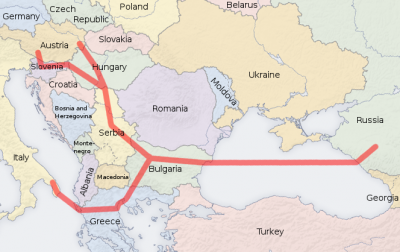
With the TurkStream gas pipeline now running through Serbia, the Balkan country will enjoy numerous benefits when exports begin, such as energy stability, the opportunity to get cheaper gas, and additional tax revenue. On December 25, Serbia successfully tested the TurkStream pipeline project that will connect Russian gas to consumers in Europe, especially in the Balkans. Serbian President Aleksandar Vučić revealed that the pipeline will be officially commissioned on December 30.

“The test run was successful. We did not publicize it too much but everything will start on December 30 as I promised. A small ceremony will be organized on that occasion because it is a huge deal for our country,” Vučić said.

The success of the test and Wednesday’s commissioning of the TurkStream brings an end to one of the most important projects in Serbian history. The gas pipeline strengthens the economic and geostrategic position of Serbia in the region as it can now become a hub to distribute Russian gas in the Balkans. The pipeline is 403 kilometers long and stretches from Zaječar on the border with Bulgaria to Horgoš on the border with Hungary.

There are numerous benefits that this gas pipeline will bring to Serbia, but the most important is energy stability. It is a two-way pipeline, meaning that gas can move between Bulgaria and Hungary in both directions. This is important because of energy security and, not only for Serbia, but for the entire Balkans network which can now be expanded.

The entire TurkStream pipeline within Serbian territory has not been built yet, but judging by the pace of the works so far, it will be completed without delay. Another compressor station remains to be completed in Serbia by June 2021.

The gas pressure on the TurkStream route is high enough that gas can pass from Bulgaria to Serbia. In fact, gas from Bulgaria can already be used in Pančevo, to the immediate east of Belgrade, for the needs of the gas power plant, such as generating electricity and heat. The extensive work for the gasification of Serbia, in full capacity, means that the TurkStream will allow Gazprom to export gas to the Republika Srpska, the Serbian-dominated entity that forms a part of Bosnia and Herzegovina, thus being able to deliver gas to the entirety of the country and perhaps even onwards to Croatia and Montenegro.

Five more gas power plants are planned to be constructed in Serbia in the near future. They will be built next to the largest industrial centers in Serbia. 4% of the total electricity produced in Serbia will come from Pančevo, in which thermal energy from the refinery and all its plants will be supplied. With the TurkStream at full capacity, it will be possible to build plants near Belgrade, Novi Sad, Niš and Kragujevac. When electricity is produced, thermal energy by-product will be used for large industrial plants, businesses and residential centers.

In addition to energy stability, Serbia will enjoy several other important benefits because of the passage of the TurkStream through its territory. Serbia will have minimum $40 cheaper gas per thousand cubic meters thanks to tax revenues that it will collect due to the transportation of gas through its territory to other countries. The Bulgarians negotiated with Gazprom a 27% lower price because imported gas from Ukraine passes through its territory to other countries. Serbia will be able to strike a similar deal so that Russian gas can reach Bosnia and Herzegovina, as well as Hungary, through its territory. It is also a benefit as servicing the gas pipeline and accompanying facilities has created job opportunities, and cheaper gas will inevitably lead to greater industrial output in other sectors.

The benefits of the TurkStream in Serbia will soon be realized as the most difficult part of the job was completed, laying pipes at the bottom of the Black Sea. It is for this reason that Russia prioritized finishing the TurkStream first, even though it has a much smaller capacity compared to Nord Stream 2. Nord Stream 2 has been continuously delayed due to Moscow’s anticipation that Washington would not only oppose the project, but pressure involved countries to withdraw and impose sanctions.

But with TurkStream to begin running in Serbia, it has not only consolidated Belgrade’s relations with Moscow, it gives hope to a country that was devastated by a decade-long NATO destruction in the 1990’s. Serbia has not been able to fully recover from the war, but cheap gas and job creation will transform the Balkan country, not only industrially, but also in terms of regional influence as it becomes a crucial energy hub for the entire region.

*

Note to readers: please click the share buttons above or below. Forward this article to your email lists. Crosspost on your blog site, internet forums. etc.

This article was originally published on InfoBrics.

Paul Antonopoulos is an independent geopolitical analyst.

Featured image is from InfoBrics

Will Azerbaijani Gas Compete with Russia in Southern Europe?

The original source of this article is Global ResearchCopyright © Paul Antonopoulos, Global Research, 2020

River to Sea Uprooted Palestinian   
The views expressed in this article are the sole responsibility of the author and do not necessarily reflect those of the Blog!

Tuesday, 8 September 2020

White House Kosovo meeting: crossing the Atlantic, for this?

White House Kosovo meeting: crossing the Atlantic, for this?

by Eric Vögelin[1] for the Saker blog

The President of Serbia and Avdullah Hoti, the Prime Minister (perhaps it would be more correct to say “self-styled Prime Minister”) of NATO’s 1999 war booty, the occupied Serbian province of Kosovo were hosted for a conference at the White House on 3 and 4 September. The ostensible purpose of the meeting was to iron out their economic relations, as if anything were there to iron out given the devastated condition of both their economies. Putting aside the sensible question of why anybody at the White House would even care about this very local issue enough to devote the good part of two days to it, and bearing in mind that nothing in the Balkans is as it appears at first glance, the real agenda was, of course, quite a bit different. It had to do with putting finishing touches on legitimizing Kosovo as a separate state with international attributes, and economic concerns only served to camouflage that intention.

When the dust settled, the Serbian President had signed what must appear as one of the weirdest documents in the history of international relations. Before making any further editorial comments, here it is:

C:\Users\hp\Desktop\Serbia-Kosovo Agreement 2020 - 1.jpg
C:\Users\hp\Desktop\Serbia-Kosovo Agreement 2020 - 2.jpg

What is so bizarre about it? It is a scrap of paper adorned with the signature of a head of state, but without any heading or logo, or place where it was signed. To add insult to injury, the signatory is identified merely as “President.” President of what, the local Rotary Club or Hunters’ Association? Would a statesman who cares about the dignity of his office or the prestige of his country sign something like this? And what is this, anyway? Is it a diplomatic document or the signatory’s private notes, written out to himself? Interesting questions, worth pondering.

For a contrast, here is President Donald Trump’s letter to his Kosovo Albanian guest, Avdullah Hoti, commemorating the occasion:

C:\Users\hp\Desktop\Trump letter to Hothi.jpg

That looks a lot better and more dignified, doesn’t it?

For an economic agreement between two Balkan entities that few in the West have heard of, care about, or could locate on the map, reached with the involvement of President Trump and members of his staff, the strangely laid out document, it must be said, contains some even stranger provisions.

It says, among other things, that the parties will “diversify their energy supplies.” What does this Aesopian language mean? Are the parties unhappy with their current sources of energy and in need of assistance to secure new ones? Hardly. In light of (a) America’s bitter opposition to North Stream 2, and (b) Secretary of State Pompeo’s recent attempts to “diversify” Belarus’ energy supplies by pushing on it US products that would have to be brought from 10,000 miles away in order to block nearby Russian energy supplies, this phrase can mean only one thing. It is an order to Serbia to abandon any thought of relying on convenient and reasonably priced Russian energy supplies. It also puts an end to Serbia’s role in the Russian European energy distribution scheme, and potentially deprives it of its lucrative position as the South Stream distribution hub. What a great deal for Serbia!

Serbia further accepts to “prohibit the use of 5G equipment supplied by untrusted vendors.” Public health advocates would at this point say “Great, the trip to Washington was not in vain after all, because the scourge of 5G will no longer endanger the health of Serbia’s population, already being decimated by dire cancer generating radioactive consequences of the 1999 NATO bombing.” But the removal of this indisputably noxious Chinese equipment (and that is the whole point of this provision) will not end the scourge but will merely lead to “other mediation efforts in a timely fashion,” e.g. to the substitution of US manufactured deadly 5G networks for those of Huawei.

So the “economic normalization agreement with Kosovo” signed by the president of Serbia’s Hunter’s Association is actually a huge slap to both Russia and China, Serbia’s important geopolitical partners, and incidentally a shot in Serbia’s own foot as well.

Next, there is a provision which Ambassador Richard Grenell, who mediated the talks, might have inserted himself: “Both parties will work with the 69 countries that criminalize homosexuality to push for decriminalization.” What has that got to do with economic relations? And why stop there and not also mandate transgender toilets in Serbian grammar schools?

Serbia is also mandated to transfer its embassy in Israel from Tel Aviv to Jerusalem. In parallel fashion, “Kosovo” and Israel will establish diplomatic relations, i.e. Israel recognizes Kosovo. Another great deal for Serbia. By moving its embassy to Jerusalem, Serbia will reward Israel for recognizing the illegal separation of 15% of its territory containing some of its most significant cultural and spiritual sites. That would be analogous to Israel ceding Temple Mount and the Wailing wall to the Arabs and opening embassies in their capitals. And, slap number three, this time to the Arab and Muslim world, for reasons that are impossible to rationally fathom, Serbia obliges itself to “implement measures to restrict Hizballah´s operations and financial activities” on its territory. Whatever position one chooses to take toward “Hizballah” there is nothing for Serbia to restrict because that organization does not conduct any activities on Serbian territory, unless the reference is to “Kosovo” which happens to be a Hizballah stronghold. So why aren´t things called by their real name, and why does a person purporting to represent Serbia consent to being strong-armed into signing such a ludicrous provision, needlessly putting his country in a bad light and courting the contempt of hundreds of millions of Muslims throughout the world?

The next to last point of the Agreement is highly indicative of the political context of the entire affair. It says that in return for “Kosovo” not seeking membership in international organizations for a year, Serbia will “agree to a one-year moratorium on its de-recognition campaign, and will refrain from formally or informally requesting any nation or International Organization not to recognize Kosovo as an independent state.” The formulation is ambiguous but it is framed to support the interpretation that Serbia will refrain from obstructing the recognition of “Kosovo as an independent state” without any time limitations. The sentence is cleverly written by Anglo-Saxon lawyers, including tricky punctuation, to obfuscate that point, but the comma after the word “year” gives the game away. The clause that follows is grammatically separate from the language that precedes it. If President Trump was in a hurry and retyping the whole thing was not an option, any prudent signatory on Serbia’s behalf would have quickly inserted in his own hand after the word refrain the phrase “for the duration of one year,” thus clearly matching the period of “Kosovo’s” commitment to refrain. But as the matter stands, “Kosovo’s” duty to refrain will expire in one year, while Serbia’s obligation to do the same will continue indefinitely after that. Pacta sunt servanda.

Did Serbia’s representative at this meeting have a legal team to assist him? Probably not, because he presumes to be a lawyer himself.

What is the political implication of this provision? It is that the US and EU sponsored process of “Kosovo” legitimation as an “independent state” shall continue unabated, culminating in UN membership, with Serbia renouncing in advance the right to oppose it in any effective way. It is a demonically clever scheme. In the end, Serbia’s de iure recognition of “Kosovo” will become irrelevant because there will no longer be a need to seek its consent or opinion on the subject.

The thought that President Trump arranged this meeting because he needed a foreign policy win before the elections is grossly exaggerated. In his press briefing on 4 September, the same day these discussions were concluded, he did not even mention them or intimate that some spectacular accords which might influence his electoral chances were signed in the Oval Office. That is a clue to the significance he attributes to the visit of his Balkan guests.

For the outlaw “government of Kosovo,” however, this is an important phase in the relentless process of legitimation that is being conducted under the auspices of its US deep state sponsors, whether Trump personally is aware of what is going on or not. For Serbia, the trans-Atlantic trip definitely was not worth it. It was another broad strategic retreat and humiliation. It demonstrates the readiness of Serbia’s leadership to needlessly abase themselves and trade the country’s crown jewels for another lease on their political life, betting on the foreign support they now think they have secured by brown-nosing the global powers-that-be. They better think again, however, and analyse realistically the trajectory of their Montenegrin colleagues.

  1. I thank a reader of my previous article for correctly spelling my surname, with the umlaut. I had used the English transliteration in order not to confuse some readers. 

River to Sea Uprooted Palestinian   
The views expressed in this article are the sole responsibility of the author and do not necessarily reflect those of the Blog!