Showing posts with label The Trial of Julian Assange. Show all posts

Tuesday, 2 November 2021

John Pilger: Justice for Assange is Justice for All

 November 01st, 2021

Julian Assange Feature photo
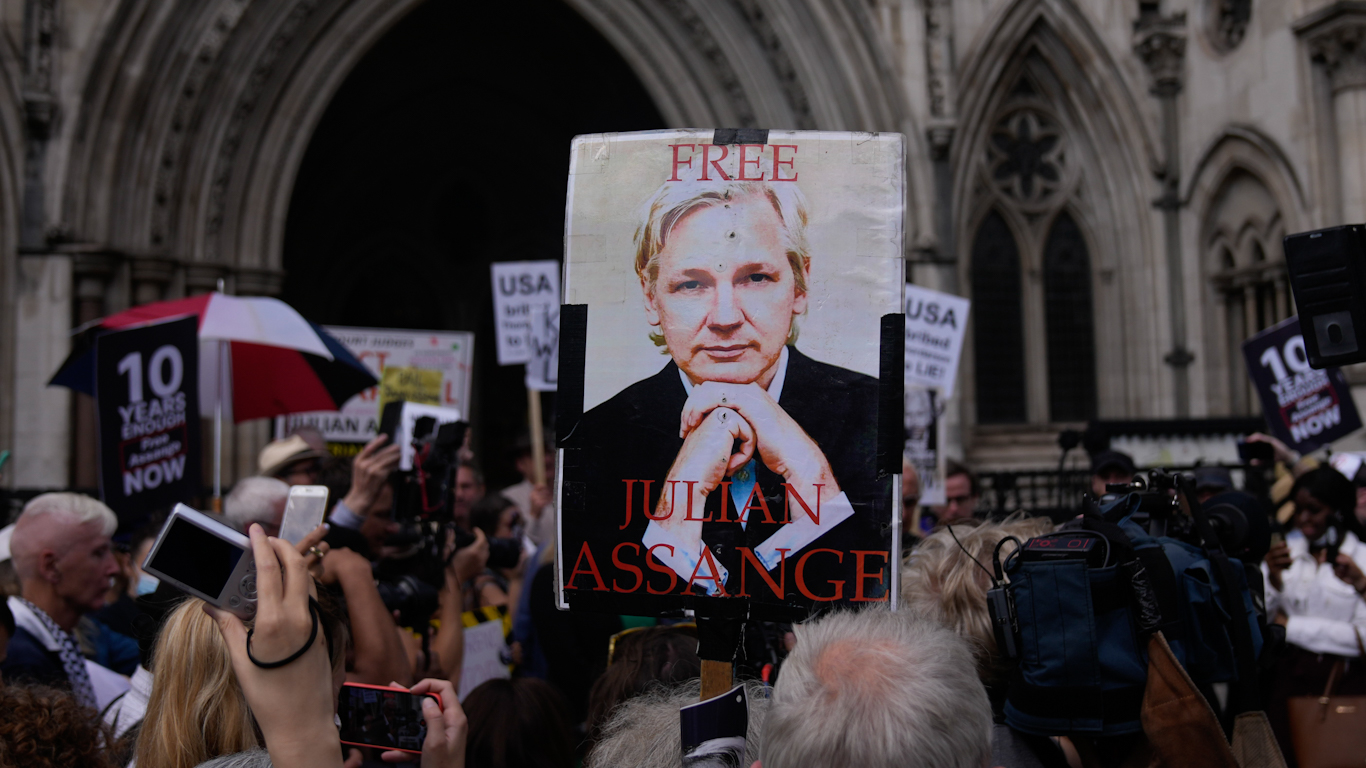
Julian Assange is a truth-teller who has committed no crime but revealed government crimes and lies on a vast scale and so performed one of the great public services of my lifetime.

By John Pilger

Source

When I first saw Julian Assange in Belmarsh prison, in 2019, shortly after he had been dragged from his refuge in the Ecuadorean embassy, he said, “I think I am losing my mind.”

He was gaunt and emaciated, his eyes hollow and the thinness of his arms was emphasised by a yellow identifying cloth tied around his left arm, an evocative symbol of institutional control.

For all but the two hours of my visit, he was confined to a solitary cell in a wing known as “healthcare”, an Orwellian name. In the cell next to him a deeply disturbed man screamed through the night. Another occupant suffered from terminal cancer. Another was seriously disabled.

“One day we were allowed to play Monopoly,” he said, “as therapy. That was our healthcare!”

“This is One Flew Over the Cuckoo’s Nest,” I said.

“Yes, only more insane.”

Julian’s black sense of humour has often rescued him, but no more. The insidious torture he has suffered in Belmarsh has had devastating effects. Read the reports of Nils Melzer, the UN Special Rapporteur on Torture, and the clinical opinions of Michael Kopelman, emeritus professor of neuropsychiatry at King’s College London and Dr. Quentin Deeley, and reserve a contempt for America’s hired gun in court, James Lewis QC, who dismissed this as “malingering”.

I was especially moved by the expert words of Dr. Kate Humphrey, a clinical neuropsychologist at Imperial College, London. She told the Old Bailey last year that Julian’s intellect had gone from “in the superior, or more likely very superior, range” to “significantly below” this optimal level, to the point where he was struggling to absorb information and “perform in the low to average range”.

At yet another court hearing in this shameful Kafkaesque drama, I watched him struggle to remember his name when asked by the judge to state it.

For most of his first year in Belmarsh, he was locked up. Denied proper exercise, he strode the length of his small cell, back and forth, back and forth, for “my own half-marathon”, he told me. This reeked of despair. A razorblade was found in his cell. He wrote “farewell letters”. He phoned the Samaritans repeatedly.

At first he was denied his reading glasses, left behind in the brutality of his kidnapping from the embassy. When the glasses finally arrived at the prison, they were not delivered to him for days. His solicitor, Gareth Peirce, wrote letter after letter to the prison governor protesting the withholding of legal documents, access to the prison library, the use of a basic laptop with which to prepare his case. The prison would take weeks, even months, to answer. (The governor, Rob Davis, has been awarded an Order of the British Empire).

Books sent to him by a friend, the journalist Charles Glass, himself a survivor of hostage-taking in Beirut, were returned. Julian could not call his American lawyers. From the start, he has been constantly medicated. Once, when I asked him what they were giving him, he couldn’t say.

At last week’s High Court hearing to decide finally whether or not Julian would be extradited to America, he appeared only briefly by video link on the first day. He looked unwell and unsettled. The court was told he had been “excused” because of his “medication”. But Julian had asked to attend the hearing and was refused, said his partner Stella Morris. Attendance in a court sitting in judgement on you is surely a right.

This intensely proud man also demands the right to appear strong and coherent in public, as he did at the Old Bailey last year. Then, he consulted constantly with his lawyers through the slit in his glass cage. He took copious notes. He stood and protested with eloquent anger at lies and abuses of process.

The damage done to him in his decade of incarceration and uncertainty, including more than two years in Belmarsh (whose brutal regime is celebrated in the latest Bond film) is beyond doubt.

But so, too, is his courage beyond doubt, and a quality of resistance and resilience that is heroism. It is this that may see him through the present Kafkaesque nightmare – if he is spared an American hellhole.

I have known Julian since he first came to Britain in 2009. In our first interview, he described the moral imperative behind WikiLeaks: that our right to the transparency of governments and the powerful was a basic democratic right. I have watched him cling to this principle when at times it has made his life even more precarious.

Almost none of this remarkable side to the man’s character has been reported in the so-called “free press” whose own future, it is said, is in jeopardy if Julian is extradited.

Of course, but there has never been a ”free press”. There have been extraordinary journalists who have occupied positions in the “mainstream” – spaces that have now closed, forcing independent journalism on to the internet.

There, it has become a “fifth estate”, a samizdat of dedicated, often unpaid work by those who were honourable exceptions in a media now reduced to an assembly line of platitudes. Words like “democracy”, “reform”, “human rights” are stripped of their dictionary meaning and censorship is by omission or exclusion.

Last week’s fateful hearing at the High Court was “disappeared” in the “free press”. Most people would not know that a court in the heart of London had sat in judgement on their right to know: their right to question and dissent.

Many Americans, if they know anything about the Assange case, believe a fantasy that Julian is a Russian agent who caused Hillary Clinton to lose the presidential election in 2016 to Donald Trump. This is strikingly similar to the lie that Saddam Hussein had weapons of mass destruction, which justified the invasion of Iraq and the deaths of a million or more people.

They are unlikely to know that the main prosecution witness underpinning one of the concocted charges against Julian has recently admitted he lied and fabricated his “evidence”.

Neither will they have heard or read about the revelation that the CIA, under its former director, the Hermann Goering lookalike Mike Pompeo, had planned to assassinate Julian.  And that was hardly new. Since I have known Julian, he has been under threat of harm and worse.

On his first night in the Ecuadorean embassy in 2012, dark figures swarmed over the front of the embassy and banged on the windows, trying to get in. In the US, public figures – including Hillary Clinton, fresh from her destruction of Libya – have long called for Julian’s assassination. The current President Biden damned him as a “hi-tech terrorist”.

The former prime minister of Australia, Julia Gillard, was so eager to please what she called “our best mates” in Washington that she demanded Julian’s passport be taken from him – until it was pointed out to her that this would be against the law. The current prime minister, Scott Morrison, a PR man, when asked about Assange, said, “He should face the music.”

It has been open season on the WikiLeaks’ founder for more than a decade. In 2011, The Guardian exploited Julian’s work as if it was its own, collected journalism prizes and Hollywood deals, then turned on its source.

Years of vituperative assaults on the man who refused to join their club followed. He was accused of failing to redact documents of the names of those considered at risk. In a Guardian book by David Leigh and Luke Harding, Assange is quoted as saying during a dinner in a London restaurant that he didn’t care if informants named in the leaks were harmed.

Neither Harding nor Leigh was at the dinner. John Goetz, an investigations reporter with Der Spiegel, actually was at the dinner and testified that Assange said nothing of the kind.

The great whistleblower Daniel Ellsberg told the Old Bailey last year that Assange had personally redacted 15,000 files. The New Zealand investigative journalist Nicky Hager, who worked with Assange on the Afghanistan and Iraq war leaks, described how Assange took “extraordinary precautions in redacting names of informants”.

In 2013,  I asked the film-maker Mark Davis about this. A respected broadcaster for SBS Australia, Davis was an eyewitness, accompanying Assange during the preparation of the leaked files for publication in The Guardian and The New York Times. He told me, “Assange was the only one who worked day and night extracting 10,000 names of people who could be targeted by the revelations in the logs.”

Lecturing a group of City University students, David Leigh mocked the very idea that “Julian Assange will end up in an orange jumpsuit”. His fears were an exaggeration, he sneered. Edward Snowden later revealed that Assange was on a “manhunt timeline”.

Luke Harding, who co-authored with Leigh the Guardian book that disclosed the password to a trove of diplomatic cables that Julian had entrusted to the paper, was outside the Ecuadorean embassy on the evening Julian sought asylum. Standing with a line of police, he gloated on his blog, “Scotland Yard may well have the last laugh.”

The campaign was relentless. Guardian columnists scraped the depths. “He really is the most massive turd,” wrote Suzanne Moore of a man she had never met.

The editor who presided over this, Alan Rusbridger, has lately joined the chorus that “defending Assange protects the free press”. Having published the initial WikiLeaks revelations, Rusbridger must wonder if the Guardian’s subsequent excommunication of Assange will be enough to protect his own skin from the wrath of Washington.

The High Court judges are likely to announce their decision on the US appeal in the new year. What they decide will determine whether or not the British judiciary has trashed the last vestiges of its vaunted reputation; in the land of Magna Carta this disgraceful case ought to have been hurled out of court long ago.

The missing imperative is not the impact on a collusive “free press”. It is justice for a man persecuted and willfully denied it.

Julian Assange is a truth-teller who has committed no crime but revealed government crimes and lies on a vast scale and so performed one of the great public services of my lifetime. Do we need to be reminded that justice for one is justice for all?


River to Sea Uprooted Palestinian   
The views expressed in this article are the sole responsibility of the author and do not necessarily reflect those of the Blog!

Sunday, 31 October 2021

Chris Hedges: The Most Important Battle for Press Freedom in Our Time

 October 30th, 2021

Britain Assange Feature photo

By Chris Hedges

Source

If he is extradited and found guilty of publishing classified material it will set a legal precedent that will effectively end national security reporting.

WASHINGTON, D.C. (Scheerpost) – For the past two days, I have been watching the extradition hearing for Julian Assange via video link from London. The United States is appealing a lower court ruling that denied the US request to extradite Assange not, unfortunately, because in the eyes of the court he is innocent of a crime, but because, as Judge Vanessa Baraitser in January concluded, Assange’s precarious psychological state would deteriorate given the “harsh conditions” of the inhumane US prison system, “causing him to commit suicide.” The United States has charged Assange with 17 counts under the Espionage Act and one count of trying to hack into a government computer, charges that could see him imprisoned for 175 years.

Assange, with long white hair, appeared on screen the first day from the video conference room in HM Prison Belmarsh. He was wearing a white shirt with an untied tie around his neck. He looked gaunt and tired. He did not appear in court, the judges explained, because he was receiving a “high dose of medication.” On the second day he was apparently not present in the prison’s video conference room.

Assange is being extradited because his organization WikiLeaks released the Iraq War Logs in October 2010, which documented numerous US war crimes — including video images of the gunning down of two Reuters journalists and 10 other unarmed civilians in the Collateral murder video, the routine torture of Iraqi prisoners, the covering up of thousands of civilian deaths and the killing of nearly 700 civilians that had approached too closely to US checkpoints. He is also being targeted by US authorities for other leaks, especially those that exposed  the hacking tools used by the CIA known as Vault 7, which enables the spy agency to compromise cars, smart TVs, web browsers and the operating systems of most smart phones, as well as operating systems such as Microsoft Windows, macOS and Linux.

If Assange is extradited and found guilty of publishing classified material, it will set a legal precedent that will effectively end national security reporting, allowing the government to use the Espionage Act to charge any reporter who possesses classified documents, and any whistleblower who leaks classified information.

If the appeal by the United States is accepted Assange will be retried in London. The ruling on the appeal is not expected until at least January.

Assange’s September 2020 trial painfully exposed how vulnerable he has become after 12 years of detention, including seven in the Ecuadorian Embassy in London. He has in the past attempted suicide by slashing his wrists. He suffers from hallucinations and depression, takes antidepressant medication and the antipsychotic quetiapine. After he was observed pacing his cell until he collapsed, punching himself in the face and banging his head against the wall he was transferred for several months to the medical wing of the Belmarsh prison. Prison authorities found “half of a razor blade” hidden under his socks. He has repeatedly called the suicide hotline run by the Samaritans because he thought about killing himself “hundreds of times a day.”

James Lewis, the lawyer for the United States, attempted to discredit the detailed and disturbing medical and psychological reports on Assange presented to the court in September 2020, painting him instead as a liar and malingerer. He excoriated the decision of Judge Baraitser to bar extradition, questioned her competence, and breezily dismissed the mountains of evidence that high-security prisoners in the United Sates, like Assange, subjected to Special Administrative Measures (SAMs), and held in virtual isolation in supermax prisons, suffer psychological distress. He charged Dr. Michael Kopelman, emeritus professor of neuropsychiatry at the Institute of Psychiatry, Psychology and Neuroscience, King’s College London, who examined Assange and testified for the defense, with deception for “concealing” that Assange fathered two children with his fiancée Stella Morris while in refuge in the Ecuadorian Embassy in London. He said that, should the Australian government request Assange, he could serve his prison time in Australia, his home country, after his appeals had been exhausted, but stopped short of promising that Assange would not be held in isolation or subject to SAMs.

The authority repeatedly cited by Lewis to describe the conditions under which Assange will be held and tried in the United States was Gordon Kromberg, the Assistant United States attorney for the Eastern District of Virginia. Kromberg is the government’s grand inquisitor in cases of terrorism and national security. He has expressed open contempt for Muslims and Islam and decried what he calls “the Islamization of the American justice system.” He oversaw the 9-year persecution of the Palestinian activist and academic Dr. Sami Al-Arian and at one point refused his request to postpone a court date during the religious holiday of Ramadan. “They can kill each other during Ramadan, they can appear before the grand jury. All they can’t do is eat before sunset,” Kromberg said in a 2006 conversation, according to an affidavit filed by one of Arian’s attorneys, Jack Fernandez.

Kromberg criticized Daniel Hale, the former Air Force analyst who recently was sentenced to 45 months in a supermax prison for leaking information about the indiscriminate killings of civilians by drones, saying Hale had not contributed to public debate, but had “endanger[ed] the people doing the fight.” He ordered Chelsea Manning jailed after she refused to testify in front of a grand jury investigating WikiLeaks. Manning attempted to commit suicide in March 2020 while being held in the Virginia jail.

Having covered the case of Syed Fahad Hashmi, who was arrested in London in 2006, I have a good idea of what waits Assange if he is extradited. Hashmi also was held in Belmarsh and extradited in 2007 to the United States where he spent three years in solitary confinement under SAMs. His “crime” was that an acquaintance who stayed in his apartment with him while he was a graduate student in London had raincoats, ponchos and waterproof socks in luggage at the apartment. The acquaintance planned to deliver the items to al-Qaida. But I doubt the government was concerned with waterproof socks being shipped to Pakistan. The reason, I suspect, Hashmi was targeted was because, like the Palestinian activist Dr. Sami Al-Arian, and like Assange, he was fearless and zealous in his defense of those being bombed, shot, terrorized and killed throughout the Muslim world while he was a student at Brooklyn College.

Hashmi was deeply religious, and some of his views, including his praise of the Afghan resistance, were controversial, but he had a right to express these sentiments. More important, he had a right to expect freedom from persecution and imprisonment because of his opinions, just as Assange should have the freedom, like any publisher, to inform the public about the inner workings of power. Facing the possibility of a 70-year sentence in prison and having already spent four years in jail, much of it in solitary confinement, Hashmi accepted a plea bargain on one count of conspiracy to provide material support to terrorism. Judge Loretta Preska, who sentenced the hacker Jeremy Hammond and human rights attorney Steven Donziger, gave him the maximum 15-year sentence. Hashmi was held for nine years in Guantanamo-like conditions in the supermax ADX [Administrative Maximum] facility in Florence, Colorado, where Assange, if found guilty in an American court, will almost certainly be imprisoned. Hashmi was released in 2019.

The pre-trial detention conditions Hashmi endured were designed to break him. He was electronically monitored 24-hours a day. He could only receive or send mail with his immediate family. He was prohibited from speaking with other prisoners through the walls. He was forbidden from taking part in group prayer. He was permitted one hour of exercise a day, in a solitary cage without fresh air. He has unable to see most of the evidence used to indict him which was classified under the Classified Information Procedures Act, enacted to prevent US intelligence officers under prosecution from threatening to reveal state secrets to manipulate the legal proceedings. The harsh conditions eroded his physical and psychological health. When he appeared in the final court proceeding to accept a guilty plea he was in a near catatonic state, clearly unable to follow the proceedings around him.

If the government will go to this length to persecute someone who was alleged to have been involved in sending waterproof socks to al-Qaida, what can we expect the government to do to Assange?

A society that prohibits the capacity to speak in truth extinguishes the capacity to live in justice. The battle for Assange’s liberty has always been much more than the persecution of a publisher. It is the most important battle for press freedom of our era. And if we lose this battle, it will be devastating, not only for Assange and his family, but for us.

Tyrannies invert the rule of law. They turn the law into an instrument of injustice. They cloak their crimes in a faux legality. They use the decorum of the courts and trials, to mask their criminality. Those, such as Assange, who expose that criminality to the public are dangerous, for without the pretext of legitimacy the tyranny loses credibility and has nothing left in its arsenal but fear, coercion and violence. The long campaign against Assange and WikiLeaks is a window into the collapse of the rule of law, the rise of what the political philosopher Sheldon Wolin calls our system of inverted totalitarianism, a form of totalitarianism that maintains the fictions of the old capitalist democracy, including its institutions, iconography, patriotic symbols and rhetoric, but internally has surrendered total control to the dictates of global corporations and the security and surveillance state.

There is no legal basis to hold Assange in prison. There is no legal basis to try him, an Australian citizen, under the US Espionage Act. The CIA spied on Assange in the Ecuadorian embassy through a Spanish company, UC Global, contracted to provide embassy security. This spying included recording the privileged conversations between Assange and his lawyers as they discussed his defense. This fact alone invalidated the trial. Assange is being held in a high security prison so the state can, as Nils Melzer, the U.N. Special Rapporteur on Torture, has testified, continue the degrading abuse and torture it hopes will lead to his psychological if not physical disintegration.The architects of imperialism, the masters of war, the corporate-controlled legislative, judicial and executive branches of government and their obsequious courtiers in the media, are guilty of egregious crimes. Say this simple truth and you are banished, as many of us have been, to the margins of the media landscape. Prove this truth, as Assange, Chelsea Manning, Jeremy Hammond and Edward Snowden have by allowing us to peer into the inner workings of power, and you are hunted down and persecuted.

Assange’s “crime” is that he exposed the more than 15,000 unreported deaths of Iraqi civilians. He exposed the torture and abuse of some 800 men and boys, aged between 14 and 89, at Guantánamo. He exposed that Hillary Clinton in 2009 ordered US diplomats to spy on U.N. Secretary General Ban Ki Moon and other U.N. representatives from China, France, Russia, and the UK, spying that included obtaining DNA, iris scans, fingerprints, and personal passwords, part of the long pattern of illegal surveillance that included the eavesdropping on UN Secretary General Kofi Annan in the weeks before the US-led invasion of Iraq in 2003. He exposed that Barack Obama, Hillary Clinton and the CIA orchestrated the June 2009 military coup in Honduras that overthrew the democratically-elected president Manuel Zelaya, replacing it with a murderous and corrupt military regime. He exposed that George W. Bush, Barack Obama and General David Petraeus prosecuted a war in Iraq that under post-Nuremberg laws is defined as a criminal war of aggression, a war crime, which authorized hundreds of targeted assassinations, including those of US citizens in Yemen. He exposed that the United States secretly launched missile, bomb, and drone attacks on Yemen, killing scores of civilians. He exposed that Goldman Sachs paid Hillary Clinton $657,000 to give talks, a sum so large it can only be considered a bribe, and that she privately assured corporate leaders she would do their bidding while promising the public financial regulation and reform. He exposed the internal campaign to discredit and destroy British Labour Party leader Jeremy Corbyn by members of his own party. He exposed how the hacking tools used by the CIA and the National Security Agency permits the wholesale government surveillance of our televisions, computers, smartphones and anti-virus software, allowing the government to record and store our conversations, images and private text messages, even from encrypted apps.

He exposed the truth. He exposed it over and over and over until there was no question of the endemic illegality, corruption and mendacity that defines the global ruling elite. And for these truths alone he is guilty.


River to Sea Uprooted Palestinian   
The views expressed in this article are the sole responsibility of the author and do not necessarily reflect those of the Blog!

Monday, 5 October 2020

John Pilger: Eyewitness to the Agony of Julian Assange


John Pilger Assange Feature photo

By John Pilger

Source

John Pilger has watched Julian Assange’s extradition trial from the public gallery at London’s Old Bailey. He spoke with Timothy Erik Ström of Arena magazine, Australia:

Q: Having watched Julian Assange’s trial firsthand, can you describe the prevailing atmosphere in the court?

The prevailing atmosphere has been shocking. I say that without hesitation; I have sat in many courts and seldom known such a corruption of due process; this is due revenge. Putting aside the ritual associated with ‘British justice’, at times it has been evocative of a Stalinist show trial. One difference is that in the show trials, the defendant stood in the court proper. In the Assange trial, the defendant was caged behind thick glass, and had to crawl on his knees to a slit in the glass, overseen by his guard, to make contact with his lawyers. His message, whispered barely audibly through face masks, WAS then passed by post-it the length of the court to where his barristers were arguing the case against his extradition to an American hellhole.

Consider this daily routine of Julian Assange, an Australian on trial for truth-telling journalism. He was woken at five o’clock in his cell at Belmarsh prison in the bleak southern sprawl of London. The first time I saw Julian in Belmarsh, having passed through half an hour of ‘security’ checks, including a dog’s snout in my rear, I found a painfully thin figure sitting alone wearing a yellow armband. He had lost more than 10 kilos in a matter of months; his arms had no muscle. His first words were: ‘I think I am losing my mind’.

I tried to assure him he wasn’t. His resilience and courage are formidable, but there is a limit. That was more than a year ago. In the past three weeks, in the pre-dawn, he was strip-searched, shackled, and prepared for transport to the Central Criminal Court, the Old Bailey, in a truck that his partner, Stella Moris, described as an upended coffin. It  had one small window; he had to stand precariously to look out. The truck and its guards were operated by Serco, one of many politically connected companies that run much of Boris Johnson’s Britain.

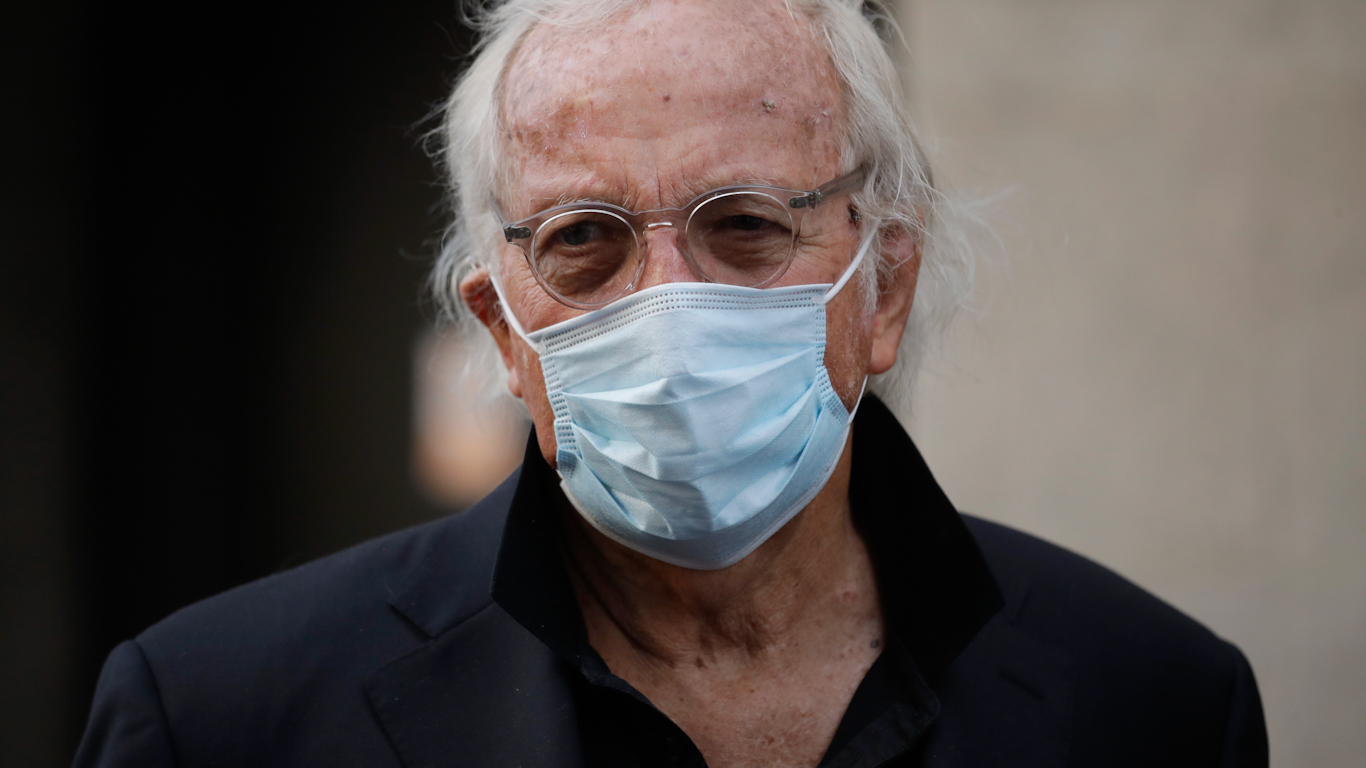
The journey to the Old Bailey took at least an hour and a half. That’s a minimum of three hours being jolted through snail-like traffic every day. He was led into his narrow cage at the back of the court, then look up, blinking, trying to make out faces in the public gallery through the reflection of the glass. He saw the courtly figure of his dad, John Shipton, and me, and our fists went up. Through the glass, he reached out to touch fingers with Stella, who is a lawyer and seated in the body of the court.

We were here for the ultimate of what the philosopher Guy Debord called The Society of the Spectacle: a man fighting for his life. Yet his crime is to have performed an epic public service: revealing that which we have a right to know: the lies of our governments and the crimes they commit in our name. His creation of WikiLeaks and its failsafe protection of sources revolutionised journalism, restoring it to the vision of its idealists. Edmund Burke’s notion of free journalism as a fourth estate is now a fifth estate that shines a light on those who diminish the very meaning of democracy with their criminal secrecy. That’s why his punishment is so extreme.

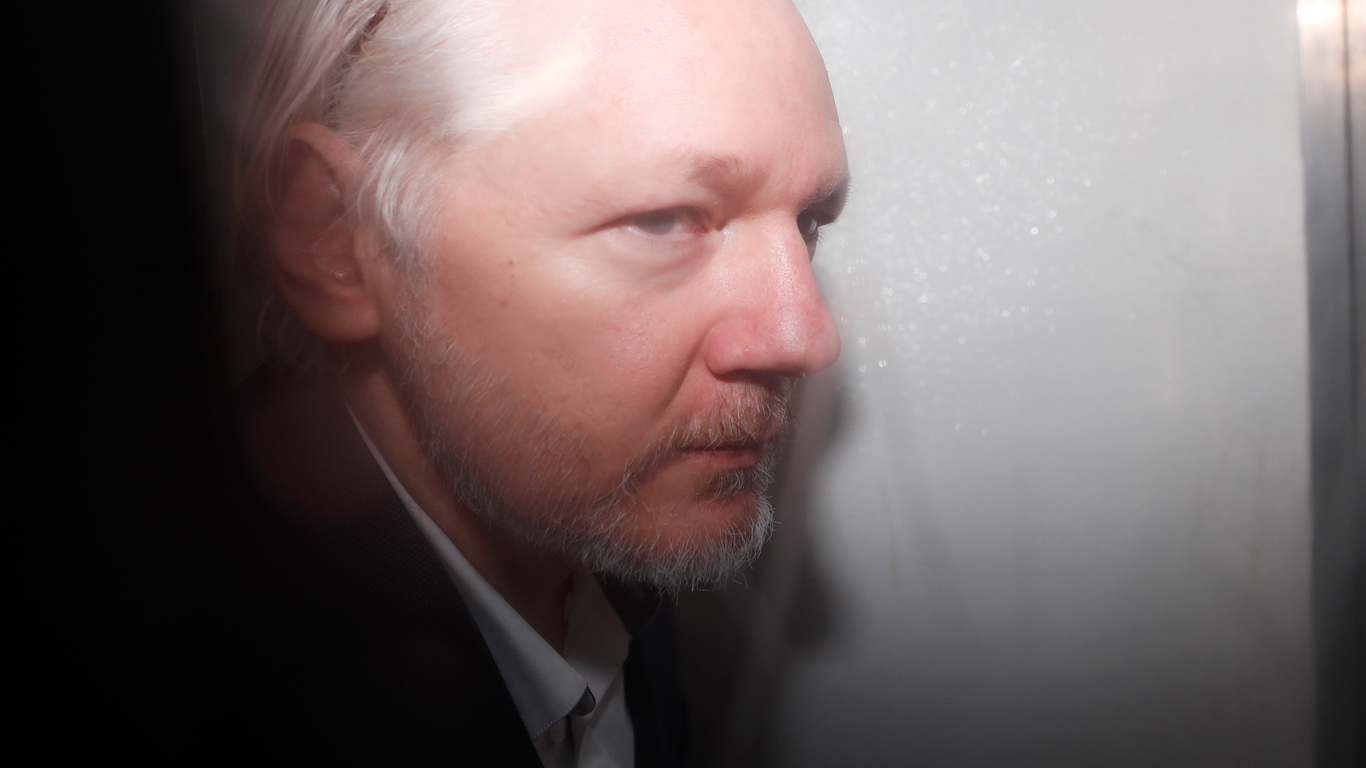
The sheer bias in the courts I have sat in this year and last year, with Julian in the dock, blight any notion of British justice. When thuggish police dragged him from his asylum in the Ecuadorean embassy—look closely at the photo and you’ll see he is clutching a Gore Vidal book; Assange has a political humour similar to Vidal’s—a judge gave him an outrageous 50-week sentence in a maximum-security prison for mere bail infringement.

For months, he was denied exercise and held in solitary confinement disguised as ‘heath care’. He once told me he strode the length of his cell, back and forth, back and forth, for his own half-marathon. In the next cell, the occupant screamed through the night. At first he was denied his reading glasses, left behind in the embassy brutality. He was denied the legal documents with which to prepare his case, and access to the prison library and the use of a basic laptop. Books sent to him by a friend, the journalist Charles Glass, himself a survivor of hostage-taking in Beirut, were returned. He could not call his American lawyers. He has been constantly medicated by the prison authorities. When I asked him what they were giving him, he couldn’t say. The governor of Belmarsh has been awarded the Order of the British Empire.

At the Old Bailey, one of the expert medical witnesses, Dr Kate Humphrey, a clinical neuropsychologist at Imperial College, London, described the damage: Julian’s intellect had gone from ‘in the superior, or more likely very superior range’ to ‘significantly below’ this optimal level, to the point where he was struggling to absorb information and ‘perform in the low average range’.

This is what the United Nations Special Rapporteur on Torture, Professor Nils Melzer, calls ‘psychological torture’, the result of a gang-like ‘mobbing’ by governments and their media shills. Some of the expert medical evidence is so shocking I have no intention of repeating it here. Suffice to say that Assange is diagnosed with autism and Asperger’s syndrome and, according to Professor Michael Kopelman, one of the world’s leading neuropsychiatrists, he suffers from ‘suicidal preoccupations’ and is likely to find a way to take his life if he is extradited to America.

James Lewis QC, America’s British prosecutor, spent the best part of his cross-examination of Professor Kopelman dismissing mental illness and its dangers as ‘malingering’. I have never heard in a modern setting such a primitive view of human frailty and vulnerability.

My own view is that if Assange is freed, he is likely to recover a substantial part of his life. He has a loving partner, devoted friends and allies and the innate strength of a principled political prisoner. He also has a wicked sense of humour.

But that is a long way off. The moments of collusion between the judge— a Gothic-looking magistrate called Vanessa Baraitser, about whom little is known—and the prosecution acting for the Trump regime have been brazen. Until the last few days, defence arguments have been routinely dismissed. The lead prosecutor, James Lewis QC, ex SAS and currently Chief Justice of the Falklands, by and large gets what he wants, notably up to four hours to denigrate expert witnesses, while the defence’s examination is guillotined at half an hour. I have no doubt, had there been a jury, his freedom would be assured.

The dissident artist Ai Weiwei came to join us one morning in the public gallery. He noted that in China the judge’s decision would already have been made. This caused some dark ironic amusement. My companion in the gallery, the astute diarist and former British ambassador Craig Murray wrote:

I fear that all over London a very hard rain is now falling on those who for a lifetime have worked within institutions of liberal democracy that at least broadly and usually used to operate within the governance of their own professed principles. It has been clear to me from Day 1 that I am watching a charade unfold. It is not in the least a shock to me that Baraitser does not think anything beyond the written opening arguments has any effect. I have again and again reported to you that, where rulings have to be made, she has brought them into court pre-written, before hearing the arguments before her.

I strongly expect the final decision was made in this case even before opening arguments were received.

The plan of the US Government throughout has been to limit the information available to the public and limit the effective access to a wider public of what information is available. Thus we have seen the extreme restrictions on both physical and video access. A complicit mainstream media has ensured those of us who know what is happening are very few in the wider population.

There are few records of the proceedings. They are Craig Murray’s personal blog, Joe Lauria’s live reporting on Consortium News, and the World Socialist Website. American journalist Kevin Gosztola’s blog, Shadowproof, funded mostly by himself, has reported more of the trial than the major US press and TV, including CNN, combined.

In Australia, Assange’s homeland, the ‘coverage’ follows a familiar formula set overseas. The London correspondent of the Sydney Morning Herald, Latika Bourke, wrote this recently:

The court heard Assange became depressed during the seven years he spent in the Ecuadorian embassy where he sought political asylum to escape extradition to Sweden to answer rape and sexual assault charges.

There were no ‘rape and sexual assault charges’ in Sweden. Bourke’s lazy falsehood is not uncommon. If the Assange trial is the political trial of the century, as I believe it is, its outcome will not only seal the fate of a journalist for doing his job but intimidate the very principles of free journalism and free speech. The absence of serious mainstream reporting of the proceedings is, at the very least, self-destructive. Journalists should ask: who is next?

How shaming it all is. A decade ago, the Guardian exploited Assange’s work, claimed its profit and prizes as well as a lucrative Hollywood deal, then turned on him with venom. Throughout the Old Bailey trial, two names have been cited by the prosecution, the Guardian’s David Leigh, now retired as ‘investigations editor’ and Luke Harding, the Russiaphobe and author of a fictional Guardian ‘scoop’ that claimed Trump adviser Paul Manafort and a group of Russians visited Assange in the Ecuadorean embassy. This never happened, and the Guardian has yet to apologise. The Harding and Leigh book on Assange—written behind their subject’s back—disclosed a secret password to a WikiLeaks file that Assange had entrusted to Leigh during the Guardian’s ‘partnership’. Why the defence has not called this pair is difficult to understand.

Assange is quoted in their book declaring during a dinner at a London restaurant that he didn’t care if informants named in the leaks were harmed. Neither Harding nor Leigh was at the dinner. John Goetz, an investigations reporter with Der Spiegel, was at the dinner and testified that Assange said nothing of the kind. Incredibly, Judge Baraitser stopped Goetz actually saying this in court.

However, the defence has succeeded in demonstrating the extent to which Assange sought to protect and redact names in the files released by WikiLeaks and that no credible evidence existed of individuals harmed by the leaks. The great whistle-blower Daniel Ellsberg said that Assange had personally redacted 15,000 files. The renowned New Zealand investigative journalist Nicky Hager, who worked with Assange on the Afghanistan and Iraq war leaks, described how Assange took ‘extraordinary precautions in redacting names of informants’.

Q: What are the implications of this trial’s verdict for journalism more broadly—is it an omen of things to come?

The ‘Assange effect’ is already being felt across the world. If they displease the regime in Washington, investigative journalists are liable to prosecution under the 1917 US Espionage Act; the precedent is stark. It doesn’t matter where you are. For Washington, other people’s nationality and sovereignty rarely mattered; now it does not exist. Britain has effectively surrendered its jurisdiction to Trump’s corrupt Department of Justice. In Australia, a National Security Information Act promises Kafkaesque trials for transgressors. The Australian Broadcasting Corporation has been raided by police and journalists’ computers taken away. The government has given unprecedented powers to intelligence officials, making journalistic whistle-blowing almost impossible. Prime Minister Scott Morrison says Assange ‘must face the music’. The perfidious cruelty of his statement is reinforced by its banality.

‘Evil’, wrote Hannah Arendt, ‘comes from a failure to think. It defies thought for as soon as thought tries to engage itself with evil and examine the premises and principles from which it originates, it is frustrated because it finds nothing there. That is the banality of evil’.

Q: Having followed the story of WikiLeaks closely for a decade, how has this eyewitness experience shifted your understanding of what’s at stake with Assange’s trial?

I have long been a critic of journalism as an echo of unaccountable power and a champion of those who are beacons. So, for me, the arrival of WikiLeaks was exciting; I admired the way Assange regarded the public with respect, that he was prepared to share his work with the ‘mainstream’ but not join their collusive club. This, and naked jealousy, made him enemies among the overpaid and undertalented, insecure in their pretensions of independence and impartiality.

I admired the moral dimension to WikiLeaks. Assange was rarely asked about this, yet much of his remarkable energy comes from a powerful moral sense that governments and other vested interests should not operate behind walls of secrecy. He is a democrat. He explained this in one of our first interviews at my home in 2010.

 
What is at stake for the rest of us has long been at stake: freedom to call authority to account, freedom to challenge, to call out hypocrisy, to dissent. The difference today is that the world’s imperial power, the United States, has never been as unsure of its metastatic authority as it is today. Like a flailing rogue, it is spinning us towards a world war if we allow it. Little of this menace is reflected in the media.

WikiLeaks, on the other hand, has allowed us to glimpse a rampant imperial march through whole societies—think of the carnage in Iraq, Afghanistan, Libya, Syria, Yemen, to name a few, the dispossession of 37 million people and the deaths of 12 million men, women and children in the ‘war on terror’—most of it behind a façade of deception. 

Julian Assange is a threat to these recurring horrors—that’s why he is being persecuted, why a court of law has become an instrument of oppression, why he ought to be our collective conscience: why we all should be the threat.

The judge’s decision will be known on the 4th of January. 

River to Sea Uprooted Palestinian   
The views expressed in this article are the sole responsibility of the author and do not necessarily reflect those of the Blog!