Showing posts with label US-China Relations. Show all posts

Thursday, 4 November 2021

China's Counterintelligence People's War Is Patriotic & Pragmatic

4 NOVEMBER 2021

By Andrew Korybko

Source

China

The Chinese people are rallying in support of their country after the CIA announced earlier in October that it created a China Mission Center exclusively dedicated to spying on the People’s Republic.

CNN published an anti-Chinese hit piece in mid-October titled “China’s propaganda machine is intensifying its ‘people’s war’ to catch American spies”. It attempts to misportray China’s counterintelligence people’s war as a paranoid witch hunt. In reality, however, this grassroots movement is patriotic and pragmatic. The Chinese people are rallying in support of their country after the CIA announced earlier in October that it created a China Mission Center exclusively dedicated to spying on the People’s Republic.

That news coincided with a New York Times report titled “Captured, Killed, or Compromised: C.I.A. Admits to Losing Dozens of Informants”, which claimed that countries such as China have successfully dismantled American spy rings over the past few years. This confirms that China’s counterintelligence people’s war has been active for some time already since the government partially relies on patriotic citizens to tip them off about suspicious persons, among the other tactics that they employ to root out traitors.

US intelligence agencies are hostile to China. They not only aim to obtain its national security secrets, but also to meddle in its internal affairs. There have been credible claims over the years that these spy services were involved in stirring up trouble in the Hong Kong Special Autonomous Region (SAR) and even the Xinjiang Uyghur Autonomous Region (XUAR). No doubt exists about the involvement of American spies in waging their country’s hybrid war on China, which includes a crucial information warfare component in recent years.

These objective observations discredit CNN’s weaponized narrative that China’s counterintelligence people’s war is a paranoid witch hunt. Truth be told, it’s actually the US that’s become consumed by paranoid witch hunts. This is evidenced by its debunked Russiagate conspiracy theory that ridiculously alleged that former US President Donald Trump was his Russian counterpart’s puppet, who was supposedly single-handedly responsible for manipulating tens of millions of Americans into voting for the Republican through propaganda.

The American establishment’s paranoia runs even deeper than that, however, which suggests that it’s become pathological at this point. The former US leader was obsessed with rooting out what he claimed were countless Chinese spy operations on his country’s territory, even imagining that they involved the several hundred thousand Chinese students studying at its universities. This was really just a racist canard intended to provoke Sinophobic sentiments for manipulating the American people into supporting his hybrid war on China.

Russia and China aren’t the only countries that the US convinced itself have spies in every corner of its land. Iran is another target of such absurd claims. Earlier this summer, the Department of Justice seized a few dozen websites that it said were secretly linked to the Islamic Republic. The American establishment is beyond fearful of the effect that alternative interpretations of relevant events both international and domestic can have on shaping its people’s views of their government. It’s this concern that’s at the root of its pathological paranoia.

The American elite have counter-productively dismantled their country’s previously appealing (though always misleading) soft power throughout the course of these paranoid witch hunts. Those who believe in the US’ conspiracy theories about those three states’ spy operations no longer have much faith in their country’s democratic processes since they wrongly think that foreign states can manipulate them at will. Critics, meanwhile, rightly suspect that the elite are manipulating these false fears to entrench their own power.


River to Sea Uprooted Palestinian   
The views expressed in this article are the sole responsibility of the author and do not necessarily reflect those of the Blog!

Sunday, 13 June 2021

China’s Anti-Foreign Sanctions Law

 June 12, 2021

By Stephen Lendman

Source

The new measure is all about countering US/Western use of weaponized sanctions to wage war on China by other means.

Adopted Thursday by China’s  National People’s Congress (NPC) Standing Committee, the Anti-Foreign Sanctions Law retaliates against what’s imposed illegally on the country, its entities and individuals.

It provides a legal foundation for countering US/Western war on China by other means.

Measures authorized include denial of visas that permit entry into the country, deporting targeted individuals, freezing or seizing property, as well as restricting or denying permission to conduct various transactions.

The law lets entities and individuals affected by foreign sanctions pursue legal action for damages in Chinese courts.

After adoption of the measure, NPC Standing Committee head Li Zhanshu said the following:

“China will not give up its legitimate interests.”

“(N)o one should have any illusion of letting China swallow the bitter fruit that harms our own interests.”

China’s Foreign Ministry spokesman Wang Wenbin stressed that the new law protects the sovereignty and core interests of the nation against hostile foreign actions, adding:

It “provides a strong legal basis and support for China to counteract foreign discriminatory measures.”

Its adoption is notably in response to illegal US, EU, UK, and Canadian sanctions on issues related to Hong Kong and phony accusations of human rights abuses against Jinjiang Uyghur Muslims.

Law Professor Tian Feilong said discussions began about drafting the measure in response to hostile US actions during Trump’s tenure.

No action was taken to see if Biden might go another way.

When the US Senate’s Foreign Relations Committee backed the hostile to China Innovation and Competition Act of 2021 last April, a draft of the Anti-Foreign Sanctions Law was finalized ahead of its subsequent adoption — based on “Biden’s China policies,” Tian explained.

Supporting the legislation, he quoted a Chinese saying that goes:

“Offend no one if none offends you, but retaliate if you are under attack.”

Beijing established a mechanism for responding to foreign sanctions.

China’s Foreign Ministry, its State Council, and other bodies are empowered to prepare countermeasures in response to hostile foreign actions.

Hong Kong’s chief executive Carrie Lam said the new law gives the US and West “a taste of their own medicine.”

Law Professor Huo Zhezngxin explained the following:

“The law precisely and effectively targets those who have taken unilateral sanctions in hurting China’s interests, and this targeted group can be expanded to their relatives or organizations, which would have strong deterrent effect.”

Huo, Tian, and other Chinese legal experts believe the first of its kind law will effectively support the country, its entities and citizens against hostile actions by foreign countries — notably US-dominated Western ones.

It shows that when China’s sovereignty, security, development, and other issues are damaged, it will retaliate appropriately.

Earlier responses by Beijing to hostile US/Western actions were “fragmented and without sufficient legal basis,” said Tian, adding:

The Anti-Foreign Sanctions Law provides a “complete legal basis, offering (China) the same position as the West in taking countermeasures.”

It makes them more systematic, scientific and powerful, he stressed.

Spokesperson for China’s Legislative Affairs Commission of the NPC Standing Committee said the new measure will have no adverse impact on the country’s economic development.

Beijing hopes the new law will deter further hostile US/Western actions.

Because of China’s prominence on the world stage free from US control, chances of achieving this aim are virtually nil.


River to Sea Uprooted Palestinian   
The views expressed in this article are the sole responsibility of the author and do not necessarily reflect those of the Blog!

Sunday, 2 May 2021

In 2018 the US Was at War With Uyghur Terrorists. Now It Claims They Don’t Even Exist

May 01st, 2021

By Alan Macleod

Source

With China now in the U.S. crosshairs, the ETIM has moved from being an adversary to being a potential asset.

WASHINGTON — In the dying months of his administration, President Donald Trump removed from the United States terrorist list a little-known paramilitary organization called ETIM, an acronym that stands for either the East Turkestan Independence Movement or the East Turkestan Islamic Movement, depending on whom one asks. The group is also sometimes known as the [East] Turkestan Islamic Party (TIP or ETIP).

Explaining the decision, the State Department said that “ETIM was removed from the list because, for more than a decade, there has been no credible evidence that ETIM continues to exist.” The move was hailed by a wide range of Uyghur groups in the United States, who saw it as a step towards blocking China’s actions against Uyghurs in Xinjiang Province.

Yet the decision will have confused anyone with a long memory or who closely followed the War on Terror. Only two years previously, the U.S. was actively at war with the East Turkestan Islamic Movement, with Trump himself ordering an escalation of a bombing campaign against them.

In 2018, Major General James Hecker, the commander of NATO Air Command-Afghanistan, gave a press conference in which he noted that not only was ETIM real but they were working hand in hand with the Taliban and boasted that his forces were destroying their training bases, thereby reducing their terrorist activities both in the Afghanistan/Pakistan/China border region and inside China itself.

“Anybody that is an enemy of Afghanistan, we’re going to target them,” Brigadier General Lance Bunch told the The Washington Post, also announcing that “[w]e’ve got new authorities now that allow us to be able to . . . target the Taliban and the ETIM where they previously thought they were safe.”

Why then was the government suddenly insisting that ETIM/TIP did not exist? And who is this shadowy organization?

Who are the ETIM/TIP?

The East Turkestan Islamic Movement is a jihadist group led since 2003 by Abdul Haq al-Turkistani, a Xinjiang-born Uyghur. Its goal is to set up a Muslim-only ethnostate (East Turkestan) in Xinjiang. A dry and mountainous region at the western edge of China, Xinjiang is about the size of Alaska and is home to around 25 million people.

“This land is for Muslims alone,” Haq explains in an al-Qaeda PR film; “the mere presence of the disbelievers on this land should be a sufficient reason for Muslims to set out for jihad.” ETIM is still considered a terrorist organization by the United NationsEuropean UnionUnited Kingdom, and Russia, among others.

Unsurprisingly, the Chinese government also classifies it as such. When asked for comment, Wang Wenbin, a spokesman for China’s Ministry of Foreign Affairs, told MintPress that “ETIM has long been engaging in terrorist and violent activities, causing heavy casualties and property losses, and posing serious threats to security and stability in China, the region and beyond.” Wenbin also criticized the U.S. “flip flop” on ETIM, something that, in his words, “once again exposes the current U.S. administration’s double standard on counter-terrorism and its repulsive practice of condoning terrorist groups as it sees fit.” MintPress also reached out to a range of Uyghur organizations for comment, but all declined to do so.

Some of the most high-profile of these attacks inside China, cited by Wenbin, were ETIM’s attempts to sabotage the 2008 Beijing Olympics by carrying out bomb attacks on host cities. Just before the games, ETIM released a video featuring a burning Olympic flag and warning all Muslims to stay away from the venues. There has also been a string of deadly attacks attributed to ETIM in which terrorists drive vehicles into crowds of pedestrians then proceed to carry out stabbing rampages.

In 2009, tensions between Uyghurs and ethnic Han Chinese spilled over into deadly riots in Xinjiang’s capital Urumqi, where nearly 200 people, mostly Han, were killed. As a result of the unrest, Beijing ordered a massive increase in surveillance and security across the region, flooding the province with cameras, armed police, and spies. To this day, it retains an extremely high-security presence.

Of course, the large majority of those killed by ETIM around the world have been non-Salafist Muslims, and considering ETIM to be representatives of the Uyghur population as a whole would be extremely misleading. In fact, the Uyghurs of Xinjiang have been caught in the crossfire between the ETIM and the Chinese government. To this day, the Afghan government also considers the group to be a serious threat to peace and security in Afghanistan.

Al-Qaeda, Taliban ties, Chinese target

ETIM units have trained and fought in what seems like virtually every single conflict involving Muslims over the past 20 years, but always with an eye to bringing their skills back home. A 2017 Associated Press exclusive titled “Uyghurs fighting in Syria take aim at China” found that at least 5,000 Xinjiang Uyghurs had traveled to Syria to train and fight alongside both al-Qaeda and the Islamic State. “We didn’t care how the fighting went or who Assad was,” one ETIM fighter told the AP; “We just wanted to learn how to use the weapons and then go back to China.” For many, Beijing’s crackdown on civil liberties in the wake of the Urumqi riots was the catalyst. “We’ll avenge our relatives being tortured in Chinese jail,” another fighter told the AP. A 2015 New York Times report also notes that one Chinese Muslim had been trained in Libya before going to Syria to fight against government forces.

The United Nations states that ETIM “has maintained close ties with the Taliban, Al-Qaida and the Islamic Movement of Uzbekistan.” Indeed, since 2005, ETIM leader Haq has been a member of al-Qaeda’s council of elders, a group of about two dozen individuals who control the organization’s direction. The UN notes that the ETIM’s major source of funding was Osama Bin Laden himself, who directly employed and paid Haq.

“The organization is clearly a part of al-Qaeda’s network — there is no real question about this fact. Al-Qaeda doesn’t hide its sponsorship of the TIP [ETIM]. And the TIP [ETIM] doesn’t hide its allegiance to al-Qaeda,” wrote Thomas Joscelyn, a senior fellow at the Foundation for the Defense of Democracy, a hawkish think tank located in Washington. “But the Chinese Communist Party’s detestable policies in Xinjiang have led some democracy and human rights activists to downplay or dismiss the TIP’s overt jihadism,” he added.

In 2002, U.S. forces captured and detained 22 Uyghur militants at an ETIM camp in Afghanistan. They were sent to Guantanamo Bay prison camp in Cuba and were accused of traveling from China to join the ETIM jihad, something many admitted to. However, all insisted that they were uninterested in harming the United States and instead saw China as their major enemy. Considering them no direct threat to itself, the United States began releasing them to third countries and by 2013 all had been freed.

Uighur Syria
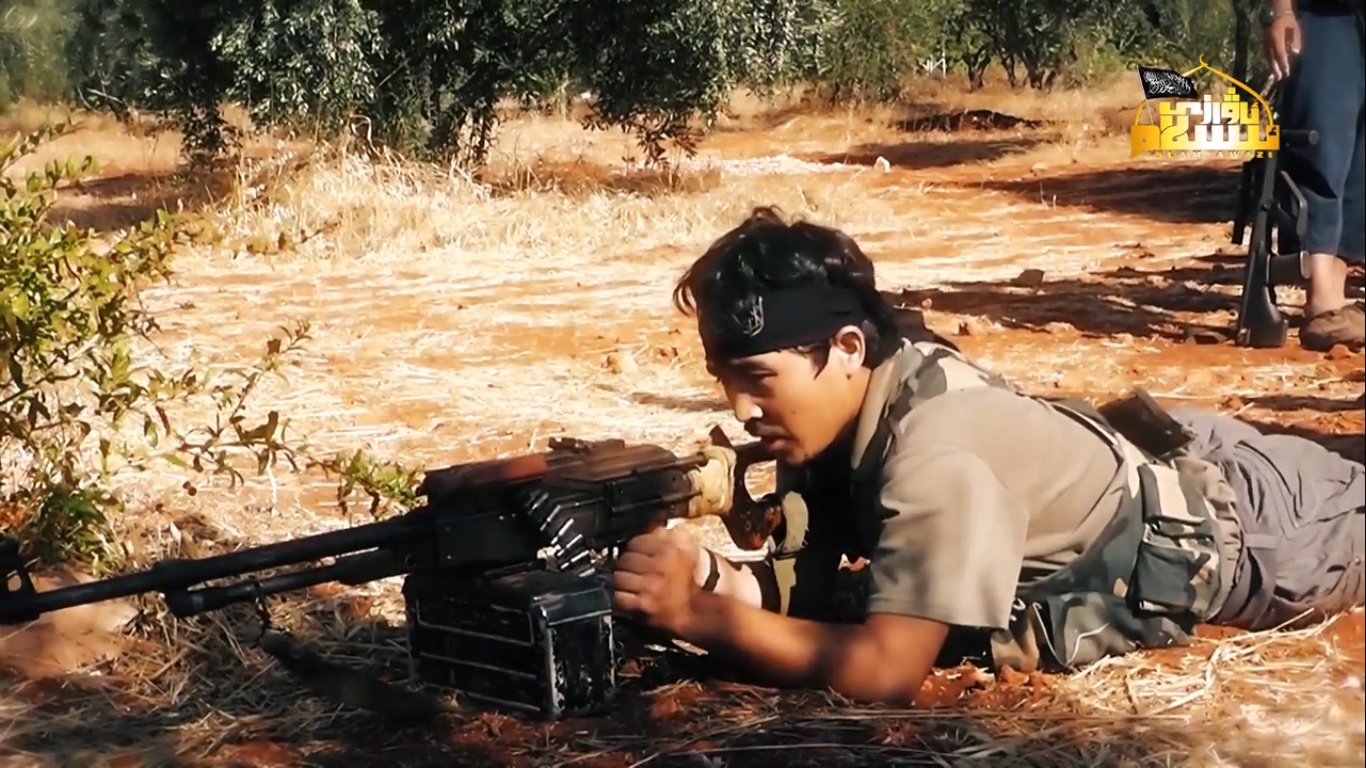
A Uyghur fighter in Syria affiliated with ETIM is shown in an al-Qaeda propaganda video

The training camp was located in the Tora Bora Mountains of Afghanistan and run by Haq himself. U.S. intelligence actually concluded that many of the trainees acted as a “blocking force” for Bin Laden in 2001, when American forces came very close to capturing him. This allowed him to evade the U.S. for a further ten years. The U.S. carried out an assassination attempt on Haq in 2010, with media reporting that he had been killed by an unmanned drone. However, he was merely seriously injured and escaped with his life.

The State Department designated the ETIM as a terrorist group, adding them to its list in September 2002. At that point, the Bush administration had declared a war on terror, was battling the Taliban in Afghanistan and was about to invade Iraq. Furthermore, relations with China were good at the time and the Bush administration wished to secure Chinese co-operation or at least dampen Chinese resistance to its campaigns.

“Designating ETIM/TIP as a terrorist organization does seem appropriate,” Daniel Dumbrill — a Canadian YouTuber currently in Xinjiang, and an outspoken critic of U.S. policy towards China — told MintPress, adding:

I don’t believe they suddenly and abruptly cease to exist and I don’t believe the U.S. government believes this either. Even if they did, the Tamil Tigers have been inactive for over 10 years since their defeat, but they remain on the U.S. government list of terrorist organizations. Therefore, it doesn’t seem like clearing off inactive terror groups has ever been a matter of priority. There is of course, I believe, an ulterior motive to [their removal from the terrorist list].”

A fight for global supremacy

Today, however, relations with China have definitely soured. The country’s rapid economic rise has alarmed and preoccupied many planners in the West, who now see China as America’s “unparalleled priority” for the 21st century. President Trump placed sanctions on the country and attempted to block the growth of Chinese tech companies like Huawei, TikTok, and Xiaomi. Along with the trade war has come a war of words, with top brass in Washington suggesting that the new Cold War with Beijing will be less about tanks and missiles and more “kicking each other under the table.” Others have advised that the U.S. should wage a widespread culture war, including commissioning what they call “Taiwanese Tom Clancy novels” meant to demonize and demoralize China.

The prospect of a hot war cannot be overlooked, however. And U.S. actions are making the threat all the more likely. In 2013, the Obama administration announced a “Pivot to Asia,” meaning a draw-down from the Middle East and an escalation of tensions in the Pacific. Today, over 400 American military bases encircle China. American ships and aircraft continue to probe the Chinese coastline, testing their defenses. In July, U.S.S. Rafael Peralta sailed within 41 nautical miles of the coastal megacity of Shanghai. Earlier this year, the head of Strategic Command stated that there was a “very real possibility” of war against Beijing in the near future.

Uyghur repression

It is in this context that the United States has begun to denounce China’s treatment of its Uyghur minority. Xinjiang has been under serious security measures for more than a decade, and the internment of Uyghurs has been going on since at least 2014. Yet the U.S. was largely silent about their treatment until recently. Today, the U.S. National Endowment for Democracy (NED) accuses China of imprisoning between one and three million Uyghur Muslims, describing it as a genocide. The NED has given nearly $9 million to Uyghur groups and has condemned what it sees as a “deafening silence in the Muslim world” about their plight.

Amnesty International has largely agreed, labeling what China calls re-education facilities, meant to deradicalize the population, as “detention camps for torture and brainwashing of anyone suspected of disloyalty.” Uyghurs have alleged that they have been forcibly sterilized, that their places of worship have been demolished, and that they were made to eat pork and separated from their families while interned.

Others have rejected this interpretation. Economist Jeffrey Sachs, head of the UN Sustainable Development Solutions Network, recently wrote:

There are credible charges of human rights abuses against Uyghurs, but those do not per se constitute genocide. And we must understand the context of the Chinese crackdown in Xinjiang, which had essentially the same motivation as America’s foray into the Middle East and Central Asia after the September 2001 attacks: to stop the terrorism of militant Islamic groups.”

Dumbrill seemed to agree, noting that many Uyghurs in Xinjiang see the extremist jihadists as their primary worry, not government forces, of whom some Uyghurs speak fondly. “The police presence aside, people lead fairly ordinary lives here with the same kinds of hopes and dreams that people anywhere else would have as well,” he told MintPress, criticizing the foreign coverage.

Wenbin was, unsurprisingly, even more dismissive of the charges. “Western politicians and media are frantically spreading lies on Xinjiang,” he said, adding that “the allegation of ‘genocide’ is more than preposterous.”

The politics of terror

At the same time as it was delisting the East Turkestan Islamic Movement for apparently not existing, the Trump administration added Cuba to its list of state sponsors of terror. Without a hint of irony, then-Secretary of State Mike Pompeo pointed to the island’s “malign interference in Venezuela and the rest of the Western Hemisphere” as the reason for the designation. A report released last month by the Department of Health and Human Services outlined what such malign influence was: offering doctors and other medical teams to other needy countries during a global pandemic.

Yet the politics of the terror list has always been highly suspect. In an attempt to dampen worldwide support for his cause and shore up the Apartheid government, the Reagan administration placed South African leader Nelson Mandela on the terrorist list in 1988. Mandela was not pulled off it until 2008 — 14 years after he became president.

Meanwhile, the Trump administration also recently removed Sudan from the list of state sponsors of terror, in what was an openly transactional event. Sudan agreed to normalize relations with Israel and give the U.S. hundreds of millions of dollars. As usual, Trump was unable not to say the quiet part out loud: “GREAT news! New government of Sudan, which is making great progress, agreed to pay $335 MILLION to U.S. terror victims and families. Once deposited, I will lift Sudan from the State Sponsors of Terrorism list. At long last, JUSTICE for the American people and BIG step for Sudan,” he tweeted.

Ultimately, the drastic change in U.S. policy on the ETIM has nothing to do with the movement itself — which remains the same jihadist group linked to al-Qaeda, ISIS, and the Taliban — but rather to a changing American stance towards China. For years, the U.S. ignored human rights issues in Xinjiang, as China was seen as a useful workshop for American capitalism. But the PRC’s rapid rise has frightened many in Washington; hence the sudden fascination with the plight of the Uyghurs. The designation of the ETIM as a terrorist group was likely seen as getting in the way of longstanding U.S. attempts to provoke unrest in China. With China now in the crosshairs, the group has moved from being an adversary to being a potential asset. It appears that the government decided that insisting they no longer exist was an easier sell than pretending they are no longer a terrorist group.

While the change in status might seem inconsequential, it could be a harbinger of a dangerous future. The East Turkestan Islamic Movement was placed on the list because of the War on Terror. Now it has been taken off because of the coming war on China.


River to Sea Uprooted Palestinian   
The views expressed in this article are the sole responsibility of the author and do not necessarily reflect those of the Blog!

Tuesday, 30 March 2021

Iran-China: the 21st century Silk Road connection

 Newly announced China-Iran strategic partnership deal shatters US sanctions while paving the Belt and Road from East to West

Iran’s Foreign Minister Mohammad Javad Zarif (R) and his Chinese counterpart Wang Yi sign a historic partnership agreement between the two sides in Tehran on March 27, 2021. (Photo by Tasnim)
Iran-China: the 21st century Silk Road connection

March 29, 2021

By Pepe Escobar posted with permission and first posted at Asia Times

The timing could not have been more spectacular, following what we examined in three previous columns: the virtual Quad and the 2+2 US-China summit in Alaska; the Lavrov-Wang Yi strategic partnership meeting in Guilin; and the NATO summit of Foreign Ministers in Brussels – key steps unveiling the birth of a new paradigm in international relations.

The officially named Sino-Iranian Comprehensive Strategic Partnership was first announced over five years ago, when President Xi Jinping visited Tehran. The result of plenty of closed-door discussions since 2016, Tehran now describes the agreement as “a complete roadmap with strategic political and economic clauses covering trade, economic and transportation cooperation.”

Once again, this is “win-win” in action: Iran, in close partnership with Chibrlna, shatters the glass of US sanctions and turbo-charges domestic investment in infrastructure, while China secures long-term, key energy imports that it treats as a matter of national security.

If a loser would have to be identified in the process, it’s certainly the Trump administration’s “maximum pressure” drive against all things Iran.

As Prof. Mohammad Marandi of the University of Tehran described it to me, “It’s basically a road map. It’s especially important coming at a time when US hostility towards China altogether is increasing. The fact that this trip to Iran [by Foreign Minister Wang Yi] and the signing of the agreement took place literally days after the events in Alaska makes it even more significant, symbolically speaking.”

Iran’s Foreign Ministry spokesman Saeed Khatibzadeh confirmed the deal was indeed a “roadmap” for trade, economic and transportation cooperation, with a “special focus on the private sectors of the two sides.”

Marandi also notes how this is a “comprehensive understanding of what can happen between Iran and China – Iran being rich in oil and gas and the only energy-producing country that can say ‘No’ to the Americans and can take an independent stance on its partnerships with others, especially China.”

China is Iran’s largest oil importer. And crucially, bill settlements bypass the US dollar.

Marandi hits the heart of the matter when he confirms how the strategic deal actually secures, for good, Iran’s very important role in the Belt and Road Initiative (BRI):

The Chinese are getting more wary about sea trade. Even the incident in the Suez Canal reinforces that, it increases Iran’s importance to China. Iran would like to use the same Belt and Road network the Chinese want to develop. For Iran, China’s economic progress is quite important, especially in high-tech fields and AI, which is something the Iranians are pursuing as well and leading the region, by far. When it comes to data technology, Iran is third in the world. This is a very appropriate time for West Asia and East Asia to move closer to one another – and since the Iranians have great influence among its allies in the Mediterranean, the Red Sea, the Hindu Kush, Central Asia and the Persian Gulf, Iran is the ideal partner for China.

In a nutshell, from Beijing’s point of view, the astonishing Evergreen saga in the Suez Canal now more than ever reiterates the crucial importance of the overland, trade/connectivity BRI corridors across Eurasia.

JCPOA? What JCPOA?

It’s fascinating to watch how Wang Yi, as he met Ali Larijani, special adviser to Ayatollah Khamenei, framed it all in a single sentence:

“Iran decides independently on its relations with other countries and is not like some countries that change their position with one phone call.”

It’s never enough to stress the sealing of the partnership was the culmination of a five-year-long process, including frequent diplomatic and presidential trips, which started even before the Trump “maximum pressure” interregnum.

Wang Yi, who has a very close relationship with Iranian Foreign Minister Mohammad Javad Zarif, once again stressed, “relations between the two countries have now reached the level of strategic partnership” and “will not be affected by the current situation, but will be permanent”.

Zarif for his part stressed that Washington should get serious about its return to the Iran nuclear deal; lift all unilateral sanctions; and be back to the JCPOA as it was clinched in Vienna in 2015. In realpolitik terms, Zarif knows that’s not going to happen – considering the prevailing mood in the Beltway. So he was left to praise China as a “reliable partner” on the dossier – as much as Russia.

Beijing is articulating a quite subtle charm offensive in Southwest Asia. Before going to Tehran, Wang Yi went to Saudi Arabia and met with Crown Prince Mohammed Bin Salman. The official spin is that China, as a “pragmatic partner”, supports Riyadh’s steps to diversify its economy and “find a path of development that fits its own conditions”.

What Wang Yi meant is that something called the China-Saudi Arabia High-Level Joint Committee should be working overtime. Yet there have been no leaks on the absolutely crucial issue: the role of oil in the Beijing-Riyadh relationship, and the fateful day when China will decide to buy Saudi oil priced exclusively in yuan.

On the (Silk) road again

It’s absolutely essential to place the importance of the Iran-China deal in a historical context.

The deal goes a long way to renew the spirit of Eurasia as a geo-historic entity, or as crack French geopolitician Christian Grataloup frames it, “a system of inter-relations from one Eurasian end to another” taking place across the hard node of world history.

Via the BRI concept, China is reconnecting with the vast intermediary region between Asia and Europe through which relations between continents were woven by more or less durable empires with diverse Eurasian dimensions: the Persians, the Greco-Romans, and the Arabs.

Persians, crucially, were the first to develop a creative role in Eurasia.

Northern Iranians, during the first millennium B.C., experts on horseback nomadism, were the prime power in the steppe core of Central Eurasia.

Historically, it’s well established that the Scythians constituted the first pastoral nomadic nation. They took over the Western steppe – as a major power – while other steppe Iranians moved East as far away as China. Scythians were not only fabulous warriors – as the myth goes, but most of all very savvy traders connecting Greece, Persia and the east of Asia: something described, among others, by Herodotus.

So an ultra-dynamic, overland international trade network across Central Eurasia developed as a direct consequence of the drive, among others, by Scythians, Sogdians and the Hsiung-Nu (who were always harassing the Chinese in their northern frontier). Different powers across Central Eurasia, in different epochs, always traded with everyone on their borders – wherever they were, from Europe to East Asia.

Essentially Iranian domination of Central Eurasia may have started as early as 1,600 B.C. – when Indo-Europeans showed up in upper Mesopotamia and the Aegean Sea in Greece while others journeyed as far as India and China.

It’s fully established, among others by an unimpeachable scholarly source, Nicola di Cosmo, in his Ancient China and Its Enemies: The Rise of Nomadic Power in East Asian History (Cambridge University Press): pastoral nomadic lifestyle on horseback was developed by Iranians of the steppe early in the first millennium B.C.

Jump cut to the end of the first century B.C., when Rome was starting to collect its precious silk from East Asia via multiple intermediaries, in what is described by historians as the first Silk Road.

A fascinating story features a Macedonian, Maes Titianos, who lived in Antioch in Roman Syria, and organized a caravan for his agents to reach beyond Central Asia, all the way to Seres (China) and its imperial capital Chang’an. The trip lasted over a year and was the precursor to Marco Polo’s travels in the 13th century. Marco Polo actually followed roads and tracks that were very well known for centuries, plied by numerous caravans of Eurasian merchants.

Up to the caravan organized by Titianos, Bactria – in today’s Afghanistan– was the limes of the known world for imperial Rome, and the revolving door, in connectivity terms, between China, India and Persia under the Parthians.

And to illustrate the “people to people contacts” very dear to the concept of 21st century BRI, after the 3rd century Manicheism – persecuted by the Roman empire – fully developed in Persia along the Silk Road thanks to Sogdian merchants. From the 8th to the 9th century it even became the official religion among the Uighurs and even reached China. Marco Polo met Manicheans in the Yuan court in the 13th century.

Ruling the Heartland

The Silk Roads were a fabulous vortex of peoples, religions and cultures – something attested by the exceptional collection of Manichean, Zoroastrian, Buddhist and Christian manuscripts, written in Chinese, Tibetan, Sanskrit, Syriac, Sogdian, Persian and Uighur, discovered in the beginning of the 20th century in the Buddhist grottoes of Dunhuang by European orientalists Aurel Stein and Paul Pelliot, following the steps of Chinese pilgrim Xuanzang. In the Chinese unconscious, this is still very much alive.

By now it’s firmly established that the Silk Roads may have started to slowly disappear from history with the Western maritime push to the East since the late 15th century. But the death blow came in the late 17th century, when the Russians and the Manchu in China divided Central Asia. The Qing dynasty destroyed the last nomadic pastoral empire, the Junghars, while the Russians colonized most of Central Eurasia. The Silk Road economy – actually the trade-based economy of the Eurasian heartland – collapsed.

Now, the vastly ambitious Chinese BRI project is inverting the expansion and construction of a Eurasian space to East to West. Since the 15th century – with the end of the Mongol Empire of the Steppes – the process was always from West to East, and maritime, driven by Western colonialism.

The China-Iran partnership may have the capacity to become the emblem of a global phenomenon as far-reaching as the Western colonial enterprises from the 15th to the 20th centuries. Geoeconomically, China is consolidating a first step to solidify its role as builder and renovator of infrastructure. The next step is to build its role in management.

Mackinder, Mahan, Spykman – the whole conceptual “rule the waves” apparatus is being surpassed. China may have been an – exhausted – Rimland power up to the mid-20th century. Now it’s clearly positioned as a Heartland power. Side by side with “strategic partner” Russia. And side by side with another “strategic partner” that happened to be the first historical Eurasian power: Iran.

River to Sea Uprooted Palestinian   
The views expressed in this article are the sole responsibility of the author and do not necessarily reflect those of the Blog!

Sunday, 21 March 2021

Frosty Sino/US Talks: Day Two

By Stephen Lendman

Source

Two days of Sino/US talks in Anchorage, Alaska were a waste of time for Beijing, accomplishing nothing positive as expected.

China and other nations know what they’re up against in dealing with hegemon USA, a wrecking ball on the world stage — including at home against ordinary Americans, exploited, not served.

It’s at a time of Main Street Depression with nearly 26% of working-age Americans unemployed.

No badly needed government jobs creation program exists at a time of widespread food insecurity, unaffordable healthcare for millions of households, and sharply rising inflation — especially for food, healthcare and energy.

Year-over-year, CPI inflation increased 9.4%, economist John Williams explained. Phony official numbers conceal reality.

Most US households are increasingly hard-pressed to make ends meet with prices rising much faster than income.

Geopolitically, US relations with China and other nations free from its control are confrontational.

Far removed from cooperative, dominant US hardliners abhor the notion with other nations, especially sovereign independent China, Russia, and Iran.

From Anchorage on Friday, interventionist Blinken said the following:

“(T)here are a number of areas where we are fundamentally at odds, including China’s actions in Xinjiang (sic), with regard to Hong Kong (sic), Tibet (sic), Taiwan (sic), as well as actions that it’s taken in cyberspace (sic).

What national security advisor Sullivan separately called “advancing the interests and values of America” are all about bludgeoning, bullying, threatening, bribing, and smashing other nations to control them.

Commenting on bilateral talks on Thursday and Friday, China’s Foreign Ministry spokesman Zhao Lijian said the following:

“The US side…provoked disagreements (with) fiery and theatrical (remarks), which is not what China wishe(d) to see,” adding:

“The Chinese delegation (came) to Anchorage with full sincerity and a constructive attitude.”

On arrival, “their hearts were chilled by the biting cold as well as the (cold) reception by their American host.”

Time and again, the US illegally interferes in the internal affairs of other countries.

A flagrant UN Charter breach, China justifiably rejects hostile US actions.

Calling the US side “confrontational” in Anchorage, Zhao slammed its “wanton attacks” and unacceptable “diplomatic etiquette.”

According to China’s Central Committee official/Foreign Affairs Director Yang Jiechi:

“The US has no competence whatsoever to take a patronizing tone with China.”

“It won’t work on us. We need to communicate based on mutual respect. If the US tries to grab us by the throat, it will harm its own interests.”

According to China Central Television (CCTV) on Saturday, citing Beijing’s delegation in Anchorage, both countries will continue high-level “dialogue and contacts” ahead.

The Chinese delegation called on the Biden regime to cease interfering in its internal affairs and lift illegally imposed sanctions on the nation and its officials.

“If the US continues its (hostile) policy, China will make a decisive response.”

In response to wrecking ball Trump regime policies, “China was forced to take relevant and necessary measures to protect its sovereignty, security, and development interests.”

It will react in similar fashion if hardliners in charge of Biden’s foreign policy continue their predecessors’ war on China by other means.

Western media reports on two days of bilateral talks said the following:

The NYT: Sino/US talks showed “a widening gulf of distrust and disagreements on a range of issues” and no breakthroughs.

WaPo: Biden regime hardliners have an “appetite for high-profile fights with China and Russia.”

WSJ: “Bitter Alaska Meeting (further) complicates already shaky US/China ties.”

Financial Times: The US and China “ended their first high-level meeting on Friday after two days of talks in Alaska that produced an extraordinary public spat and no sign of improved relations.”

Bloomberg News: Both countries “end(ed) contentious Alaska meeting with little to show” from two days of talks.

Politico called their talks an “undiplomatic war of words.”

AP News said both countries “spar(red) in their first face-to-face meeting” since Biden replaced Trump.

According to Reuters, “(t)ough (Sino/US) talks signal rocky start to (bilateral) relations” — likely to worsen ahead, not improve.

Singapore-based Channel News Asia reported the following:

“Top US and Chinese officials wrapped up two days of contentious talks in Alaska on Friday after trading sharp and unusually public barbs over vastly different views of each other and the world in their first face-to-face meeting since” Biden took office.

The South China Morning Post (SCMP) asked:

“Is US-China friction at Alaska meetings a sign of worse to come or start of something better?”

There’s been nothing “better” since Trump’s trade war began.

Biden regime Chinaphobes may harden US war on the country other means instead going the other way.

China’s Global Times said Beijing’s delegation in Alaska showed “strength, indicating to the US that China’s development and growth cannot be stopped.” 

“China’s sovereignty and territorial integrity are main issues of principle.”

China’s official People’s Daily broadsheet said the US side “had better quit political threatening.”

It slammed US “hegemony and interventionism…(its) vicious intention…to disrupt Hong Kong and hinder China’s stability and development.”

“Wielding the big stick of sanctions” accomplishes nothing with China. 

Calling them “nothing but a piece of useless paper,” they’re hostile breaches of international law when imposed, adding:

“(A)arbitrary sanctions…by the US on other sovereignty countries have already triggered unanimous opposition and condemnation from the international society.”

“Being ignorant to justice and wielding the big stick of sanctions, the US will only once again expose its hypocrisy and hegemony.”

“China is firm in its determination to” defend its sovereignty and territorial integrity against hostile actions by hegemon USA.


River to Sea Uprooted Palestinian   
The views expressed in this article are the sole responsibility of the author and do not necessarily reflect those of the Blog!

Wednesday, 17 March 2021

Chinese Foreign Policy Outlook

Chinese Foreign Policy Outlook

March 13, 2021

By Zamir Awan for the Saker Blog

China achieved miraculous progress during the last four decades, which were never seen in humankind’s known history. There must be many reasons for its rapid developments, but its foreign policy was one of the significant reasons. In simple words, China opted for a reconciliation policy and avoided any confrontation with any other nation or country. It helped China to focus only on developments and achieved the desired results.

State Councilor and Foreign Minister Wang Yi expressed outlooks of Chinese foreign policy and answered questions about the country’s foreign policy and external relations at a virtual press conference on Sunday during the fourth session of the 13th National People’s Congress, China’s top legislature. Some of the highlights are given below:-

Pandemic

Through innovative “cloud diplomacy,” President Xi Jinping has championed solidarity in the world’s fight against COVID-19 and pointed the way forward for the international community to jointly fight the virus.

China will continue working with other countries in ongoing efforts to defeat the COVID-19 pandemic ultimately. Since the founding of the People’s Republic of China in 1949, China has carried out its most extensive emergency humanitarian action, contributing to the world’s anti-coronavirus efforts.

On China-Russia relations

In the face of the once-in-a-century pandemic, China and Russia have stood shoulder to shoulder and worked closely to combat “both the coronavirus and the political virus.”

China and Russia should be each other’s strategic support, development opportunity, and global partner. It is both an experience gained from history and an imperative under the current circumstances.

On CPC leadership

Facts have proved that the Communist Party of China’s leadership is the most prominent political advantage of Chinese diplomacy. Leadership will offer fundamental support for China’s diplomatic agenda to secure more victories.

Wang said that China’s diplomacy is people-oriented diplomacy led by the CPC, and the Party set the direction for China’s diplomatic agenda. The original inspiration and mission of the CPC – to seek happiness for the Chinese people and rejuvenation for the Chinese nation — determine China’s diplomacy’s responsibility.

On China-Africa relations

Helping African countries contain the COVID-19 pandemic and bringing their economies back on track is the top priority of the China-Africa cooperation. China will always support developing countries. China has started to provide COVID-19 vaccines to 35 African countries and the African Union Commission already.

On ‘patriots administering Hong Kong’

Hong Kong is a particular administrative region of China. One cannot talk about loving Hong Kong without loving its motherland, adding that love for the country and Hong Kong is entirely consistent. Hong Kong enjoyed no democracy during colonial rule. Since its return to the homeland 24 years ago, no one is more concerned about Hong Kong’s democratic development and wishes Hong Kong to remain prosperous and stable than the central government, he said.

On China-US relations

It is logical for China and the US, two countries with different social systems, to have differences and disagreements. “What matters most is to manage them effectively through candid communication to prevent strategic miscalculation and avoid conflict and confrontation.”

China hopes the US can remove its unreasonable restriction on bilateral cooperation as soon as possible and refrain from artificially creating new ones. China is willing to work with the US and set China-US relations on a new path of healthy and steady development.

On Taiwan question

The two sides of the Taiwan Strait must be and will surely be reunified, which is the trend of history and the entire Chinese nation’s collective will, Wang said, adding the one-China principle is the political foundation of the China-US relationship. It is considered a red line and should not be crossed. There is no room for compromise or concession from the Chinese government on the Taiwan question.

“We would hope to see a clear departure from the previous administration’s (Trump Administration) dangerous practice of ‘pushing the red line’ and ‘playing with fire, and we hope that the Taiwan question will be handled prudently and properly,” Wang said.

China stresses the UN’s core status

The UN is not a club for big or rich countries. All countries enjoy equal sovereignty, and no country is in a position to dictate international affairs, Wang said. He also urged efforts to enhance the representativeness and voice of developing countries in the UN to better reflect the common aspiration of most countries.

China, EU not systemic rivals

The China-Europe relationship is equal and open and not targeting any third party or is controlled by anyone else. China never intends to divide relations between Europe and the United States, Wang said, adding that the country is glad to see the European Union uphold multilateralism and remain devoted to coordination and cooperation among major countries.

China opposes ‘vaccine nationalism.’

China opposes “vaccine nationalism,” rejects any “vaccine divide” or any attempt to politicize vaccine cooperation. More than 60 countries have authorized the use of Chinese vaccines. China has provided COVID-19 vaccine aid free of charge to 69 developing countries urgently need while exporting vaccines to 43 countries.

On China-Arab relations

China will work with Arab states in solidarity, pursue expected progress, and prepare for a China-Arab States Summit.

In the past year, relations between China and the Arab States have continued to progress amid various challenges, Wang said, adding their joint fight against the COVID-19 pandemic has set an excellent example for international cooperation.

On multilateralism

Building small circles in the name of multilateralism is, in fact, “group politics,” multilateralism with one’s own interests taking precedence, is still unilateral thinking, and “selective multilateralism” is not the right choice.

Genuine multilateralism means openness and inclusiveness instead of closeness and exclusion. It means equal-footed consultation instead of supremacy over others.

China’s WTO accession

The past two decades had taught China four crucial lessons: China will stay committed to the fundamental policy of opening-up, remain committed to the principle of win-win cooperation, remain committed to the right direction of economic globalization, and we must stay committed to the central role of the WTO.

“China has injected energy into economic globalization and facilitated the optimization of global industry chains and resources,” he said.

On China-Japan relations

China and Japan should remain focused without being distracted by any single event to make the bilateral relations more mature and stable. China and Japan should support each other in hosting the upcoming Olympic Games this year and next year. China hopes the Japanese society would truly embrace an objective and rational perception of China to solidify public support for long-term progress in China-Japan relations.

‘Xinjiang genocide’ claim a thorough lie

The so-called claim of genocide in Northwest China’s Xinjiang Uygur autonomous region is preposterous, a rumor fabricated with ulterior motives and a complete lie.

Some western politicians chose to believe in the lies cooked up by a few instead of listening to the voice of 25 million Xinjiang residents of various ethnic groups, Wang said, adding that they chose to dance with the clumsy dramas by a few anti-China forces instead of acknowledging the progress in Xinjiang.

On China-ASEAN relations

Wang said that China stands ready to develop an even closer community with a shared future with ASEAN as the two sides celebrate the 30th anniversary of establishing bilateral dialogue relations this year.

China will continue to prioritize efforts to meet vaccine demand from ASEAN and further consolidate beneficial cooperation and see that China’s new development paradigm is better to align with the ASEAN Comprehensive Recovery Framework, he said.

On the Belt and Road Initiative

China’s commitment to supporting the Belt and Road Initiative has not changed, and the country will continue to work with stakeholders to advance high-quality Belt and Road cooperation, Wang Yi said.

COVID-19 may have changed the world, but the need for Belt and Road cooperation has not subsided, he said.

“As we pursue a new development paradigm, we will explore better pathways for Belt and Road cooperation and offer greater opportunities to BRI partners,” he added.

In the new development stage

China will create a better business environment, pursue opening-up at a higher level, and work with various countries to accelerate an open world economy, Wang Yi said.

China is like an express train with the greater driving force and load capacity accelerating towards a new goal in the further development stage, he said.

On China-India relations

China stands in a firm position to solve border disputes through dialogue and consultations and, at the same time, is determined to safeguard its own sovereign interests, Wang Yi said.

Border issues are not the whole of the China-India relationship, Wang said, noting that what happened again proves that initiating confrontation will not solve the problem and that returning to peaceful negation is the right way forward.

On climate change

Even though China and the US, and the European Union are in different development stages and face other challenges, they share the same mission in coping with climate change.

Wang urged enhanced communication and coordination between the three sides. They play a leading role in the international community, adding that China welcomes the US’s return to the Paris Agreement and expects that the US will shoulder its responsibility and make its due contribution.

On Iran nuclear issue

China hopes the United States will show sincerity on the Iran nuclear issue, take actions as quickly as possible, including removing unjustified unilateral sanctions and lifting the “long-arm jurisdiction” on third-party entities and individuals, Wang Yi said.

At the same time, he said, Iran should resume compliance with the Iran nuclear deal and shoulder its responsibility of nuclear non-proliferation, Wang said.

On the South China Sea

The only intention of some Western countries, including the United States, is to stir up troubles in the South China Sea in the name of so-called free navigation and undermine peace in the South China Sea and disturb regional stability, Wang said.

He called on China and ASEAN countries to continue to remove distractions and press ahead with Code of Conduct consultations, and continue with the full and effective implementation of the Declaration on Conduct of Parties in the South China Sea.

On Myanmar tensions

Relevant parties in Myanmar should maintain calm and exercise restraint, address their differences through dialogue and consultation within the constitutional and legal framework, and continue to advance the democratic transition.

“The immediate priority is to prevent further bloodshed and conflict, and ease and cool down the situation as soon as possible,” Wang said.

On China and Latin America

China is providing COVID-19 vaccines to 12 Latin American and Caribbean countries. “China and Latin American and Caribbean countries have stood alongside and supported each other in COVID-19 response and economic recovery,” he said. “Our cooperation best illustrates the saying, that ‘a bosom friend afar brings a distant land near.”

On objective coverage of China

China hopes to see and welcome more journalists in Edgar Snow’s mold in this new era among foreign journalists.

Wang Yi said he hopes that foreign journalists will not apply any filter to their camera, whether beautiful or gloomy, when reporting on China.

“Truthful, objective, and fair stories will always appeal to people and can stand the scrutiny of history,” he said. “However the world changes, the media should stand by their professional ethics.”


Author: Prof. Engr. Zamir Ahmed Awan, Sinologist (ex-Diplomat), Editor, Analyst, Non-Resident Fellow of CCG (Center for China and Globalization), National University of Sciences and Technology (NUST), Islamabad, Pakistan. (E-mail: awanzamir@yahoo.com).


River to Sea Uprooted Palestinian   
The views expressed in this article are the sole responsibility of the author and do not necessarily reflect those of the Blog!