Sunday, 5 June 2011

International law and the problem of enforcement


By Lawrence Davidson

5 June 2011

Lawrence Davidson traces the flaws built into the International Criminal Court that allow some states to get away with crimes to the exceptionalism and superiority complexes afflicting countries such as Russia, China and the US, which is also “tied so closely to the criminal behaviour of the Israelis that it has dedicated itself to protecting Israeli nationals as well”.

Anthropomorphizing the nation state

One of the defining characteristics of modern Western culture is individuality. Most people in the West take it for granted that they have the right to free expression and personality development.

However, in practice, this right is not open ended. It is fine if you want to express yourself as a musician, a painter, a film maker, a writer, etc. Equally legitimate is your desire to express yourself as an engineer, accountant, bus driver or auto mechanic.

Things become very different if you have a great desire to express yourself as a thief or want to develop your personality as a serial killer. There are rules, in the form of laws, against these latter avenues of expression. If you choose to ignore these laws there are police forces and courts systems that will seek to force you to do so. Another way of saying this is that within states or nations, people usually must confine their right of self expression to activities that do not impinge in a harmful or unwanted way on others in the community

It was at the end of the 18th century and throughout the19th century that Western leaders of both established nations and aspiring nationalities began to apply this language of self expression to the nation state. In other words, they claimed the same right of self expression for the collective as for the individual. This represented a melding of romanticism and politics that allowed for the anthropomorphizing of the nation. That is, something that was not a human being (the nation) was being treated as if it was.

The French revolutionaries spoke of "France" as the growing embodiment of human freedom with a mission to export liberty to others, German nationalists such as Herder and Fichte believed that the "German nation" embodied a volkgiest, or "spirit of the people" that had to be free to create a unified and enduring state. Italian, Russian and other nationalists made the same argument for their nationalities or ethnic groups. In each case, the claim that the collective, with its unique cultural personality, had the right to unfettered development led to a serious and continuing problem.

The problem

One half of the problem expresses itself in the form of "exceptionalism". That is the assertion that the nation has rights because its culture and people are, in some way, superior to others and/or because they are "God blessed". Being superior to others means the nation, striving to realize its uniqueness, has priority claims to a "homeland" and its resources. Those who stand in the way of this goal can be evicted or otherwise persecuted.

Or, perhaps, the nation in question has evolved a special way of life (democracy, capitalism, communism or some religion) that its leaders feel it must share with others – whether they want this gift or not. So it sends out missionaries and diplomats and then usually follows them up with gunboats.

Empire building based on a claim of superiority often results. It turns out that almost all great powers, Western and non-Western, have expressed some form of exceptionalism.

The second half of the problem lies in the fact that these anthropomorphized nation states, with their insistence on the right of self-expression, are acting in an arena of international relations that lacks sufficient rules to limit their behaviour. There is nothing to actually force them to confine their acts of self expression to activities that do not impinge in a harmful or unwanted way on other states or populations.

Certainly, traditional diplomacy and the use of standard treaties has not been able to do so. Until the end of World War II there were a few Geneva conventions that, with mediocre success, sought to ameliorate the treatment of civilians and prisoners during wartime. Come the world wars of the 20th century even these were ignored. The horrors of World War II gave new impetus to establishing enforceable international rules or laws, including laws against genocide and crimes against humanity, but over time these too have been eroded. And, here again, exceptionalism has been the motivator. We can see how this has taken place by looking at the case of the International Criminal Court (ICC).

Undermining international law

The ICC was created in 2002 by the a founding treaty known as the Rome Statute. The court was designed to be an independent body capable of prosecuting major transgressions such as genocide, war crimes and crimes against humanity.

However, there were also conflicting amendments built into the founding document. Among others, the court’s jurisdiction is usually limited to crimes committed by a national of a state that is party to the treaty or committed on such a state’s territory. Nonetheless, the court is also obligated to investigate any case referred to it by the United Nations Security Council, whether the nation or individuals involved are covered by the treaty or not.

Presently, 114 countries are party to the treaty and thus subject to the jurisdiction of the ICC. Some 34 others, including Russia, have signed the treaty but are yet to ratify it. Thus, they are still outside its jurisdiction. An additional 44 states, including China, have never signed the treaty. And finally, several states, such as the United States and Israel, while having initially adhered to the treaty have subsequently "unsigned" it and thereby withdrawn from its jurisdiction.

Just what is going on here? It would seem that the leaders of many of the major world powers – China, Russia and the United States – know that they operate in the world on the basis of exceptionalism. They actually are or likely will occupy foreign lands, pursue foreign wars, massacre civilian populations, etc. In other words, the behaviour of their nationals is very likely to transgress the laws against war crimes and crimes against humanity, and perhaps genocide as well. So they seek to stay clear of the ICC’s jurisdiction. And, in the case of the United States, the government is tied so closely to the criminal behaviour of the Israelis that it has dedicated itself to protecting Israeli nationals as well.

That is why, if you look at the record of ICC prosecutions, all of them have to do with smaller states, mostly African, who have relatively little power and no great power patrons.

Yet this skewed record gets worse, for the United States and other great powers, which are not even a party to the Rome Statute, have found a way to turn the court into a weapon to be directed at their assumed enemies. They have done so by taking advantage of the treaty clause requiring the ICC to pursue cases referred to it by the UN Security Council. This harmful bit of hypocrisy has recently been examined in an article by Stuart Littlewood, using information and analysis supplied by Dr. David Morrison of Ireland. Here are some of the points they make:
1. Libya is not a party to the ICC...Yet three months ago the UN Security Council voted unanimously, in Resolution 1970, to refer the situation in Libya to the prosecutor of the ICC. Five of the states that voted for this referral [including the United States] ... are not parties to the ICC and don’t accept its jurisdiction. So here we see the US among those forcing Libya to accept the jurisdiction of the ICC, when it refuses to do so itself.

2. This is a situation that cannot happen to countries like the United States because they can "wield their veto to block any attempt by UN colleagues to extend ICC jurisdiction to their territory".

3. David Morrison concludes that "a court with universal jurisdiction is fair. A court whose jurisdiction you, as a state, can choose to accept or reject has some semblance of fairness. But a court like the ICC, whose jurisdiction can be targeted, at the whim of the Security Council, on certain states that have chosen not to accept it, but not others, is grossly unfair."

Conclusion

It is the sad height of hypocrisy when the United States, whose leaders claim to have the secret to world salvation (both politically and economically), not only corrupts international law to target others, but simultaneously goes to extraordinary lengths to protect its own nationals from that same law.

For instance, if Americans were to commit war crimes in the territories of states party to the Rome Statute, those states could refer the matter to the ICC and the court could then go after US citizens. Washington has negotiated bilateral agreements with over 100 nations that specifically forbid those states from doing just that. No nation can receive military aide from the US without making this pledge.

This is the behavior of a government that knows it acts in a criminal fashion, be it on a small scale or large, and claims the exceptional right to do so with impunity. The leaders of the US do this because, as so many presidents have told us time and again, the free expression and expansion of the American way of life is best for the world. God has decreed it so. This is extraordinary hubris in action and it is why so much of the rest of the world have, at best, a love-hate relationship with the US and what it claims to stand for.

The notable English thinker and politician, Edmund Burke (1729-97), once observed that "the greater the power, the more dangerous the abuse". What can be more powerful, and therefore more abusive, than great powers claiming the right of free expression in an international arena devoid of restraining rules? In a world that is, like ours, mostly lawless.
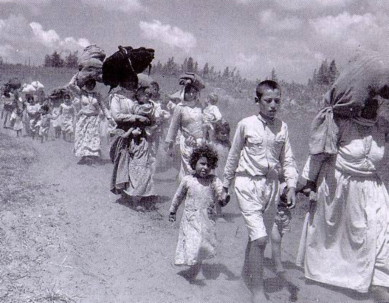
River to Sea Uprooted Palestinian

Naksa Day: As twenty two Martyred, hundreds injured in Naksa Day Marches, Abbas Agrees to Attend “Peace” Talks in Paris as Israel Still “Studying”

 I lived in Bent jbeil from 1948 until Lebanon forced uprooted Palestinians living along the borders waiting to Return to their land on the other side, to move to north of Litani river.  Until 1969, the Lebanese army was protecting the enemy.

Upon the instructions of Feltman, the Lebanese army resumed the task of securing the lebanse borders with Israel.

Consequently, the Palestinians in Lebanon, cancelled the Naksa march, and cellebrated the event in their besieged camps.


Palestinians in Lebanon Commemorate Naksa Day
Local Editor
Palestinian refugees across Lebanon commemorate the 44th anniversary Naksa day (the Defeat Day) on Sunday.

Shops were closed in Lebanon's 12 Palestinian refugee camps, where black flags of mourning were hoisted, as the Lebanese army reinforced its presence, particularly in the south.
Lebanese soldiers manned roadblocks on roads to the border.

Lebanese and Palestinian activists had planned to protest at the border with the Palestinian occupied territories but the army banned any gatherings at the frontier.

Several protesters tried to stage a rally in the southern village of Adaisseh near the Lebanese-Palestinian border. However, police and soldiers quickly disperse them.

Al-Manar correspondent in the south reported that the army arrest 14 Lebanese citizens and two Palestinians. The army asked the protesters to leave the area, the correspondent added.

During the Six-Day War, Israel seized Sinai, which it returned to Egypt in 1982, Syria's Golan Heights, the West Bank including east Al-Quds, and the Gaza Strip.

Yesterday, Mahmoud Abbas welcomed a proposal by France to resume peace talks with Israel,
And yesterday, the Egyptian military councel decided to close Rafah crossing. Looks like Tantawi, and his Brothers failed to domaticate Hamas. Bye, Bye Palestinian reconciliation.

Abbas Agrees to Attend “Peace” Talks in Paris as Israel Still “Studying”
Local Editor
As Palestinian youths were being martyred along the borders with the occupied territories, Palestinian Authority Chief Mahmoud Abbas, from Rammallah, announced he was ready to attend a French proposal to hold what so-called “peace” conference in Paris by the end of July.

Nimr Hammad, a political advisor to Abbas, said the president had told French Foreign Minister Alain Juppe that he agreed officially to France's proposal to host a “peace” conference in Paris before the end of July.

"President Abbas told Foreign Minister Juppe that he agrees officially to the French initiative of holding an international peace conference in Paris," Hammad told AFP news agency.

Abbas insisted that participation be “conditioned” on using the lines which existed before the 1967 Six-Day War as the basis for negotiating future borders, Hammad said.

"In order to start negotiations, their basis must be ending the Israeli occupation of Palestinian land occupied since 1967, and the borders of the state will be determined on this basis with land swaps agreed by both the Israeli and Palestinian sides", he said.

Meanwhile, and as the PA Chief said he was ready to attend the conference, Israeli Prime Minister Benjamin Netanyahu said that the Zionist entity was “studying” the French proposal.
"I heard the proposal brought by French Foreign Minister Alain Juppe," Netanyahu told media at the beginning of a weekly meeting of his cabinet.

"We very much appreciate our French friends and I will respond to them after we have considered matters. We will study the proposal and discuss it with our American friends as well."
Netanyahu also added he would not consider resuming negotiations with any Palestinians government that includes the Islamic Resistance Movement, Hamas, which last month signed a unity deal with the Fatah movement of Abbas.

"We would also like to emphasize and reiterate: Negotiations will not be conducted with a Palestinian government, half of which is Hamas, a terrorist organization that seeks to destroy Israel," Netanyahu said.

After meeting Prime Minister in Fatah government, Salam Fayyad, in Ramallah on Thursday, Juppe said France was willing to transform a scheduled meeting of international donors into a broader “peace” conference to help prelaunch stalled negotiations.

On the Syrian front, while, the Syrians army is trying the secure the Last resistance fort, uprooted Palestinian and Syrian youth, marshed to Majdal Shams and Qunaitra. So far 6 martyred and dozens injured


Six Martyred, Dozens injured in Naksa Day Marches
Local Editor
Israeli occupation forces killed at least six people and injured dozens others as hundreds of protesters marched on Sunday, at the Syrian border with the Palestinian occupied territories in Golan Heights, marking Naksa day.

Al-Manar TV correspondent in Quneitra area in Golan Heights, Anass Azrak reported there were at least six martyrs.
Azrak said that at least hundred protesters were injured.
Palestinian and Syrian protesters head to the border with occupied territories in Golan Heights on Naksa Day (The Day of Defeat) to mark the 44th anniversary of the beginning of Israel's 1967 Six-Day War against Arabs.
The Syrian TV showed footage of Israeli soldiers on top of a tank opening fire on the protesters.
Live footages broadcast on Syrian TV and Al-Jazeera also showed heavy gunfire along the Golan Heights border and protesters carrying wounded people away.

WEST BANK RALIES

In West Bank, dozens of Palestinians rallied in the Qalandiya village north of Al-Quds.
Al-Manar correspondent Deeb Hourani reported that at least 90 protesters were wounded as Israeli occupation forces fired rubber bullets and tear gas.
The Protesters were hoisting signs reading "A million shahids are marching in Al-Quds," "The people want end to occupation," and "occupation is illegal.”

ISRAEL ON HIGH ALERT

Israeli media outlets reported on Sunday that occupation forces were on high alert for fear of any attempt by protesters to cross the border.

Israeli Daily, Haaretz, said that Northern Command of occupation forces was “on high alert this morning ahead of a possible attempt by thousands of Palestinian refugees from the Damascus area to storm the border of the Golan Heights as a way of marking Naksa Day”.

It added that the Central Command and the Southern Command also declared high alert in case protesters in West Bank and Gaza Strip respectively took to streets marking the event.
However, the daily said that the “northern border seems the most likely area for clashes”.

[ 05/06/2011 - 05:05 PM ]
WEST BANK, (PIC)-- Israeli occupation forces (IOF) used violent means to disperse peaceful Palestinian demonstrations on Sunday including rubber bullets, stun grenades, and teargas canisters.
 Palestinian sources said that five citizens were hospitalized with gunshot wounds while 40 others were treated for breathing difficulty near Qalandia roadblock north of occupied Jerusalem.

They said that the IOF soldiers assaulted a number of Palestinian figures and foreign solidarity activists who participated in the march.
Hundreds of Palestinians took part in the march to mark the Naksa or the defeat of Arab armies in 1967 and the consequent Israeli occupation of eastern Jerusalem, West Bank, and Gaza Strip in addition to other Arab lands.

In a similar incident, Palestinians organized a march in Deir Al-Hatab village east of Nablus on the same occasion and to protest Israeli confiscation of their land.
Local sources said that many young men were treated for breathing problems due to the IOF soldiers’ use of tear gas to disperse the demonstrators while nearby plantations were seen on fire.
++++++++++++++++++++++
Three Martyrs, Nine Injured in Israeli Attack against Syrian and Palestinian citizens in Occupied Syrian Golan
Jun 05, 2011

<><><><><><><><><>QUNEITRA, (SANA)-<> An Israeli attack on scores of the Syrian and Palestinian youths, who gathered Sunday close to the occupied Syrian Golan borders on the anniversary of June Naksa (Setback), left 3 martyrs and dozens of injuries. <>
All the young men were exposed to direct fire by the Israeli forces in the breast and other parts of the body.

According to Director of Martyr Mamdouh Abaza Hospital in Quneitera Dr, Ali Kanaan, the hospital has so far received the bodies of three martyrs; Mahmoud Awad al-Sawan, 19 years old, who was martyred by a bullet in breast, martyr Ahmad al-Said, 29 years old, who was shot in head and martyr Majdi Zeidan, 22 years old.
The number of the injured exceeded 35, including 4 young men in critical condition, said Dr. Kanaan.

"Surgical operations are conducted to two youths whose conditions are critical,", Dr. Kanaan added, asserting that all the young men were exposed to live bullets by the Israeli forces close to the occupied Syrian Golan borders.

SANA correspondent said "the Israeli occupation forces used live bullets and tear gas bombs against the young men who want to return to their occupied lands."

A young man said "They fired against us but we are determined to return .. Either we martyr or we return to our occupied lands."

Another young man said "It is our natural and legitimate right .. We will not accept that our lands to remain occupied.. We will continue offering convoys of martyrs until liberation".
SANA Correspondent in Quneitra reported that the Israeli soldiers are firing intensively at scores of Syrian and Palestinians youths who continue in their attempts to cross the barbed wire into the occupied Syrian Golan from various areas opposite to the occupied Majdal Shams village.
English Bulletin

Popular Commission for the Liberation of Golan Stresses Determination to Return

Jun 05, 2011


DAMASCUS, (SANA) – Popular Commission for the Liberation of Golan on Saturday stressed determination to return and continue the liberation process.

In a statement marking the 44th anniversary of "al-Naksa Day", the Commission added "the conspiracy against Syria targets undermining its stability and security in an attempt to separate Syria from the Arab resistance through preoccupying with an internal affair."
The statement indicated to the Zionist entity and its inhuman practices of forcing the people of Golan to leave their lands and destroying towns and farms which stress Israel's racism and inhumanity.

The Commission stressed the Golan people's support to the reform program under the leadership of President Bahar al-Assad, expressing faith in Syria's resistant policy and the certainty of victory.

The statement pointed out that the Naksa Day anniversary should be a motive for exerting more effort to continue the struggle to end the Zionist project and return to Golan.
The Commission saluted people in the Occupied Golan and the captives in the occupation jails.

++++++++++++++++++++++++++++++
Israeli army on full alert in anticipation of Arab border demos

+++++++++++++++++++++++++++++++
14:19 Al-Manar correspondent quotes witnesses: Israeli occupation forces arrest Syrian citizen at the border with the occupied territories
14:17 Al-Manar correspondent quotes witnesses: number of Israeli forces are injured as a mine explodes on their vehicle
14:09 Al-Manar correspondant: more than 25 injured as Israeli occupation forces fire bullets and tear gas in Quneitra in Golan Heights
13:56 The death toll of Naksa day marches rises to reach 5 martyrs, including a child
13:09 A group of protesters cross the border to the occupied territories and Israeli occupation forces open fire at them

Meanwhile on the other Syria fronts
River to Sea Uprooted Palestinian

I Have Zero Respect For The Mainstream Media: Gilad Atzmon Interview By Silvia Cattori

 Saturday, June 4, 2011 at 7:08AM AuthorGilad Atzmon

Jazz saxophonist Gilad Atzmon has a blog where he denounces the policy of his country of origin, Israel. He is not afraid to bluntly express what he regards to be the truth. He is impervious to the concept of self-censorship. He speaks here about how little respect he has for the Western press. (*)

Silvia Cattori: Your political analysis, translated into dozens of languages [1], reaches a wide readership on the web. For whom exactly do you write?

Add caption
Gilad Atzmon: I write mainly for myself. I try to understand the world around me. A few years ago, I began to understand that a lot of people out there were also interested in the thoughts I indulge myself with, so I started to let other people have access into my boiling destructive mind.

Silvia Cattori: At a time when the press has reached its lowest point ever, are you among those who still continue to read newspapers?

Gilad Atzmon: No. For many years I have not bought newspapers. I am interested in the Middle East, and the mainstream media has very little to offer on that front. Probably the only expert within the British or even English-speaking media press is Robert Fisk. If I want to know what is happening in the Middle East I go to “Counterpunch”, “Information Clearing House”, “Veterans Today”, “Rense.com”, “Uprooted Palestinian”, “PalestineTelegraph”, “Palestine Chronicle”, “Dissident Voice”, “Uruknet”, and other reliable websites.

Our independent websites and blogs are far more informative than the mainstream media. Collectively, we provide a source of information that people can trust, and we are rapidly becoming the main source of information. I see how many people are coming to visit my site. If there is a crisis in Gaza for instance, the public want to see what Gordon Duff, Ramzy Baroud, Alan Hart, Israel Shamir, Alex Cockburn, and Ali Abunimah have to say about it. I have zero respect for the mainstream media. And if the mainstream media wishes to survive, it had better move on quickly, otherwise it is finished.

Silvia Cattori: Doesn’t the disinformation regarding Israel relate to the fact that honest journalists are themselves subject to Israeli propaganda?

Gilad Atzmon: As for Great Britain, it is far from being a secret that the biggest supporters of Blair’s criminal war against Iraq were journalists like David Aaronovitch and Nick Cohen, both who also write for the notorious Zionist Jewish Chronicle. I guess that these people are now exposed. As I mention often enough, “The Tide Has Changed.”

Silvia Cattori: We see the same mechanisms of censorship and information control at work in the new alternative media as well. Anyone whose views are likely to jostle the agenda of the online donors is censored. Don’t you think that’s sad?

Gilad Atzmon: Yes it is irritating, but to a degree, that is what is to be expected — you have to remember that every form of discourse is, in practice, another set of boundaries. That may explain why the artist is far more effective than the Marxist agitator, or even the academic: while the Marxist or the academic are there to maintain the boundaries, the artist is there to present an alternative reality. My choice is obviously clear — I am an artist.

Silvia Cattori: In your opinion, is the Israeli press freer than our own press?

Gilad Atzmon: Interestingly, the Israeli press is not free; but it is still more open than the Western media. In spite of the censorship, it is still open to discussions about ‘Jewish questions,’ and it is noticeably more critical of the Israeli State than the Guardian, the New York Times or even the Socialist Worker. By the way, even the UK Zionist newspaper, The Jewish Chronicle (JC) is more open than the Guardian: it was in the JC that I read a report about David Miliband’s relentless attempts to amend the British universal Jurisdiction laws.

Silvia Cattori: Despite the harshness of your criticism against Israel, the Israeli daily Haaretz [2] or the Arte channel have not censored you. Is it the accomplished jazz musician or the Israeli opponent that appeals to the interest of the Media? Is it a sign that something has changed?

Gilad Atzmon: Both I guess. I may be interesting for them in different ways — perhaps I offer them an opportunity to express what they think, exactly where they lack the courage to say it themselves.
However, the title of my new album is “The Tide Has Changed” [3]. And something is clearly changing, and it is big. Also, I can see that more and more people are beginning to admit that my writings are becoming influential. When I tour around the world I give very many interviews and talks.

It is also true to say that I have a few enemies, who consistently try to silence me. They struggle to cancel my talks and concerts.

But they have failed, again and again. I am still kicking, and I do not have any plan to stop.
*) An excerpt of this interview appeared in the Swiss magazine EDITO
[1] http://www.gilad.co.uk/
[2] http://www.haaretz.com/weekend/magazine/haunted-by-ghosts-1.319263
[3] The album “The tide as changed“, Gilad Atzmon & The Orient House Ensemble, 2011 (World Village)
http://www.silviacattori.net
River to Sea Uprooted Palestinian

Egypt closes Rafah!

Via FLC  
For 'renovation'!!!! 
(AFP)- "... The sudden closure came a day after Lebanon barred its residents from approaching the border with Israel on Sunday, when the Palestinians mark 44 years since the seizure of the West Bank and Gaza Strip in the Six-Day War..."


River to Sea Uprooted Palestinian

Nothing new: Abu Marzouk visit to Egypt not connected to exchange deal

Bardawil: Nothing new in exchange deal

[ 05/06/2011 - 09:57 AM ] 
GAZA, (PIC)-- Hamas leader Dr. Salah Al-Bardawil has denied any new progress in the prisoners’ exchange deal between his movement and Israel, describing press reports in this regard as “media speculations”.

He told the Quds Press on Sunday that there was nothing new on the ground.

Shifting to another issue, Bardawil said that consultations on the formation of the new national unity government were not over yet.

He added that it was not true that the cabinet line-up would be announced tomorrow Monday. He added that it was still too early for such a step.


Resheq: Abu Marzouk visit to Egypt not connected to exchange deal

[ 05/06/2011 - 04:35 PM ] 

DAMASCUS, (PIC)-- Political bureau member of Hamas Ezzet Al-Resheq has said that the visit to Cairo by Dr. Mousa Abu Marzouk, the deputy political bureau chief, had nothing to do with the prisoners’ exchange deal.

He said in a press release on Sunday that there was no progress in the exchange deal.

Media reports said that Abu Marzouk, during his visit to Cairo on Saturday, handed the Egyptian officials his movement’s final response to the exchange deal proposals. The report was officially denied by Hamas.
River to Sea Uprooted Palestinian

Saleh Leaves Yemen to Saudi Arabia for Medical Treatment

Local Editor

Embattled Yemeni President Ali Abdullah Saleh left the country to Saudi Arabia for medical treatment for wounds suffered in a rocket attack on his compound.

A Saudi official, who asked not to be named, said: "He's just landed. He's here for medical treatment. We are the closest country and we have the capabilities."
Asked whether Saleh was stepping down, the official said only: "He's coming for medical treatment."

Saleh, 69, was wounded by a blast at a mosque inside his presidential compound on Friday.
In Sanaa, a presidential palace source confirmed the departure of Saleh, who under the constitution is to be replaced by Vice President Abdrabuh Mansur Hadi in his absence.

Al-Manar TV correspondent reported that Saleh flew to Riyadh on a Saudi aircraft, adding that a second plane carried 24 of his family members.
His eldest son Ahmad, commander of the elite Republican Guard, remained in Yemen. The opposition says Ahmad was preparing to take over from his father before the popular uprising started.


The blast at the presidential palace's mosque killed 11 people and wounded 124 others, according to an official toll.
The embattled leader suffered "burns and scratches to the face and chest," an official said, after the ruling General People's Congress party had said he was only "lightly wounded in the back of the head."


PROTESTERS CELEBRATE

Few hours after Saleh has left Sanaa, young protesters celebrated what they said was the fall of the Yemeni regime
"Today, Yemen is newborn," sang dozens of youths in Sanaa's University Square -- dubbed "Change Square" -- the epicenter of anti-regime protests that have raged against Saleh's rule since January.
"This is it, the regime has fallen," others chanted.

In Yemen's second-largest city Taez, a flashpoint of anti-regime demonstrations south of Sanaa, hundreds also celebrated, chanting: "Freedom freedom, Ali has fled."
Sanaa, where battles since last month between Saleh's troops and opposition tribesmen loyal to powerful chieftain Sheikh Sadiq al-Ahmar have killed dozens of people, was calm on Sunday after sporadic overnight gunfire.

A source close to Sheikh Sadiq said the powerful tribal chief was "committed to a ceasefire based on mediation efforts led by Saudi King Abdullah and Crown Prince Sultan bin Abdul Aziz despite continuous shelling" by Saleh's forces.


SALEH’S GRIP APPERS TO BE SLIPPING

The reports of Saleh's journey to Saudi Arabia came amid speculation from Yemeni and western analysts that it was unlikely that he would be able to return to Yemen if he was forced to seek medical assistance abroad.

Saleh delivered an audio address on television to reassure supporters, but his voice sounded labored and the address was made accompanied by an old photograph of him on the screen.

Analysts fear that a sudden departure by Saleh, after 33 years in power, would leave a political vacuum and create even deeper chaos in Yemen, where the government has already lost control of some outlying provinces.

There are fears that without Saleh, whose regime has been responsible for the deaths of hundreds of protesters and political opponents, the nascent civil war between rival factions could escalate further.

River to Sea Uprooted Palestinian

Palestinians: Subhuman & 'culturally hateful'!

Via FLC

THIS is the root of the 'conflict'!
"WASHINGTON – House Majority Leader Eric Cantor (R-VA) on Friday blamed a hateful Palestinian culture for the bloody half-century long Arab-Israeli conflict in the Middle East.
'Per Cantor, hate preceded this!'
"Sadly it's a culture filled with resentment and hatred," Cantor said at the Faith and Freedom Conference, as first reported by TPM's Benjy Sarlin. "It is that culture that underlies the Palestinians' and broader Arab world's refusal to accept Israel's right to exist, and this is the root of the conflict between Israel and the Palestinians... It's not about the 1967 lines," said Cantor, the only Jewish Republican in Congress."

River to Sea Uprooted Palestinian

Michel Samaha: Provocative Media Responsible for Killing and Sabotage Acts in Syria

Via Sana

Jun 05, 2011

BEIRUT, (SANA) - Former Lebanese Information Minister Michel Samaha said that provocative media channels are responsible for the killing and sabotage acts taking place in Syria, pointing out that some Arab channels have long started to report stirring statements with the aim of sowing sedition in Syria and a number of Arab countries.
Samaha said in an interview with the Lebanese al-Jadeed TV Channel on Sunday that there are foreign circles which are working on instigating some outlaws to practice terrorist acts against the Syrian people, military and security forces.
The Minister denounced the attempts of some foreign forces to divide the region's counties, particularly Syria which has always been steadfast against the U.S. and Israeli plots in the region.
Samaha expressed his full confidence that Syria will overcome the conspiracy targeting its national and pan-Arab stances, rejecting all projects which aim at liquidating the Arab central cause of Palestine.
He considered that Syria's unity, its people's strength and its national army's steadfastness enable it to foil the vicious attack and sedition attempts targeting it.
Samaha hailed the Syrian leadership's keenness to provide all the requirements of the country through the reforms and decisions taken and the calls for national dialogue.
R. Milhem / H. Said
River to Sea Uprooted Palestinian

Abbas welcomes French initiative to resume Israel peace talks

[ 04/06/2011 - 04:46 PM ]

Mahmoud Abbas has welcomed a proposal by France to resume peace talks with Israel and hinted that he would not unilaterally seek statehood from the United Nations in September.,,

According to Abbas, the proposal is based on an earlier initiative by US President Barack Obama which stipulated that Israel return to 1967 borders with Palestine, Egypt, and Jordan in an apparent bid to avert the Palestinians from unilaterally appealing to the UN for state recognition.

Abbas said that he accepts the initiative “in principle”.

“Our first, second, and third option is negotiations. If it doesn't bear fruit, we'll go to the United Nations without guaranteeing the results. But we'll exert every effort, and if the big powers stand in our way, we'll return to leadership to decide what to do in the next stage,” Abbas said.

In a related development, the French document designed to convene the Palestinians and Israelis to resume talks includes statements in favor of Israel and conditions set by Israeli Prime Minister Benjamin Netanyahu, Haaretz has reported.

The document differs in that it puts off talks on the status of Jerusalem, which the international community had previously suggested would be the capital of both states.

Also, the diplomatic document revolves around borders and security arrangements and leaves Jerusalem and the refugees issue to be discussed somewhere down the line during talks, but no longer than a year from the onset of negotiations.

Abbas welcomed the document after one day of deliberations after it was presented to both Abbas and Netanyahu. An official from the prime minister's office said the document is still being studied.

Israel demands that any future talks are based on the understanding that Israel would maintain military presence on the Jordan River and that talks would not resume with a government that includes Israel's arch enemy Hamas, which does not recognize occupation state.

French Foreign Minister Alain Juppe said the document has already received the blessing of the US administration and EU states.

PFLP rejects French initiative, calls it a gift for Netanyahu
[ 04/06/2011 - 05:30 PM ]

GAZA, (PIC)-- The French initiative calling for resumption of peace talks between the Palestinian Authority and Israel does not meet the aspirations of the Palestinian people, a responsible source in the Palestinian front for the liberation of Palestine said.

Emad Abu Rahme, member of the PFLP central committee, said in a press release on Saturday that the initiative was tabled to block the Palestinian decision to go to the UN next September seeking international recognition of an independent Palestinian state on 1967 occupied land.

He said that PA chief Mahmoud Abbas’s acceptance of that initiative was a mistake. He described the initiative as a free gift for Israeli premier Benjamin Netanyahu, arguing that negotiations did not bring anything good for the Palestinians but achieved a lot for Israel.


Bardawil: Abbas approval of French peace proposal "hasty"

[ 04/06/2011 - 05:45 PM ]


GAZA, (PIC)-- Senior Hamas official Salah al-Bardawil has condemned Abbas's approval of the French proposal designed to urge the Palestinians to resume peace talks with Israel.

He said the position was “hasty, misguided, and had no relevance at this time”.

“The approval of the French initiative to again return to the cycle of futile negotiations on issues related to Israel, like security and borders – which Israel wants to impose inside the 1967 borders – we consider it a sort of retreat by the [Palestinian] Authority, and a failure to manage the conflict with the Israeli enemy, and a step backwards in Palestinian unity,” Bardawil said in a statement to Quds Press.

“Abu Mazen (Abbas) should not take any steps in isolation of the joint command created by the Palestinian reconciliation, especially since Israel doesn't care about such steps. It takes and doesn't give, and it benefits. Such a step would weaken the Palestinian position and bring the Palestinian ceiling below the minimal requirement.”....

River to Sea Uprooted Palestinian

Egyptian Revolution Taking a New Shape

( Mostafa Omar | DP-News IDN)


Cairo - About one million people gathered in Cairo's Tahrir Square and across Egypt May 27 for a "Friday of Anger" that showed that the revolution against dictator Hosni Mubarak and his regime has reached a new stage.

The May 27 demonstrations were called by left organizations in defiance of Egypt's military rulers -- as well as the Muslim Brotherhood and liberal groups that were part of the mass protests against Mubarak in February.

Despite a scare campaign in the official media -- and most of the liberal media as well -- aimed at steering people away from the protests, the turnout was huge in Cairo, and even bigger in Egypt's other main city of Alexandria, where at least 500,000 people marched. Tens of thousands rallied in Suez, Port Said, Mansoura and many other cities.
In Tahrir, the militant crowd spent the day chanting, listening to speeches, and engaging in lively discussions about the nature of the revolution, and what should be done about the Supreme Council of the Armed Forces, the military body that has ruled Egypt since Mubarak's ouster. The spirit of revolution was in the air -- the demonstration was reminiscent of Tahrir in the days before Mubarak's fall.

Families of the martyrs and those injured in the uprising spoke at the rallies, and victims of military torture and the regime's tribunals told their stories. Speaker after speaker talked about how the Supreme Council is trying to contain the masses' demands for democracy and equality, and the revolution must continue.

The new Friday of Anger on May 27 announced that the struggle is continuing in Egypt, but now, it is against the country's military rulers who have refused to grant many of the revolution's demands for democracy and who have tried to demobilize the movement through a combination of some concessions and reforms and renewed repression.

The future of Egypt's struggle will depend on whether the forces that participated on May 27 can continue to meet the urgent task of bringing wider layers of people into the fight--and build an alternative to the Supreme Council and its supporters, including the liberal organizations that were once sympathetic to the revolution.

A RALLY RESHAPES

In the two weeks prior to the May 27 rallies, the issue of support for or opposition to the planned demonstrations dominated the media and polarized the country.

On the one hand, the Supreme Council issued press statements insinuating that some organizers of the protests intended to foment chaos and civil war. The media, both official and liberal, mainly toed the line of the Council -- many reporters and commentators claimed the protesters are actually planning an armed uprising, rather than a peaceful demonstration.

Rumors spread that thugs and provocateurs would carry out widespread of acts of vandalism, that banks would close their ATMs, and that Hardee's and Kentucky Fried Chicken would close their Tahrir Square franchises Friday in anticipation of rioting. Multinational firms sent e-mails to employees telling them to avoid going near protest spots.

On the day before the protest, police arrested three activists for distributing leaflets and posters critical of the Supreme Council, and handed them over to the military, which in turn detained them for 12 hours.

The powerful Muslim Brotherhood organization, whose members participated in the revolutionary uprising back in January and February, declared its opposition to the rally.

It issued a statement in support of the Supreme Council in which it denounced May 27 organizers as "counterrevolutionary," and accused them of conspiring against the army. In Alexandria, Brotherhood supporters launched a red-baiting campaign, distributing thousands of leaflets that accused anyone who would demonstrate against the Supreme Council as being "communists and secularists" -- code words for those who would propagate atheism.

Other more hard-line fundamentalist groups -- known collectively as Salafists -- also declared that they would not participate in the demonstration.

But organizers for the Friday of Anger also had reasons for feeling emboldened in the days before May 27. One critical factor was the Supreme Council's concession on the prosecution of Mubarak.

In April, in response to tremendous popular pressure, the Supreme Council announced that Mubarak would go on trial for corruption and theft -- his sons have also been accused. But the Council refused to make him stand trial on more serious charges of killing peaceful protesters. This dodged the issue of having to put the handcuffs on their former boss -- Mubarak was allowed to remain under treatment for a heart condition in a five-star hospital in the posh tourist destination of Sharm el-Sheikh.

But the move was rejected among the mass of the population -- and thus, in an unexpected move, Egypt's attorney general announced on May 24 that Mubarak would go on trial for conspiring with the former Interior Minister to kill more than 865 people and injure thousands of others during the revolutionary uprising from its beginning on January 25 until Mubarak's resignation on February 11.

The Supreme Council's change of heart to try Mubarak for murder and not just financial corruption was typical of previous concessions to mass pressure since it took power in February.

First, the Council drags its feet and tries to shield corrupt and brutal businessmen and politicians as long as it can, so as to salvage as much of the old regime as possible. Then, when millions begin to question why the army is being so soft Mubarak-era figures and threats of marches and protests in Tahrir and elsewhere after Friday prayers begin to grow, the Council hastens to make concessions in an attempt to absorb popular outrage.

In this case, organizations frustrated with the Council's timidity in holding trials for Mubarak and his entourage planned a new protest for May 27 -- called the "Second Friday of Anger" in reference to the mass demonstrations that shook the Mubarak regime on Friday, January 28 and on a weekly basis in the days that followed. But this time, the protesters' target would be the Supreme Council of the Armed Forces.

In the days immediately leading up to the rally, aside from the arrest of the three activists, the government adopted a more conciliatory tone toward the protests. The Council announced that it respected the right to peaceful protest and vowed that the military would never open fire on the Egyptian people. Also, Egyptian Prime Minister Essam Sharaf declared that workers' frustration over low wages was legitimate, and that he unconditionally supports peaceful protests.

THE MESSAGE

Organizers of the Friday of Anger said they were demanding that the Supreme Council:
1) try Mubarak for murder;
2) end the use of military trials against activists and revolutionaries;
3) abandon its authoritarian monopoly over major issues in the transition to a democratic system; and
4) begin a process of redistributing the country's wealth toward the poor by setting a living minimum wage.

The demonstrations were a huge success -- and, considering all the attempts to derail them, a blow to the Council and its supporters, including the Muslim Brotherhood.

In spite of the absence of the Brotherhood, the rallies were the largest show of force in weeks by left and liberal forces in the country that support a continued struggle for real democracy and social justice.

In the early hours of Friday, young people who organized themselves in public safety committees secured the entrances to Tahrir Square, as had happened during the early days of the revolution -- searching participants to weed out provocateurs or thugs. As the day wore on, speaker after speaker talked about the failures of the military to honor the demands of the revolution, and declared their opposition to military trials and the "kid gloves" treatment that Mubarak and his cronies have gotten.

The crowd chanted over and over about the Muslim Brotherhood's betrayal: "Where is the Brotherhood? Here is Tahrir!" The protests all ended peacefully, with thousands reserving the right to come back and reoccupy Tahrir in the future if necessary.

On Saturday morning, all the newspapers and TV stations had to report on the large size of the turnout and the peaceful nature of the mobilizations. Millions who were subjected to a weeklong campaign of scaremongering discovered that those who organized the rally had the best interests of the revolution at heart.
River to Sea Uprooted Palestinian

Israel wishes liberals in the next Egyptian elections 'good luck', thus claimed Khalid Amayreh

["There is no doubt that any words of praise coming from Israel in favor of any political group in Egypt would seriously harm the image of that group to say the least given the immense dislike most Egyptians harbor for Israel.


One Egyptian journalist told this writer that any perceived backing or support by Israel of an Egyptian candidate would be sufficient to kill that candidate's chances for election or even for public respect.


"Any association with Israel would mean an instantaneous public relations disaster. If you want to destroy a political candidate or a political party, try to link it to Israel.]

In general I agree with Khalid, Israeli support is sufficient to kill any candidate's chances for election or even for public respect, because Polls shows Egypt majority against Israel and peace treaty


So following the same naive logic, I would ask Khalid:
  • Why, would Israel destroy the image of "Egyptian Librals"?
  • Does it mean that Israel, indirectly, polishing MB's and wishs them luck in the next Egyptian elections?

Khalid devided the Egyptians into three groups:

Muslim Brothers and "the anti-Islamic forces, e.g. the liberals and remnants of the previous regime's supporter's"

I don't know where leftists, naserist, etc.. falls, under Anti "Islamic" librals or under "other anti-Israeli forces???

Who are the ant-Islamic Librals?

Ayman Nour (Quoting a Jewish site) :

Immediately after his release earlier this year, he attended a celebration organized by opposition groups—including the Muslim Brotherhood—in the northern city of Port Said, commemorating "the first battalion of volunteers from the Egyptian People setting off to fight the Jews in 1948." The word "Jews" was stressed in bolded black lettering on the otherwise blue and red banner hanging above the conference panel. Yet far from trying to distance himself from that message, Mr. Nour got into the spirit of the conference, talking not only about his solidarity with Palestinians but also "the value of standing up to this enemy, behind which lies all evils, conspiracies, and threats that are spawned against Egypt."

Is Israel polishing Ayman Nour?

"Anti-Islamic" Ayman Nour Called for Revision of Israel Peace Treaty, so did the Muslim Brothers

Al-Wafd (Quoting the same Jewish site)

Then there is the case of Egypt's oldest "liberal" party, Al-Wafd, whose eponymous daily newspaper is one of Egypt's most active platforms for anti-Semitism. Following President Obama's conciliatory Cairo speech to the Muslim world, columnist Ahmed Ezz El-Arab faulted Mr. Obama for insisting that the Holocaust was an actual historical event and gave nine historical "proofs" that it had never happened. He concluded that "the evil Jewish lies succeeded in creating an atmosphere of hatred for Germans that resulted in the death of millions."
Again, Is Israel polishing Al-Wafd?

Let us remember who ignited the revolution.

Inspired by Tunisia revolurion,, it is the Egyptian youth such as Asmaa  Mahfouz, Israa Abdel Fattah, Nawwara Nagm, and others, who ignited the revolution, while thirty-four leaders from the Muslim Brotherhood were in Wadi Natroun prison.

I still remmeber Isam Alaryan, immediatly, after being freed telling media that he don't know who freed them, asking the regime to take him back to prison.

Taking into consideration, that Hezbullah and Hamas detainees were in the same prison, its not difficult to guess who freed Hamas detainees and Muslim brothers leaders from that prison.
Mubarak captured one Hezhballa cell.

Is it the only cell?

Yes MB's joined the millions in Tahrir square, added more millions, and protected the protests against baltagiya.

It is them, and libral Baradei, who negociated with Mubarak cheif spy.
It is them who hijacked the revolution and occupied the Tahrir stand for the "REVOLUTION MUFTI"  driving the first nail in the coffen of Egytian unity.

It is Brotherhood who rejects Pre-election Drafting of Constitution, and recentley withdraws their representatives from the 25 January Revolution Youth Coalition, the coalition who refused meeting Clinton, made Breaking the siege of Gaza their high priority, and accused Israel for standing behind Imbaba sectairian clashes, to hamper Egypt's efforts to support calls for the third intifada due May 15

A final word to Khalid. Wake-up Israel neither looking to destroy nor to polish the so-called Anti-Islamic forces. Israel, who failed to have normal relation with Egyptian people since camp david, is trying to destroy the revolution, and divide Egypt into at least three states.

BTW, Khalid

"Anti-Islamic" Ahmed Foud Nagm, the poet of the revolution, joined a new "Egypt Libral Party"


In case you missed it Ahmad Foad Nagm ans Sheikh Imam were the first supporters of the islamic revolution in Iran.

In case you missed it:
Ahmed Foud Nagm (40 Years ago): What happened their (in Iran) must happen here

+++++++++++++++++++


Israel wishes liberals in the next Egyptian elections 'good luck'

[ 03/06/2011 - 11:30 PM ]

By Khalid Amayreh in Occupied Jerusalem

Officially, Israeli officials say they don’t want to appear as interfering in the next Egyptian elections, slated to take place in September.

However, privately, these officials make no secret of their "burning wish" to see the anti-Islamic forces, e.g. the liberals and remnants of the previous regime's supporter's triumph over the Muslim Brotherhood, widely thought to be the most organized political group on the Egyptian arena.

According to reliable sources in Washington and Cairo, Israeli Prime Minister Benyamin Netanyahu last month privately asked President Obama to press the Egyptian government to "restrict the chances of the fundamentalists reaching power or achieving real influence."

Netanyahu reportedly pressed the Obama administration to threaten economic and other sanctions against Egypt if the next Egyptian government displayed more anti-Israeli attitudes, including more support for the Palestinians.

Obama tactfully rejected the Israeli request, arguing that the Egyptians were in no mood to tolerate foreign interference in their internal affairs, adding that any such interference would be taken advantage of by the Islamists to make even more gains.

However, it is unlikely that this will spell the end of Israeli attempts and efforts to influence the post-Mubarak political scene in the largest and most important Arab country.

Israel is very likely to further press Congress, often described as an Israeli-occupied territory because of overwhelming Jewish-Zionist influence over the bicameral American legislature, to exert every possible pressure on the evolving Egyptian regime to observe "Israeli sensitivities."

Meanwhile, Israeli and Zionist circles continued to incite against anything Islamic in Egypt, with a clear monomaniac fixation on the Muslim Brothers.

On 31 May, the right-wing Israeli newspaper, the Jerusalem Post, published an article accusing the Muslim Brothers of using mosques as party branches. The article quoted former Mossad Chief Shabtai Shavit as saying that "every mosque is a party branch headquarters. Every cleric at the mosque is the party branch chairman. A contribution to the mosque is a contribution to the party."

Shabtai, who recently chaired a conference at Tel Aviv University organized by a right-wing think-tank, the Workshop for Science, Technology and Security, claimed that the Muslim Brothers were seeking to create a Sharia'-based state.

Like other Jewish supremacists, who are indoctrinated in Jewish exceptionalism and superiority, Shabtai ignored the fact that Jewish religious parties, who exude a clear-cut fascist discourse, are granted full freedom to participate and influence the political process in Israel without any Israeli intellectual or commentator batting an eyelash.

Indeed, the religious mentor of one major coalition partner in the current Israeli government was quoted recently as telling a Sabbath-eve synagogue gathering in West Jerusalem that non-Jews were very much like donkeys and other beasts of burden, which the Almighty created solely to serve the chosen people.

Statements resembling in letter and spirit the most venomous Nazi propaganda are routinely made by Israeli religious and political leaders. However, such statements don't raise many eyebrows in a society where brash racism and fascism have become the norm rather than the exception.

One Israeli cabinet minister remarked a few months ago that "we have already become a fascist state."

Another speaker at the conference was Haim Asa who recognized that the Arab-Muslim youths were undergoing a real transformation and going through an empowerment process.

"They stand in Tahrir square and in Deraa, they are injured and killed, and they continue to stand. This is an unstoppable process. I don't know what will come next, but it seems the old style of dictators will be no more.

Asa warned that what he called the "new phenomenon of mobs" which he described as "a civil atomic bomb" would pose a greater danger to Israel than an Iranian nuclear bomb."

There is no doubt that the Muslim brothers and other anti-Israeli forces in Egypt stand to gain in terms of popularity from the manifestly-brazen anti-Ikhwan Israeli propaganda. After all, one of the main reasons the repressive Mubarak regime was kept in power by the United States all these years was to placate Israel and protect its interests.

Anti-Israeli forces, especially the Muslim Brothers, were systematically persecuted by the former regime. Hundreds of Muslim Brothers, including the group's leading political activists, spent prolonged periods of time in the regime's slimy prisons and dungeons.

Besides, there is no doubt that any words of praise coming from Israel in favor of any political group in Egypt would seriously harm the image of that group to say the least given the immense dislike most Egyptians harbor for Israel.

One Egyptian journalist told this writer that any perceived backing or support by Israel of an Egyptian candidate would be sufficient to kill that candidate's chances for election or even for public respect.

"Any association with Israel would mean an instantaneous public relations disaster. If you want to destroy a political candidate or a political party, try to link it to Israel.

"Israel is still widely perceived as the enemy. Israel is likely to remain the Egyptian people's main enemy as long the conflict with the Palestinians remains unresolved."

I asked my interlocutor if he thought the next elections in September could produce a government that is significantly more anti-Israel than the current government.

His answer was clear. "Governments anywhere have their own calculations. But, we the peopl, have our own convictions as well. And if the next government in Egypt is to be faithful to democracy and answerable to the masses, it will have to take the people's convictions vis-à-vis Israel into account."

River to Sea Uprooted Palestinian