Friday, 15 March 2013

Foul sewage flooding raises Palestinian ire


BY Mohammed Omer
Gaza Strip - Gazans are crying foul after Egypt stepped up its campaign to wipe out an underground network of transportation tunnels by blasting raw sewage down them, sometimes with deadly results for Palestinian workers.
 
Some 2,000 men and boys work in the tunnel trade in the Gaza Strip. But over the past three months, more than 80 percent have lost the only work and benefits available in besieged Gaza, which remains stuck in an Israeli blockade.
 
That occurred after the government of Egyptian President Mohammed Morsi ordered the destruction of the underground transportation network. As part of that effort, the military began dumping raw sewage into the passageways.
 
It's the most serious - and arguably the most dangerous - attempt by Egypt to close down the tunnels since 2006, when Palestinians began digging the warrens after Israel sealed off its borders with Gaza following Hamas' election victory.
 
An estimated 30 percent of goods that reach Gaza's 1.7 million Palestinians come through the tunnels.
Heralded by Israel as a necessary step to prevent weapons sales into Gaza and to keep attackers out, the blockade has resulted in Palestinians being cut off from many essential items such as food, fuel and building materials.
 
Egypt frequently seals its border in Rafah citing security concerns, as attackers have launched assaults on security forces on the Sinai peninsula by using the underground network. 
 
Hundreds of tunnels have been burrowed over the 14-kilometre stretch of land linking Egypt to Gaza.
The transportation lines have come at a cost. Israel's Air Force frequently bombs them, resulting in the deaths of at least 20 Palestinians by direct missile hits, according to statistics from the Al Mezan Center for Human Rights.
 
One tunnel owner who identified himself as Abu Suliman said only 50 tunnels are functioning, as opposed to about 550 working at full capacity following Israel's last military operation on Gaza in November 2012.
Egypt's Interior Ministry spokesman, Islam Shawan, estimates about 900 tunnels had been operational between Gaza and Egypt until the recent campaign to flood them with sewage water.
Security versus bread
 
Israel's air, sea and land blockade of Gaza has led to a booming tunnel excavation business that supplies basic food staples, medicine, and even cars to cut-off Palestinians.
 
Amer, who gave only one name as he feared reprisals for talking about the issue, sits against the wheel of a truck parked on the border area, waiting for a shipment to turn up. Every morning he comes from the north of Gaza to the south in search of work. He has been waiting for eight hours in vain, and is ready to return home empty-handed.
 
The owner of the tunnel where Amer works says it was destroyed by sewage pumped in by the Egyptian military.
 
For the past month Amer, 22, had mostly been hauling gravel, which like all construction materials is denied entry into Gaza by the Israeli government.
A Palestinian works inside a flooded tunnel [Reuters]
In the past, he could earn $26 per day, which helped feed his family and pay part of the school tuition for his two brothers.
 
When asked what he plans to do with work opportunities dried up, he looks frustrated. "I don't know. This was the only way I could earn living and put food on the table for my brothers and mom. It may take some time to find another way," says Amer.
A friend nearby has a solution: "There is always a way to dig deeper. We dug 20 metres before - now let us dig 30 meters instead," says Mahmoud, who also asked that only his first name be used.
 
But 30 metres is risky work. Many coworkers have died inside tunnel collapses, and it sometimes takes days to find their bodies, the Palestinian men say.
 
 
The number of workers killed since January is seven, for a total of 236 victims since 2006, according to the Al Mezan Center for Human Rights.
 
Endangered and abused
 
Essam Hadded, national security advisor to President Morsi, recently told Egyptian reporters that the move to shut down the tunnels is in response to weapons smuggling, which "shakes the security in Sinai".
Last August, 16 Egyptian border guards were killed by fighters near the Gaza border, highlighting the lawlessness in the Sinai desert region adjoining Israel and Gaza.
 
Hamas, meanwhile, says it is concerned over Egypt's move to pump the tunnels full of stinky wastewater. "Tunnels are considered to be the artery of life for the population of Gaza," says Yousef Rezqa, political advisor to Prime Minister Ismail Haniyeh.
 
A tunnel worker from the Al Shaer family in Rafah - who also requested anonymity fearing retribution for speaking to the media - says the Egyptian military recently dumped sewage into his tunnel for the fourth time. He says he and his coworkers are tired of cleaning out the filth, and worry the toxic material threatens their health.
 
Worker abuse is also rampant, with tunnel owners underpaying and overworking the vulnerable labour force. The average excavator works 12 hours a day.
 
Advocate Hazem Hanyia, of the Independent Commission for Human Rights, conducted a study on the tunnels and found that working conditions do not meet minimum safety standards and violate Palestinian labour laws.
Amer says some tunnel owners create imaginary problems three or four hours into a shift in order to kick workers out and not pay them for a full day's work.
 
"We never knew there is something called labour rights in this work," says Amer. "It feels like an animal farm, and the tunnel owner comes and collects how much he needs, and he would not mind if we die."
 
Compensating death
 
It is an unwritten rule that if a single tunnel worker dies his family receives $5,000 in compensation, while a married labourer's family gets $10,000 as a one-time pay-off.
 
But this money often doesn't find its way to bereaved relatives. Bassam Khader disappeared while working underground in Rafah last month, after heavy rain and flooding collapsed a tunnel.
His difficult-to-identify body was recovered nine days later, but his family is still without compensation. Khader had a young wife and nine children.
 
Suddenly during an interview, a group of young men surface and hurry an injured worker on their shoulders out of the ground to a medical facility, their faces and clothing covered with mud.
 
An hour later, health officials at Abu Yousef Al Najjar hospital confirm 18-year-old Mohammed Khalil Irbaia was killed by electric shock, as sewage water flooded the tunnel where he was working.
 
When the news of Irbaia's death reaches coworkers at the tunnels they stand silent, remembering how he had been searching for a job just the previous morning.
 
During Egyptian President Hosni Mubarak's time, Amer recalls, soldiers fired tear-gas into the tunnels. Although some friends were killed by the gas, Amer says he fears the sewage water more.
 
Follow Mohammed Omer on Twitter: @mogaza
 
River to Sea Uprooted Palestinian  
The views expressed in this article are the sole responsibility of the author and do not necessarily reflect those of this Blog!

Syria: A photoshopped "revolution"

By
Pro-rebel photoshop propaganda

A Start-Up Figures Out Photoshop Abuses

Hany Farid, a professor at Dartmouth College, has built a career and a reputation as a leading researcher in digital image forensics. He has made software tools for a number of impressive projects in recent years. One was a pixel-sleuthing program to detect how much fashion photographs have been burnished with Adobe's Photoshop editing program to remove wrinkles and flab, while plumping up lips and breasts. Another was software for the automated detection of child pornography on the Web to help law enforcement agencies.

Mr. Farid has worked with government agencies and companies, but these collaborations have typically been for individual projects. "Research is critical," Mr. Farid said. "But unless you put your ideas into a product, the impact is limited." Mr. Farid is hoping to broaden the reach of his work as co-founder and chief technology officer of a start-up company, Fourandsix Technologies, which is being announced on Tuesday. [...] At a company whose key product has been transmuted into a verb - "to photoshop" - that means to doctor pictures, the technology to authenticate images was not a priority.

At a glance, Fourandsix seems to be in the Photoshop-busting business. Mr. Connor does not see it that way. Photoshop, he said, is "a great tool" - and one that is only misused at times. [...] In law enforcement and photojournalism, Mr. Connor said, there is a clear need for the start-up's product. "There is a business here," he said. "But the open question is what size of a business is it?"
The initial product is for professionals, priced at $890 with an annual fee for updates to the database of digital signatures

Photoshop and the Syrian crisis

One of the most famous examples of photoshopping during the ongoing foreign-orchastrated Syrian crisis is the photo which appeared in Austria’s largest newspaper Kronen Zeitung on July 28 (first photo below) when readers were treated to the image on the left of bombed out Aleppo. The original photo on the right came from the European Pressphoto Agency and shows a Syrian family that was or wasn’t fleeing for the violence – but the Zionist media moguls apparently needed a more apocalyptic background to communicate their propaganda message against the Syrian government.
In numerous other cases photos of former war zones are used by the media as a propaganda tool in their anti-Assad campaign while photos of pro-government demonstrations in a Hollywood-esque way have been changed into photos of anti-government protestors.
Syria photoshop
Syria photoshop
Syria photoshop
Syria photoshop
Syria photoshop
Syria photoshop
Syria photoshop
Syria photoshop
Syria photoshop
Syria photoshop
Syria photoshop
Syria photoshop
Syria photoshop
Syria photoshop
Syria photoshop
More photoshop propaganda can be watched here. (Google+ page)
 
River to Sea Uprooted Palestinian  
The views expressed in this article are the sole responsibility of the author and do not necessarily reflect those of this Blog!

The Arab Reaction to Chavez’s Death and What it Tells Us


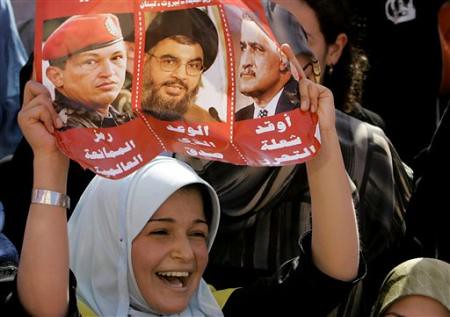
A Palestinian takes part with his daughter in a tribute for late Venezuelan President Hugo Chavez in Gaza City 7 March 2013. (Photo: Reuters - Suhaib Salem)
 
Published Tuesday, March 12, 2013
 
Outside of Venezuela and Latin America, there was no greater outpouring of support and sympathy for Venezuelan President Hugo Chavez than in the Arab world.

Comparisons to the great Egyptian president Gamal Abdul-Nasser began immediately. Many even declared Chavez himself an Arab based on his anti-imperialist policies and support for Palestinian liberation. Political commentators, at least those not on the Saudi and Qatari payrolls, emphasized his public support for Palestinian rights and Iran’s right to pursue a peaceful nuclear program, as well as his opposition to the wars on Iraq, Libya, and most recently the proxy war on Syria.

It’s not difficult to understand why Chavez enjoyed such support and admiration among the Arab public. Chavez stood in stark contrast to the politically impotent, petty tyrants that rule the Arab world. He spent 14 years as president of Venezuela and consistently won clear majorities of the vote in free and fair elections.

During this period Arabs watched him defy the American empire as semi-literate oil-Sheikhs and brutal dictators groveled in front of the latest US secretary of state. They heard Chavez condemn the war on Iraq as Gulf Cooperation Council royals did sword dances with George W. Bush.

Arabs remembered Chavez’s condemnations of Israel’s 2006 onslaught of Lebanon, when Arab regimes were quietly, and some not so quietly, supporting Israel’s bid to destroy the resistance in Lebanon. Arabs watched Chavez’s famous speech on Gaza when Hosni Mubarak, along with Israel, was enforcing a siege on 1.5 million Palestinians. They also remember that it was Chavez who expelled the Israeli Ambassador to Venezuela in protest of Israel’s 2008 massacre in Gaza.

But it wasn’t only Chavez’s impact on the world stage and his support for Arab causes that earned him popular respect and admiration. The Arab public also admired Chavez’s achievements in Venezuela and Latin America, which also stood in sharp contrast to the failures, incompetence, and corruption of Arab regimes. Chavez succeeded in achieving greater economic and political integration in Latin America while pursuing progressive social and economic policies at home.

Arabs watched Chavez nationalize Venezuelan oil and use the increased revenues to help improve the lives of the most marginalized Venezuelans. Arabs watched their own oil profits squandered on the lavish lifestyles of indulgent sheikhs while Chavez cut poverty in half. Arabs also watched the rise of obscene skyscrapers and the construction of artificial islands as Chavez was investing in social programs to end illiteracy, expand education, and provide healthcare to the most impoverished areas of Venezuela.

Chavez and Nasser had much in common both on a personal and political level. Both came from a humble background, began their careers in the military, and then lead popular revolutions that changed their society. As with Nasser, Arab support and sympathy for Chavez was not emotional nor was it driven solely by a charismatic personality. Although both leaders were highly charismatic, enjoyed an emotional connection with their people, and brought them a greater degree of dignity, their support derived mainly from tangible accomplishments at home and abroad.

Chavez and Nasser were able to improve the quality of life for the neediest in their societies, and both men understood the struggle for freedom and social justice at home was intrinsically linked to the struggle against imperialism and foreign domination. For this, Chavez, like Nasser and all leaders that insist on full sovereignty and the right to pursue independent domestic and foreign policies, was also vilified by Western governments and media.

We often hear that Arab Nationalism is dead and that Arabs do not share any common concerns beyond the borders. US client regimes in the region and their hired propagandists have insisted Arabs no longer consider the liberation of Palestine the central cause of the Arab people and that anti-imperialist discourse is something of the past. Yet the passing of Chavez and the invocation of Nasser’s memory in the wake of his death show the exact opposite.

The overwhelming support for Chavez leaves no doubt that his vision for Venezuela represents many Arabs’ vision for their own future, and that must be very troubling for many people.

Thabit Al-Arabi is co-editor of Ikhras, an Arab-American website that covers Arab and Muslim American politics and activism. You can follow Ikhras on Twitter.
 
The views expressed by the author do not necessarily reflect al-Akhbar's editorial policy.
 
River to Sea Uprooted Palestinian  
The views expressed in this article are the sole responsibility of the author and do not necessarily reflect those of this Blog!

Israel's a rogue terror state


Israel's a rogue terror state. It's been so from inception. Its leaders' hands are blood-drenched. They're responsible for decades of high crimes.
 
A rare New York Times Opinionator piece challenged Israel's right to exist. It did so responsibly. Joseph Levine wrote it. He "was raised in a strongly Jewish environment."
 
He's not a self-hating Jew. Saying so about anyone is oxymoronic. It's offensive and wrongheaded.
 
Levine's a University of Massachusetts Professor of Philosophy. His interest areas include Philosophy of Mind, Philosophy of Language, and Metaphysics. 
 
His current research involves intentionality, consciousness, and materialism. His books include "Purple Haze: The Puzzle of Consciousness," and "Experience and Representation."
 
His Times piece was bold and honest. He headlined "On Questioning the Jewish State."
 
He was taught growing up believing "Israel has a right to exist." Most critics feel the same way. Mainstream consensus claims denying it reflects anti-Semitism. It's not a people of conscience option, they claim.
 
Since when was free-thinking outlawed? Why should consensus views subvert others?
 
Debates are a longstanding tradition. Genuine ones air views freely. Beliefs are challenged. Truths are sought.
 
Critical thinking is stimulated. Opinions are formed. Conclusions are reached. It's done through free and open dialogue and discussion.
 
One size doesn't fit all. One view alone doesn't wash. Challenging them on vital issues matters. Bolding going where others won't dare is courageous. 
 
Levine did so publicly. To their credit, Times editors gave him space.
 
"Over the years," he said, "I came to question this consensus and to see that the general fealty to it has seriously constrained open debate on the issue, one of vital importance not just to the people directly involved - Israelis and Palestinians - but to the conduct of our own foreign policy and, more important, to the safety of the world at large."
 
"My view is that one really ought to question Israel's right to exist and that doing so does not manifest anti-Semitism."
 
Doing so is courageously honest. Many more Levines are needed. Their religious affiliation, if any, is irrelevant. Honest opinion matters. So does truth and full disclosure.
 
War without mercy established Israel. Hundreds of Arab cities and villages were depopulated. Thousands of innocent victims were massacred.
 
Rapes and other atrocities followed. Property was bulldozed, burned or stolen. Palestinian survivors were prevented from returning. Doing so violates international law.
 
Israel institutionalized state terror. It did from inception. Genocidal ethnic cleansing became policy. Horrendous crimes of war and against humanity were committed. 
 
They continue to this day. Convicted Nazis were hanged for similar crimes. Israeli war criminals go unpunished.
 
Decades of occupation harshness continue. Palestinians have no control over their daily lives. They live in constant fear. They're unsure if they'll live, die, be arrested, or face years in gulag prison hell.
 
They're economically strangled. Israel does it unjustly. They're collectively punished for any reason or none at all. They're criminalized for praying to the wrong God. Israel calls self-defense terrorism.
 
Gaza's besieged. Israel suffocates 1.7 million Palestinians. It's done so for nearly six years. Israel acts lawlessly. Humanitarian relief missions are assaulted. 
 
They're attacked maliciously and viciously. Israel gets away with murder and much more. Accountability is long overdue. So is challenging its right to exist responsibly.
 
Doing so isn't a right to life issue. It "sounds awfully close to permitting the extermination of its people," said Levine. "It's not surprising many would view it that way.''
 
"So what is this 'right' that many uphold as so basic that to question it reflects anti-Semitism, and yet is one that I claim ought to be questioned?"
 
Key for Levine is claiming Israel's right to exist as a Jewish state. Denying non-Jews equal rights is unconscionable. It's incompatible with democracy. It's more than that.
 
Stealing historic Palestine was lawless. It's criminal. Slaughtering or displacing hundreds of thousands doing so constitutes genocide. It continues today non-stop. It's slow-motion, not fast.
 
Responsible officials remain unaccountable. World leaders turn a blind eye. Millions of Palestinians suffer. Long denied justice remains unresolved. 
 
Jews have a right to live in historic Palestine or anywhere. So Do Muslims, Christians and others. Running things despotically is lawless. Institutionalized racism has no place in free societies.
 
"Any state that 'belongs' to one ethnic group within it violates the core democratic principle of equality, and the self-determination rights of the non-members of that group," says Levine.
 
He "conclude(s) that the very idea of a Jewish state is undemocratic. (He calls it) a violation of the self-determination rights of its non-Jewish citizens, and therefore morally problematic."
 
"There is an unavoidable conflict between being a Jewish state and a democratic" one.
 
At issue is more than that. International law is clear. It's unambiguous. Israel violates it. It does so with impunity. It's high time that changed.
 
Self-determination is universal. No religious, ethnic or other group holds exclusive franchise rights anywhere. 
 
Israeli leaders believe in Jewish exceptionalism. They have no right to do so.
 
Levine "emphasized….nothing anti-Semitic." His commentary set the record straight. Discussing topics this important should be prioritized. 
 
It should be done "openly on its merits, without the charge of anti-Semitism hovering in the background."
 
Hopefully others will answer Levine's call. Ending longstanding injustice depends of it.
 
Stephen Lendman lives in Chicago. He can be reached at lendmanstephen@sbcglobal.net
 
His new book is titled "Banker Occupation: Waging Financial War on Humanity."
 
 
Visit his blog site at sjlendman.blogspot.com.
 
River to Sea Uprooted Palestinian  
The views expressed in this article are the sole responsibility of the author and do not necessarily reflect those of this Blog!

The day the battle of Palestine moved to Damascus neighborhoods يوم انتقلت معركة فلسطين إلى أحياء دمشق

يوم انتقلت معركة فلسطين إلى أحياء دمشق


مصطفى يعقوب

يوميات أهل الشام اختلفت. سنتا «ثورة» أو «مؤامرة». لا فرق. المسألة اليوم في اشتباك دولي خضعت له واشنطن. وموسكو دافعت عن أسوارها من داخل الشام. هي معركة وجود، حافظت فيها دمشق على جسمها: الجيش ودبلوماسيوها

إيلي حنا

في البدء كانت درعا. حادثة الأطفال الشهيرة التي لم يلتقطها النظام. واليوم تسليم عالمي بالعجز عن تنحية بشار الأسد. وما بينهما من دماء ودمار وألسنة لهب امتد إلى ما وراء الحدود، إمّا على شكل اضطرابات أو على شكل أزمات انسانية، عنوانها اللاجئون. هي قصة شعب سعى إلى التخلص من معاناة، فوجد نفسه وسط كارثة. وحكاية نظام أراد التمسك بخياراته السياسية، فلقيَ نفسه في خضمّ «حرب كونية» تريد اقتلاعه من جذوره. في النهاية، بات واضحاً أنّ في الميزان ما يكفي لإشعال المنطقة والعالم. وكأنّها معركة استعادة فلسطين تخاض في أحياء دمشق. هيَ الجولة الأخيرة التي يتحدّد في ضوء نتائجها مستقبل المنطقة. ينبثق من ثناياها خاسر ورابح.

كلام وزير الخارجية الأميركي جون كيري قبل يومين ليس تفصيلاً عابراً. إقرار أميركي بالعجز عن تنحية بشار الأسد. مشهد لم يكن في دائرة الخيال عند اندلاع الأزمة، يوم اعتقد البعض أن نسائم «الربيع العربي» تداعب سوريا. كان الطلب، قبل الحراك السوري، تغيير سلوك النظام. وعند اشتعال الشارع تحوّل إلى التخلّص من النظام من جذوره، قبل أن يتحوّل إلى قبول بالهيكل شرط رحيل قائده. نتيجة لم تأتِ من فراغ. هي ثمرة تماسك والتفاف حول خيارات سياسية، وسقوط رهانات على انشقاق مؤسسة عسكرية عُرفت بانتمائها العربي، وجهاز دبلوماسي اشتهر بالتزامه القضايا القومية، التي تخلّت عنها جامعة العروبة أخيراً، بتشريعها تسليح «شعب شقيق» وتشجيعه على الاقتتال الأهلي. أليسَت هي نفسها التي طردت دولة شقيقة قبل أشهر، كرمة لعيون أباطرة النفط والغاز، في سابقة لم تحصل منذ توقيع مصر على معاهدة كامب ديفيد. وهي أيضاً نتاج توازن رعب فرضته إيران وحلفاؤها ومن خلفها روسيا والصين، التي أعلنتها منذ اللحظة الأولى: الأسد خط أحمر. سدّ دبلوماسي وعسكري لم تشهد واشنطن مثيلاً له، حتى في عزّ الاتحاد السوفياتي. اعتادت النزهات من الحرب على يوغوسلافيا إلى غزو العراق مروراً بالحرب على أفغانستان. واشنطن اليوم لحقت بموسكو، في ظل تباين أوروبي، بين بريطانيا وفرنسا وألمانيا، عنوانه: ما العمل؟ الجواب جاء أميركياً: بيان جنيف أولاً وبالطبعة الروسية، أي الحوار مع الحكومة السورية تحت عباءة الأسد.
 
لا شك في أنّ غياب البديل أدى دوراً أساسياً في الوصول إلى هذه الخلاصة. معارضة سوريّة مشتّتة، يغلب عليها الطابع الإسلامي السلفي، الذي أربك الغرب وبثّ الرعب في صفوف أجهزته الأمنية، حتى المعتدلين منهم، من قوى تدعي العلمانية، عجزت عن التفاهم على برنامج موّحد، مرتين، الأولى عند تشكيل «المجلس الوطني السوري»، والثانية عند التحوّل إلى ما يعرف بـ«الائتلاف الوطني السوري لقوى المعارضة الوطنية». بل لم تتمكن الفصائل التي تريد الحلول مكان النظام من الاتفاق على جهاز تنفيذي رغم الإغراء بتوليه مقعد سوريا في جامعة الدول العربية.

لعلّ لحظات الحقيقة قد أذنت. النظام استعاد مبادرته العسكرية في الداخل، بعد أسابيع من الانكار في بداية الحراك الشعبي، وأشهر من التخبّط، والمحاولات السياسية، ومثيلها من التجهيز والتدريب. فرض خيار التفاوض بعدما تهيأ لكثيرين أنّه دخل في مرحلة الانهيار. بعد سنتين، من مطالبة آلاف المتظاهرين السلميين بحقوقهم المشروعة وتبيان وجود فريق عريض في الداخل يريد تغيير أركان الحكم بالكامل، تبيّن منذ الأسابيع الأولى أنّ القرار في الخارج. نفّذت مجموعة من الاصلاحات، يتقدمها دستور جديد وقانون أحزاب وقانون انتخابات وعفو عام لأكثر من ست مرات. استفتي على الدستور وجرت عملية الاقتراع، وبقي المطلب واحداً، رحيل بشار الأسد.

كانت «غرفة عمليات اسطنبول» سيّدة القرار، على معظم فصائل المعارضة، يتقدمها ما بات يعرف بـ«الجيش الحرّ» الذي أعلن عن تشكيله في شهر تموز عام 2011. لم تنجح سياسة اليد الممدودة التي تبناها الأسد في البدايات، عبر استقبال مئات الوفود الشعبية لاستبيان مطالبها. ثقة بحبّ الناس له لم تؤت أكلها، ولا تحييده الأجهزة الأمنية. سبق السيف العذل. الأموال والأسلحة والمقاتلون الأجانب والعرب كانوا يتدفقون من كلّ حدب وصوب
 
لحظات حقيقة ليس على المستوى السوري فحسب، وإنما على مستوى المنطقة. النيران التي أحرقت مساجد دمشق وحلب، باتت تتهدّد العراق بحرب مذهبية. حتى الأردن، بوضعه الاقتصادي الصعب، ينازع بين سياسة النأي بالنفس والقواعد العسكرية التي فرضها الغرب على أراضيه لدعم معارضي النظام السوري. وإن كانت عمّان تجنح اليوم نحو إعادة ترتيب الوضع مع موسكو، في ظلّ ضغوط عربية لتقف في صف «المعارضين رسمياً».

مآسي الشعب السوري حملها معه إلى لبنان، حيث الأمن بالتراضي يترنّح، فيما تبدو تركيا مرتبكة، وكأنها معلّقة بين الأرض والسماء. إيران تستعد لـ«معركة الداخل» التي تحمل عنوان انتخابات الرئاسة المقرّرة في شهر حزيران المقبل.

أما العين فتبقى على روسيا التي ترى بدفاعها عن الشام حماية لأسوار موسكو. المعركة في سوريا ليست فقط لاسقاط النظام ومجيء بديل عنه. سقوط سوريا يسقط فريقاً بأكمله من بيروت إلى بكين مروراً ببغداد وطهران وموسكو. سقوط عاصمة الأمويين من عدمه يعني تغييراً للمشهد الشرق أوسطي بكامله. هي معركة وجود بالنسبة لفرقين لن يقبلا التراجع... وما الضحية إلّا سوريا وشعبها.


الاخبار
River to Sea Uprooted Palestinian  
The views expressed in this article are the sole responsibility of the author and do not necessarily reflect those of this Blog!

For 33 years they have been telling us that #Iran almost has a nuke

Here's the latest Obama Says Iran A Year Away From Nuclear Weapon http://washington.cbslocal.com/2013/03/14/obama-says-iran-a-year-away-from-nuclear-weapon/

Breathless predictions that the Islamic Republic will soon be at the brink of nuclear capability, or – worse – acquire an actual nuclear bomb, are not new.

For more than quarter of a century Western officials have claimed repeatedly that Iran is close to joining the nuclear club. Such a result is always declared “unacceptable” and a possible reason for military action, with “all options on the table” to prevent upsetting the Mideast strategic balance dominated by the US and Israel.

And yet, those predictions have time and again come and gone. This chronicle of past predictions lends historical perspective to today’s rhetoric about Iran.

1. Earliest warnings: 1979-84

Fear of an Iranian nuclear weapon predates Iran’s 1979 Islamic revolution, when the pro-West Shah Mohammad Reza Pahlavi was deep in negotiations with the US, France and West Germany, on a nuclear-energy spending spree that was to yield 20 reactors.

Late 1970s: US receives intelligence that the Shah had “set up a clandestine nuclear weapons development program.”

1979: Shah ousted in the Iranian revolution, ushering in the Islamic Republic. After the overthrow of the Shah, the US stopped supplying highly enriched uranium (HEU) to Iran. The revolutionary government guided by Ayatollah Ruhollah Khomeini condemned nuclear weapons and energy, and for a time stopped all projects.

1984: Soon after West German engineers visit the unfinished Bushehr nuclear reactor, Jane’s Defence Weekly quotes West German intelligence sources saying that Iran’s production of a bomb “is entering its final stages.” US Senator Alan Cranston claims Iran is seven years away from making a weapon.

2. Israel paints Iran as Enemy No. 1: 1992

Though Israel had secretly done business with the Islamic Republic after the 1979 revolution, seeking to cultivate a Persian wedge against its local Arab enemies, the early 1990s saw a concerted effort by Tel Aviv to portray Iran as a new and existential threat.

1992: Israeli parliamentarian Benjamin Netanyahu tells his colleagues that Iran is 3 to 5 years from being able to produce a nuclear weapon – and that the threat had to be “uprooted by an international front headed by the US.”

1992: Israeli Foreign Minister Shimon Peres tells French TV that Iran was set to have nuclear warheads by 1999. “Iran is the greatest threat and greatest problem in the Middle East,” Peres warned, “because it seeks the nuclear option while holding a highly dangerous stance of extreme religious militanCY.”

1992: Joseph Alpher, a former official of Israel’s Mossad spy agency, says “Iran has to be identified as Enemy No. 1.” Iran’s nascent nuclear program, he told The New York Times, “really gives Israel the jitters.”

US america Iran painting

3. US joins the warnings: 1992-97

The same alarm bells were already ringing in Washington, where in early 1992 a task force of the House Republican Research Committee claimed that there was a “98 percent certainty that Iran already had all (or virtually all) of the components required for two or three operational nuclear weapons.”

Similar predictions received airtime, including one from then-CIA chief Robert Gates that Iran’s nuclear program could be a “serious problem” in five years or less. Still, the bureaucracy took some time to catch up with the Iran threat rhetoric.

1992: Leaked copy of the Pentagon’s “Defense Strategy for the 1990s” makes little reference to Iran, despite laying out seven scenarios for potential future conflict that stretch from Iraq to North Korea.

1995: The New York Times conveys the fears of senior US and Israeli officials that “Iran is much closer to producing nuclear weapons than previously thought” – about five years away – and that Iran’s nuclear bomb is “at the top of the list” of dangers in the coming decade. The report speaks of an “acceleration of the Iranian nuclear program,” claims that Iran “began an intensive campaign to develop and acquire nuclear weapons” in 1987, and says Iran was “believed” to have recruited scientists from the former Soviet Union and Pakistan to advise them.

1997: The Christian Science Monitor reports that US pressure on Iran’s nuclear suppliers had “forced Iran to adjust its suspected timetable for a bomb. Experts now say Iran is unlikely to acquire nuclear weapons for eight or 10 years.”

4. Rhetoric escalates against ‘axis of evil’: 1998-2002

But Iran was putting the pieces of its strategic puzzle together. A US spy satellite detected the launch of an Iranian medium-range missile, sparking speculation about the danger posed to Israel.

1998: The New York Times said that Israel was less safe as a result of the launch even though Israel alone in the Middle East possessed both nuclear weapons and the long-range missiles to drop them anywhere. “The major reaction to this is going to be from Israel, and we have to worry what action the Israelis will take,” the Times quoted a former intelligence official as saying. An unidentified expert said: “This test shows Iran is bent on acquiring nuclear weapons, because no one builds an 800-mile missile to deliver conventional warheads.”

1998: The same week, former Defense Secretary Donald Rumsfeld reports to Congress that Iran could build an intercontinental ballistic missile – one that could hit the US – within five years. The CIA gave a timeframe of 12 years.

2002: CIA warns that the danger from nuclear-tipped missiles, especially from Iran and North Korea, is higher than during the cold war. Robert Walpole, then a top CIA officer for strategic and nuclear programs, tells a Senate panel that Iran’s missile capability had grown more quickly than expected in the previous two years – putting it on par with North Korea. The threat “will continue to grow as the capabilities of potential adversaries mature,” he says.

2002: President George W. Bush labels Iran as part of the “axis of evil,” along with Iraq and North Korea.

Army bases Iran America

5. Revelations from inside Iran: 2002-05

In August 2002, the Iranian opposition group Mojahedin-e Khalq (MEK, a.k.a. MKO) announces that Iran is building an underground uranium enrichment facility at Natanz, and a heavy water reactor at Arak. It is widely believed that the evidence had been passed to the MEK by Israeli intelligence.

Enrichment and reactors are not forbidden to Iran as a signatory of the Nuclear Non-Proliferation Treaty (NPT), but the failure to disclose the work prompts an IAEA investigation and much closer scrutiny. Iran insists its efforts are peaceful, but is found in breach of its IAEA safeguards agreement, and accused by the IAEA of a “pattern of concealment.”

2004: Then-Secretary of State Colin Powell tells reporters that Iran had been working on technology to fit a nuclear warhead onto a missile. “We are talking about information that says they not only have [the] missiles but information that suggests they are working hard about how to put the two together,” he said.

2005: US presents 1,000 pages of designs and other documentation allegedly retrieved from a computer laptop in Iran the previous year, which are said to detail high-explosives testing and a nuclear-capable missile warhead. The “alleged studies,” as they have since been called, are dismissed by Iran as forgeries by hostile intelligence services.

6. Dialing back the estimate: 2006-09

2006: The drums of war beat faster after the New Yorker’s Seymour Hersh quotes US sources saying that a strike on Iran is all but inevitable, and that there are plans to use tactical nuclear weapons against buried Iranian facilities.

2007: President Bush warns that a nuclear-armed Iran could lead to “World War III.” Vice President Dick Cheney had previously warned of “serious consequences” if Iran did not give up its nuclear program.

2007: A month later, an unclassified National Intelligence Estimate (NIE) on Iran is released, which controversially judges with “high confidence” that Iran had given up its nuclear weapons effort in fall 2003.

The report, meant to codify the received wisdom of America’s 16 spy agencies, turns decades of Washington assumptions upside down. Iranian President Mahmoud Ahmadinejad calls the report a “victory for the Iranian nation.” An Iranian newspaper editor in Tehran tells the Monitor, “The conservatives … feel the chance of war against them is gone.”

June 2008: Then-US Ambassador to the United Nations John Bolton predicts that Israel will attack Iran before January 2009, taking advantage of a window before the next US president came to office.

May 2009: US Senate Foreign Relations Committee reports states: “There is no sign that Iran’s leaders have ordered up a bomb.”

7. Israel’s one-year timeframe disproved: 2010-11

Despite reports and intelligence assessments to the contrary, Israeli and many US officials continue to assume that Iran is determined to have nuclear weapons as soon as possible.

August 2010: An article by Jeffrey Goldberg in The Atlantic’s September issue is published online, outlining a scenario in which Israel would chose to launch a unilateral strike against Iran with 100 aircraft, “because a nuclear Iran poses the gravest threat since Hitler to the physical survival of the Jewish people.”

Drawing on interviews with “roughly 40 current and past Israeli decision makers about a military strike” and American and Arab officials, Mr. Goldberg predicts that Israel will launch a strike by July 2011. The story notes previous Israeli strikes on nuclear facilities in Iraq and Syria, and quotes Israeli Prime Minister Benjamin Netanyahu saying, “You don’t want a messianic apocalyptic cult controlling atomic bombs. When the wide-eyed believer gets hold of the reins of power and the weapons of mass death, then the world should start worrying, and that’s what is happening in Iran.”

2010: US officials note that Iran’s nuclear program has been slowed by four sets of UN Security Council sanctions and a host of US and EU measures. The Stuxnet computer virus also played havoc through 2011 with Iran’s thousands of spinning centrifuges that enrich uranium.

January 2011: When Meir Dagan steps down as director of Israel’s Mossad spy agency, he says that Iran would not be able to produce a nuclear weapon until 2015. “Israel should not hasten to attack Iran, doing so only when the sword is upon its neck,” Mr. Dagan warned. Later he said that attacking Iran would be “a stupid idea…. The regional challenge that Israel would face would be impossible.”

January 2011: A report by the Federation of American Scientists on Iran’s uranium enrichment says there is “no question” that Tehran already has the technical capability to produce a “crude” nuclear device.

February 2011: National intelligence director James Clapper affirms in testimony before Congress that “Iran is keeping the option open to develop nuclear weapons in part by developing various nuclear capabilities and better position it to produce such weapons, should it choose to do so,” Mr. Clapper said. “We do not know, however, if Iran will eventually decide to build nuclear weapons.”

November 2011: The IAEA claims for the first time that Iran is has worked on weapons-related activities for years, publishing detailed information based on more than 1,000 pages of design information that is corroborated, it says, by data from 10 member states and its own investigation and interviews.

Netanyahu Iran bomb

Israel’s Prime Minister Benjamin Netanyahu repeating the lie to the United Nations last week about how close Iran is to building a nuke.

Source: http://www.csmonitor.com/World/Middle-East/2011/1108/Imminent-Iran-nuclear-threat-A-timeline-of-warnings-since-1979/Earliest-warnings-1979-84

River to Sea Uprooted Palestinian   The views expressed in this article are the sole responsibility of the author and do not necessarily reflect those of this Blog!

One Dead, 20 Injured in Egypt Clashes over Diesel Fuel

Local Editor

At least one person died from a shot to the head, while 17 residents and three policemen were injured in clashes between two Daqahlia families over diesel fuel on Wednesday.
The family feud began with an altercation between a driver and another over who was first in line for diesel fuel at a Nabrawa City gas station.

Egypt fuel stationThe argument escalated into a fight with bladed weapons, which later became a major feud between both drivers’ families that involved firearms.

Abdallah Abdel Hamid al-Manzalawy, 35, was shot in the head and transferred to hospital in serious condition. He later died of his injuries, which pushed the infighting to a new extreme.

Three houses were also set ablaze.
The police, with help from the Central Security Forces, used tear gas to disperse crowds and put out the fire that had spread to two other homes.

Central Security Forces and armored vehicles were deployed in the city to restore calm.

The Public Prosecution is investigating the incident by gathering testimonies from those hospitalized and ordering an autopsy on the man killed.
Source: Websites
14-03-2013 - 19:06 Last updated 14-03-2013 - 19:18

Egypt Court Adjourns State Security Trial to 16 April

Local Editor

Egypt CourtThe South Giza Criminal Court of Egypt adjourned the trial of dozens of senior intelligence officers accused of ordering the destruction of important documents to 16 April.
The court made the ruling Thursday after Defense Minister Abdel Fattah al-Sisi was unable to testify a second time citing the deteriorating security situation.

Prosecutors claim Major General Hassan Abdel Rahman and 40 other members of the now defunct State Security Investigation Services bureau destroyed numerous SSIS documents before the body was shut down after the January 25 uprising.

As public employees, the prosecution claims the defendants sought to sabotage national security through their actions.
Source: Websites
14-03-2013 - 19:16 Last updated 14-03-2013 - 19:16

yyy
River to Sea Uprooted Palestinian  
The views expressed in this article are the sole responsibility of the author and do not necessarily reflect those of this Blog!

Sheikh Assir’s Antics Rattle Lebanon’s Security


Ahmad al-Assir speaks on a talkie walkie during a sit-in in Sidon, southern Lebanon, 28 June 2012. (Photo: Ali Hashisho)
Published Wednesday, March 13, 2013
 
Salafi Sheikh Ahmad al-Assir tested his supporters on the night of 13 March by sending out messages that the army was about to breach his mosque, prompting hundreds of Salafis to block roads in Tripoli, Beirut, and Saida.

It all started when soldiers at an army checkpoint in east Saida stopped one Ahmad al-Assir’s supporters, Sheikh Assem al-Arifi, after discovering that his car papers were forged.
Arifi’s driver refused to abide by the army’s orders and fled to Assir’s mosque nearby. In what may have been an attempt to test the readiness of his supporters, Assir fired off text messages and posts on his Facebook page claiming that the army was preparing to assault the mosque.

Despite the small number of people who took to the streets, the incident nevertheless rattled the uneasy peace prevalent in a number of cities, particularly in Saida and Tripoli, where Assir’s supporters and allies tend to be concentrated.

According to army sources, several hundred young men responded to Assir’s call, blocking roads in Saida, Beirut, and Tripoli for a short period of time before being reopened by security forces.

Army sources in Saida maintained that they “had no intention of entering the mosque, and would not do so under any circumstance.” They had merely asked the mosque’s guards to hand over Arifi, who they explained had counterfeit papers and refused to abide by the army’s orders.
Earlier in the day, Assir – who had previously avoided a direct confrontation with the armed forces – called his supporters and their family members to the mosque and declared that it was time to break the army’s siege.

It is worth noting that the army had begun to implement a security plan at noon the same day, which included establishing permanent checkpoints around the mosque to search all vehicles exiting and entering the area under Assir’s control.

In the northern city of Tripoli, the response to Assir’s call was surprisingly fast as Salafis and groups of armed men descended on Nour Square, threatening to declare jihad against the army if Assir’s mosque was breached.

Notably, the protesters ripped down pictures of Saudi King Abdullah bin Abdul-Aziz and replaced them with al-Qaeda banners.

In Beirut, protesters blocked two main roads around the Tariq al-Jadida area. Smaller groups of demonstrators also tried to block main arteries in Akkar near Tripoli, in Nahmeh south of Beirut, and in the Bekaa in the east of the country.

It is clear that Assir is ratcheting up the pressure on the army as it tightens security measures around his mosque by resorting to panicked text and Internet messages, one of which called on Muslims around the world to picket Lebanese embassies in their respective countries.

This article is an edited translation from the Arabic Edition.
River to Sea Uprooted Palestinian  
The views expressed in this article are the sole responsibility of the author and do not necessarily reflect those of this Blog!