Uprooted Palestinians are at the heart of the conflict in the M.E Palestinians uprooted by force of arms. Yet faced immense difficulties have survived, kept alive their history and culture, passed keys of family homes in occupied Palestine from one generation to the next.
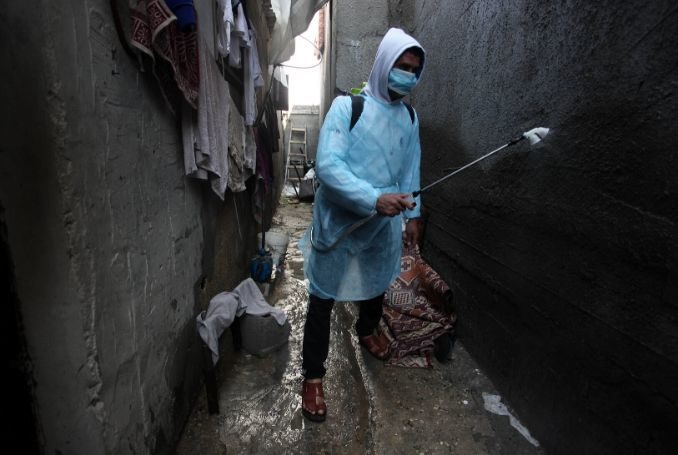
While the Coronavirus continues to ravage almost every nation on earth, Arab countries remain unable, or unwilling, to formulate a collective strategy to help the poorest and most vulnerable Arabs survive the deadly virus and its economic fallout.
Worse, amid growing international solidarity, we are yet to see a pan-Arab initiative that aims to provide material support to countries and regions that have been hit hardest by the COVID-19 disease.
The lack of collective Arab responsiveness is not unique as it mirrors Europe’s own systematic failure, exhibiting ‘solidarity’ when it is financially convenient, and turning its back, sometimes at its own brethren, when there are no economic incentives.
For example, when Greece defaulted on its debt to international donors in 2015, Germany, and other European Union countries, pounced on the opportunity to dismantle the country’s major financial institutions and to profit from Athens’ mounting miseries.
All the talk of European solidarity, fraternity and community floundered at the altar of greed and unhindered profits.
That was not the first – nor will it be the last – occasion when the opportunistic EU showed its true colors. In truth, Europe is united, not by common history or unbreakable social bonds, but rather by the shared belief that a united Europe is a stronger economic unit.
The same sordid scenario was recently repeated. As Italy began buckling down under the unbearable burdens of the deadly Coronavirus, it immediately, and naturally, sought the help of its European sister states. To no avail.
Despite its sizable debt, Italy is a major player in the economic arena of Europe and, in fact, the world. Indeed, Italy is the world’s 8th largest economy. But the country’s economy is now experiencing a rare freefall, especially in the poorer regions of the South, where people are literally going hungry.
The first country to come to Italy’s aid was neither France, nor, unsurprisingly, Germany, but China, followed by Russia, then Cuba, and others.
This palpable lack of solidarity among European countries has further empowered the ethnocentric view already prevailing in Europe, and championed by far-right movements like Italy’s League Party of Matteo Salvini. For years, the latter has advocated against European integration.
It will take months, if not years, for the political fallout of the Coronavirus to be fully assessed. But what is already clear is that international and regional economic hubs are actively hedging their bets to consolidate their geopolitical positions in the post-Coronavirus world.
Despite bashful American attempts to join the politically-motivated international solidarity, US President Donald Trump’s humble moves arrived too little, too late. In fact, a sign of the times is that Chinese and Russian aid is pouring in to help the United States, which now has the world’s largest number of COVID-19 cases.
A compelling question, however, is where are the Arabs in all of this?
Italy and Spain, in particular, share historical and cultural bonds, and broad political interests, with many Arab countries, interests that will remain long after the Coronavirus is eradicated. Failing to register on the radar of international solidarity with Italy and Spain will prove a strategic miscalculation.
Israel, on the other hand, is activating its aid agency, IsraAID, which has previously worked in Italy between 2016 and 2019, after a major earthquake killed nearly 300 people and left behind massive infrastructural damage.
Israel uses ‘humanitarian aid’ as a political and propaganda tool. Israeli missions are often under-funded and short-lasting, but their impact is greatly amplified by a powerful, official media machine that tries to project Israel as a ‘peace-maker’, not a war-monger.
The truth is, some Arab governments do, in fact, provide badly needed funds and aid to countries that are devastated by wars or natural disasters; alas, these efforts are often disorganized and self-centered – and frankly, not at all motivated by true solidarity.
That said, the absence of Arab initiatives in the field of international humanitarian solidarity dwarf in comparison to the lack of Arab solidarity within the Arab world itself.
According to United Nation estimates, there are “101.4 million (people) in the region who already live in poverty, according to official criteria, and around 52 million undernourished.”
A new policy brief issued on April 1 by the United Nations Economic and Social Commission for Western Asia (ESCWA), projects that an additional 8.3 million people are set to join the poor and undernourished masses throughout the Arab world.
Aside from empty rhetoric and useless press releases, we are yet to witness a major collective Arab initiative, championed by, for example, the Arab League, to provide an Arab equivalent to the many economic stimulus plans that have been set into motion in many other countries and regions around the world.
Late March, United Nations Secretary-General, António Guterres, issued a ‘global ceasefire appeal’, pleading to the world, especially to warring Middle Eastern nations, to cease fire and to unite all efforts in one single war against the Coronavirus.
Sadly, that call has so far gone unheeded. The war in Libya is escalating, not subsiding; Israeli killing of Palestinians in the occupied West Bank continues unabated; the flood of refugees out of Syria, Turkey, and other Middle Eastern countries is yet to slow down.
Times of crisis, especially the kind that targets all of us regardless of race, religion, or geography, often constitute a wake-up call, present an opportunity for a new beginning, a new social contract so that we may resurrect from the ashes of our collective pain to build a better world.
Let COVID-19 be that opportunity that will allow all nations, especially in the Middle East, to take a stance against war, hunger and disease, to share their wealth and to extend the hand of solidarity to Africa and our historic allies throughout the world.
– Ramzy Baroud is a journalist and the Editor of The Palestine Chronicle. He is the author of five books. His latest is “These Chains Will Be Broken: Palestinian Stories of Struggle and Defiance in Israeli Prisons” (Clarity Press, Atlanta). Dr. Baroud is a Non-resident Senior Research Fellow at the Center for Islam and Global Affairs (CIGA), Istanbul Zaim University (IZU). His website is www.ramzybaroud.net
EUA ampliam ambições no Ártico
-
Os EUA estão avançando com sucesso em sua estratégia para o Ártico em
colaboração com nações do norte da Europa. A recente “anexação de facto” da
Groenlâ...
Another Epstein Class whistleblower ‘suicide’
-
“How US commerce secretary’s Epstein links were uncovered by British
whistleblower“ (Verity/Byrne/Milne):Andriesz suspected there was yet more
to find in t...
The Legendary Golem
-
The Legendary Golem October 3 2026 ___________________________________ More
Vids! +BN Vids Archive! HERE! ___________________________________ Support
The B...
The United States At A Crossroad
-
The United States At A Crossroad—An Analysis (16 Sept 2026) by Lawrence
Davidson Part I—Texas vs Minnesota Back in mid-May […]
Report on Beth Israel vigil 09-12-26
-
*Eat-a-Cheeseburger Day Approaches*
This year, EAC Day appears on Monday, September 21st. The date coincides
with the Jewish holiday called Yom Kippur. Cl...
-
Hello all,
It is with great sadness that I share with you the passing of our beloved
sister, Mother, and Grandmother, the individual that you all knew ...
Best Horror Podcast
-
Best Horror Podcast Introduction: Horror podcasts […]
The post Best Horror Podcast appeared first on Copper Shock Horror Podcast.
Ikhras Endorses Muntadhar Al-Zaidi
-
“Oh parties of banditry and sectarianism and corruption, we have come and
our goal is to destroy you.” Ikhras formally endorses Muntadhar al-Zaidi,
Iraqi j...
Prince Charles: Foreign Jews behind bloodshed in ME
-
In May, 2017, British Crown Prince Charles declined an invitation from
Zionist entity’s president Reuven Rivlin‘s to attend the 100th anniversary
of the no...
Palestinian Women – One for All, All for One
-
Honouring All Palestinian Women by Honouring Three: Hanin Zoabi, Ahed
Tamimi, Samah Sabawi Vacy Vlazna “Palestinian women have always stood side
by side ...
US’s Saudi Oil Deal from Win-Win to Mega-Lose
-
By F. William Engdahl Who would’ve thought it would come to this? Certainly
not the Obama Administration, and their brilliant geo-political think-tank
neo-...
-
*Mordechai Vanunu wins human rights prize of Brazilian Press Association *
* http://www.alternativenews.org/english/index.php/features/updates/7038-mordechai...
Abdul Aziz Rantissi:
"My ultimate wish, my God, is to attain martyrdom,"...God granted him his wish on April 17, 2004, at the hands of Israeli assassins.


No comments:
Post a Comment