Showing posts with label Abdel Aziz Ibn Saud. Show all posts

Sunday, 26 September 2021

Who Really Runs the Middle East?

 September 25, 2021

Who Really Runs the Middle East?

By Cynthia Chung for the Saker Blog

Afghanistan is on many people’s minds lately, though the sentiment is rather mixed. Some think of it as a cause for celebration, others for deep concern, and then there are those who think it an utter disaster that justifies foreign re-entry.

Most of the western concern arises out of 9/11 and the Taliban’s supposed connection to this through Al-Qaeda and Osama bin Laden, however, as Scott Ritter (who was the lead analyst for the 7th Marine Amphibious Brigade on the Soviet war in Afghanistan) wrote:

“The entire Afghan conflict must be examined considering this reality – everything is a lie. Every battle, every campaign, every contract written and implemented – everything was founded in a lie…

Admiral McRaven, when speaking of the operation to kill Bin Laden, noted that there wasn’t anything fundamentally special about that mission in terms of the tactics. ‘I think that night we ran 11 or 12 [other] missions in Afghanistan,’ McRaven noted. Clearly there was a military focus beyond simply killing Bin Laden. It was secretive work, reportedly involving the assassination of Taliban members, that often resulted in innocent civilians beings killed.

It should be noted that, as of 2019, McRaven believed that this kind of special operations activity should be continued in Afghanistan for years to come. So much for the US mission in Afghanistan being defined by the death of Bin Laden. The mission had become death, and the careers that were defined by those deaths.

The fact is the war in Afghanistan did not need to be fought. We could have ended the threat posed by Bin Laden simply by negotiating with the Taliban in the aftermath of 9/11, providing the evidence we claimed to have linking Bin Laden to the terrorist attacks on the United States. Any student of Afghanistan worth their salt knows the fundamental importance of honor that is enshrined in the concepts of Pashtunwali, the unwritten ethical code that defines the traditional lifestyle of the Pashtun people. If, as we claimed, Bin Laden carried out an attack on women and children while he was living under the protection of Pashtunwali, then his dishonor is that of the Pashtun tribes. To clear their honor, they would seek justice – in this case, evicting Bin Laden and his followers from Afghanistan.

In fact, the Taliban made precisely this offer.

For America, however, this would have been an unsatisfying result. We needed blood, not justice, and we sent our troops to Afghanistan to stack bodies, which they did, in prodigious numbers. Most of these bodies were Taliban. We excused this by claiming the Taliban were providing safe haven to Bin Laden, and as such were complicit in the 9/11 attacks.

Which was a lie.”

Scott Ritter (who was a former UN weapons inspector in Iraq from ’91-98) had also played a leading role in bringing to the public’s attention the lies told to justify the illegal war in Iraq, which was based off of cooked British intelligence.

It was not just based on the illusion of “justice,” there was a deeper and much more disturbing agenda under the patriotic trumpet blaring.

In this light, Afghanistan is indeed an incredible American “failure,” not only in failing to install their puppet government; it has also failed the American people, however, not in the way most are talking about.

The 20 year, some say occupancy others say terrorizing, of Afghanistan, is estimated at $1-2 trillion. This is only for the case of Afghanistan, it does not account for the total cost thus far of the War on Terror. Such extravagant spending with really nothing to show for it but destruction, the slaughter of innocents, instability and chaos; you would think the United States must be a very rich country to afford such a budget with no clear goal or objective. Instead, what we find is that the American economy is tanking and the living standard is plummeting, while drug use and overdose rates are sky-rocketing and suicide is among the top causes of death in the United States, especially among their youth.

What is going on here? Have the Americans gone mad? Or is there something much much more sinister afoot?

This situation cannot just be explained away as incompetence or the money-making business of war, or even the crazed end-of-world ideologies of neo-conservatives or Zionists, although these are all major factors.

The reason for this is because there has been something operating within the Middle East for much longer, it is even the reason why we call the Middle East and the Far East by such a name, it is the reason for why many countries in this region have the boundaries they do, and was the originator of the Palestine/Israel conflict.

It is also found at the center of the origin and funding of Islamic terrorism as we see in its modern form today.

Whose “Arab Awakening”?

“The renunciation will not be easy. Jewish hopes have been raised to such a pitch that the non-fulfilment of the Zionist dream of a Jewish state in Palestine will cause intense disillusionment and bitterness. The manifold proofs of public spirit and of capacity to endure hardships and face danger in the building up of the national home are there to testify to the devotion with which a large section of the Jewish people cherish the Zionist ideal. And it would be an act of further cruelty to the Jews to disappoint those hopes if there existed some way of satisfying them, that did not involve cruelty to another people. But the logic of facts is inexorable. It shows that no room can be made in Palestine for a second nation except by dislodging or exterminating the nation in possession.” [emphasis added]

– the concluding paragraph of George Antonius’ “The Arab Awakening” (1938), graduate from Cambridge University, civil servant in the British Mandate of Palestine

Much of what is responsible for the war and havoc in the Middle East today has the British orchestrated so-called “Arab Awakening” to thank, led by characters such as E.G. Browne, St. John Philby, T.E. Lawrence of Arabia, and Gertrude Bell. Although its origins go as far back as the 19th century, it was only until the early 20th century, that the British were able to reap significant results from its long harvest.

The Arab Revolt of 1916-1918, had been, to the detriment of the Arab people, a British led rebellion. The British claimed that their sole interest in the affair was the dismantling of the Ottoman Empire and had given their word that these Arab territories would be freed and allowed independence if they agreed to rebel, in large part led and directed by the British.

It is a rather predictable feature of the British to lie and double cross and thus it should be of no surprise to anyone that their intentions were quite the opposite of what they had promised and thanks to the Sykes-Picot Russian leak, were revealed in their entire shameful glory.

Once the Arab Revolt was “won” against the Ottoman Empire, instead of the promised Arab independence, the Middle East was carved up into zones of influence under British and French colonial rule. Puppet monarchies were created in regions that were considered not under direct colonial subjugation in order to continue the illusion that Arabs remained in charge of sacred regions such as Mecca and Medina.

https://www.strategic-culture.org/wp-content/uploads/2021/06/sc15062101.jpg

In central Arabia, Hussein ibn Ali, Sharif of Mecca, the puppet leader of the Arab Revolt laid claim to the title Caliph in 1924, which his rival Wahhabite Abdul-Aziz ibn Saud rejected and declared war, defeating the Hashemites. Hussein (British Cairo Office favourite) abdicated and Ibn Saud (British India Office favourite), was proclaimed King of Hejaz and Najd in 1926, which led to the founding of the kingdom of Saudi Arabia.

The Al Saud (House of Saud) warriors of Wahhabism were a formidable strike force that the British believed would help London gain control of the western shores of the Persian Gulf.

Hussein ibn Ali’s son Faisal (under the heavy tutelage of T.E. Lawrence, Cairo Office) was bestowed as King of Iraq and Hussein’s other son, Abdullah I was established as the Emir of Transjordan until a negotiated legal separation of Transjordan from Britain’s Palestine mandate occurred in 1946, whereupon he was crowned King of Jordan.

While the British were promising Arab independence they simultaneously were promising a homeland in Palestine to the Jews. The Balfour Declaration of November 2nd, 1917 states:

“His majesty’s government view with favour the establishment in Palestine of a national home for the Jewish people, and will use their best endeavours to facilitate the achievement of this object…”

Palestine had been seized by the British during the so-called “Arab Revolt” on December 11th, 1917 when General Allenby marched into Jerusalem through the Jaffa Gate and declared martial law over the city. Palestine has remained occupied ever since.

https://www.strategic-culture.org/wp-content/uploads/2021/06/sc15062102.jpg

Britain would receive the mandate over Palestine from the League of Nations in July 1922.

Throughout the 1920s and 1930s violent confrontations between Jews and Arabs took place in Palestine costing thousands of lives. In 1936 a major Arab revolt occurred over 7 months, until diplomatic efforts involving other Arab countries led to a ceasefire. In 1937, a British Royal Commission of Inquiry headed by William Peel concluded that Palestine had two distinct societies with irreconcilable political demands, thus making it necessary to partition the land.

https://www.strategic-culture.org/wp-content/uploads/2021/06/sc15062103.jpg

The Arab Higher Committee refused Peel’s “prescription” and the revolt broke out again. This time, Britain responded with a devastatingly heavy hand. Roughly 5,000 Arabs were killed by the British armed forces and police.

Following the riots, the British mandate government dissolved the Arab Higher Committee and declared it an illegal body.

In response to the revolt, the British government issued the White Paper of 1939, which stated that Palestine should be a bi-national state, inhabited by both Arabs and Jews. Due to the international unpopularity of the mandate including within Britain itself, it was organised such that the United Nations would take responsibility for the British initiative and adopted the resolution to partition Palestine on November 29th, 1947. Britain would announce its termination of its Mandate for Palestine on May 15th, 1948 after the State of Israel declared its independence on May 14th, 1948.

The Rise of the Muslim Brotherhood

“We do not cut the head of religion except by sword of religion.”

– Jamal al-Din al-Afghani

In 1869, a man named Jamal al-Din al-Afghani, the intellectual founder of the Salafiyya movement, went to India where British led colonial authorities welcomed him with honors and graciously escorted him aboard a government owned vessel on an all-expenses paid voyage to the Suez. [1]

In Cairo he was adopted by the Egyptian prime minister Riad Pasha, a notorious enemy of the emerging nationalist movement in Egypt. Pasha persuaded Afghani to stay in Egypt and allowed him to take up residence in Cairo’s 900 year old Al Azhar mosque considered the center of Islamic learning worldwide, where he received lodging and a monthly government stipend (paid for by the British).[2]

While Egypt was fighting its nationalist fight from 1879-1882, Afghani and his chief disciple Muhammad Abduh travelled together first to Paris and then to Britain, it was in Britain that they would make a proposal for a pan-Islamic alliance among Egypt, Turkey, Persia and Afghanistan against Czarist Russia.[3]

What Afghani was proposing to the British was that they provide aid and resources to support his formation of a militant Islam sect that would favour Britain’s interest in the Middle East, in other words, Afghani was offering to fight Islam with Islam to service British interests, having stated in one of his works “We do not cut the head of religion except by sword of religion.”[4]

Although it is said that the British refused this offer, this is not likely considering the support Afghani would receive in creating the intellectual foundation for a pan-Islamic movement with British patronage and the support of England’s leading orientalist E.G. Browne, the godfather of twentieth century Orientalism and teacher of St John Philby and T.E. Lawrence.

E.G. Browne would make sure the work of Afghani would continue long beyond his death by lionising him in his 1910 “The Persian Revolution,” considered an authoritative history of the time.

In 1888, Abduh, the chief disciple of Afghani, would return to Egypt in triumph with the full support of the representatives of her Majesty’s imperial force and took the first of several positions in Cairo, openly casting his lot with Lord Cromer, who was the symbol of British imperialism in Egypt.

Abduh would found, with the hold of London’s Egyptian proconsul Evelyn Baring (aka Lord Cromer) who was the scion of the enormously powerful banking clan (Barings Bank) under the city of London, the Salafiyya movement.[5]

Abduh had attached himself to the British rulers of Egypt and created the cornerstone of the Muslim Brotherhood which dominated the militant Islamic right throughout the twentieth century.

In 1899, Abduh reached the pinnacle of his power and influence, and was named mufti of Egypt.

***

In 1902, Riyadh fell to Ibn Saud and it was during this period that Ibn Saud established the fearsome Ikhwan (translated as “brotherhood”). From the 1920s onward, the new Saudi state merged its Wahhabi orthodoxy with the Salafiyya movement (which would be organised into the Muslim Brotherhood in 1928).

William Shakespear, a famed British agent, forged the first formal treaty between England and Saudi Arabia which was signed in 1915, which bound London and Arabia for years before Saudi Arabia became a country. “It formally recognized Ibn Saud as the independent ruler of the Nejd and its Dependencies under British protection. In return, Ibn Saud undertook to follow British advice.”[6]

Harry St. John Bridger Philby, a British operative schooled by E.G. Browne and father to the legendary triple agent Kim Philby, would succeed Shakespear as Great Britain’s liaison to Ibn Saud under the British India Office, the friendly rival of the Cairo Arab Bureau office which was sponsoring T.E. Lawrence of Arabia.

In Egypt 1928, Hassan al-Banna (a follower of Afghani and Abduh) founded the Muslim Brotherhood (Ikhwan al-Muslimeen), the organization that would change the course of history in the twentieth century Middle East.

Banna’s Muslim Brotherhood was established with a grant from England’s Suez Canal Company[7] and from that point on, British diplomats and intelligence service, along with the British puppet King Farouq would use the Muslim Brotherhood as a truncheon against Egypt’s nationalists and later against Egyptian president Gamal Abdel Nasser. (For more on this refer to my paper.)

To get the Muslim Brotherhood off the ground, the Suez Canal Company helped Banna build the mosque in Ismailia that would serve as its headquarters and base of operation.[8] The fact that Banna created the organization in Ismailia is itself worthy of note. For England, the Suez Canal was the indispensable route to its prize possession, India, and in 1928 the town Ismailia happened to house not only the company’s offices but a major British military base built during WWI. It was also, in the 1920s a center of pro-British sentiment in Egypt.

In the post-WWI world, England reigned supreme, the flag of the British Empire was everywhere from the Mediterranean to India. A new generation of kings and potentates ruled over British dominated colonies, mandates, vassal states, and semi-independent fiefdoms in Egypt, Arabia, Iraq, Transjordan and Persia. To varying degrees those monarchies were beholden to London.

In the half century between 1875 and 1925 the building blocks of the militant Islamic right were cemented in place by the British Empire.

Islamic Banking Made in Geneva/London

Islamic banking [that is the banking system dominated presently by Saudi Arabia and the other Gulf States] was born in Egypt and financed by Saudi Arabia and then spread to the far corners of the Muslim world. Eventually the Islamic banking movement became a vehicle not only for exporting political Islam but for sponsoring violence. However, Islamic banking did not get off the ground on its own, as Ibrahim Warde (a renowned scholar of international finance) explains in his book “Islamic Finance in the Global Economy,” Islamic banking:

“…operates more out of London, Geneva, or the Bahamas than it does out of Jeddah, Karachi or Cairo…Ideologically, both liberalism and economic Islam were driven by their common opposition to socialism and economic dirigisme…Even Islamic Republics have on occasion openly embraced neo-liberalism…In Sudan, between 1992 and the end of 1993, Economics Minister Abdul Rahim Hamdi – a disciple of Milton Friedman and incidentally a former Islamic banker in London – did not hesitate to implement the harshest free-market remedies dictated by the International Monetary Fund. He said he was committed to transforming the heretofore statist economy ‘according to free-market rules, because this is how an Islamic economy should function.’ ” [emphasis added]

Perhaps the best case study to this phenomenon is the Bank of Credit and Commerce International (BCCI).

BCCI was an international bank founded in 1972 by Agha Hasan Abedi, a Pakistani financier. The bank was registered in Luxembourg with head offices in Karachi and London. A decade after opening, BCCI had over 400 branches in 78 countries in excess of $20 billion USD, making it the seventh largest private bank in the world.

In the 1980s investigations into BCCI led to the discovery of its involvement in massive money laundering and other financial crimes, and that the BCCI had illegally and secretly gained the control of a major American bank, First American, according to Robert Morgenthau (Manhattan DA) who had been investigating the bank for over two years.

BCCI was also to be found guilty for illegally buying another American bank, the Independence Bank of Los Angeles, using a Saudi businessman Ghaith Paraon as the puppet owner. The American depositors lost most of their money when BCCI was forced to foreclose since it was essentially operating a Ponzi scheme to fund illegal activity of all sorts.

According to Elizabeth Gould and Paul Fitzgerald’s book “The Valediction”:

“Afghanistan offered the opportunity for BCCI to migrate the lucrative heroin business from Southeast Asia [Laos/Cambodia/Vietnam] to the Pakistani/Afghan border under the cover of destabilization. President Carter supported Brzezinski’s provocations into Soviet territory from the minute they got into the White House. He then sanctioned Brzezinski’s plan to use Afghanistan to lure the Soviet Union into its own Vietnam and lied to the public about it when they fell into the trap on December 27, 1979.

…The destabilization kills three birds with one stone. It weakens the Soviets…It acts as a cover for moving the heroin business out of Vietnam/Laos and Cambodia to a safe haven on the Pakistan frontier with Afghanistan – a trade that propped up the British Empire financially for over a hundred years.

…Afghan drug dealer and CIA asset Gulbuddin Hekmatyar…[then organizes] a deal with the renegade gangster, Afghan prime minister, and possible CIA asset Hafizullah Amin…to make Kabul the center of the world heroin trade…pays for the off-the-books operation with drug money brought in by Hekmatyar and laundered through a Pakistani bank…known as BCCI. Everything goes smoothly until the new US Ambassador Adolph Dubs launches a campaign against the destabilization…”

US Ambassador Adolph Dubs was assassinated, just seven months after taking his post, under an extremely suspect situation, on February 14, 1979, to which Gould and Fitzgerald do a superb investigation of, as well as what really happened in Afghanistan in 1979, in their book “The Valediction.”

Investigators in the United States and the UK determined that BCCI had been “set up deliberately to avoid centralized regulatory review, and operated extensively in bank secrecy jurisdictions. Its affairs were extraordinarily complex. Its officers were sophisticated international bankers whose apparent objective was to keep their affairs secret, to commit fraud on a massive scale, and to avoid detection.”[9]

This is an incredibly sophisticated operation, and interestingly, uses the very same methods that the City of London has been using for centuries and presently operates to a diabolical perfection today. There is no way that a solo Pakistani financier, even if he was financed by the Sheik of Abu Dhabi, could rise in less than a decade, operating on the turf of ancient banking channels that go back several centuries, to rise to become the seventh largest bank in the netherworld of finance without a little help from the big boys.

On July 29th, 1991, a Manhattan grand jury indicted BCCI on twelve accounts of fraud, money laundering and larceny. Robert Morgenthau (Manhattan DA), who was in charge of the investigation, has described BCCI as “the largest bank fraud in world financial history.”

Through the Rabbit Hole and Out Again

Today, the actions of the United States can best be understood in the context of the Anglo-American Empire, with Wall Street operating as an extension of the ancient banking channels of the City of London and Geneva.

The disastrous foreign policy of namely Britain and the United States in the War on Terror Crusade has been exposed multiple times. That is, that the very governments who have been shouting the loudest against Islamic extremism and for stability in the Middle East, are the very ones who have been weaponising, training and funding such terrorist groupings. The Muslim Brotherhood, Al Qaeda, ISIS (and all its viral variants) would not exist today if it were not for namely Britain’s age old strategy.

So what is the goal?

Well, what does any empire seek? Global domination.

In this light, the War on Terror is exposed for what it truly is. It is meant to impoverish and destroy the national sovereignty of the people, not only of the Middle East (or more accurately Southwest Asia), but as we are seeing clearly today, it has also acted as a slow blood-letting of the western people, whose economies are much weaker today than they were 20 years ago.

While western countries are increasingly unable to provide a proper standard of living, with mass unemployment, lack of healthcare, increased crime and suicide rates, and increased overdoses and homelessness, and pretty much everything you would expect to rise during a Dark Age straight out of a Goya painting, these “first-world” governments are applying further austerity measures on the people, even after prolonged lockdowns, while openly pumping trillions of dollars into wars that not only fund the destruction of entire nations, but funds the global drug, arms and sex-trafficking trade. All of this dirty money then circles back into the London-Geneva fondi, benefitting a select class that has existed and thrived for centuries on this sort of backdrop.

Nobody has benefitted from this War on Terror except the global elite.

So stop getting sucked into the same old same old lies; stop being a slave to the system and let us finally unite and stand up against the true common enemy of the people of the world.

The author can be reached at https://cynthiachung.substack.com/

  1. Elie Kedourie, “Afghani and Abduh: An Essay on Religious Unbelief and Political Activism in Modern Islam” ↑
  2. Ibid. ↑
  3. The proposal to London from Jamal al-Din al-Afghani was reported by a British Orientalist and author W.S. Blunt, a friend of Afghani’s. It is cited in C.C. Adams, “Islam and Modernism in Egypt.” ↑
  4. Elie Kedourie, “Afghani and Abduh: An Essay on Religious Unbelief and Political Activism in Modern Islam.” ↑
  5. Ibid. ↑
  6. David Holden and Richard Johns, “The House of Saud.” ↑
  7. Richard P. Mitchell, “The Society of the Muslim Brothers.” ↑
  8. Ibid. ↑
  9. John Kerry “The BCCI Affair: A Report to the Committee on Foreign Relations.” ↑

River to Sea Uprooted Palestinian   
The views expressed in this article are the sole responsibility of the author and do not necessarily reflect those of the Blog!

Wednesday, 16 June 2021

On Nasser’s Fight for Arabic Independence and a Free Palestine


Visual search query image

Cynthia Chung

June 15, 2021

Nasser became the catalyst for an Arab Revolution for independence, a revolution that remains yet to be finished, Cynthia Chung writes.

In the 1950s the so-called enemy of the West was not only Moscow but the Third World’s emerging nationalists, from Gamal Abdel Nasser in Egypt to Mohammed Mossadegh in Iran. The United States and Britain staged a coup d’état against Mossadegh, and used the Muslim Brotherhood, a terrorist movement and the grandfather organization of the militant Islamic right, in an attempt to remove Nasser, the leader of the Arab nationalists.

In the 1960s, left wing nationalism and Arab socialism spread from Egypt to Algeria to Syria, Iraq and Palestine. This emergence presented a threat to the old imperialist game of Great Britain, to which the United States was a recent recruit of, and thus they decided to forge a working alliance with Saudi Arabia intent on using Wahhabi fundamentalism as their foreign policy arm in the Middle East, along with the Muslim Brotherhood.

This paper will go through the carving up of the Middle East under Sykes-Picot, the British creation of Saudi Arabia and Israel and the British occupation of Palestine, the origin of the Muslim Brotherhood and Nasser’s fight for Arab independence. In a follow-up paper, I will discuss the role of the City of London in facilitating the bankroll of the first Islamic fundamentalist state Saudi Arabia, along with the Muslim Brotherhood and its terrorist apparatus.

An “Arab Awakening” Made in Britain

“The renunciation will not be easy. Jewish hopes have been raised to such a pitch that the non-fulfilment of the Zionist dream of a Jewish state in Palestine will cause intense disillusionment and bitterness. The manifold proofs of public spirit and of capacity to endure hardships and face danger in the building up of the national home are there to testify to the devotion with which a large section of the Jewish people cherish the Zionist ideal. And it would be an act of further cruelty to the Jews to disappoint those hopes if there existed some way of satisfying them, that did not involve cruelty to another people. But the logic of facts is inexorable. It shows that no room can be made in Palestine for a second nation except by dislodging or exterminating the nation in possession.”

– the concluding paragraph of George Antonius’ “The Arab Awakening” (1938)

Much of what is responsible for the war and havoc in the Middle East today has the British orchestrated so-called “Arab Awakening” to thank, led by characters such as E.G. Browne, St. John Philby, T.E. Lawrence of Arabia, and Gertrude Bell. Although its origins go as far back as the 19th century, it was only until the early 20th century, that the British were able to reap significant results from its long harvest.

The Arab Revolt of 1916-1918, had been, to the detriment of the Arab people, a British led rebellion. The British claimed that their sole interest in the affair was the dismantling of the Ottoman Empire and had given their word that these Arab territories would be freed and allowed independence if they agreed to rebel, in large part led and directed by the British.

It is a rather predictable feature of the British to lie and double cross and thus it should be of no surprise to anyone that their intentions were quite the opposite of what they had promised and thanks to the Sykes-Picot Russian leak, were revealed in their entire shameful glory.

If the Sultan of Turkey were to disappear, then the Caliphate by common consent of Islam would fall to the family of the prophet, Hussein ibn Ali the Sharif of Mecca, a candidate which was approved by the British Cairo office as suitable for British strings. T.E. Lawrence, who worked at the Cairo bureau is quoted as saying:

“If the Sultan of Turkey were to disappear, then the Caliphate by common consent of Islam would fall to the family of the prophet, the present representative of which is Hussein, the Sharif of Mecca….If properly handled the Arab States would remain in a state of political mosaic, a tissue of jealous principalities incapable of cohesion…” (1)

Once the Arab Revolt was “won” against the Ottoman Empire, instead of the promised Arab independence, the Middle East was carved up into zones of influence under British and French colonial rule. Puppet monarchies were created in regions that were considered not under direct colonial subjugation in order to continue the illusion that Arabs remained in charge of sacred regions such as Mecca and Medina.

In central Arabia, Hussein, Sharif of Mecca, the puppet leader of the Arab Revolt laid claim to the title Caliph in 1924, which his rival Wahhabite Abdul-Aziz ibn Saud rejected and declared war, defeating the Hashemites. Hussein abdicated and ibn Saud, the favourite of the British India Office, was proclaimed King of Hejaz and Najd in 1926, which led to the founding of the kingdom of Saudi Arabia.

The Al Saud warriors of Wahhabism were a formidable strike force that the British believed would help London gain control of the western shores of the Persian Gulf.

Hussein ibn Ali’s son Faisal (under the heavy tutelage of T.E. Lawrence) was bestowed as King of Iraq and Hussein’s other son, Abdullah I was established as the Emir of Transjordan until a negotiated legal separation of Transjordan from Britain’s Palestine mandate occurred in 1946, whereupon he was crowned King of Jordan. (For more on this history refer to my paper.)

While the British were promising Arab independence they simultaneously were promising a homeland in Palestine to the Jews. The Balfour Declaration of November 2nd, 1917 states:

“His majesty’s government view with favour the establishment in Palestine of a national home for the Jewish people, and will use their best endeavours to facilitate the achievement of this object…”

Palestine had been seized by the British during the so-called Arab Revolt on December 11th, 1917 when General Allenby marched into Jerusalem through the Jaffa Gate and declared martial law over the city. Palestine has remained occupied ever since.

Britain would receive the mandate over Palestine from the League of Nations in July 1922.

Throughout the 1920s and 1930s violent confrontations between Jews and Arabs took place in Palestine costing hundreds of lives. In 1936 a major Arab revolt occurred over 7 months, until diplomatic efforts involving other Arab countries led to a ceasefire. In 1937, a British Royal Commission of Inquiry headed by William Peel concluded that Palestine had two distinct societies with irreconcilable political demands, thus making it necessary to partition the land.

The Arab Higher Committee refused Peel’s “prescription” and the revolt broke out again. This time, Britain responded with a devastatingly heavy hand. Roughly 5,000 Arabs were killed by the British armed forces and police.

Following the riots, the British mandate government dissolved the Arab Higher Committee and declared it an illegal body.

In response to the revolt, the British government issued the White Paper of 1939, which stated that Palestine should be a bi-national state, inhabited by both Arabs and Jews. Due to the international unpopularity of the mandate including within Britain itself, it was organised such that the United Nations would take responsibility for the British initiative and adopted the resolution to partition Palestine on November 29th, 1947. Britain would announce its termination of its Mandate for Palestine on May 15th, 1948 after the State of Israel declared its independence on May 14th, 1948.

The Rise of the Muslim Brotherhood

In 1869, a man named Jamal al-Din al-Afghani, the intellectual founder of the Salafiyya movement, went to India where British led colonial authorities welcomed him with honors and graciously escorted him aboard a government owned vessel on an all expenses paid voyage to the Suez. (2)

In Cairo he was adopted by the Egyptian prime minister Riad Pasha, a notorious enemy of the emerging nationalist movement in Egypt. Pasha persuaded Afghani to stay in Egypt and allowed him to take up residence in Cairo’s 900 year old Al Azhar mosque considered the center of Islamic learning worldwide, where he received lodging and a monthly government stipend (paid for by the British). (3)

In 1879, Cairo nationalists in the Egyptian Army, led by the famous Egyptian hero Ahmed ‘Urabi, organised an uprising against the British role in Egypt. Afghani was expelled from Egypt by the Egyptian nationalists that same year.

Ahmed ‘Urabi served as prime minister of Egypt briefly, from July 1882 to Sept 1882, however, his movement for Egyptian independence was eventually crushed by the British with the shelling of Alexandria in July 1882 followed by an invasion which resulted in a direct British occupation of Egypt that would last until 1956. It would be Gamal Abdel Nasser who would finally end British colonial rule of Egypt during the Suez Crisis, whereupon the Suez canal was nationalised and the British military bases expelled.

While Egypt was fighting its nationalist fight from 1879-1882, Afghani and his chief disciple Muhammad Abduh travelled together first to Paris and then to Britain, it was in Britain that they would make a proposal for a pan-Islamic alliance among Egypt, Turkey, Persia and Afghanistan against Czarist Russia (4).

In addition, the crisis in Sudan, was in the middle of a tribal religious rebellion against the British led by a man named Mohammed Ahmad a Sudanese sheikh who proclaimed himself the Mahdi, or savior, and was leading a puritanical Islamic revolt. (5)

What Afghani was proposing to the British was that they provide aid and resources to support his formation of a militant Islam sect that would favour Britain’s interest in the Middle East, in other words, Afghani wished to fight Islam with Islam, having stated in one of his works “We do not cut the head of religion except by sword of religion.”(6)

Although it is said that the British refused this offer, this is not likely considering the support Afghani would receive in creating the intellectual foundation for a pan-Islamic movement with British patronage and the support of England’s leading orientalist E.G. Browne, the godfather of twentieth century Orientalism and teacher of St John Philby and T.E. Lawrence.

E.G. Browne would make sure the work of Afghani would continue long beyond his death by immortalising him in his 1910 “The Persian Revolution,” considered an authoritative history of the time.

In 1888, Abduh, the chief disciple of Afghani, would return to Egypt in triumph with the full support of the representatives of her Majesty’s imperial force and took the first of several positions in Cairo, openly casting his lot with Lord Cromer, who was the symbol of British imperialism in Egypt.

Abduh would found, with the hold of London’s Egyptian proconsul Evelyn Baring (aka Lord Cromer) who was the scion of the enormously powerful banking clan (Barings Bank) under the city of London, the Salafiyya movement. (7)

Abduh had attached himself to the British rulers of Egypt and created the cornerstone of the Muslim Brotherhood which dominated the militant Islamic right throughout the twentieth century.

In 1899, Abduh reached the pinnacle of his power and influence, and was named mufti of Egypt.

***

In 1902, Riyadh fell to Ibn Saud and it was during this period that Ibn Saud established the fearsome Ikhwan (translated as “brotherhood”). He collected fighters from Bedouin tribes firing them up with fanatical religious zeal and threw them into battle. By 1912 the Ikhwan numbered 11,000 and Ibn Saud had both central Arabia’s Nejd and Al-Ahsa in the east under his control.

From the 1920s onward, the new Saudi state merged its Wahhabi orthodoxy with the Salafiyya movement (which would be organised into the Muslim Brotherhood in 1928).

William Shakespear, a famed British agent, forged the first formal treaty between England and Saudi Arabia which was signed in 1915, which bound London and Arabia for years before Saudi Arabia became a country. “It formally recognized Ibn Saud as the independent ruler of the Nejd and its Dependencies under British protection. In return, Ibn Saud undertook to follow British advice.” (8)

Harry St. John Bridger Philby, a British operative schooled by E.G. Browne and father to the legendary triple agent Kim Philby, would succeed Shakespear as Great Britain’s liaison to Ibn Saud under the British India Office, the friendly rival of the Cairo Arab Bureau office which was sponsoring T.E. Lawrence of Arabia.

In Egypt 1928, Hassan al-Banna (a follower of Afghani and Abduh) founded the Muslim Brotherhood (Ikhwan al-Muslimeen), the organization that would change the course of history in the twentieth century Middle East.

Banna’s Muslim Brotherhood was established with a grant from England’s Suez Canal Company (9) and from that point on, British diplomats and intelligence service, along with the British puppet King Farouq would use the Muslim Brotherhood as a truncheon against Egypt’s nationalists and later against Egyptian president Gamal Abdel Nasser.

To get the Muslim Brotherhood off the ground, the Suez Canal Company helped Banna build the mosque in Ismailia that would serve as its headquarters and base of operation. (10) The fact that Banna created the organization in Ismailia is itself worthy of note. For England, the Suez Canal was the indispensable route to its prize possession, India and in 1928 the town Ismailia happened to house not only the company’s offices but a major British military base built during WWI. It was also, in the 1920s a center of pro-British sentiment in Egypt.

In the post-WWI world, England reigned supreme, the flag of the British empire was everywhere from the Mediterranean to India. A new generation of kings and potentates ruled over British dominated colonies, mandates, vassal states, and semi-independent fiefdoms in Egypt, Iraq, Transjordan, Arabia and Persia. To varying degrees those monarchies were beholden to London.

In the half century between 1875 and 1925 the building blocks of the militant Islamic right were cemented in place by the British Empire.

Nasser Leads the Fight for Arab Independence

In 1942, the Muslim Brotherhood would earn their well-deserved reputation for extremism and violence by establishing the “Secret Apparatus,” an intelligence service and secret terrorist unit. This clandestine unit functioned for over twelve years almost entirely unchecked, assassinating judges, police officers, government officials and engaging in goon squad attacks on labor unions and communists.

Throughout this period the Muslim Brotherhood worked for the most part in an alliance with King Farouq (and thus the British), using their clandestine forces on behalf of British interests. And throughout its entire existence it would receive political support and money from the Saudi royal family and the Wahhabi establishment (more on this in part 2 of this series).

The Secret Apparatus would be smashed into pieces by Nasser in 1954.

After WWII, the faltering Farouq regime lashed out against the left in an intense campaign of repression aimed at the communists. The Cold War was beginning. In 1946, prime minister Isma’il Sidqi of Egypt who was installed as head of the government with the support of Banna, openly funded the Muslim Brotherhood and provided training camps for its shock troops used in a sweeping anti-left campaign. Sidqi resigned in Dec 1946 after less than one year as PM due to massive unpopularity.

As King Farouq began to lose his grip on the Egyptian people, the Brotherhood distanced itself while maintaining shadowy ties to the army and to foreign intelligence agencies and always opposed to the left.

The Palestine War (1947-1949) resulted in the establishment of the State of Israel at the cost of 700,000 displaced Palestinian Arabs and the destruction of most of their urban areas.

The territory that was under British administration before the war was divided between the State of Israel (officially formed May 14th, 1948), which captured about 78% of it. In opposition to Israel, the Kingdom of Jordan captured and later annexed the West Bank, and Egypt captured the Gaza Strip, with the Arab League establishing the All-Palestine Government, which came to an end in June 1967 when the Gaza Strip, along with the West Bank, were captured by Israel in the Six-Day War.

The Egyptian people were furious over these developments, and the reign of British puppet King Farouq who had done nothing to prevent the dismantling of Palestine was on extremely shaky ground. In response to this, Farouq’s accord with the Muslim Brotherhood broke down, and in December 1948, the Egyptian government outlawed the Muslim Brotherhood. Weeks later a Brotherhood assassin murdered prime minister Mahmoud El Nokrashy.

Two months later, in Feb. 1949, Banna was assassinated in Cairo by the Egyptian secret police.

For Arab nationalists, Israel was a symbol of Arab weakness and semi-colonial subjugation, overseen by proxy kings in Egypt, Jordan, Iraq, and Saudi Arabia.

On the night of July 23, 1952, the Free Officers, led by Muhammad Naguib and Gamal Abdel Nasser, staged a military coup that launched the Egyptian Revolution of 1952, overthrowing the British puppet monarch. The Free Officers, knowing that warrants had been issued for their arrest, launched the coup that night, storming the staff headquarters in Cairo.

Cairo was now, for the first time, under the control of the Arab people after over 70 years of British occupation.

The seizure of power by the Free Officers in Egypt came during an era when the entire Arab world from Morocco to Iraq was locked in the grip of imperialism. Morocco, Algeria, and Tunisia were French colonies; Kuwait, Qatar, Bahrain, the UAE, Oman and Yemen were British colonies. Iraq, Jordan and Saudi Arabia were kingdoms ruled by monarchies installed by London. And Egypt under King Farouq was the political and economic center of the Arab world.

A growing surge of Arab nationalism arose in response to the Free Officers’ actions in Egypt. The powerful Voice of the Arabs radio in Cairo was reporting to the entire Arab world that they had found their independence movement, and that Nasser was at its helm.

From 1956 to 1958 Iraq, Jordan and Lebanon underwent rebellions, Iraq’s king was toppled, and Syria united with Egypt in Nasser’s United Arab Republic, part of Nasser’s strategy to unify the Arab world.

In Algeria, moral and material support was given from Cairo towards the Algerian revolution that finally won them independence from French colonial rule in 1962.

That same year, Yemen underwent a Nasser-inspired revolt, triggering a proxy war pitting Saudi Arabia against Egypt, with Nasser stating in a 1962 speech, “Yemen’s fight is my fight. Yemen’s Revolution is our Revolution.”

Nasser’s leadership and the inspiration he stirred were so strong that even as late as 1969 the year before Nasser’s death, Libya’s king was overthrown and Sudan’s right-wing regime was eliminated by military leaders loyal to Nasser.

Nasser had managed to threaten the very heart of Anglo-America’s post-WWII strategy in the Middle East. Nasser understood, that if the vast oil fields in Saudi Arabia were under Arab control, the potential for an economic boom would be enormous for all Arab states, such that the old game of imperialism by Britain and France could no longer retain its chokehold on Arab independence.

Not only was Egypt a military rival to Saudi Arabia, not only did Cairo clash with Riyadh in a shooting war in Yemen, not only did Nasser inspire Arabs in Saudi Arabia with republican ideals but the Egyptian leader even won over some of Saudi Arabia’s royal family. This group was led by Prince Talal to form the ‘Free Princes’, which defected to Egypt demanding the establishment of a republic in Saudi Arabia!

What was really going on during the period of 1954 to 1970, under Nasser’s leadership, was a war between two competing visions for the future of the Middle East; an Arab world of independent but cooperative Arab republics utilising their natural resources to facilitate an economic boom in industrialisation vs a semi-feudal scattering of monarchies with their natural resources largely at the West’s disposal.

The real reason why the British and Anglo Americans wanted Nasser removed, was not because he was a communist or because he was susceptible to communist influence; it was because he refused to obey his would-be foreign controllers and was rather successful in this endeavour, bringing their shadowy actions uncomfortably close to the light and inspiring loyalty amongst Arabs outside of Egypt including those sitting on top of the oil.

What especially worried London and Washington was the idea that Nasser might succeed in his plan to unify Egypt and Saudi Arabia thus creating a major Arab power. Nasser believed that these oil wells were not only for the government of those territories to do with as they wished but belonged to all Arab people and thus should be used for the advancement of the Arab world. Afterall, most Arabs are aware that both the monarchies themselves and the artificial borders that demarcate their states, were designed by imperialists seeking to build fences around oil wells in the 1920s.

Nasser understood that if Cairo and Riyadh were to unite in a common cause for the uplifting of the Arab people, it would create a vastly important new Arab center of gravity with worldwide influence.

In 1954 Egypt and the United Kingdom had signed an agreement over the Suez Canal and British military basing rights. It was a short lived. By 1956 Great Britain, France and Israel concocted a plot against Egypt aimed at toppling Nasser and seizing control of the Suez Canal, a conspiracy that enlisted the Muslim Brotherhood.

In fact, the British went so far as to hold secret meetings with the Muslim Brotherhood in Geneva. According to author Stephen Dorrill, two British intelligence agents Col. Neil McLean and Julian Amery, helped MI6 organize a clandestine anti-Nasser opposition in the south of France and in Switzerland, (11) in his book he writes “They also went so far as to make contact in Geneva…with members of the Muslim Brotherhood, informing only MI6 of this demarche which they kept secret from the rest of the Suez Group [which was planning the military operation via its British bases by the Suez Canal]. Amery forwarded various names to [Selwyn] Lloyd, [the British foreign secretary].”

British prime minister Anthony Eden, Churchill’s handpicked successor, was violently anti-Nasser all along and considered a British coup d’état in Cairo as early as 1953. Other than such brash actions, the only political force that could mount a challenge to Nasser was the Muslim Brotherhood which had hundreds of thousands of followers.

Nasser’s long postponed showdown with the Muslim Brotherhood occurred in 1954, this was timed to add pressure during the rising frustration concerning the British-Egyptian negotiations over the transfer of the Suez Canal and its military bases to Egypt. The British, after over 70 years of direct occupation in Egypt, were not going to give up on one of their most prized jewels, their gateway to the Orient, so easily.

From 1954 on, Anthony Eden, the British prime minister was demanding Nasser’s head. According to Stephen Dorrill’s “MI6: Fifty Years of Special Operations”, Eden had ranted “What’s all this nonsense about isolating Nasser or ‘neutralising’ him, as you call it? I want him destroyed, can’t you understand? I want him murdered…And I don’t give a damn if there’s anarchy and chaos in Egypt.”

Nasser would not back down, and in the first few months of 1954 the Muslim Brotherhood and Nasser went to war, culminating in Nasser outlawing them as a terrorist group and a pawn of the British.

On Oct. 1954, a Muslim Brotherhood member Mahmoud Abdel-Latif attempted to assassinate Nasser while he was delivering a speech in Alexandria, which was live broadcasting to the Arab world by radio, to celebrate the British military withdrawal.

Panic broke out in the mass audience, but Nasser maintained his posture and raised his voice to appeal for calm, and with great emotion he exclaimed the following:

“My countrymen, my blood spills for you and for Egypt. I will live for your sake and die for the sake of your freedom and honor. Let them kill me; it does not concern me so long as I have instilled pride, honor, and freedom in you.”

The crowd roared in approval and Arab audiences were electrified. The assassination attempt backfired, and quickly played back into Nasser’s hands. Upon returning to Cairo, he ordered one of the largest political crackdowns in the modern history of Egypt, with the arrests of thousands of dissenters, mostly members of the Brotherhood.

The decree banning the Muslim Brotherhood organization said “The revolution will never allow reactionary corruption to recur in the name of religion.” (12)

In 1967, there was a Six-Day War between Israel and the Arab states Egypt, Syria, Jordan and Iraq, which was started by Israel in a coordinated aerial attack on Egypt, eliminating roughly 90% of Egyptian air forces that were still on the ground, followed by an aerial attack on Jordan, Syria and Iraq. Israel then went on to conduct a ground attack with tanks and infantry, devastating whole Arab regions.

Despite the disastrous loss to Israel, the people of Egypt refused to accept Nasser’s resignation and took to the streets in a mass demonstration calling for Nasser’s return. Nasser accepted the call of the people and returned to his position as president where he remained as until his death in Sept 1970.

Five million people turned out on the streets of Egypt for Nasser’s funeral, and hundreds of millions more mourned his death throughout the world.

Although Nasser had devastatingly lost a battle, the Egyptian people along with their Arab compatriots understood that the fight for Arab independence was not lost. The dream of dignity and freedom, in forever opposition to the shackles of tyranny could not be buried now that it had been stirred to its very core. Nasser would be the catalyst for an Arab Revolution for independence, a revolution that remains yet to be finished.

This image has an empty alt attribute; its file name is chung_1-175x230.jpg

Also by this author

Cynthia CHUNG

Cynthia Chung is a lecturer, writer and co-founder and editor of the Rising Tide Foundation (Montreal, Canada).

A Damned Murder Inc: Kennedy’s Battle Against the Leviathan

The U.S. Pivot to Asia: Cold War Lessons From Vietnam for TodayReturn of the Leviathan: The Fascist Roots of the CIA and the True Origin of the Cold WarBeyond Oil: How the UAE’s HOPE Mars Mission Is Breaking the Arab World Out of the Crisis of Scarcity

Newspeak in the 21st Century: How to Become a Model Citizen in the New Era of Domestic Warfare


River to Sea Uprooted Palestinian   
The views expressed in this article are the sole responsibility of the author and do not necessarily reflect those of the Blog!

Wednesday, 23 September 2020

History: The Zionist Origins of Saudi Arabia and Its Royals

 Part I

By Rez Karim

Global Research, September 22, 2020

Recognizing the contentious nature of the subject, this two-part article relies only on official treatises, pacts and primary sourced evidence to compile a historically accurate account of the founding of Saudi Arabia and Al Saud family becoming ‘Royals’.

Growing up Muslim in a Muslim majority country, I spent most Friday afternoons at a mosque, attending the Jummah prayer. First part of a Jummah prayer calls for the Imam to perform a Khutbah – a weekly sermon of sorts. It was in one of those Khutbahs that I, as a very young boy, learnt about the plight of the Palestinians for the first time.

Indeed, it’s a common practice among Imams around the world to bring up the Palestinian issue at mosques, especially during Friday sermons, and pray for the Palestinian people. In those prayers and discussions, Israel’s name comes up inevitably. In fact, Israel’s oppression of Palestinians bears no ambiguity in Islamic thoughts. And condemnation of Israel, therefore, comes naturally to Muslims around the world.

However, what escapes awareness in almost all Muslims is the connection between Israel and Saudi Arabia. While zealously castigating Israel for its atrocities, Muslims often revere Saudi Arabia as the custodians of Islam’s holiest sites; completely ignoring the Kingdom’s role in founding the Zionist state in the first place.

Notwithstanding the existence of a deep-seated bias against Israel among Muslims, it’s important to recognize that the lack of criticism for Saudi Kingdom, alongside Israel, doesn’t come from bias. Indeed, this absence finds its roots not in bias, but in a complete lack of knowledge. Knowledge among current generation of Muslims, as well as among the world population, about how Saudi Arabia and its founding king, Abdel Aziz Ibn Saud, played a critical role in establishing the Zionist state of Israel.

Suffice it to say, this ignorance about one of the most critical periods in world history seems anything but normal. Amazingly, the world, especially the Muslim world, had been kept in darkness about this momentous chapter in Middle East history. Propaganda and omissions run rampant within the historical accounts of this period. Official Saudi sources like House of Saud website, for example, avoids any mention of British involvement in founding the KSA. Although this omission seems predictable to many, it’s worth noting that even mainstream media outlets like the BBC, and prominent historians such as Professor Eugene Rogan etc., routinely portray Ibn Saud as having acted independently during WWI, and not as an instrument for the British Empire.

Therefore, recognizing the contentious nature of the issue – and to avoid becoming yet another ‘perspective’ on the subject – this article relies only on primary sourced evidence and the following four official treatises and declarations to compile a historically accurate account of the events:

  1. The McMahon-Hussain Correspondence
  2. The Treaty of Darin
  3. The Sykes-Picot Agreement
  4. The Balfour Declaration

1. The McMahon-Hussain Correspondence

To properly understand the events that led to the creation of both Israel and Saudi Arabia, we must travel back to the early 1900s’ Middle East. At the outbreak of WWI in the region, Sir Henry McMahon, then British High Commissioner in Egypt, offered Hussain bin Ali, Sharif of Hijaz (or ruler of the Hijaz – the western Arabian region in which Mecca and Medina lie), an independent Arab state if he would help the British fight against the Ottoman Empire. Hussein’s interest in throwing off his Turkish overlords converged with Britain’s war aim of defeating the Ottomans. McMahon made this offer via a series of letters exchanged between him and Sharif Hussain, collectively known as the McMahon-Hussain Correspondence. On his 14 July 1915 letter to McMahon, Hussain stated, among other things, the following as one of his propositions:Palestine: Britain Should Apologise for the Balfour Declaration, Not ‘Celebrate’ It

“Firstly.- England will acknowledge the independence of the Arab countries, bounded on the north by Mersina and Adana up to the 37th degree of latitude, on which degree fall Birijik, Urfa, Mardin, Midiat, Jezirat (Ibn ‘Umar), Amadia, up to the border of Persia; on the east by the borders of Persia up to the Gulf of Basra; on the south by the Indian Ocean, with the exception of the position of Aden to remain as it is; on the west by the Red Sea, the Mediterranean Sea up to Mersina. England to approve the proclamation of an Arab Khalifate of Islam.”

In response, McMahon wrote on 24 October 1915:

“I regret that you should have received from my last letter the impression that I regarded the question of the limits and boundaries with coldness and hesitation; such was not the case, but it appeared to me that the time had not yet come when that question could be discussed in a conclusive manner.

“I have realized, however, from your last letter that you regard this question as one of vital and urgent importance. I have, therefore, lost no time in informing the Government of Great Britain of the contents of your letter, and it is with great pleasure that I communicate to you on their behalf the following statement, which I am confident you will receive with satisfaction:-

“The two districts of Mersina and Alexandretta and portions of Syria lying to the west of the districts of Damascus, Homs, Hama and Aleppo cannot be said to be purely Arab, and should be excluded from the limits demanded.

“With the above modification, and without prejudice of our existing treaties with Arab chiefs, we accept those limits.”

Interestingly, throughout history, there has been much disagreement as to whether this promise included Palestine. However, as we can see above, the area promised to the Arabs in McMahon’s letter excluded only the territory to the west of a line from Damascus north to Aleppo. Palestine, far to the south, was, by implication, included. Nevertheless, the British subsequently denied that they included Palestine in the promise and refused to publish the correspondence until 1939.

At the time however, Sharif Hussain believed this official promise from the British Government. He went on to make the most significant contribution to the Ottoman Empire’s defeat. He switched allegiances and led the so-called ‘Arab Revolt’ in June of 1916, which removed the Turkish presence from Arabia.

The defeat of the Ottoman Empire by the British in WWI left three distinct authorities in the Arabian peninsula. Sharif of Hijaz Hussain bin Ali of Mecca (in the west); Ibn Rashid of Ha’il (in the north); and Emir Abdel Aziz Ibn Saud of Najd and his religiously fanatical followers, the Wahhabis (in the east).

2. The Treaty of Darin

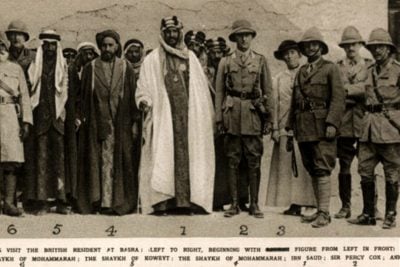
On 26 December 1915, Sir Percy Cox, on behalf of the British Government, signed the Treaty of Darin with Abdel Aziz Ibn Saud. Also known as the Darn Pact, the treaty made the lands of the House of Saud a British protectorate. The British aim of the treaty was to guarantee the sovereignty of Kuwait, Qatar and the Trucial States (later UAE). Abdul-Aziz vowed not to attack these British protectorates. He also pledged to enter WWI in the Middle East against the Ottoman Empire as an ally of Britain.

Britain’s signing of Darin Pact in December went against their promises of mutual protection made to Sharif Hussain in October; because Britain’s treaty with Ibn Saud does not oblige him to not attack the Hijaz.

The treaty also saw Abdel Aziz receiving £5000 per month ‘tribute’ from the British Government. After World War I, he received further support from the British. Support included substantially more monetary rewards and a glut of surplus munitions.

3. The Sykes-Picot Agreement 

On May 19, 1916, representatives of Great Britain and France secretly reached an accord, known as the Sykes-Picot Agreement. The accord aimed at dividing most of Arab lands under the Ottoman rule between the British and the French at the end of WWI. In its designated sphere, it was agreed, each country shall be allowed to establish such direct or indirect administration or control as they desire and as they may think fit.

Two diplomats, a Briton and a Frenchman, divided the map of one of the most volatile regions in the world into states that cut through ethnic and religious communities. The secret agreement largely neglected to allow for the future growth of Arab nationalism; which at that same moment the British government was using to their advantage against the Turks.

A century on, the Middle East continues to bear the consequences of the treaty. Many Arabs across the region continue to blame the subsequent violence in the Middle East, from the occupation of Palestine to the rise of the Islamic State of Iraq and the Levant (ISIL), on the Sykes-Picot treaty.

Indeed, Britain’s signing of this treaty went directly against what it promised to the Sharif of Hijaz in October of previous year. As we will see in Part II of this article, Britain’s betrayal of their promises of an independent Arab state eventually led them to unleash their attack dog, Ibn Saud, on Sharif Hussain and topple him. This allowed the British to effectuate the Sykes-Picot accord, and subsequently establish the Zionist state of Israel.

Read Part II

*

Note to readers: please click the share buttons above or below. Forward this article to your email lists. Crosspost on your blog site, internet forums. etc.

Author Rez Karim is an Electrical Engineer and Chief Editor at VitalColumns.com.

Featured image is from the authorThe original source of this article is Global ResearchCopyright © Rez Karim, Global Research, 2020


River to Sea Uprooted Palestinian   
The views expressed in this article are the sole responsibility of the author and do not necessarily reflect those of the Blog!