Showing posts with label Mosaddegh. Show all posts

Wednesday, 16 June 2021

On Nasser’s Fight for Arabic Independence and a Free Palestine


Visual search query image

Cynthia Chung

June 15, 2021

Nasser became the catalyst for an Arab Revolution for independence, a revolution that remains yet to be finished, Cynthia Chung writes.

In the 1950s the so-called enemy of the West was not only Moscow but the Third World’s emerging nationalists, from Gamal Abdel Nasser in Egypt to Mohammed Mossadegh in Iran. The United States and Britain staged a coup d’état against Mossadegh, and used the Muslim Brotherhood, a terrorist movement and the grandfather organization of the militant Islamic right, in an attempt to remove Nasser, the leader of the Arab nationalists.

In the 1960s, left wing nationalism and Arab socialism spread from Egypt to Algeria to Syria, Iraq and Palestine. This emergence presented a threat to the old imperialist game of Great Britain, to which the United States was a recent recruit of, and thus they decided to forge a working alliance with Saudi Arabia intent on using Wahhabi fundamentalism as their foreign policy arm in the Middle East, along with the Muslim Brotherhood.

This paper will go through the carving up of the Middle East under Sykes-Picot, the British creation of Saudi Arabia and Israel and the British occupation of Palestine, the origin of the Muslim Brotherhood and Nasser’s fight for Arab independence. In a follow-up paper, I will discuss the role of the City of London in facilitating the bankroll of the first Islamic fundamentalist state Saudi Arabia, along with the Muslim Brotherhood and its terrorist apparatus.

An “Arab Awakening” Made in Britain

The renunciation will not be easy. Jewish hopes have been raised to such a pitch that the non-fulfilment of the Zionist dream of a Jewish state in Palestine will cause intense disillusionment and bitterness. The manifold proofs of public spirit and of capacity to endure hardships and face danger in the building up of the national home are there to testify to the devotion with which a large section of the Jewish people cherish the Zionist ideal. And it would be an act of further cruelty to the Jews to disappoint those hopes if there existed some way of satisfying them, that did not involve cruelty to another people. But the logic of facts is inexorable. It shows that no room can be made in Palestine for a second nation except by dislodging or exterminating the nation in possession.”

– the concluding paragraph of George Antonius’ “The Arab Awakening” (1938)

Much of what is responsible for the war and havoc in the Middle East today has the British orchestrated so-called “Arab Awakening” to thank, led by characters such as E.G. Browne, St. John Philby, T.E. Lawrence of Arabia, and Gertrude Bell. Although its origins go as far back as the 19th century, it was only until the early 20th century, that the British were able to reap significant results from its long harvest.

The Arab Revolt of 1916-1918, had been, to the detriment of the Arab people, a British led rebellion. The British claimed that their sole interest in the affair was the dismantling of the Ottoman Empire and had given their word that these Arab territories would be freed and allowed independence if they agreed to rebel, in large part led and directed by the British.

It is a rather predictable feature of the British to lie and double cross and thus it should be of no surprise to anyone that their intentions were quite the opposite of what they had promised and thanks to the Sykes-Picot Russian leak, were revealed in their entire shameful glory.

If the Sultan of Turkey were to disappear, then the Caliphate by common consent of Islam would fall to the family of the prophet, Hussein ibn Ali the Sharif of Mecca, a candidate which was approved by the British Cairo office as suitable for British strings. T.E. Lawrence, who worked at the Cairo bureau is quoted as saying:

If the Sultan of Turkey were to disappear, then the Caliphate by common consent of Islam would fall to the family of the prophet, the present representative of which is Hussein, the Sharif of Mecca….If properly handled the Arab States would remain in a state of political mosaic, a tissue of jealous principalities incapable of cohesion…” (1)

Once the Arab Revolt was “won” against the Ottoman Empire, instead of the promised Arab independence, the Middle East was carved up into zones of influence under British and French colonial rule. Puppet monarchies were created in regions that were considered not under direct colonial subjugation in order to continue the illusion that Arabs remained in charge of sacred regions such as Mecca and Medina.

In central Arabia, Hussein, Sharif of Mecca, the puppet leader of the Arab Revolt laid claim to the title Caliph in 1924, which his rival Wahhabite Abdul-Aziz ibn Saud rejected and declared war, defeating the Hashemites. Hussein abdicated and ibn Saud, the favourite of the British India Office, was proclaimed King of Hejaz and Najd in 1926, which led to the founding of the kingdom of Saudi Arabia.

The Al Saud warriors of Wahhabism were a formidable strike force that the British believed would help London gain control of the western shores of the Persian Gulf.

Hussein ibn Ali’s son Faisal (under the heavy tutelage of T.E. Lawrence) was bestowed as King of Iraq and Hussein’s other son, Abdullah I was established as the Emir of Transjordan until a negotiated legal separation of Transjordan from Britain’s Palestine mandate occurred in 1946, whereupon he was crowned King of Jordan. (For more on this history refer to my paper.)

While the British were promising Arab independence they simultaneously were promising a homeland in Palestine to the Jews. The Balfour Declaration of November 2nd, 1917 states:

His majesty’s government view with favour the establishment in Palestine of a national home for the Jewish people, and will use their best endeavours to facilitate the achievement of this object…

Palestine had been seized by the British during the so-called Arab Revolt on December 11th, 1917 when General Allenby marched into Jerusalem through the Jaffa Gate and declared martial law over the city. Palestine has remained occupied ever since.

Britain would receive the mandate over Palestine from the League of Nations in July 1922.

Throughout the 1920s and 1930s violent confrontations between Jews and Arabs took place in Palestine costing hundreds of lives. In 1936 a major Arab revolt occurred over 7 months, until diplomatic efforts involving other Arab countries led to a ceasefire. In 1937, a British Royal Commission of Inquiry headed by William Peel concluded that Palestine had two distinct societies with irreconcilable political demands, thus making it necessary to partition the land.

The Arab Higher Committee refused Peel’s “prescription” and the revolt broke out again. This time, Britain responded with a devastatingly heavy hand. Roughly 5,000 Arabs were killed by the British armed forces and police.

Following the riots, the British mandate government dissolved the Arab Higher Committee and declared it an illegal body.

In response to the revolt, the British government issued the White Paper of 1939, which stated that Palestine should be a bi-national state, inhabited by both Arabs and Jews. Due to the international unpopularity of the mandate including within Britain itself, it was organised such that the United Nations would take responsibility for the British initiative and adopted the resolution to partition Palestine on November 29th, 1947. Britain would announce its termination of its Mandate for Palestine on May 15th, 1948 after the State of Israel declared its independence on May 14th, 1948.

The Rise of the Muslim Brotherhood

In 1869, a man named Jamal al-Din al-Afghani, the intellectual founder of the Salafiyya movement, went to India where British led colonial authorities welcomed him with honors and graciously escorted him aboard a government owned vessel on an all expenses paid voyage to the Suez. (2)

In Cairo he was adopted by the Egyptian prime minister Riad Pasha, a notorious enemy of the emerging nationalist movement in Egypt. Pasha persuaded Afghani to stay in Egypt and allowed him to take up residence in Cairo’s 900 year old Al Azhar mosque considered the center of Islamic learning worldwide, where he received lodging and a monthly government stipend (paid for by the British). (3)

In 1879, Cairo nationalists in the Egyptian Army, led by the famous Egyptian hero Ahmed ‘Urabi, organised an uprising against the British role in Egypt. Afghani was expelled from Egypt by the Egyptian nationalists that same year.

Ahmed ‘Urabi served as prime minister of Egypt briefly, from July 1882 to Sept 1882, however, his movement for Egyptian independence was eventually crushed by the British with the shelling of Alexandria in July 1882 followed by an invasion which resulted in a direct British occupation of Egypt that would last until 1956. It would be Gamal Abdel Nasser who would finally end British colonial rule of Egypt during the Suez Crisis, whereupon the Suez canal was nationalised and the British military bases expelled.

While Egypt was fighting its nationalist fight from 1879-1882, Afghani and his chief disciple Muhammad Abduh travelled together first to Paris and then to Britain, it was in Britain that they would make a proposal for a pan-Islamic alliance among Egypt, Turkey, Persia and Afghanistan against Czarist Russia (4).

In addition, the crisis in Sudan, was in the middle of a tribal religious rebellion against the British led by a man named Mohammed Ahmad a Sudanese sheikh who proclaimed himself the Mahdi, or savior, and was leading a puritanical Islamic revolt. (5)

What Afghani was proposing to the British was that they provide aid and resources to support his formation of a militant Islam sect that would favour Britain’s interest in the Middle East, in other words, Afghani wished to fight Islam with Islam, having stated in one of his works “We do not cut the head of religion except by sword of religion.”(6)

Although it is said that the British refused this offer, this is not likely considering the support Afghani would receive in creating the intellectual foundation for a pan-Islamic movement with British patronage and the support of England’s leading orientalist E.G. Browne, the godfather of twentieth century Orientalism and teacher of St John Philby and T.E. Lawrence.

E.G. Browne would make sure the work of Afghani would continue long beyond his death by immortalising him in his 1910 “The Persian Revolution,” considered an authoritative history of the time.

In 1888, Abduh, the chief disciple of Afghani, would return to Egypt in triumph with the full support of the representatives of her Majesty’s imperial force and took the first of several positions in Cairo, openly casting his lot with Lord Cromer, who was the symbol of British imperialism in Egypt.

Abduh would found, with the hold of London’s Egyptian proconsul Evelyn Baring (aka Lord Cromer) who was the scion of the enormously powerful banking clan (Barings Bank) under the city of London, the Salafiyya movement. (7)

Abduh had attached himself to the British rulers of Egypt and created the cornerstone of the Muslim Brotherhood which dominated the militant Islamic right throughout the twentieth century.

In 1899, Abduh reached the pinnacle of his power and influence, and was named mufti of Egypt.

***

In 1902, Riyadh fell to Ibn Saud and it was during this period that Ibn Saud established the fearsome Ikhwan (translated as “brotherhood”). He collected fighters from Bedouin tribes firing them up with fanatical religious zeal and threw them into battle. By 1912 the Ikhwan numbered 11,000 and Ibn Saud had both central Arabia’s Nejd and Al-Ahsa in the east under his control.

From the 1920s onward, the new Saudi state merged its Wahhabi orthodoxy with the Salafiyya movement (which would be organised into the Muslim Brotherhood in 1928).

William Shakespear, a famed British agent, forged the first formal treaty between England and Saudi Arabia which was signed in 1915, which bound London and Arabia for years before Saudi Arabia became a country. “It formally recognized Ibn Saud as the independent ruler of the Nejd and its Dependencies under British protection. In return, Ibn Saud undertook to follow British advice.” (8)

Harry St. John Bridger Philby, a British operative schooled by E.G. Browne and father to the legendary triple agent Kim Philby, would succeed Shakespear as Great Britain’s liaison to Ibn Saud under the British India Office, the friendly rival of the Cairo Arab Bureau office which was sponsoring T.E. Lawrence of Arabia.

In Egypt 1928, Hassan al-Banna (a follower of Afghani and Abduh) founded the Muslim Brotherhood (Ikhwan al-Muslimeen), the organization that would change the course of history in the twentieth century Middle East.

Banna’s Muslim Brotherhood was established with a grant from England’s Suez Canal Company (9) and from that point on, British diplomats and intelligence service, along with the British puppet King Farouq would use the Muslim Brotherhood as a truncheon against Egypt’s nationalists and later against Egyptian president Gamal Abdel Nasser.

To get the Muslim Brotherhood off the ground, the Suez Canal Company helped Banna build the mosque in Ismailia that would serve as its headquarters and base of operation. (10) The fact that Banna created the organization in Ismailia is itself worthy of note. For England, the Suez Canal was the indispensable route to its prize possession, India and in 1928 the town Ismailia happened to house not only the company’s offices but a major British military base built during WWI. It was also, in the 1920s a center of pro-British sentiment in Egypt.

In the post-WWI world, England reigned supreme, the flag of the British empire was everywhere from the Mediterranean to India. A new generation of kings and potentates ruled over British dominated colonies, mandates, vassal states, and semi-independent fiefdoms in Egypt, Iraq, Transjordan, Arabia and Persia. To varying degrees those monarchies were beholden to London.

In the half century between 1875 and 1925 the building blocks of the militant Islamic right were cemented in place by the British Empire.

Nasser Leads the Fight for Arab Independence

In 1942, the Muslim Brotherhood would earn their well-deserved reputation for extremism and violence by establishing the “Secret Apparatus,” an intelligence service and secret terrorist unit. This clandestine unit functioned for over twelve years almost entirely unchecked, assassinating judges, police officers, government officials and engaging in goon squad attacks on labor unions and communists.

Throughout this period the Muslim Brotherhood worked for the most part in an alliance with King Farouq (and thus the British), using their clandestine forces on behalf of British interests. And throughout its entire existence it would receive political support and money from the Saudi royal family and the Wahhabi establishment (more on this in part 2 of this series).

The Secret Apparatus would be smashed into pieces by Nasser in 1954.

After WWII, the faltering Farouq regime lashed out against the left in an intense campaign of repression aimed at the communists. The Cold War was beginning. In 1946, prime minister Isma’il Sidqi of Egypt who was installed as head of the government with the support of Banna, openly funded the Muslim Brotherhood and provided training camps for its shock troops used in a sweeping anti-left campaign. Sidqi resigned in Dec 1946 after less than one year as PM due to massive unpopularity.

As King Farouq began to lose his grip on the Egyptian people, the Brotherhood distanced itself while maintaining shadowy ties to the army and to foreign intelligence agencies and always opposed to the left.

The Palestine War (1947-1949) resulted in the establishment of the State of Israel at the cost of 700,000 displaced Palestinian Arabs and the destruction of most of their urban areas.

The territory that was under British administration before the war was divided between the State of Israel (officially formed May 14th, 1948), which captured about 78% of it. In opposition to Israel, the Kingdom of Jordan captured and later annexed the West Bank, and Egypt captured the Gaza Strip, with the Arab League establishing the All-Palestine Government, which came to an end in June 1967 when the Gaza Strip, along with the West Bank, were captured by Israel in the Six-Day War.

The Egyptian people were furious over these developments, and the reign of British puppet King Farouq who had done nothing to prevent the dismantling of Palestine was on extremely shaky ground. In response to this, Farouq’s accord with the Muslim Brotherhood broke down, and in December 1948, the Egyptian government outlawed the Muslim Brotherhood. Weeks later a Brotherhood assassin murdered prime minister Mahmoud El Nokrashy.

Two months later, in Feb. 1949, Banna was assassinated in Cairo by the Egyptian secret police.

For Arab nationalists, Israel was a symbol of Arab weakness and semi-colonial subjugation, overseen by proxy kings in Egypt, Jordan, Iraq, and Saudi Arabia.

On the night of July 23, 1952, the Free Officers, led by Muhammad Naguib and Gamal Abdel Nasser, staged a military coup that launched the Egyptian Revolution of 1952, overthrowing the British puppet monarch. The Free Officers, knowing that warrants had been issued for their arrest, launched the coup that night, storming the staff headquarters in Cairo.

Cairo was now, for the first time, under the control of the Arab people after over 70 years of British occupation.

The seizure of power by the Free Officers in Egypt came during an era when the entire Arab world from Morocco to Iraq was locked in the grip of imperialism. Morocco, Algeria, and Tunisia were French colonies; Kuwait, Qatar, Bahrain, the UAE, Oman and Yemen were British colonies. Iraq, Jordan and Saudi Arabia were kingdoms ruled by monarchies installed by London. And Egypt under King Farouq was the political and economic center of the Arab world.

A growing surge of Arab nationalism arose in response to the Free Officers’ actions in Egypt. The powerful Voice of the Arabs radio in Cairo was reporting to the entire Arab world that they had found their independence movement, and that Nasser was at its helm.

From 1956 to 1958 Iraq, Jordan and Lebanon underwent rebellions, Iraq’s king was toppled, and Syria united with Egypt in Nasser’s United Arab Republic, part of Nasser’s strategy to unify the Arab world.

In Algeria, moral and material support was given from Cairo towards the Algerian revolution that finally won them independence from French colonial rule in 1962.

That same year, Yemen underwent a Nasser-inspired revolt, triggering a proxy war pitting Saudi Arabia against Egypt, with Nasser stating in a 1962 speech, “Yemen’s fight is my fight. Yemen’s Revolution is our Revolution.”

Nasser’s leadership and the inspiration he stirred were so strong that even as late as 1969 the year before Nasser’s death, Libya’s king was overthrown and Sudan’s right-wing regime was eliminated by military leaders loyal to Nasser.

Nasser had managed to threaten the very heart of Anglo-America’s post-WWII strategy in the Middle East. Nasser understood, that if the vast oil fields in Saudi Arabia were under Arab control, the potential for an economic boom would be enormous for all Arab states, such that the old game of imperialism by Britain and France could no longer retain its chokehold on Arab independence.

Not only was Egypt a military rival to Saudi Arabia, not only did Cairo clash with Riyadh in a shooting war in Yemen, not only did Nasser inspire Arabs in Saudi Arabia with republican ideals but the Egyptian leader even won over some of Saudi Arabia’s royal family. This group was led by Prince Talal to form the ‘Free Princes’, which defected to Egypt demanding the establishment of a republic in Saudi Arabia!

What was really going on during the period of 1954 to 1970, under Nasser’s leadership, was a war between two competing visions for the future of the Middle East; an Arab world of independent but cooperative Arab republics utilising their natural resources to facilitate an economic boom in industrialisation vs a semi-feudal scattering of monarchies with their natural resources largely at the West’s disposal.

The real reason why the British and Anglo Americans wanted Nasser removed, was not because he was a communist or because he was susceptible to communist influence; it was because he refused to obey his would-be foreign controllers and was rather successful in this endeavour, bringing their shadowy actions uncomfortably close to the light and inspiring loyalty amongst Arabs outside of Egypt including those sitting on top of the oil.

What especially worried London and Washington was the idea that Nasser might succeed in his plan to unify Egypt and Saudi Arabia thus creating a major Arab power. Nasser believed that these oil wells were not only for the government of those territories to do with as they wished but belonged to all Arab people and thus should be used for the advancement of the Arab world. Afterall, most Arabs are aware that both the monarchies themselves and the artificial borders that demarcate their states, were designed by imperialists seeking to build fences around oil wells in the 1920s.

Nasser understood that if Cairo and Riyadh were to unite in a common cause for the uplifting of the Arab people, it would create a vastly important new Arab center of gravity with worldwide influence.

In 1954 Egypt and the United Kingdom had signed an agreement over the Suez Canal and British military basing rights. It was a short lived. By 1956 Great Britain, France and Israel concocted a plot against Egypt aimed at toppling Nasser and seizing control of the Suez Canal, a conspiracy that enlisted the Muslim Brotherhood.

In fact, the British went so far as to hold secret meetings with the Muslim Brotherhood in Geneva. According to author Stephen Dorrill, two British intelligence agents Col. Neil McLean and Julian Amery, helped MI6 organize a clandestine anti-Nasser opposition in the south of France and in Switzerland, (11) in his book he writes “They also went so far as to make contact in Geneva…with members of the Muslim Brotherhood, informing only MI6 of this demarche which they kept secret from the rest of the Suez Group [which was planning the military operation via its British bases by the Suez Canal]. Amery forwarded various names to [Selwyn] Lloyd, [the British foreign secretary].”

British prime minister Anthony Eden, Churchill’s handpicked successor, was violently anti-Nasser all along and considered a British coup d’état in Cairo as early as 1953. Other than such brash actions, the only political force that could mount a challenge to Nasser was the Muslim Brotherhood which had hundreds of thousands of followers.

Nasser’s long postponed showdown with the Muslim Brotherhood occurred in 1954, this was timed to add pressure during the rising frustration concerning the British-Egyptian negotiations over the transfer of the Suez Canal and its military bases to Egypt. The British, after over 70 years of direct occupation in Egypt, were not going to give up on one of their most prized jewels, their gateway to the Orient, so easily.

From 1954 on, Anthony Eden, the British prime minister was demanding Nasser’s head. According to Stephen Dorrill’s “MI6: Fifty Years of Special Operations”, Eden had ranted “What’s all this nonsense about isolating Nasser or ‘neutralising’ him, as you call it? I want him destroyed, can’t you understand? I want him murdered…And I don’t give a damn if there’s anarchy and chaos in Egypt.”

Nasser would not back down, and in the first few months of 1954 the Muslim Brotherhood and Nasser went to war, culminating in Nasser outlawing them as a terrorist group and a pawn of the British.

On Oct. 1954, a Muslim Brotherhood member Mahmoud Abdel-Latif attempted to assassinate Nasser while he was delivering a speech in Alexandria, which was live broadcasting to the Arab world by radio, to celebrate the British military withdrawal.

Panic broke out in the mass audience, but Nasser maintained his posture and raised his voice to appeal for calm, and with great emotion he exclaimed the following:

My countrymen, my blood spills for you and for Egypt. I will live for your sake and die for the sake of your freedom and honor. Let them kill me; it does not concern me so long as I have instilled pride, honor, and freedom in you.”

The crowd roared in approval and Arab audiences were electrified. The assassination attempt backfired, and quickly played back into Nasser’s hands. Upon returning to Cairo, he ordered one of the largest political crackdowns in the modern history of Egypt, with the arrests of thousands of dissenters, mostly members of the Brotherhood.

The decree banning the Muslim Brotherhood organization said “The revolution will never allow reactionary corruption to recur in the name of religion.” (12)

In 1967, there was a Six-Day War between Israel and the Arab states Egypt, Syria, Jordan and Iraq, which was started by Israel in a coordinated aerial attack on Egypt, eliminating roughly 90% of Egyptian air forces that were still on the ground, followed by an aerial attack on Jordan, Syria and Iraq. Israel then went on to conduct a ground attack with tanks and infantry, devastating whole Arab regions.

Despite the disastrous loss to Israel, the people of Egypt refused to accept Nasser’s resignation and took to the streets in a mass demonstration calling for Nasser’s return. Nasser accepted the call of the people and returned to his position as president where he remained as until his death in Sept 1970.

Five million people turned out on the streets of Egypt for Nasser’s funeral, and hundreds of millions more mourned his death throughout the world.

Although Nasser had devastatingly lost a battle, the Egyptian people along with their Arab compatriots understood that the fight for Arab independence was not lost. The dream of dignity and freedom, in forever opposition to the shackles of tyranny could not be buried now that it had been stirred to its very core. Nasser would be the catalyst for an Arab Revolution for independence, a revolution that remains yet to be finished.

This image has an empty alt attribute; its file name is chung_1-175x230.jpg

Also by this author

Cynthia CHUNG

Cynthia Chung is a lecturer, writer and co-founder and editor of the Rising Tide Foundation (Montreal, Canada).

A Damned Murder Inc: Kennedy’s Battle Against the Leviathan

The U.S. Pivot to Asia: Cold War Lessons From Vietnam for TodayReturn of the Leviathan: The Fascist Roots of the CIA and the True Origin of the Cold WarBeyond Oil: How the UAE’s HOPE Mars Mission Is Breaking the Arab World Out of the Crisis of Scarcity

Newspeak in the 21st Century: How to Become a Model Citizen in the New Era of Domestic Warfare


River to Sea Uprooted Palestinian   
The views expressed in this article are the sole responsibility of the author and do not necessarily reflect those of the Blog!

Thursday, 1 April 2021

Canada Ties to the U.S. Empire: Lester Pearson and the Myth of Canada as “Peaceable Kingdom” Part I

By Richard Sanders

Global Research, March 31, 2021

CovertAction Magazine 30 March 2021

All Global Research articles can be read in 51 languages by activating the “Translate Website” drop down menu on the top banner of our home page (Desktop version).

*

[T]here are two sides whose composition cuts across national and even community boundaries. The issues … can be described as freedom vs. slavery…. [T]wo powerful leaders of these opposed sides have emerged—the United States of America and the USSR.

We are faced now with a situation similar in some respects to that which confronted our forefathers in early colonial days when they ploughed the land with a rifle slung on the shoulder. If they stuck to the plough and left the rifle at home, they would have been easy victims for any savages lurking in the woods. ”

As Canada’s Minister of External Affairs, Lester Pearson delivered the above statements in his speech entitled “Canadian Foreign Policy in a Two Power World” to a joint meeting of the Empire Club of Canada and Canadian Club of Toronto. (April 10, 1951)

*

For centuries, self-righteous state myths have depicted the imperial Canadian project as a victory for democracy and human rights. Despite Canada’s long record of genocide, land plunder, and war profiteering, official narratives about noble “Canadian values” still reign in this imagined “peaceable kingdom.”

Canada’s ethnonationalist propaganda demonized First Nations as hostile sub-humans to be enslaved, imprisoned on reservations and made Christian in residential schools. This White-Power racism served imperialist containment policies designed to turn “Red Indian” enemies into captive nations.

By the early 1950s, then-external affairs minister Lester Pearson was pioneering a new containment policy. During the transition to the new world order of the Cold War, he rallied his powerful allies in Canada’s racist old-boys’ clubs.

Pearson’s status as a national hero was consolidated when he won the Nobel Peace Prize in 1957 for his role in helping to establish a UN peacekeeping force.

But Pearson was far from a progressive. In 1951, he compared the new Red Menace of communism to what he called “savages lurking in the woods.” These “savages,” he declared, had violently threatened the peaceful lives of innocent white Europeans whom he lovingly called “our forefathers.”

By conjuring unsettling images of a Red-Indian bogeyman, Pearson helped manufacture consent for a new, politically Red enemy to meet the needs of NATO’s capitalist powers.

On the home front, Pearson’s fierce anticommunism justified Canada’s systematic abuses of civil rights. As Ian MacKay and Jamie Swift note in Warrior Nation: “Pearson enthusiastically supported a Cold War against any Canadians suspected of viewing the world outside the newly hegemonic framework of the American imperium.”[1]

Headline in Toronto newspaper pointing to repressive political environment in the early Cold War. [Source: opentext.bc.ca]

Targeted for abuse by Canada’s Cold War elites were “peaceniks,” radical unionists and anyone branded as too leftwing. “Pearson had become an ever-more-aggressive accomplice,” said MacKay and Swift, “in government attacks on dissidents.”[2]

To Pearson and other Cold Warriors, the world was torn. As chief architect of Canada’s postwar anti-Red foreign policy, Pearson demonized the Soviet Union as the epicenter of evil. The USSR was still reeling after 27 million of its citizens had been killed by Hitler’s anti-communist crusade.

This is the cover of the Canadian edition (1947) of a U.S. comic by the Catechetical Guild Educational Society. [Source: coat.ncf.ca]

Anti-communist propaganda which Pearson echoed. [Source: coat.ncf.ca]

After the Red Army liberated Eastern Europe and led Germany’s defeat, the U.S. replaced the Nazis as global leaders in the war on communism. NATO efforts to destroy the USSR used Cold-War “containment” strategies: surrounding the Soviet Union with nuclear weapons, isolating it with political and economic sanctions, and vilifying it with propaganda. Pearson had a central role in this new phase of the West’s war on communism.

Lester Pearson, far right, with Halvard Lange of Norway and Gaetano Martino of Italy. They were known as the “Three Wise Men” who were ardent in supporting NATO. [Source: nato.int]

The Red Scare had been going on for decades. In Pearson’s youth during WWI and the First Red Scare (1914-20), Canada ran slave-labor, concentration camps that interned thousands of single immigrant men, mostly Ukrainians, who had been laid off from rural work camps. Elites feared their growing protests in urban centers might spark a socialist revolution.[3]

Ukrainians interned during World War I and the First Red Scare. [Source: infoukes]

And, in 1919, Canada was among thirteen countries that invaded newborn Soviet Russia with 150,000 troops to intervene in its civil war and reverse its revolution. Canada’s allies in the war, led by Admiral Alexander Vasilevich Kolchak, killed at least 100 civilians for every one killed by the Bolshevik Red Army, according to General William S. Graves, who headed the U.S. contingent.[4]

Members of the Canadian Army’s 67th Battery pose for a photo following the Battle of Tulgas, Russia, on November 11, 1918. [Source: ipolitics.ca]

During the Depression, when Pearson was a bureaucrat working closely with Canada’s prime minister, some 170,000 single, unemployed men were forced into remote work camps to prevent a potential revolution.[5]

One means of dismantling Canada’s prevailing peace mythology is to examine this country’s support for U.S. militarism throughout the Cold War. This study leads to the conclusion that little if anything has changed.

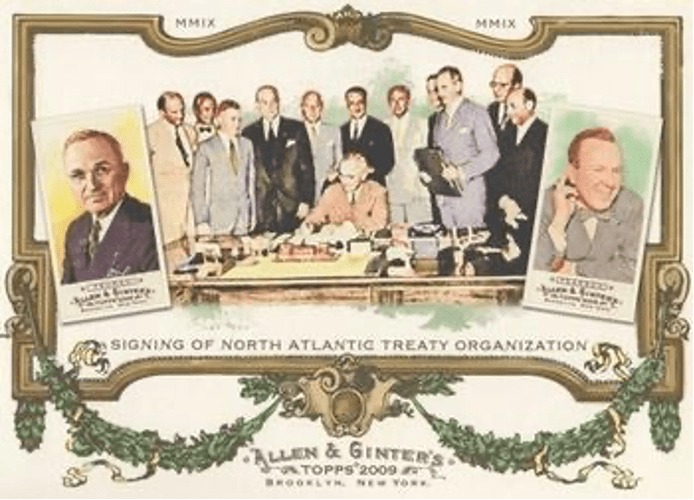
Plaque commemorating Pearson and Truman and signing of original NATO treaty in 1949. [Source: tcdb.com]

Always a stalwart NATO warrior giving solid allegiance to U.S.-led military, political, economic and propaganda warfare, Canada has taken leading roles in a new Cold War being waged by the American empire.

Lester Pearson at West Germany’s accession to NATO in 1955. [Source: nato.int]

Facing Canada’s history of duplicity is especially difficult because it means challenging the villainous hypocrisy of some of this nation’s most-beloved leaders. It also means confronting the powerful, political descendants of Canada’s much-glorified peace cult heroes, and debunking pernicious narratives that are still perpetuated, even by many mainstream progressives.

Pearson As Peace-Cult Hero and Cold-War Hatemonger

While state-sponsored myths have helped to create an institutionalized cult around Pearson, Canada’s beloved Nobel Peace Prize winner was actually a vociferous Cold Warrior. Besides using hateful anti-Red rhetoric to whitewash U.S.-backed wars, Pearson rallied support for various covert actions that squashed anti-colonial struggles in Africa, Asia and Latin America.

Canada’s largest political, corporate, religious and media institutions shared with their Western allies a fierce loathing for anyone who could be labelled communist. Their global crusade maligned all individuals, groups, parties, movements and governments that dared to threaten the freewheeling reign of predatory corporations. In Lester Pearson, these fear-mongering elites found a believable voice whose skilful devotion to Cold War tropes served their shared, vested interests.

Pearson was useful to British and American power elites because he leveraged Canada’s well-crafted reputation as a neutral “middle power” to cheerlead their neocolonial adventures. This included lending Canada’s respected voice to the ousting of elected, socialist-friendly governments that tried to limit the exploits of foreign corporations.

As Canada’s most influential confidence man, Pearson exuded faith in America’s supposed devotion to peace. “It is inconceivable to me that the United States would ever initiate an aggressive war,” said Pearson in 1955, and “it is also inconceivable that Canada would ever take part in such a war.”[6]

Captivated by the era’s extreme anti-communism, Pearson ignored Western war crimes. In fact, he artfully glorified these crimes with phobic narratives that painted assaults on democracy as if they were part of a noble, god-inspired plan to wipe communist evil off the face of the earth.

Before examining Pearson’s key role in leading Canada’s support for these American adventures, it is worth examining the cultural influences in his early life that helped create his pious devotion to Cold War causes.

The Early Origins of Pearson’s “Muscular Christianity”

That Pearson slipped so easily into sermonizing about the Red Menace can be explained largely by his ultrareligious upbringing. His father, and both grandfathers, were Methodist ministers. [NOTE: Not sure what a “staunch” Methodist minister is.]

Methodism, which was then Canada’s largest Protestant denomination, was central to the imperial project of spreading “Christian values” at home and abroad.

This religious exercise, to build the moral muscles of a global Anglo-based civilization, fixated on the Social Gospel movement. Its mission was to take up the “white man’s burden” and uplift atheist heathens and inferior races through such genocidal institutions as Indian Residential Schools.[7]

Pearson describes his maternal grandfather, Rev. Thomas Bowles, as “a pillar of the church and the Liberal party.” He had been elected county warden three times, township reeve (mayor) ten times, and was appointed first sheriff of Dufferin County, Ontario. Pearson notes that his paternal grandfather Rev. Marmaduke L. Pearson, one of the Methodist “church’s most distinguished divines,” was a devoted Tory who seemed to spend an inordinate amount of time thinking about and playing baseball, lawn-bowling and cricket.

This obsession was passed on to his sons, including Lester’s father, Rev. Edwin A. Pearson. He was described by historian John English, as “a strong imperialist” whose “three boys shared his enthusiasm for sports and the empire.”[8]

Lester Pearson (bottom left), at home in Hamilton, 1913, with brothers, parents and grandfather. His father and grandfather were both Methodist ministers who zealously supported British imperialism. [Source: coat.ncf.ca]

Pearson’s memoir also reveals the great influence of certain novels he found in his Sunday School library. “From its shelves I learned of life and adventure,” said Pearson, “through Horatio Alger, G.A. Henty and similar heroic books.”[9] Alger, a disgraced Unitarian minister who became one of the most popular novelists of the late 1800s, is best known for perpetuating the American dream’s “rags-to-riches” myth.

George A. Henty though, revealed Pearson, was “the author whom I knew the best among all English writers before I went to college.” [10] As a British war correspondent, Henty’s travels across Europe, the Middle East, Africa and Asia, were always sure to promote British imperialism. Throughout the late 19th and early 20th centuries, his work epitomized that blatantly jingoistic literary genre known as “imperial adventure fiction.”Canada’s Secret War: IRAQ – Ten Years After “Shock and Awe”

Henty’s books embodied the spirit of so-called “Muscular Christianity.” This Victorian movement glorified the pious athleticism and virile masculinity of tough, white saviors who would happily knock heads together (and kill if need be) for the glory of god, king, country and empire.

Always ready to save the brutish, lower-class savages from themselves, Henty’s heroes enthralled impressionable juveniles, like Pearson, who lapped up this macho vision of a missionizing, tough-love fundamentalism that was hopped up on just wars and imperial steroids.[11]  “To be a true hero,” explained Henty when interviewed, “you must be a true Christian.”[12]

Henty’s 122 novels were riddled with white supremacist heroes who spouted the era’s outrageously popular racist, sexist and anti-semitic beliefs. His books also targeted left-wing, cartoon villains from the ruthless labour leaders of striking English coal miners[13] to the eroticized socialist women who ran loose in the 1871 “Paris Commune.”[14]

Considering his class and the strong religious leanings of his family and community, it is not surprising that Pearson would be so captivated by Henty’s writings. While Pearson’s 1972 memoir offers no critique of Henty, it praises the author’s historical fiction for having provided a knowledge of the world that informed and inspired him throughout his political career:

“His exciting stories based on history’s more romantic episodes stirred my imagination mightily and, I suspect, had much to do with my liking for and concentration on history in my educational progress. When years later I traveled extensively abroad as Canada’s Secretary of State for External Affairs, there was hardly a place I visited which I had not known through that prolific but now almost forgotten writer of adventure stories for boys.”[15]

Pearson’s exceedingly sheltered childhood kept him cozy in the warmth of positive feelings for imperialism. “[T]he parish was my world,” he confessed. “As for the rest of the world, I thought about it … largely in terms of the British Empire which was looking after the ‘lesser breeds’ and keeping the French and Germans under control.”[16]

Admitting that his was “an absorbing mind rather than a questioning mind,” Pearson also disclosed that he had “a rather superficial approach to life.” His “limited” world, Pearson says, “did not broaden much” until 1913 when, at age 16, he entered Toronto’s Victoria College.[17]

Named for Queen Victoria, and founded by the Wesleyan Methodist Church in 1836, this was no breeding ground for radical thought; it was a hotbed of imperialist education.

Rather than freeing Pearson’s mind from its fetters, college life further narrowed Pearson’s “limited” worldview. And, it was here that Pearson first made contact with influential men who led him along the political path to power.

Victoria College was where he began what he called his “long and … rewarding association”[18] with Vincent Massey, a history lecturer and dean of the residence building which his family had built and furnished. Massey’s Methodist father, owning one of Toronto’s biggest industrial concerns, had close links to the highest echelons of the Liberal Party. Massey was already a good friend of Mackenzie King, who became Canada’s longest-standing prime minister.

Massey became one of Pearson’s most important Methodist mentors. His deeds included being a leader of Toronto’s Cecil Rhodes-inspired Round Table Society (1911-18); marrying Alice Parkin, daughter of Sir George Parkin, secretary of The Rhodes Trust (1915); being appointed to Prime Minister Mackenzie King’s cabinet war committee (1918) and to the Liberal cabinet (1925); being appointed Canada’s first envoy to the U.S. (1926-30) and its high commissioner to Britain (1930, 1935-46); being president of England and Wales’ National Liberal Federation (1932-35); being made Canada’s delegate to the League of Nations (1936) and being appointed to represent the Queen as Canada’s governor general (1952-59).[19]

Massey, who Pearson notes was “personal friends of the Royal Family, and … seemed to know every duke by his first name,”[20] was able to open doors for Pearson throughout his career. This included funding Pearson’s BA and MA studies at Oxford (1923-25).[21]

Pearson’s subservience to the moneyed interests of empire helped ensure his rise through the Department of External Affairs. He joined that bureaucracy in 1928, during the King government, but when Conservative Prime Minister Richard “Iron Heel” Bennett took power in 1930, “Pearson was a beneficiary.”[22]

Bennett, who was also a devout Methodist, earned his nickname after an inflammatory 1932 speech in which he said:

“What do these so-called groups of Socialists and Communists offer you? They are sowing their seeds everywhere…. [T]hroughout Canada this propaganda is being put forward by organizations from foreign lands that seek to destroy our institutions. And we ask that every man and woman put the iron heel of ruthlessness against a thing of that kind.”[23]

Crushing communism was clearly the order of the day, and Pearson was ambitious and eager to comply.

Talent-spotted by Bennett, Pearson was soon appointed to two royal commissions on economic issues. As journalism professor Andrew Cohen noted: “Pearson liked Bennett who treated him as a protegé.”

In early 1935, Pearson accompanied Bennett to London where they took part in the Jubilee to celebrate King George V’s 25-year reign. During their lavish sea voyage with its sumptuous cuisine, Pearson learned he would receive the Order of the British Empire and asked Bennett for a raise of $25 per week.[24]

This increase boosted Pearson’s salary by an extra $25,000 per year in today’s dollars. This was distasteful considering all those who were hungry for food and justice during the Great Depression.

Unmentioned by Cohen or Pearson is that, between 1932 and 1935, Bennett’s government rounded up 170,000 single, unemployed, urban men and forced them into slavery in army-run “Relief Camps.”

Army-run relief camp during Great Depression, designed to remove “red” agitators from the cities. [Source: sutori.com]

General Andrew McNaughton’s internment plan makes it clear why. “In their ragged platoons,” he explained to the cabinet, “here are the prospective members of what Marx called the ‘industrial reserve army, the storm troopers of the revolution.’”[25]

General McNaughton further told Bennett that “[b]y taking the men out … of the cities” and forcing them into remote work camps, “we were removing the active elements on which the ‘red’ agitators could play.”[26]

In 1935, Bennett approved Pearson’s posting to Canada’s High Commission in London. When Bennett was replaced by King, Pearson’s move was confirmed and he continued his climb, becoming second in command under High Commissioner Vincent Massey (1939-42).

In 1940, Pearson was recruited by Sir William Stephenson to be a “King’s messenger” carrying secret documents to Europe. Nicknamed “the Quiet Canadian,” Stephenson was the Canadian intelligence agent, codenamed “Intrepid,”[27] who inspired Ian Fleming’s fictional, anti-communist superspy, 007.[28]

James Bond was also the violently racist and sexist Cold War equivalent of the Victorian era’s manly, white, imperial adventure heroes, so admired by Pearson.

From London, Pearson was transferred to Washington, D.C., where he was Canada’s ambassador and envoy extraordinaire to the U.S. (1942-46).

After returning to Ottawa, he was appointed foreign minister for the last few months of Prime Minister King’s time in office (1948). When King’s protégé, Louis St. Laurent, took over, he retained Pearson as foreign minister (1948-57).

Pearson’s early decades of pliable innocence were over. Having been moulded and mentored into form by family, church, schools and government, he had thoroughly internalized the deceitful scripts of elite institutions.

But though he became a manager and manipulator in his own right, Pearson’s role on the global stage was still directed by external forces in Washington and London. While just following his social orders, Pearson’s acts of complicity in Cold War coups, wars, invasions and occupations cannot be excused. He was culpable for the criminality in which he willfully engaged. Let’s look at a few examples.

The Korean War and Its Planning, 1947-1953

Pearson was a strong supporter of the Korean War (1950-1953), which devastated the Korean peninsula and left a legacy of conflict and division that persists to this day.

Pearson considered the war part of a moral crusade against communism.

His understanding overlooked the fact that the northern communist regime, led by Kim Il-Sung, had led the fight against Japanese colonialism. By contrast, the southern regime, led by Syngman Rhee and dominated by Japanese colonial collaborators, killed over 100,000 of its own citizens and launched raids into the north, all of which provoked the onset of the war.

Image from Pyongyang museum of American war crimes depicting U.S. soldiers brutalizing North Koreans. [Source: peacehistory-usfp.org]

Pearson’s hawkish position contrasted with Prime Minister Mackenzie King’s, who said that “Canada should not automatically support the United States in all its endeavors.”[29]

Pearson also clashed with Defense Minister Brooke Claxton who opposed sending Canadian troops to Korea presciently because the U.S. was “getting [Canada] into something to which there is really no end.”[30]

When Pearson was dispatched to Washington to meet with President Harry S. Truman in 1948, he conspired behind the scenes with Truman to undermine King’s direct orders regarding the pursuit of an independent Canadian foreign policy, and assisted U.S. State Department officials in crafting a letter that urged King to support the Korean War.[31]

King’s successor, Louis St. Laurent, assisted the war effort by deploying a Royal Canadian Air Force (RCAF) squadron of transport planes to airlift U.S. troops, weapons and other materiel across the Pacific.

Canadian soldiers playing ice hockey, the national sport, on a rink they built in South Korea. [Source: bardown.com]

Military historian David Bercusson,[32] who continues to spread official narratives promoting this and other wars, wrote:

“Pearson was correct about what the Korean War meant in the global confrontation between Soviet Communism and the Western democratic powers and correct too in believing that Canada could not sit out the war if the Americans insisted that Canadian troops were needed. He was far wiser than Claxton in knowing this. With Pearson leading the way, Claxton came on board.”[33]

Pearson told St. Laurent that he supported troop deployments based on his anti-communist views about “the menace which faces us, … the expression of that menace in Korea, and the necessity of defeating it there by United Nations action.” Pearson’s efforts paid off. “St. Laurent came around,” said Bercusson, because “he and the nation really had little choice.”[34]

The speech St. Laurent gave over the radio announcing Canada’s commitment to the war was probably crafted in part by Pearson. It was deep in Orwellian newspeak:

“The action of the United Nations in Korea,” St. Laurent intoned, “is not war; it is police action intended to prevent war by discouraging aggression.” Since “the war to end all wars” had already come and gone 30 years hence, the Korean War was framed as “important to all of us who want to avoid another world war.” The need to “defeat the Communist aggressors in Korea,” said St. Laurent, was like fighting “fascist aggression” in WWII. He concluded his deceit with “We owe it to to ourselves, to each other, to our children, and each other’s children … to prevent the disasters of a third world war.”[35]

This launched Canada’s four-year collaboration—under the UN’s respectable cover—in a barrage of napalm-saturated bombings that slaughtered some three or four million Koreans.

This supposed non-war, also caused “six to seven million” more to be “rendered refugees,” says historian Jeremy Kuzmarov, who also notes that the onslaught destroyed “8,500 factories, 5,000 schools, 1,000 hospitals, and 600,000 homes.”[36]

Canadian troops marching in North Korea during a brutal 40-day U.S.-UN occupation. [Source: thecanadianencyclopedia.ca]

To aid and abet this mayhem, Canada supplied its good name, plus more than 20,000 troops (516 of whom died), numerous war planes, eight destroyers and a wealth of strategic minerals and military hardware.

Canadian troops after the Battle of Kapyong in April 1951. [Source: veterans.gc.ca]

In return, the St. Laurent government exploited the war as an excuse to vastly expand Canada’s army, navy and air force and to accelerate the production of jet fighters, jet engines, naval vessels, weapons, ammunition, radar and more.

“We are working in the closest co-operation with the United States,” said St. Laurent, so “that our joint resources and facilities are put to the most effective use in the common defence [sic] effort.” The government, he went on, was also “looking forward confidently to an acceleration and an intensification of our joint [military] production efforts” through the “U.S.-Canada industrial mobilization planning committee.”[37]

While devastating Korea itself, the Korean War sparked the blossoming of Canada’s military-industrial complex, which fueled its complicity in Cold War adventures for decades to come.

Similarly, anti-communism was harnessed by Western governments to repress the civil liberties of anti-war activists. Quebec’s “Padlock Law” (1937-57) made it illegal to copy, publish or distribute anything deemed pro-communist. Although the King and St. Laurent governments could have struck down this law, they didn’t. It was used against peace activists opposing the Korean War.

In May 1951, an “anti-subversion squad” raided a Montreal home where about thirty labor and civil rights activists were meeting with James Endicott, president of the Canadian Peace Congress. Literature was seized and male police invasively searched activists, including the women, who lodged a complaint to Pearson’s office, which did nothing.[38]

In January 1952, Endicott denounced the “Padlock Law” at a meeting in London, England. “Under American pressure,” he reported, Canada’s treason act had been amended “so that a cabinet committee can order secret arrests and hold people indefinitely and incommunicado without trial. They are doing that against peace workers.”[39]

Coup in Iran, 1953

Pearson’s foreign ministry supported the coup that installed Shah Mohammad Reza Pahlavi as Iran’s dictator in 1953.

This CIA/MI5-led coup ousted Mohammad Mosaddegh’s elected government after it dared to nationalize Iran’s UK-owned oil industry in March 1951. Although not a socialist, Mosaddegh worked with Iran’s communist party, Tudeh, which had played a key role in Iran’s struggle to gain control of its own oil resources.

As revealed by anti-war writer Yves Engler, Pearson “was not happy with the Iranian’s move”:

In May 1951 External Minister Lester Pearson told the House of Commons the “problem can be settled” only if the Iranians keep in mind the “legitimate interests of other people who have ministered to the well-being of Iran in administering the oil industry of that country which they have been instrumental in developing.”[40]

Mossadegh’s duly-elected government also angered Pearson. “In their anxiety to gain full control of their affairs by the elimination of foreign influence,” he told parliament, Iran had exposed itself “to the menace of communist penetration and absorption—absorption into the Soviet sphere.”[41]

As Engler notes, “Pearson did not protest the overthrow of Iran’s first elected prime minister” and three days after the coup, Canada’s ambassador expressed concern with what he called the “disturbing factor” of “the continued strength of the Tudeh party.”[42]

In response, the Shah’s CIA-trained secret police (SAVAK) quickly began arresting thousands of Tudeh members. By 1958, SAVAK torture and assassination campaigns had decimated Tudeh and other popular, democratic forces.[43] This “progress” allowed Canada to begin diplomatic relations with Iran in 1955.

By May 1965, when deposed Prime Minister Mossadegh was still under arrest, Pearson was prime minister and hosted the Shah’s state visit to Canada.

Upon his arrival in Ottawa, aboard a Canadian military plane, the Shah was greeted by Pearson, Foreign Minister Paul Martin, Sr., and Governor General George Vanier, who literally gave him the red-carpet treatment.

Vanier intoned “I greet Your Imperial Majesty as an able and valiant head of state and as a great leader with progressive policies,”[44] while Pearson said the Shah “had given outstanding leadership in bringing his country forward into the modern world.”[45]

During his eight-day visit to five cities, the Shah attended top-government meetings, inspected an honor guard, waved to the public, laid a wreath, spoke at press conferences and elite clubs, was feted at gala luncheons and black-tie dinners, dined privately at Pearson’s home, was honored at a state banquet and reception by Vanier in his palatial mansion, and was regaled by Canada’s mass media. Pahlavi and his Empress were a hit.[46]

Special police precautions were taken for fear of Iranian student protests, which the Shah “dismissed …  as the work of communists.”[47]

Summing up the visit, Pearson said it had “brought our two countries even closer together in our approach to problems of peace and the United Nations.”[48]

Coup in Guatemala, 1954

A CIA-led coup toppled Guatemala’s elected government and ushered in decades of dictatorships that killed about 200,000 people.

Diego Rivera painting, Glorious Victory, which depicts Secretary of State John Foster Dulles shaking hands over a pile of dead corpses with Castillo Armas who deposed Guatemala’s left-leaning president Jacobo Arbenz. CIA Director Allen Dulles stands next to the pair, his satchel full of cash, while Dwight Eisenhower’s face is pictured in a bomb. [Source: wikipedia.org]

As a U.S. State Department official said, Guatemala’s elected President Jacobo Arbenz—the target of the coup—had a “broad social program” to aid “workers and peasants in a victorious struggle against the upper classes and large foreign enterprises.”

This, he admitted, had “strong appeal to the populations of Central America.”[49] Arbenz was not allowed to pose the threat of a good example.

Even before Arbenz’s 1950 election, Ottawa’s trade commissioner in Guatemala had characterized him as “unscrupulous, daring and ruthless, and not one to be allayed in his aims by bloodshed or killing.”[50]

Prior to the coup, Arbenz’s Foreign Minister Guillermo Toriello asked Canada to allow embassies to open in their two countries.

Pearson’s department refused. “At external affairs and in Canadian board rooms,” said reporter Peter McFarlane, “the coup was chalked up as another victory of the Free World against the [Red] Menace.”[51]

Afterwards, U.S.-led counter-insurgency operations directed against left-wing rebels who sought to restore Arbenz’s political program benefited from the use of Canadian military hardware. The key U.S. warplanes used in this CIA operation were P-47 and F-47N fighter planes and C-47 and C-54 cargo planes. Owned and operated by the CIA, they were flown by American pilots.[52]

These aircraft in the CIA’s “Liberation Air Force” were powered by Wasp-series engines built in Montreal, Quebec, by Pratt & Whitney Canada (PWC).[53]

Throughout the 1980s, when the Guatemalan air force attacked villages, they employed U.S. Bell 212 and 412 helicopters—made famous in the Vietnam War—that were powered by PWC’s PT6T engines.[54]

PWC has long been one of the highest government-subsidized war industries in Canada. For example, between 1982 and 2006 it was Canada’s top corporate welfare recipient, raking in about $1.5 billion.[55]

Vietnam War, 1952-1974

From the beginning, Pearson was a gung-ho supporter of the Vietnam War. When France initiated the first Indochina War (1946-1954) in an attempt to reclaim its former colony, Pearson led Canadian efforts to supply weapons for use by French forces in Indochina (now Vietnam, Laos and Cambodia).[56]

This was done under the radar through NATO’s Mutual Aid Program. Between 1950 and 1954 alone, about $650 million (in 2021 dollars) worth of Canadian “armaments, ammunition, aircraft, and engines were transferred … to the Indochina war theatre.”[57]

In 1952, Pearson “okayed the deal” to allow Canadian arms, sold to France for use in Europe only, to be diverted to Indochina. This materiel included “antitank and anti-aircraft guns, ammunition, rangefinders and telescopic sights.” Behind the cabinet’s back, Pearson decided that arming France’s Indochina War was lawful because it “help[ed] assure the preservation of peace.”[58]

In one of Pearson’s many 1951 tirades affirming his support for that war, he suggested that if the independence of Indochina were to fail, “all of South-East Asia, including Burma, Malaya and Indonesia, with their important resources of rubber, rice and tin, might well come under communist control.”[59]

Pearson at the same time was claiming in the early 1950s that the “‘Soviet colonial authority in Indochina’ appeared to be stronger than that of France.” Considering that there was “not a Russian anywhere in the neighborhood,” Noam Chomsky wrote, “[o]ne has to search pretty far to find more fervent devotion to imperial crimes than Pearson’s declarations.”[60]

Pearson’s collaboration in the Vietnam War included his backing of Canadian government collaboration in “spying, weapons sales, and complicity in the bombing of the North.”[61]

Many Canadians believe the myth today that Pearson helped keep Canada out of the Vietnam War. However, 40,000 Canadians joined the U.S. armed forces during the war.[62] This was 50% more than the 26,000 Canadian soldiers who had served in Korea.

In 1954, when Pearson was minister of external affairs, he helped gain American backing for Canada’s bid for a seat on the International Control Commission (ICC)—whose purpose was to enforce the 1954 Geneva accords.

Pearson served as the handler of Canada’s ambassador to the U.S., Arnold Heeney, who forged an agreement with U.S. Deputy Undersecretary of State Robert Murphy, that Canada would illegally supply the U.S. with secret intelligence obtained through its involvement in the ICC mission.[63]

Canada’s best-known ICC spy was Blair Seaborn, a long-time friend of America’s ambassador to South Vietnam, Henry Cabot Lodge, Jr. In late April 1964, U.S. Secretary of State Dean Rusk met Prime Minister Pearson and External Affairs Minister Paul Martin, Sr., to discuss the “Seaborn Mission.” A month later Pearson conveyed to Johnson his “willingness to lend Canadian good offices to this endeavour.”

The Pentagon Papers later revealed that Pearson told Johnson at this meeting that, although he “would have great reservations about the use of nuclear weapons,” in Vietnam, America’s “punitive striking” with “iron bomb attacks” (i.e., unguided, air-dropped conventional munitions) was fine.[64]

Seaborn conveyed U.S. threats to the North Vietnamese that, unless they surrendered, the U.S. would unleash massive military attacks.

Seaborn also “gathered intelligence for U.S. authorities” on many strategic issues that aided and abetted America’s war. The Pentagon Papers showed that the U.S. informed Canada, seven months in advance, of closely guarded U.S. plans for a major bombing campaign against the north in December 1964.[65]

Victor Levant’s groundbreaking book, Quiet ComplicityCanadian Involvement in the Vietnam War (1986), reveals that Pearson’s government (he was prime minister from 1963 to 1968) was aiding and abetting domestic war industries to cash in on the bonanza.

This was despite the fact that, as a member of the ICC, one of Canada’s duties was “to restrict the entry of arms into Vietnam from anywhere.”[66] But, said Levant, “[f]ar from trying to curtail U.S. purchases of Canadian military equipment, the government in Ottawa actively encouraged the process” with grants to so-called “defense industries” between 1964 and 1968, that were worth just over $1 billion in 2021 dollars.[67]

This investment of taxpayers’ money paid off, at least for Canadian corporations that received over $2.16 billion (in 2021 dollars) “in 1965 [alone] by making military equipment, ranging from green berets to airplanes, for the U.S. war effort in Vietnam.”[68]

Prime Minister Pearson tried to absolve himself and the government of complicity in this war profiteering by claiming in 1967 that Canada could not determine the whereabouts of military equipment purchased in Canada by the U.S., though he conceded that a “small percentage of Canadian arms could be reaching the battlefield in Vietnam.” [69]

While cheered by virulently anti-communist groups, Pearson became a main target of the anti-war protesters who carried banners that read “End Canadian complicity in Viet Nam War,” “Pearson accomplice in genocide” and “Accomplice in mass murder.” A chant that was familiar in those days,was “Pearson, Martin, LBJ, how many kids did you kill today?”[70]

On the nation’s 100th anniversary (July 1, 1967) in Montreal, when thousands marched to protest Canada’s role in the Vietnam War, French chants included “Johnson assassin. Pearson Complice.”[71]  The fact that Pearson was an accomplice to mass murder in Vietnam was then well known to the peace movement. This institutional memory has now been all but erased.

*

Note to readers: please click the share buttons above or below. Forward this article to your email lists. Crosspost on your blog site, internet forums. etc.

Richard Sanders is an anti-war activist and writer in Canada. In 1984, he received an MA in cultural anthropology and began working to expose Canada’s complicity in U.S.-led wars. In 1989, he founded the Coalition to Oppose the Arms Trade (COAT), which led to a 20-year municipal ban on Ottawa’s arms bazaars. Richard can be reached at overcoat@rogers.com

Notes

[1] Ian MacKay and Jamie Swift, Warrior Nation: Rebranding Canada in an Age of Anxiety, 2012, p. 128.

[2] Ibid., p. 118.

[3] Richard Sanders, “War Mania, Mass Hysteria and Moral Panics,” Captive CanadaPress for Conversion!, March 2016, pp. 5-14. http://bit.ly/RedScare-1

[4] See Jeremy Kuzmarov and John Marciano, The Russians Are Coming, Again: The First Cold War as Tragedy, the Second as Farce (New York: Monthly Review Press, 2018).

[5] Richard Sanders, “Left-Right Camps: A Century of Ukrainian Canadian Internment,” Captive Canadaop. cit., pp. 40-55. https://coat.ncf.ca/P4C/68/68_40-55.htm

[6] Lester Pearson, Statements and Speeches, 55/10, March 24, 1955, cited by Levant, op. cit., pp. 12-13.

[7] Richard Sanders, “The Occupation(al) Psychosis of Empire-Building Missionaries,” Captive Canadaop. cit., pp. 18-19.https://coat.ncf.ca/P4C/68/68_18-19.htm

[8] John English, “Pearson, Lester Bowles,” Dictionary of Canadian Biography, 2003- http://bit.ly/EdwinP

[9] Lester Pearson, Mike: The Memoirs of the Rt. Hon. Lester B. Pearson, Vol.1, 1972, p. 10.

[10] Ibid.

[11] For more on this genre and its Canadian exemplar, Charles Gordon, see Richard Sanders, “Religious Guardians of the Peaceable Kingdom: Winnipeg’s Key Social-Gospel Gatekeepers of Canada West,” Captive Canada op. cit., pp. 22-29. https://coat.ncf.ca/P4C/68/68_22-29.htm

[12] Ray Van Neste, Review of The Boy’s Guide to the Historical Adventures of G. A. Henty, March 3, 2006. http://rayvanneste.com/?p=686

[13] G.A. Henty, Facing Death: A Tale of the Coal Mines, 1883. https://books.google.ca/books?id=rRcCAAAAQAAJ

[14] Matthew Beaumont, “Anti-Communism and the Cacotopia,” Utopia Ltd.: Ideologies of Social Dreaming in England 1870-1900, 2005, pp. 152-154. https://brill.com/view/book/9789047407096/BP000006.xml

G.A. Henty, Woman of the Commune: A Tale of Two Sieges of Paris, 1895. https://books.google.ca/books?id=9mZWAAAAMAAJ

[15] Pearson 1972, op. cit., p. 10.

[16] Ibid., p. 15

[17] Ibid., pp. 14-15.

[18] Ibid., p. 15.

[19] Claude Bissell, The Young Vincent Massey, 1981, passim.

[20] Pearson 1972, op. cit., p. 105.

[21] Ibid., p. 45.

[22] Andrew Cohen, Lester B. Pearson, 2008.

[23] Thomas Green, “Bennett Raps Socialism, Communism,” Saskatoon Star-Phoenix, Nov. 10, 1932, p. 5. https://www.newspapers.com/image/508724453

[24] Cohen 2008, op. cit.

[25] Canada: A People’s History, Vol. 2http://books.google.ca/books?id=2fcXAAAAYAAJ

[26] In Jean Barman, The West Beyond the West: A History of British Columbia, 1991. http://books.google.ca/books?id=JbYe6fCOSTAC

[27] A Man Called Intrepid: The Incredible True Story of the Master Spy Who Helped Win WWII, 1976, pp. 191, 216.

[28] Guy F. Burnett, “Ian Fleming’s Coldest Warrior: The Anticommunist Origins of James Bond,” Dissident, Nov. 17, 2015. http://bit.ly/antiRedBond

(The above archived article, from the anti-communist, “Victims of Communism Memorial Foundation” website, celebrates both Fleming and his Bond character as those “who fought to save the world from tyranny and oppression.”

[29] Pearson 1972, p. 139.

[30] David Jay Bercuson, Blood on the Hills: The Canadian Army in the Korean War, 1999, pp. 31-32. https://books.google.ca/books?id=eCizi80V1M0C

[31] Pearson 1972, op. cit., pp. 140-141. https://books.google.ca/books?id=nXM2CwAAQBAJ&pg=PA140

[32] Bercuson is a director of two right-wing, Calgary-based think tanks, the Centre for Military and Strategic Studies (funded by the Canadian war department’s “Security and Defence Forum”), and the Canadian Defence and Foreign Affairs Institute (which has accepted funding from General Dynamics and publicly promoted the company’s exports of major Canadian-made weapons systems, such as LAVs, to Saudi Arabia.

[33] Ibid., p. 33.

[34] Ibid.

[35] “St. Laurent Text on Resisting Reds,” Windsor Daily Star, August 8, 1950, p. 14.

https://www.newspapers.com/clip/72910987/the-windsor-star/

[36] Jeremy Kuzmarov, “The Korean War: Barbarism Unleashed,” United States Foreign Policy, History and Resource Guide website, 2016. http://peacehistory-usfp.org/korean-war/

[37] Windsor Daily Starop. cit.

[38] See author’s collection of seven newsclips, May 25-28, 1951.

[39] “Says working for peace in America hard,” Ottawa Citizen, Jan. 10, 1952, p. 10.

https://www.newspapers.com/clip/73516103/the-ottawa-citizen/

[40] Engler 2012, citing Pearson, Hansard, May 14, 1951, 3002.

[41] Lester Pearson, Hansard, Oct. 22, 1951, p. 253, cited by Engler, op. cit., pp. 75.

[42] Engle, ibid., p. 76.

[43] Ervand Abrahamian, Tortured Confessions: Prisons and Public Recantations in Modern Iran, 1999, pp. 89-101. http://bit.ly/SAVAK-Tudeh

[44] “Shah, Empress in Ottawa,” Ottawa Journal, May 19, 1965, p. 1. https://www.newspapers.com/clip/73543166/the-ottawa-journal/

[45] “Shah starts visit,” Ottawa Citizen, May 19, 1965, p. 1. https://www.newspapers.com/clip/73528451/the-ottawa-citizen/

“Shah in Canada,” Ottawa Citizenibid., p. 3. https://www.newspapers.com/clip/73534362/the-ottawa-citizen/

[46] “Shah has busy schedule here,” Ottawa Citizen, May 17, 1965, p. 3. https://www.newspapers.com/clip/73524704/the-ottawa-citizen/

“Shah of Persia in Canada, 1965.” https://www.britishpathe.com/video/shah-of-persia-in-canada

(Note: These film clips from the Shah’s visit include footage of the state dinner with Governor General Vanier at Rideau Hall.)

[47] “Shah in capital,” Ottawa Citizen, May 19, 1965, p. 3. https://www.newspapers.com/clip/73534362/the-ottawa-citizen/

[48] “Royal Visits Top News Events,” Brandon Sun, May 31, 1965, p. 12. https://www.newspapers.com/clip/73525463/the-brandon-sun/

[49] Cited by Noam Chomsky, Deterring Democracy, 1991, p. 419. http://bit.ly/Chomsky1991

[50] James Rochlin, Discovering the Americas: Evolution of Canadian Foreign Policy towards Latin America, 1994, p. 35. http://bit.ly/Roch94

[51] Peter McFarlane, Northern Shadows: Canadians in Central America, 1989, pp. 98, 100, cited by Engler op. cit., p. 79.

[52] Guatemala: Air Force History

http://www.aeroflight.co.uk/waf/americas/guatemala/Guatemala-af-history.htm

[53] Pratt & Whitney Canada ; http://bit.ly/PWC-WASP; Republic P-47 Thunderbolt

https://en.wikipedia.org/wiki/Republic_P-47_Thunderbolt; Douglas C-47 Skytrain [Dakota]

https://en.wikipedia.org/wiki/Douglas_C-47_Skytrain#Postwar_era; Douglas C-54 Skymaster

https://en.wikipedia.org/wiki/Douglas_C-54_Skymaster

[54] Pratt & Whitney Canada PT6T  https://en.wikipedia.org/wiki/Pratt_%26_Whitney_Canada_PT6T

Bell 212 in Fuerza Aerea Guatemalteca (Guatemalan Air Force) 1980 to present https://www.helis.com/database/modelorg/Guatemala-Bell-212/

Bell 412 in Fuerza Aerea Guatemalteca (Guatemalan Air Force) 1982 to present https://www.helis.com/database/modelorg/Guatemala-Bell-412/

[55] Mark Milke, Corporate Welfare: A $144 billion addiction, Nov. 2007. https://www.fraserinstitute.org/sites/default/files/corporate-welfare-a-144-billion-addiction.pdf

[56] Levant, op. cit., p. 42

[57] Ibid., p. 43

[58] Levant, op. cit., p. 43 [NOTE: I believe “Idem.” in italics would be appropriate here.]

[59] Chomsky 2012, op. cit., p. 9.

[60] Noam Chomsky, “Imperial Presidency,” Canadian Dimension, Jan/Feb 2005. http://bit.ly/CDchom

[61] Noam Chomsky, Foreword, in Yves Engler, Lester Pearson’s Peacekeeping: The Truth May Hurt, 2012, p. 8.

[62] Ryan Goldsworthy, “The Canadian Way: The Case of Canadian Vietnam War Veterans,”  http://www.journal.forces.gc.ca/vol15/no3/page48-eng.asp

[63] James Eayrs, In Defence of Canada: Indochina – Roots of Complicity, 1983, pp. 242-243, cited in Levant, op. cit., p. 193.

[64] Levant, op. cit., pp. 178-79.

[65] Ibid., p. 178

[66] Harry Trimborn, “Canada-US Tieup? Some Other Time!” Los Angeles Times, Aug. 23, 1966, p. 82.  https://www.newspapers.com/clip/73697853/the-los-angeles-times/

[67] Levant, op. cit., p. 57.

[68] Trimborn, op. cit.

(Note: The article noted a figure of $260 million, which the Bank of Canada, when corrected for inflation, says is worth $2,164,578,313.25 in 2021 dollars.)

[69] Lester Pearson, Statements and Speeches, March 10, 1967, Levant, ibid.

[70] Alex Young, “Heavy guard for PM: ‘Vietniks’ at airport, club,” Province, Mar. 31, 1967, p. 1 https://www.newspapers.com/clip/73069053/the-province

Peter Loudon, “Like French Revolution Some Feast Others Chant,” Times Colonist, Apr. 1, 1967, p. 2. https://www.newspapers.com/clip/73616904/times-colonist/

(Note: This article, covering a protest the next day outside a gala banquet attended by Pearson, notes the same “Pearson, Martin, LBJ…” chant.  The reporter mocked the protesters’ appearance, and said they were “denouncing Canada’s alleged support of the US in Vietnam.” Emphasis added.)

[71] Nick Auf der Maur, “Vietnam Protesters March Through City, Montreal Gazette, July 3, 1967, p. 3. https://www.newspapers.com/clip/73067312/the-gazette/

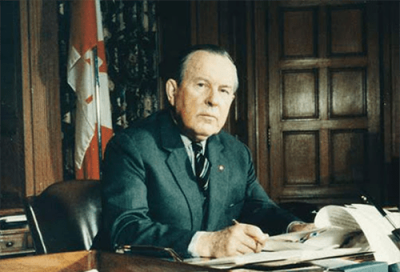
Featured image: Former Canadian Secretary of State for External Affairs (1948-1957), Lester B. Pearson, at his desk in Ottawa. As leader of Canada’s Liberal Party, he served from 1958 to 1968. [Source: journal.forces.gc.ca]


River to Sea Uprooted Palestinian   
The views expressed in this article are the sole responsibility of the author and do not necessarily reflect those of the Blog!