Showing posts with label Ahmad Shafiq. Show all posts

Wednesday, 28 November 2012

Pumped: "Two cheers for Mursi! Now let's get to work."

I poster the the pumped article on June 12, 2012

"If the Muslim Brotherhood's Mursi wins and he will, the Muslim Brotherhood will be in charge -- and be forced to deliver." Elliott Abrams

AND THEY DELIVERED HAMAS

 "And when they fail, as they will,"......Elliott Abrams


Abrams summarises his thesis in an AIPAC e-mail to donors: "So as far as Israel is concerned, a Mursi victory should not be mourned; given the situation in Egypt, in this election we can assure that the loser will pity the winner.


=====================

Zionists eager for Mursi

Instead of embracing a Mubarak throwback, the Zionist lobby is warming to Mohamed Mursi in Egypt's presidential race, sure he will fail miserably and carry the blame, writes Franklin Lamb from Beirut

Two faces of the Same Shekel
 "Our enemy and your enemy is one"
"The Syrian regime must change, or it will be changed" 
The results of the opening round of the historic Egyptian presidential elections, the first ever in Mother Egypt where the results were not known in advance, present an encouraging snapshot of a "new democratic Egypt". The two candidates that will face each other in the 16-17 June final round of voting will be the Muslim Brotherhood's Mohamed Mursi (who got 25 per cent of the first round vote) and Mubarak-era prime minister Ahmed Shafik (who took 24 per cent).
Mursi and Shafik represent very different strands of Egyptian society. Shafik will continue to draw his support from people fearful of an Islamist takeover, and those exhausted by the upheavals of the past 16 months.
Both finalists will carry substantial political baggage into round two. While Mursi will have the vast and competent Muslim Brotherhood organisation working during the next two weeks to get out the vote for him, as well as the support of most Islamist parties, his candidacy still faces pervasive voter doubt over having the long outlawed Muslim Brotherhood control both the Egypt's parliament and its presidency. Egyptian voters appear to be worrying that this kind of broad power is too similar to the Mubarak era and also eliminates checks and balances needed to moderate the Muslim Brotherhood's pledge to enact Sharia law and to honour its commitment to scrap military rule.
The following statement by the Muslim Brotherhood's Mursi, delivered just last week at a Cairo University campaign rally, is raising concern: "The Quran is our constitution, the Prophet is our leader, jihad is our path, and martyrdom in the service of God is our goal. We shall enforce Islamic Sharia, and shall accept no alternative to it."
Israel and the US will back Shafik in various ways and he will benefit from the view that he represents Egypt's military, many of the country's wealthy and powerful and more conservative voting blocs, the business community, Coptic Christians (roughly 10 per cent of the voters) who understandably seek security above all else, and many others who will vote for what they calculate to be the lesser of two evils.
Yet barring surprises such as ex-president Hosni Mubarak being found innocent of all charges on 2 June when the verdict is to be announced in his case, which many lawyers are predicting is exactly what will happen, Mursi will very likely prevail in the mid-June run-off and become Egypt's first democratically elected president.
Many Middle East analysts, including American University of Beirut professor of political sociology Sari Hanafi, believe this result will be good for the more than five million Palestinian refugees in the Diaspora, those still under Zionist occupation in their own country, and welcomed by all who advocate the Palestinians' full return to their as yet occupied country.
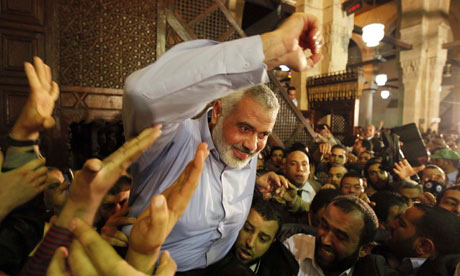
Hamas leader Ismail Haniyeh is carried by supporters
 In Al-azher: Haniyeh climaxed with explicit
support for the people of Syria against a brutal regime.
To the Gaurdian: I would like to reiterate on behalf of my people
our sincere desire to live in security and stability,
without wars and bloodshed..We do not want more blood.
The prime minister of the Palestinian government in Gaza, Ismail Haniyeh, declared Thursday that "the Egyptian presidential election results will have a very positive affect on the course and future of the Palestinian cause as well as the role and place of the Muslim people in the world."
Haniyeh knows that the Muslim Brotherhood, from which Hamas evolved, is highly sophisticated politically and while it tries to avoid attracting condemnation, or worse, from Washington and Tel Aviv, the Muslim Brotherhood's intentions regarding Camp David, giveaway gas and other deals with Israel, and even diplomatic relations with the occupiers of Palestine are clear. A majority of Egyptians believe all will eventually be discarded, as will the sole remaining 19th century colonial enterprise itself.
"We promised them
with every revolution to rejoice
their defeat
and
our next gloat will be soon
from free Damascus,
God willing, that's a promise!"
Hamas officials have also acknowledged that they are looking more to Egypt and the Brotherhood for support as they move away from Syria, and a top Hamas official, Moussa Mohamed Abu Marzouk, settled in Cairo after fleeing the unrest in Syria and maintains close ties with the Brotherhood.
Mursi has a long history of criticism of Israel's treatment of the Palestinians. He has referred to Israel's foreign minister, Joseph Lieberman, as a "vampire" and the settler movement as "Draculas". Mursi has also criticised Fatah leader Mahmoud Abbas for what he called gullible collaboration with Israel, for believing they would voluntarily accept a Palestinian state, and he has praised Hamas for resisting the Israeli occupation.
Brotherhood leaders have said they intend to use their influence with both Fatah and Hamas to urge them to compromise with each other to press Israel to recognise a Palestinian state. "The Brotherhood will gently pressure Hamas to be more pragmatic, although that is a direction in which Hamas is already moving," according to Shadi Hamid of the Brookings Doha Centre.
Speaking with Muslim Brotherhood representatives in Cairo and Beirut over the past several months, the party's position expressed to this observer is that the common thread that stitches together all the continuing regional uprisings can be described as a fundamental quest for dignity and the casting off of humiliation, either from Western imposed despotic regimes or from their illegitimate and aggressive agent, Israel.
Even before the completion of Egypt's first democratic elections, which long-time election monitor Jimmy Carter labelled "very encouraging" there is broad recognition in Egypt that basic dignity demands the return of Palestine and its holy places, not just to the 1.5 billion Muslims and nearly as many Christians worldwide, but to all people of good will.
While no official Muslim Brotherhood decisions have been published regarding relations with Gaza and occupied Palestine, signs are everywhere from non-enforcement of Mubarak-Israeli-US pressures on Rafah, Gaza, travel and trade prohibitions, that full normalisation of relations between Egyptians and Palestinians under occupation is imminent. And Israel and its American lobby know it and are preparing.
On Capitol Hill, and among the more than 60 intensively active and well-funded pro-Zionist organisations in the US, a campaign has already begun to neuter the Egyptian voter's choice next month, as surely as was achieved during the three decades of Mubarak rule. A couple of examples. AIPAC (the American Israel Public Affairs Committee) has launched a campaign to have the Obama administration, during the run-up to the coming US election, now barely six months away, demand three things from the Mursi presidency: "that the Muslim Brotherhood scrap key elements of its political programme and disassociate itself from 'Islamism'; that it publicly pledge to fight 'terrorism' ie the Palestinian and Lebanese resistance, and that the Muslim Brotherhood pledge in writing to fully abide by the Camp David Accords."
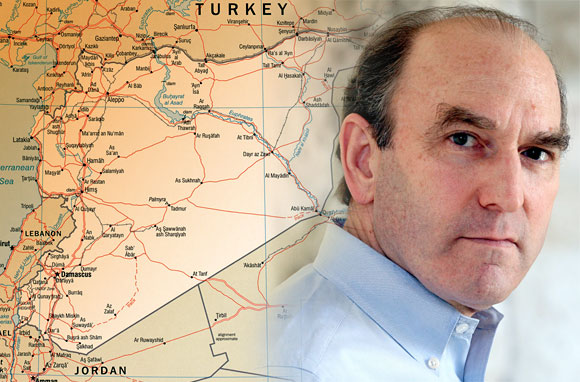
Elliott Abrams’ Plan For Syria
Washington, according to Israel, must insist that Egypt not only maintain its peace treaty with Israel, but Obama must tell the Brotherhood that any referendum on the Camp David Accords will be interpreted by the US as an attempt to destroy that agreement. According to Israeli government water carrier Dennis Ross, "In recent conversations, Brotherhood leaders have expressed their belief that they would not be blamed if the treaty were revoked by a nationwide vote, as seems likely. They need to be told otherwise."

When measured against what the Muslim Brotherhood stands and has struggled for since its founding in 1928 by the Islamic scholar and schoolteacher Hassan Al-Banna, as well as the growing demands of the Egyptian public coupled with regional pleas for Egypt's new government to restore Arab and Muslim dignity, these Israeli-US demands are patently absurd.

Ever in the service of Israel, Elliot Abrams, writing in the Zionist Islamophobic Weekly Standard, is proposing an approach that appears as fanciful and misguided as his WMD 2002-3 schemes to get the US to attack Iraq on behalf of Israel or his continuing five year campaign to get the US to bomb Iran for Israel.

Abrams is arguing recently, apparently seriously, that since the Muslim Brotherhood will be Egypt's new government, Israel can still prevail if his advice is followed. Obviously unhappy with the prospect of the Muslim Brotherhood governing Egypt, Abrams does what he is paid to do for Israel -- he metaphorically paints pigs hoping they will look like princesses.

He is publicly blaming the US for not "standing by the Mubarak regime like the Russians are with Syria's [regime]." He declared: "Had Mubarak and the army played their cards better, Shafik might have been Mubarak's successor without the harmful uprising that Egypt has experienced. Egypt's peace treaty with Israel with all its blessings would be secure. Now, unless Shafik wins, Camp David is finished but we still have some excellent options." It is unclear who Abrams is speaking about when he says, "we".

Abrams and elements of the Zionist lobby are telling Congress that "Israel must support Egypt's 'liberals' meaning, people who believe in democracy, liberty, and the rule of law rather than Islam as the guiding principles of Egypt and that the predicate must be that the electorate believes the Muslim Brotherhood had a clear chance and failed them." He continued: "If Shafik were to win many Egyptians will believe the elections were stolen by the army and the old regime's machine, and in any event power will be divided between the Muslim Brotherhood, on the one side, and the army and president on the other. There will be no clear lesson to learn when conditions in the country then continue to deteriorate given that the previous annual $6.5 billion foreign infusion into Egypt's economy has reversed to a current annual $500,000 outflow with foreign investors fleeing and tourism down 40 per cent from when Mubarak was in charge."
Interestingly, Abrams and other spokesmen for AIPAC and the Zionist lobby argue that Shafik's victory next month is not necessarily something Israel and the West should favour or work to arrange. Given that the Muslim Brotherhood is the leading party in parliament and with Salafis having an Islamist majority there, Abrams claims that this is actually good for Israel since its lobby will organise Congress to push the idea that Muslim Brotherhood control of both parliament and the presidency is dangerous and, "we can hold them and all Islamists in Egypt absolutely responsible for what happens to Egypt with its myriad problems and thus 100 per cent of the responsibility for Egypt's fate will drop on the Muslim Brotherhood."

Abrams continues: "If the Muslim Brotherhood's Mursi wins and he will, the Muslim Brotherhood will be in charge -- and be forced to deliver. And when they fail, as they will, given Israel's key friends in the international business community, it will be absolutely clear who was to blame and this is good for Israel. What is in Israel's interest is to support Egypt's military, which it has worked closely with for years, and encourage the army to fight with all its tools for its interests".
Abrams summarises his thesis in an AIPAC e-mail to donors: "So as far as Israel is concerned, a Mursi victory should not be mourned; given the situation in Egypt, in this election we can assure that the loser will pity the winner.

Two cheers for Mursi! Now let's get to work."

"Success will never come from deviant".

River to Sea Uprooted Palestinian  
The views expressed in this article are the sole responsibility of the author and do not necessarily reflect those of this Blog!

Wednesday, 26 September 2012

Mursi Treads in Muslim Brotherhood’s Steps, Compatibility Toppled Tantawi (P1)


Israa Al-Fass

Al-AshaalThe hardest are the interviews done with diplomats, since every word implies hundreds of meanings, and political considerations that respect interests and the international relations balance.

Abdullah Al-Ashaal, one of the most distinguished diplomats, academics, politicians, and men of law in Cairo, had run for Egyptian presidential elections in 2011, and worked as an ambassador to his country and assistant for the Foreign Minister during the previous era. He is the Professor of International Law in the American University, an Islamic intellectual, and one of the well-known strategic experts specialized in the Palestinian Cause and the Arab-Israeli conflict.

AshaalConsiderations are present in Al-Ashaal’s stances, some of which are related to the diplomacy he’s specialized in. Others are controlled by certain considerations that weren’t away from his ambitions until recently since that the former presidential candidate confesses that he will run again for President in any upcoming round.

The academic who has five PhDs in Law and Politics, boasts of not being among those who joined the revolution by its end, he rather preceded it by his opposition to the former regime. He goes further to talk about how the Brotherhood reached presidency in Egypt, focusing on what is being triggered about cancelling or modifying the so-called peace
agreement between Egyptians and Zionists, known also as “Camp David Agreement”. He details the Egyptian-Iranian relations; exactly as he clarifies the American stance from Brotherhood’s taking power in the country. In the interview, he didn’t forget the events in Syria. As for the Bahraini crisis, Al-Ashaal deals with it in a way that reminds his interviewer that he is a diplomat first and foremost.

In a special interview with Al-Manar website, Dr. Abdullah Al-Ashaal dwells upon the arrival of Mohammad Mursi, Freedom and Justice Party’s candidate, and adherent to Muslim Brotherhood of Egypt, to the Egyptian presidency. He explains the percentage of his competitors’ representation in Egypt, asserting that any of the candidates did present an electoral program, rather flooding voters with money, as well as soSabbahime other factors, contributed to transferring votes for the sake of the candidates.

Hamdeen Sabbahi: A man obsessed with both the experience and the personality of the former Egyptian President Jamal Abdul Nasser, and tries to clone it. This is how Al-Ashaal briefly describes the candidate who occupied the third level according to the election results. Sabbahi presents himself as a nationalist, something that drove nationalists to vote for him. He also succeeded in gaining the votes of the Liberals and those opposing Islamists’ taking to power.

ShafiqAhmad Shafiq: The Military Council’s candidate. Saudi Arabia funded his electoral campaign, exactly as it did, along with other sides, in the campaigns of the other candidates. The Egyptian diplomat says that the Military Council tried its best to bring Shafiq to presidency in an attempt to abort the revolution.

Mohammad Mursi: The most well-known figure not only for being the President, but also for being the candidate of a groAshaal with Mursiup that enjoys a large popularity in the Egyptian milieu. Dr. Al-Ashaal confesses that the electoral campaign of the Muslim Brotherhood was mainly funded by the State of Qatar. This annoyed Saudi Arabia that was beforehand uneasy about the Brotherhood’s rising in the region. In spite of that, the Kingdom of Saudi Arabia provided Mursi’s campaign with financial aid.

“The Islamist stream coming to power doesn’t mean that the Islamists will have the reins,” Al-Ashaal said, noting that the Egyptian arena is controlled by political partition and a state of animosity between its streams.

Brotherhood“The Islamist stream is undergoing its first test in this domain,” which means lacking experience, he said. According to him, if the Egyptian exemplar succeeded, other models will succeed. Yet if it failed, the region will go back to the ancient ages. Al-Ashaal confessed that there are major sophistications and challenges on both the inner and the outer levels.

As he calls for linger in judging the Brotherhood, he considers that “Mursi is not acting in the national sense – until the moment- but in the sense of a Brotherhood Leader,” and that the project in Egypt mustn’t be Islamist, but national in order to confront the inner challenges and make achievements on this level.

Camp David… Between Modification and Cancellation

Concerning what is rumored about the “Peace Agreement” between Egypt and “Israel”, Al-Ashaal has his own point of view.

Protesters burning Israeli flagThe Egyptian politician asserts that the “popular temper in Egypt is hostile to Israel… and people hated it more after Mubarak’s reign and his total official bowing to it. People rejects any relation with Israel.” As for the Brotherhood, he recalls that it fought the Zionist gangs in 1948, and that Captain Ahmad Abdul Aziz of the Egyptian army, affiliated with the Brotherhood, trained and equipped Palestinian commandos.

Al-Ashaal talks about the existential contradiction between Egyptians and Zionists, noting that the Muslim Brotherhood in Egypt doesn’t declare its true stances concerning the relations with the Zionist entity due to the intense pressures they are suffering from, as well as for not being able to strengthen their rule till the moment.

With respect to the items of the Agreement, he considers that it has some advantages for Egypt, and what must be modified, according to Al-Ashaal, are the items related to the security level, in addition to some of the attached appendixes.

He says that Zionists are also demanding the Agreement modification to obtain President Mohammad Mursi’s signature on an agreement modified by the two sides. In his opinion, Israelis consider Mursi’s signature on such agreement a gain itself, something Mursi, who’s working on practically modifying some items, refuses. Al-Ashaal noted that Egyptian tanks entering Sinai following the recent events doesn’t go with the Agreement.

Toppling the Symbols of the Military Council: “A Compatibility of Wills”
Tantawi
Dr. Abdullah Al-Ashaal refuses describing the dismissal of Field Marshal Hussein Tantawi and Lieutenant General Sami Anan as a deal between the Brotherhood and the USA, rather he agrees on describing it as an American consent regarding this step, and considers what happened as a compatibility of wills between Mursi and the Americans not to face the desires of the Brotherhood and seeking its pleasure with respect to its popular influence.

“The White Revolution” served the Egyptian public interests. Al-Ashaal explains that the Military Council wasn’t but an American card of power in Egypt, and was closely related to the Israeli Mossad. For this reason, it was one of the red lines unless circumstances would change. It wasn’t possible for the members of the armed forces to reach the centers of control in the council since it was exclusive for certain figures.

According to Al-Ashaal, the Military Council did its best to abort the revolution, until the Sinai events took place that contributed in toppling its symbols after slackness became clear, so this didn’t produce echoes.

As for justifying the American consent, the Egyptian diplomat links the reason to the American awareness of its disability to confront the Brotherhood with their popular base, so that the USA decided to take it to power.
“America wants the Islamists to reach the power to be expelled by the people themselves because the Islamists will be unable to face the challenges and find solutions and exits for the inner crises, not to mention the obstacles America will put in their way.”

How does Al-Ashaal view the events in Syria? What about Mursi’s stands from the Syrian regime? How does he approach the Bahraini crisis? And why does he consider assaulting the American Embassy in Cairo, and running up the Al-Qaeda flags, to condemn the movie that insulted Prophet Mohammad (PBUH), a film made in the USA?
Expect Dr. Abdullah Al-Ashaal’s answers on those questions in Part II of this interview.
 
Translated by: Zeinab Abdallah
 
To read the Arabic version of this article click here.
 
River to Sea Uprooted Palestinian
The views expressed in this article are the sole responsibility of the author and do not necessarily reflect those of this Blog!


Wednesday, 12 September 2012

Egypt Orders Arrest of Shafiq

Local Editor
 
Egyptian authorities ordered on Tuesday the arrest of the last premier during the rule of ousted president Hosni Mubarak, Ahmad Shafiq, on suspicion of corruption.
ahmad shafiq
The Egyptian judiciary did not mention any extradition request, saying only that he would be arrested if he set foot back in Egypt.

Shafiq, who has been living abroad in the United Arab Emirates since narrowly losing the first post-Mubarak elections to Islamist incumbent Mohamad Mursi in June, has been barred from travel using his Egyptian passport since last month.

He faces corruption charges in a case connected to that of Mubarak's long untouchable sons Alaa and Gamal.

A former air force chief and civil aviation minister, Shafiq was named premier in the last days of Mubarak's presidency before the veteran strongman's overthrow in February last year.

He got 48.3 percent of the vote in a second-round presidential election runoff against Mursi in June.
Last month, he slammed the travel restrictions imposed on him as "political". He said he would have no hesitation about flying home if he deemed it necessary.
 
River to Sea Uprooted Palestinian  
The views expressed in this article are the sole responsibility of the author and do not necessarily reflect those of this Blog!

Sunday, 1 July 2012

Israel dismayed by Shafiq defeat

The Latest of Khalid Amayereh, edited to set the record straight

Khalid ignored that Mursi got 52%, many of of them are anti Islamists and anti Mubarak, Ahmad Shafik got 48% many of them are also anti Islamist and anti Mubarak.

In the first rigged round Hamdeen Sabahi got 22%, Mursi got 25%, Shafik got 24%

However, as seyyed Nasralla said, anything after Mubarak would be better, and is not the end,
"The gene is out the bottle, and Israel and the west is righding the Tiger to behind the bars" Galloway


Israel dismayed by Mursi Victory by Shafiq defeat


by Khalid Amayreh
Sunday, July 1st, 2012

According to some Israeli strategic thinkers, “darkness” "Uncertainity" has descended with the victory of the Islamist current the defeat of Ahmad Shafiq in Egypt’s presidential race, writes Khaled Amayreh in occupied Jerusalem…

Palestinians wave green Islamic flags that represent Hamas and the Egyptian national flag as they celebrate the victory of Mohamed Mursi in the Egyptian presidential elections, in Gaza City on Sunday

Despite Israeli Prime Minister Binyamin Netanyahu’s diplomatic remarks, the Israeli media reacted to the victory of president-elect Mohamed Mursi the defeat of Ahmad Shafiq gloomily, mournfully and sometimes hysterically.

Netanyahu said Israel respected the democratic process in Egypt, calling on President Mursi to maintain the 1979 peace treaty between Israel and Egypt.

Israel expects continued cooperation with the [new] Egyptian administration on the peace accord between the two countries, which is in the interest of the two peoples and contributes to regional stability,” read a terse statement issued by Netanyahu’s office.

As of now, Netanyahu has not sent a formal letter of congratulation to the new Egyptian leader. (it was delivered to Mursi, via the Israeli embassy in Cairo.)

Other Israeli officials sought to reassure Israelis, arguing that Mursi’s powers would be diluted by the Egyptian military and that his time and energy would be devoted to Egypt’s internal and economic problems, not to Palestinian affairs.

Nonetheless, prominent Israeli commentators almost unanimously caricatured a depressive image of relations between Israel and Egypt under Mursi after Mubarak, with the main headline of the top-selling Yediot Aharonot newspaper reading “Darkness in Egypt”.

Ron Ben-Yishai, a veteran journalist and editor-in-chief of Ynet, the English-language website of Yediot Aharonot, noted that for the first time in Egypt’s history, the country’s government adhered to what he called “blatant religious ideology”.

He dutifully ignored the fact that the current Israeli government is essentially a government of rightwing and Talmudic parties whose extremism, racism and fascism make the Islamists of Egypt look extremely moderate (American tool) in comparison.

Yishai took note of the fact that Mursi was the first Egyptian president to be elected in truly democratic elections, adding that the era of secular colonels who ruled Egypt since the 1950s was over.
(According to Galloway the first round was rigged to put Egyptian between two bitter choices)
However, he argued that an Islamist-ideological regime, as moderate as it may be and even if it didn’t impose Islamic law on Egypt, Egyptians after the fall of Pharaoh would be hostile to Israel based on its very nature and worldview.

In addition to highlighting the so-called “terror threat”, Yishai invoked the “danger” posed by the ascendancy of the Muslim Brotherhood to the helm of power fall of the Statigic traitor in the most important and populous Arab country.

Hence, Egypt’s Islamicisation constitutes a very negative harbinger for secular regimes that rely on the army, not only in Lebanon and Syria, but also in Jordan and the Palestinian Authority.” (And all Arab kingdoms. It constitutes a very positive harbinger for the Jewish State)

Another prominent commentator, Samadar Peri, wrote that Mursi’s victory the fall of Mubarak and the defeat of Shafiq was a dangerous development for Israel.

From our standpoint, when the presidential palace in Cairo is painted for the first time in Islamic colours, this is a black gloomy day for Israel.”
Real Liberation started from here, nothing can stop it
Another columnist, Alex Fishman, opined that Mursi’s victory Mubarak fall meant that everything was open and that the future was unclear.

Israel should be prepared for every eventuality, evoking the possibility of an Islamist patriot intelligence minister, a re-examination of the peace treaty, a collapse of the economic agreement and lack of security coordination.”

The Hebrew daily, Maariv, lamented that in the new Middle East, the fear has become reality, and the Muslim Brotherhood are Israeli stratigic asset is not in power in Egypt.”
Border wall with Egypt
To be sure, most Israelis are not really worried about an immediate worsening of relations with Egypt, calculating that the new Egyptian leadership will be preoccupied with domestic affairs. This gives Israeli military leaders sufficient time to draw “contingency plans” and scenarios in order to “meet all possibilities”.

And while Israel is not worried about the possibility of war, at least in the immediate and foreseeable future, Tel Aviv is concerned with the change and how to respond.

“What happens, for example, if in a year from now Mursi gives the military an order to move a division to the Sinai Peninsula for training to stop resistance. This would not be a violation of the peace treaty, but would Israel go to war in such a case? Probably not,” wrote Yaccov Kats in the English language daily The Jerusalem Post.

Kats pointed out that Mursi’s victory would hinder Israel’s operational freedom the next time there is a flare up with Hamas, saying that air strikes in Gaza would quickly lead to a crisis with Cairo.
There is no doubt that Israel views the collapse of the Mubarak regime as a great political calamity. Indeed, the ascendancy to power in Cairo of an Islamist president must be even a greater lesser calamity for Israeli leaders and strategic planners.

According to diplomatic sources in Jerusalem, to Khalid Amayereh Israel is mostly worried about the likelihood that the new Egyptian leadership will link its commitment to the Camp David Accords to Israel’s behaviour towards the Palestinians. (LONG LIVE THE ALTERNAVE STATIGY FOR LIBERATION)

That would pose a real dilemma to Israel. On the one hand, Israel views stable relations with Egypt as a strategic asset. On the other hand, Israel cannot appear soft on the Palestinians, especially Hamas,” one Western diplomat told Al-Ahram Weekly.

In its 65 years of existence, Israel relied on two main pillars in pursuing territorial aggrandisement and defeating actual and potential enemies. First, securing and guaranteeing constant US political, economic and especially military backing, which gave Israel a qualitative military edge over all Arab adversaries combined.

The second pillar was courting and neutralising Arab dictators TRAITORS who proved highly effective in pacifying their own masses and dividing Palestinians. Now, that Israel is beginning to lose the second pillar, alarm bells are sounding in the chambers of Israeli strategic planning.

Israel’s lugubrious reactions to Mursi’s win Mubarak's fall have been contrasted by almost euphoric and spontaneous celebrations by Islamist groups Palestinians in the Gaza Strip and the West Bank.

Ismail Haniyeh, the elected prime minister of the Hamas-run government in Gaza, was seen holding a picture of Mursi aloft. And as night fell, popular rallies and marches were held all over the coastal enclave. Islamist speakers hailed Mursi’s victory as a victory for Egypt, Palestine and the entire Arab world, as well as for all free men and women in the world.

In contrast, Fatah’s reactions have been generally circumspect, lacking the enthusiasm characterising reactions by Islamists.
Fatah President Mahmoud Abbas has congratulated Mursi in a formal letter. However, it is widely thought that Fatah is worried that Egypt under Mursi will be closer to its rival, Hamas, a fear downplayed by the new Egyptian leadership.
River to Sea Uprooted Palestinian  
The views expressed in this article are the sole responsibility of the author and do not necessarily reflect those of this Blog!