
July 15, 2021
By Amro Allan
‘President Joe Biden may be nearly done with America’s two-decade military involvement in Afghanistan, but another nearby war zone, where U.S. troops have been based for almost as long, is threatening to become a major thorn in the White House’s side: Iraq’, says Foreign Policy in its Situation Report on July 8, 2021, entitled ‘Red Alert in Iraq’. This comes after two fairly heated weeks in Iraq and Syria, where an escalation in the resistance groups operations against American troops was noticeable, both in frequency and in nature.
For instance, on Wednesday, July 7, 14 rockets hit Ain al-Assad Air Base, the largest military installation in Iraq housing U.S. troops, wounding at least two American soldiers. Another suicide drone attack, a day before, targeted U.S. forces based in Erbil airport, not far from where the U.S. consulate is located. Also, there were multiple improvised explosive device (IED) attacks against convoys transporting U.S. military logistic supplies, that took place in various Iraqi towns and cities in recent weeks.
Meanwhile, in Eastern Syria, U.S. occupation forces were busy fending off suicide drone and rocket attacks targeting al-Omar oilfield and nearby areas. Al-Omar oilfield is the largest in the country, and It is invested with both the U.S. forces and their collaborators the Syrian Democratic Forces (SDF).
No American soldiers have been killed in these recent intense activities in Iraq and Syria. However, Michael Knights, a fellow at the Washington Institute for Near East Policy, explains ‘It’s already very intense. The strikes aren’t killing people, but they could, easily, if they want them to’, and he adds ‘The missile defences are quietly working quite well. But what we haven’t seen is determined efforts to kill Americans’.
Many analysts consider this escalation a retaliation for the second round of U.S. airstrikes under Biden’s administration on June 27. Those airstrikes used the pretext ‘Iran-backed militia’, although in reality, they targeted a static Iraqi-Syrian border position of the Iraqi security forces (Popular Mobilisation Forces) under Iraqi Prime Minister Mustafa al-Kadhimi, killing four members of brigade 14 of the PMF.
While agreeing with this analysis in principle, I believe widening the scope would put the latest events in the broader context they deserve.
It is quite clear that Biden’s administration’s main foreign policy strategy, and indeed the U.S. establishment’s attitude in general of late, is to concentrate its overseas efforts on opposing the rise of China and Russia: what Biden dubbed defending and strengthening democracy. This focus shift first took shape during Obama’s days in 2012 with his (unsuccessful) ‘Pivot to Asia’ policy and it has remained in principal a U.S. foreign policy objective since. But this shift naturally requires an improved allocation of U.S. resources.
Thus, when Biden came to power, he followed in the steps of his two predecessors in aiming to disengage from the ‘Middle East’ and West Asia in general as much as possible.
As the QUINCY Paper No. 7 entitled ‘Nothing Much to Do: Why America Can Bring All Troops Home From the Middle East’, published on June 24, 2021, poses the question ‘Three successive American Presidents — Barack Obama, Donald Trump, and Joe Biden — have pledged to end the post 9/11 wars and reunite U.S. soldiers with their families.
Yet, fulfilling that pledge has proven tougher than expected. Do U.S. interests in the region require so much of the U.S. military that full-scale withdrawals are not feasible?’. The paper argued that ‘the United States has no compelling military need to keep a permanent troop presence in the Middle East.
The two core U.S. interests in the region — preventing a hostile hegemony and ensuring the free flow of oil through the Straits of Hormuz — can be achieved without a permanent military presence. There are no plausible paths for an adversary, regional or extra-regional, to achieve a situation that would harm these core U.S. interests. No country can plausibly establish hegemony in the Middle East, nor can a regional power close the Strait of Hormuz and strangle the flow of oil. To the extent that the United States might need to intervene militarily, it would not need a permanent military presence in the region to do so’.
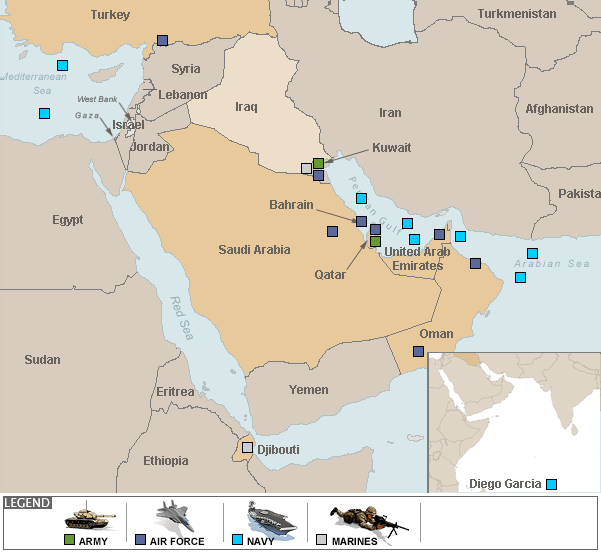
The U.S. withdrawal from Afghanistan, to be presumably fully completed by September 2021, was the first manifestation of Biden’s drawdown policy from West Asia. However, when it came to Iraq and Syria, the equations were quite different.
Despite Biden’s pledge to return to the JCPOA in his election campaign, there was an assessment that was widely spread between Iranian officials which says that the Biden administration would capitalise on Trump’s ‘maximum pressure’ policy to extract concessions from Iran, before re-joining the JCPOA. Those concessions are related to two aspects:
- Change in Iran’s foreign policy, especially its support for resistance groups in the region. This is to the benefit of the Zionist entity, which remains a core influence on U.S. foreign policy.
- Imposing restrictions on Iran’s ballistic missiles programme.
This American approach became apparent after Biden took office, and during the latest Vienna talks to salvage the nuclear deal. However, contrary to Biden’s false assumptions, the Americans found out that Iran will not give them any concessions, and that it meant what it said when Ayatollah Sayyid Ali Khamenei stated back in 2015 ‘We negotiated with the U.S. on the nuclear issue for specific reasons. The Americans performed well in the talks, but we didn’t and we won’t allow negotiation with the Americans on other issues’.
This has put the Americans in a quandary. Biden found that he could not withdraw from Iraq and Syria without getting guarantees from Iran and the Axis of Resistance related to the security of the Zionist entity, as the Axis of Resistance will never offer any guarantees at the expense of the Palestinians’ inalienable rights. Nor could Biden maintain the same level of American involvement in the ‘Middle East’ indefinitely. As this would be at the expense of the main U.S. foreign policy strategy, “Facing the Chinese challenge”, according to the terminology the U.S. uses.
Furthermore, this American quandary has deepened after the battle of the ‘Sword of Jerusalem’ exposed many of the Zionist Entity’s [Israel] weaknesses tactically and strategically in the face of the Axis of Resistance.
Based on this overview, we can expect a fairly heated summer for the U.S. occupation forces in the region, as from the Axis of Resistance point of view, the negotiations for the American withdrawal from the ‘Middle East’ and West Asia in general are not open-ended.
And it seems that the U.S. needs a nudge to decide whether: to start a meaningful and peaceful drawdown, with minimal losses; or risk a new ‘Middle East’ all-out war by trying to impose its sovereign will on the whole region.
And I believe, based on the Americans’ experience of the past two decades, that the consensus within the U.S. institutes is that the latter option would be highly costly. Not to mention that based on the current balance of powers in the region, as we read them, the outcome is not guaranteed to be in the favour of the U.S., nor in the favour of “Israel” its closest ally.


