Showing posts with label Ashraf Ezzat. Show all posts

Tuesday, 17 July 2012

huge brewing up, which Mrs. Clinton was not informed with, awaited her arrival”

Dr. Ashraf Ezzat

When president Obama visited Egypt in June 2009, and gave his famous and good for nothing speech for the Muslim world from the big reception hall at Cairo University, he and his team must have felt that Cairo was the quietest and most peaceful place on earth second only to the Seychelles islands.

The reason for that was so simple, but rather dictatorial; the deposed President Mubarak was so careful nothing and no one would bother the American delegation, he simply ordered the day off for all Cairenes whom were also told to stay home and not venture to go out until Mr. Obama had already boarded his flight back to the States.

Mrs. Hillary Clinton, who have been lately engaged in a diplomatic drone attacks on the Russians and the Chinese over the Syrian issue, must have thought nothing would be rewarding and relaxing like winding up her latest world tour with a visit to the historic city of Cairo, where she would only have to do the hand shake-routine and smile back at few of the Muslim Brotherhood (MB) faces, but at the end of the day she would have all the time to enjoy sightseeing, may be the pyramids, and indulge in the Cairene serenity, she still recalls from the 2009 visit.

Prior to Mrs. Clinton’s visit to Cairo, the usual security arrangements were meticulously gone over time and again and a full week weather forecast was submitted to help the state secretary to decide on her wardrobe during the visit. … and yes, a couple of young American tourists were kidnapped in Sinai close to the borders with Israel, to highlight the Sinai loose security issue, just in case Mrs. Clinton forgot to bring it up.

President Morsi meets secretary Clinton in Cairo
But that was not all. Something was missing. There was more to this visit than just the usual speeches, the TV interviews and the expected tranquil royal suite with the majestic view of the pyramids.
There was something huge brewing up, which Mrs. Clinton was not informed with, awaited her arrival.

In her brief and careful remarks after meeting with the newly elected president, Mr. Mohamed Morsi of the MB, and Instead of calling for an immediate handover of power as American officials have in the past, Mrs. Clinton instead emphasized only the need for “building consensus across the Egyptian political spectrum.”
What Mrs. Clinton did is simply add more gray to the current vague picture, whereas what most Egyptians longed for is black and white.
The White House’s struggle to deliver a satisfactory message here, for all parties involved including Israel, reflects its dilemma with how to deal with a rapidly evolving contest for power whose outcome remains yet unclear.

The American diplomacy is trying to balance a public push for a democratic Egypt against a deeply seated desire to maintain long-term ties with both factions, the generals and the Islamists, in a context where the United States seems to have virtually zero influence in post-Mubarak Egypt, and almost any American statement is sure to provoke a backlash. And provoke a backlash it did.

More shoes and tomatoes


One of the Coptic community protesting Clinton’s visit to Egypt
Thousands of anti-MB rallied outside Mrs. Clinton’s hotel, The Four Seasons, at downtown Cairo to protest what they called the American plot to help the MB to outweigh the generals and take full control of the country.

According to the protesters, the American administration unable to curb down the post-Mubarak Islamist tide, decided to use the MB to discipline Hamas and may be make it come to terms with Israel.

By nightfall Saturday, thousands of protesters, who practically surrounded Mrs. Clinton’s Hotel, kept chanting anti-American and anti-MB slogans all night long.

One of the protest leaders chanted “If you like the MB so much, why you don’t take them back with you”

General Tantawi meets Clinton
In the following morning, without a good night sleep I presume, Mrs. Clinton went on to meet General. Houssein Tantawy, the head of the supreme council of armed forces (SCAF) behind closed doors.
The meeting with general Tantawy was seen by some of the liberal parties as a provocative move that added to the polarization of the political scene in Egypt.

As if this was not enough of a disappointment for Mrs. Clinton, her invitation to convene with the Coptic heads was unexpectedly turned down by most of the leaders of the Christian community in Egypt.
“We kind of hoped Mrs. Hillary Clinton had transparently met with all parties and factions of the Egyptian political spectrum in the same room, and not to divide and aggravate the already volatile situation by meeting with the Salafists and the MB first and in private and then ask to meet with some of the Coptic community heads” said Emad Gad, a prominent Coptic activist.
On Sunday, and after inaugurating the new American consulate in Alexandria, all of Mrs. Clinton’s appointments and her expected visit and speech at the library of Alexandria, an event I planned to attend, were cancelled for security reasons.

The road to the library of Alexandria was practically blocked by anti-American protesters who raised shoes, a sign of disrespect, and showered Mrs. Clinton’s car with a descent quantity of Egyptian tomatoes forcing her car to turn around and head for the airport.

After almost one year and a half of the so called Arab Spring, I think it’s only fair to admit that the Europeans and the Americans were outpaced and taken by surprise by the uprisings in both Tunisia and Egypt and it was not before Gaddafi took up arms did they sober up and sent in the NATO planes.
After that they were ready, and in full gear, for Syria, where the Arab spring turned into a nightmare and a theater for all the local and international powers to play out their ugliest plans.

Till this moment, the American administration is trying to make head or tail of the post-Mubarak Egypt and May be that’s why we don’t hear the Obama’s campaign Bragging about how they got rid of Mubarak. Because, frankly, they didn’t.


As the American plane was taking off the Cairo airport and heading for Tel Aviv, I guess Mrs. Clinton started typing down the report on her two-day visit to Egypt, and her lines went as follows …
“Egyptians are not happy with our current stance, the MB are wary of our moves, and I don’t trust them as well. I’m Afraid we don’t have an influence over the generals … not even by threatening to withhold the American annual aide; anyway we’ve done it before and didn’t work. Dealing with the Islamists will cost us; it has already turned the seculars and Copts against us. As for the peace treaty with Israel, no robust commitment detected, and there are too many possible scenarios. … I don’t know, but I liked Egypt 2009 better. Cairo is not tranquil nor friendly as it used to be”

Wednesday, 2 May 2012

Sadat’s War on Israel: A heroic or a Collusive Act

Worth reading, but keep in mind that the victory achieved in 1973 by the Egyptian Army, rebuilt by Naser, and don't forget that Sadat, the CIA agent, poisoned Naser.
May 1, 2012

“Conciliation between Cairo and Tel Aviv was not Kissinger’s idea, besides he never expected the bold diplomatic move by Sadat whom he never took seriously. But all that was to change after the October war 1973″

Dr. Ashraf Ezzat

Anwar el-Sadat the former Egyptian president (1970-1981) who launched a daring military war against Israel to liberate the occupied land of the Sinai Peninsula in 1973, whose military commanders and valiant soldiers made an astonishing crossing of the Suez Canal and took over the impregnable Bar Lev line and who also surprised the whole world with his visit to Jerusalem in 1977 and later with his peace treaty with Israel in 1979 was not a hero of war and peace, as he is dubbed in Egypt, rather he was a conniver , a co-conspirator with the Americans and Israelis and a traitor to his Syrian allies and Arab friends.
According to one of the most controversial articles that has been circulating the web since last February, president Sadat got into conspiracy with the Israelis, betrayed his ally Syria, condemned the Syrian army to destruction and Damascus to bombardment, allowed General Sharon’s tanks to cross without hindrance to the western bank of the Suez Canal, and actually planned a defeat of the Egyptian troops in the October War 1973.

Vladimir Vinogradov
The author of that unsubstantiated article talks of some secret file, written by the Soviet Ambassador in Cairo at the early 1970s, Vladimir M. Vinogradov, apparently a draft for a memorandum addressed to the Soviet politbureau, describes the 1973 October War as a collusive enterprise between US, Egyptian and Israeli leaders and orchestrated by Henry Kissinger.

Though such a memorandum was never published by the former soviet ambassador nor confirmed by the Russian diplomatic circles, nevertheless, and for the sake of shedding more light on this highly important war, I thought we might delve into the historical records of the October 1973/ yum Kippur war and reexamine the chronicles of the ferocious three week- military confrontation between Egypt and Israel, and see if the alleged story of Mr. Vinogradov held any water.

October 6 /Yom Kippur War

The war was initiated by Egypt and Syria on Oct. 6, 1973, on the Jewish holy day of Yom Kippur and during Ramadan, the holy month of fasting in Islam, and continued until Oct. 25, 1973.

The war, which eventually drew both the United States and the Soviet Union into indirect confrontation in defense of their respective allies, was launched, above all by president Sadat, with the diplomatic aim of convincing a chastened—if still undefeated—Israel to negotiate on terms more favorable to the Arab countries and especially Egypt.
“It was aimed as a limited operation; the land was not my aim, at all. I wanted only to prove to the whole world that the Israeli theory of security would collapse and we could cross the Suez Canal and capture the Bar Lev line.” declared Sadat in a 1974 documentary by (abc)
I believe we should bear that goal of Sadat clearly in mind before we carry on with our reexamination of the October war for this rationale will help us understand some of the shadowy chronicles of the war.

Six-Day War 1967

The previous Arab-Israeli war, the Six-Day War (1967), was perhaps more than a just war for the Arabs and for Egyptians in particular. The 1967 defeat was so unexpected and bitter that the Egyptians dubbed it “Naksa” – the grave setback.

The withdrawal from Sinai in that humiliating manner has plunged the Egyptian nation and its army into a deep psychological trauma near to defeatism.

The most strategic outcomes of this war was not the land Israel grabbed over the six-day attack, rather it was the breakdown of president Nasser’s project of pan-Arabism along with his rejection to acknowledge the existence of Israel.

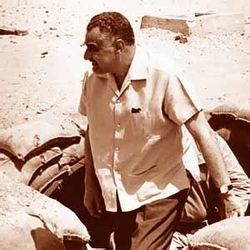
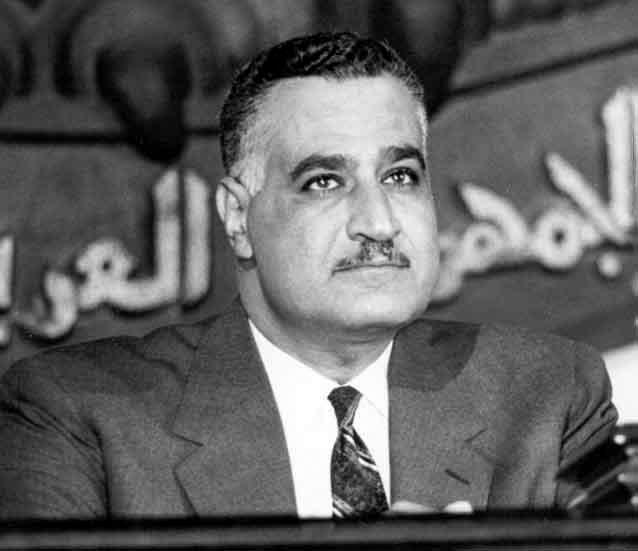
President Nasser
The Arabs under Nasser’s leadership believed they could easily settle the conflict with Israel militarily. The 1967 war proved them wrong.

President Nasser was an outright socialist who made his opposition to the neo-imperialism represented in the United States and the neo-colonialism embodied by Israel no secret.

And since his popularity in the Arab world was indeed unprecedented and unshakable, the United States had to give credit to Israel for the eclipse of his glory in the Middle East. And from then on, Israel has touted its place as the indispensable ally of the United States in the Middle East.

When Sadat took over after Nasser died in 1970, he actually inherited a heavy burden. Egypt was a broken nation suffering from a failing economy, haunted by the shameful Naksa and aspiring to restore its pride by a military revenge no matter how long it took or how much sacrifices it required.

As 80% of Egypt military capability was destroyed in 1967, the Israelis, according to most military experts, agreed that Egypt would need at least another 10 years before it could engage in any military confrontation with Israel especially after Israel had fortified its positions in Sinai behind the infamously formidable Bar Lev line that stretched along the eastern coast of the Suez canal.

Unlike Nasser, Sadat despised socialism and in a way anticipated that the Soviets’ influence in the Middle East would recede, in that respect he was a true visionary, and he firmly believed that the United States, according to his own perspective, would want to step in and take the place of the Russians.

Sadat’s initiative

Embarking on his presidency, it didn’t take Sadat long before he managed to set his priorities straight. He knew he needed to get rid of the old guards of Nasser’s era, he knew he should begin weaning Egypt from relying solely on the Soviet Union and he wanted from his first day in office to, believe it or not, go to Israel and sign a peace treaty with the Jewish state. Watch Walter Cronkite, CBS anchorman, remembering Sadat’s early initiative.

Anwar Sadat with Golda Meir in Israel 1977
Yes, shaking hands with the Israelis was Sadat’s own idea to spare Egypt long years of backbreaking military confrontations, restore the Egyptian sovereignty over Sinai and hopefully his opportunity to get into a new alliance with the white house.

In other words, the conciliation between Cairo and Tel Aviv was not the idea of Kissinger who never expected such a diplomatic move. Sadat for two years hoped that the white house would take notice of his new initiative by any means even if it meant sending a message with the American actress Shirley Temple when she was in Cairo 1972

Just as Nasser made no secret of his animosity to the Americans and the Israelis, Sadat was making it loud and clear from the very beginning, especially to the western main stream media, that he was embarking on a brand new path in the Arab-Israeli conflict and that the white house should take notice, for he really meant business.

But unfortunately, President Nixon never lent him enough attention and Kissinger himself, whom the alleged report accuse of choreographing the 1973 war, never took Sadat seriously and instead thought that he was just bluffing.

With diplomacy stalemated, during 1972 and 1973, Sadat’s decision to launch a joint attack with the Syrians on the Israeli forces occupying Sinai and the Golan heights was not based on merely retaliatory motives or only aimed at settling the score with the Israelis, rather it was his last resort to get the Israeli diplomacy into negotiating a withdrawal from Sinai under the auspices of the Americans.

The surprise of the October war

President Sadat
The war began with a massive and astonishing Egyptian crossing of the Suez Canal during the first three days – according to the plan of Marshal Saad Shazly, Egypt’s chief of staff, after which the Egyptians dug in a territory (12 km deep east of Suez Canal) that was protected by the powerful Egyptian air defense (soviet SAM missile) umbrella and settled into a semi-stalemate.

On the other hand, the Syrians coordinated their attack on the Golan Heights to coincide with the Egyptian offensive and initially made threatening gains against the greatly outnumbered Israelis. Within a week and after the massive American airlift of reinforcement and resupply of munitions Israel recovered and launched a four-day counter-offensive, driving deep into Syria.

To relieve this pressure on the Syrian front and bending to the Syrians and Russians, the Egyptians went back on the offensive and operated outside the range of SAM missiles- so much to the furious opposition and dismay of marshal Shazly, and the Egyptian forces were decisively overpowered; an Israeli armored division then counterattacked at the gap between the second and third Egyptian armies headed by General Ariel Sharon, crossed the Suez Canal, and advanced southward and westward in over a week of heavy fighting.

On October 22 a United Nations-brokered ceasefire quickly unraveled, with each side blaming the other for the breach. By October 24, the Israelis had improved their positions considerably and completed their encirclement of Egypt’s Third Army.

This development led to tensions between the United States and the Soviet Union and consequently U.S. military raised their alert levels to DEFCON (Defense Condition) III. Eventually, a second ceasefire, closely monitored by Kissinger, was imposed cooperatively on October 25 to end the war.
Back to Vinogradov’s alleged memorandum. In conclusion, he asks some questions: how the Egyptian crossing of Suez Canal could be a surprise if the Russians evacuated their families a few days before the war? Why did the Egyptian forces not proceed after the crossing but stood still? Why did they have no plans for advancing? Why there was a forty km-wide unguarded gap between the 2d and the 3d armies, the gap that invited Sharon’s raid?

A military accomplishment and a prelude to peace


Egyptian forces crossing Suez Canal and seizing Israeli Bar Lev line, October 1973
The published memoirs of Marshal Saad Shazly along with the recently declassified U.S. archival material, unearthed by the National Security Archive, provide critically important information on policies, perceptions, and decisions of the parties involved in the October War 1973.
During the late winter and spring of 1973, Henry Kissinger held several secret meetings on Middle East issues in New York and France with Muhammad Hafez Ismail, Sadat’s national security adviser. In one of the meetings Kissinger told Ismail “don’t expect to win on the negotiating table what you lost on the battlefield.” In other words, Washington could do little to help as long as Egypt was the defeated power.

So according to Kissinger and considering the then stalemated status quo, Sadat had no alternative but to start a sudden and swift war with the element of deception/surprise as one of his most strategic tools for, if not winning the whole war, securing at least the first phase of crossing the Suez Canal into Sinai.
Document 7 of the declassified American national security archive stated “Neither Israeli nor U.S. intelligence recognized the imminence of war in early October 1973. AMAN, the Israeli military intelligence organization, and the leadership generally assumed that national military power would deter war and downplayed the possibility of conflict until 1975 when Egypt and Syria had better air capabilities. Moreover, Israeli military and political leaders had a condescending view of Arab fighting abilities”
During the weeks before the war, the Soviets believed that the situation was growing more dangerous, but like the Americans and the Israelis they did not see the resumption of fighting [as] at all likely. Yet, they had begun to evacuate dependents because they had learned of the decision for war, but not its exact timing.

A suspected Russian Intelligence Services (RIS, or KGB) official, Leo Yerdrashnikov (whose official cover was deputy director of the local Tass office in Cairo) also sheds light on when the Soviets learned of Sadat’s decision. On 3 October, Sadat told Soviet Ambassador Vladimir Vinogradov that war was imminent. Moscow did not, however, learn when the war would start until the morning of 6 October. (Note 19)

And as the Russians knew that the war was imminent, so did the Israelis whom were tipped off by an Egyptian Top Source (who may have been a double agent) Moreover, in late September Jordan’s King Hussein warned Prime Minister Golda Meir that Syrian forces were taking an “attack position.” These developments concerned the Israelis but AMAN ruled out major war.

The received wisdom in the American intelligence establishment was that the Arabs would not initiate war as long as the military balance favored Israel. In other words, Tel Aviv’s preponderant military power deterred war. This was the prevailing view of Israeli intelligence and U.S. intelligence bought into it. A few weeks later, Assistant Secretary of State Intelligence and Research Ray Cline observed, “Our difficulty was partly that we were brainwashed by the Israelis, who brainwashed themselves.” (Note 24)

As for the reluctance of the Egyptian army to advance deeper into Sinai after crossing the canal, it was simply, and according to Shazly’s plan (The High Minarets) a suicidal tactic to operate out of the cover range of the SAM anti-craft missile especially that the Israelis had the superiority in the air forces and outnumbered the Egyptian tanks on the ground.

And wasn’t it for the Syrians’ plea for the Soviet Union to interfere and urge Sadat to advance into Sinai, the Egyptian armored divisions wouldn’t have pressed on.

Sadat believed that, with the miraculous crossing of the Suez Canal and the seizing of Bar Lev line and the whole eastern coast of Sinai, he got all he ever needed to start maneuvering diplomatically.

Debunking the Israeli invincibility, under the nose of the Americans, was indeed Sadat’s idea of winning the military conflict in October 1973

As for the gap that showed up in the Egyptian lines along the western side of the canal, a game changer in the war, was easily detected by the Israelis once the two armored units – the 4th&21st – were ordered by Sadat on October 12, to thrust deeper into Sinai and try to reach the strategic Mitla and Gidi Passes.
Expanding the military operations beyond the protective range of the SAM umbrella was absolutely a wrong military decision by Sadat. But I wouldn’t rule out the possibility that Kissinger and the Russians, trying to break the stalemate on the battlefield, influenced Sadat’s decision.
And while the Russians and the Americans helped Sadat to put an end to the O
ctober war, they both had no say in how or when it started. Let’s make no mistake about that.


Almost 40 years have gone since October war during which the Israeli side got the security, the recognition and the peace they needed, while the Egyptian side got back all of its occupied land and above all restored the pride they lost in 1967.

To most analysts and observers this sounds as a fair deal but actually it isn’t, not for many Egyptians any way. And nobody could sum it up better than the man who fought the war himself, Marshal Saad Shazly.
Shazly looked back at how the October war started and how it ended up in a way that led to the Camp David treaty and eventually neutralized Egypt in the Arab-Israeli conflict, and concluded
“This brilliant military victory was turned into a political defeat, when Egypt was removed from the camp of resistance, to Israeli occupation of Arab lands to the camp of appeasement.

This shift in the balance of power in the region and the vacuum created by the absence of Egypt, allowed Israel to try to eliminate resisters one by one, starting with Lebanon, Iraq, Palestine and Lebanon again, Iraq again and now current rhetoric indicates that Iran and Syria are next.”

River to Sea Uprooted Palestinian  
The views expressed in this article are the sole responsibility of the author and do not necessarily reflect those of this Blog!

Thursday, 8 March 2012

The "True" Story .........

If you want the 'true" Story Behind Damascus ‘False Flag’ Bombing Caught on Camera, Egypt NGO's check Dr. Ashraf Izat.
Mainstream Media keeps al-Qaeda Myth Alive. he wrote, consequently Al-qaeda, the CIA creation, never exisited, after liberation of Afghanistan, niether in Iraq, nor in Syria and Yeman.

Also if you want the truth about Egypt NGO's check Dr. Ashraf Izat, they are freedom fighters, and not a CIA, NED, creations, funded to spread democracy.

Laura StuartOn the opposite side, if you want the 'true" Story Behind Syria unrest, don't hesitste, go to "Sister" Laura Stuart, at deLiberation and watch her God"brother" Sheikh Arifi, and Al-Qurni.

Her Palestinian friend told her tha Assad helped palestinians, but he is deviant and her God told here "Success will never come from deviant",  so “Murdering Assad more Noble than Killing an Israeli”

And if you want to know about the justice in  'Qatar", the cave of the champion "Islam", "democracy" and "Arab Spring" who has lived in exile in Qatar for many years and spoke out during the revolutions, Egypt, Libya and has issued a warning to stop the injustice action towards Syrian nationals who staged a protest against the ongoing "Massacre" in Homs, (but some wish to deny) and listen Syrian "Propaganda" exposing CNN and Al-Jazeerah "TRUTH"

If you want the truth about most "peacfull spring", go to VT, in particullar to Gordon Duff, and his Sabr Nourideen of redress, however, in case you want to know about the still ongoing libyan "spring" never, ever visit both sites, the Libyan file is closed since Sabr left the scene after the capture of Kadafi, leaving the stage for hilary, to Come, and see

To sum up, in case you want to know about good news for Palestinians, and the great impact of the "Arab Spring", the great asset for Palestinian cause, never, ever miss "Brother" Khalid Amayereh, in particular this one: 
"The Syrian regime must change, or it will b e changed"

River to Sea Uprooted Palestinian  
The views expressed in this article are the sole responsibility of the author and do not necessarily reflect those of this Blog!

Friday, 16 December 2011

Mr. Gingrich, Grab a Pen, it’s Time for your History Lesson

December 15, 2011

“How did America end up in that humiliating situation, where its presidential frontrunners are but a bunch of clowns who are always willing to dance to Israel’s favorite tune?”

“The Israelite history is invented and therefore the Zionists could have settled somewhere else than Palestine, Uganda for example, as Herzl had proposed at the Sixth Zionist Congress”

 Dr. Ashraf Ezzat
The United States for Israel
It’s elections time ladies and gentlemen once again. It is the presidential candidates’ time to line up and take part in Israel lovefest. It’s time for Zionist-funded electoral campaigns and solid promises to do the utmost and maybe the impossible for the “United States for Israel”. The 2012 White House elections has unleashed a fierce race amongst the presidential hopefuls- who come this year in all colors, sizes and IQs- to kiss ass and suck up to the Israeli lobbies in the land of the free and home of the brave.


Sleeping with the enemy


Newt Gingrich
And since all the candidates have consumed almost all the usual tricks to tout their own “do for Israel” credentials starting from accusing the Palestinians of hindering the peace process and denying Israel’s right to exist …. Right down to calling them terrorists, the republican White House hopeful, Newt Gingrich has found himself in a position where he has to come up with a brand new trick that would enhance his approval rating in the race to the white house.
Being an expert on solutions for winning the future, Gingrich didn’t waste much time and decided to not only do the utmost but also the impossible for Israel’s sake by calling the Palestinians an “invented” people who could have- voluntarily evacuated their homeland- and chose to live elsewhere.

While I could conceal my annoyance over Gingrich’s outrageous and deceitful statement, which lacks both the minimum historical awareness and political wisdom I find myself unable to hide my disgust of his disgraceful conduct. Mr. Gingrich as a presidential hopeful and a longtime politician is supposed to be, in a way, representing the mainstream American diplomacy when he speaks to the foreign media- unless the Jewish channel is not considered that. And if he as a person was not embarrassed to openly brownnose Israel in that unprecedented and degrading manner, then he should have uttered those nonsense comments in a less public session, like at his country club and amongst his circle of Zionist financiers of his campaign who certainly would have been ecstatic to hear him ranting that way. But for him to publicize this hate speech in a televised interview and furthermore repeat it during the presidential debates is an affront to the whole American diplomacy and a dangerous indication for a paradigm shift of that diplomacy in the Middle East.

Who allowed this plumpy Gingrich to act as Israel’s advocate while ironically running for the presidency of the United States? Who told him that he can put on his racist mask, erase decades of peace brokering, albeit not entirely successful, and start messing up the politics of one of the most volatile places on earth while hallucinating about its documented ancient history? The Arabs and the Palestinians, whom he likes to see invented and therefore movable or even invisible, will not take his statement as a twisted attitude of some republican candidate but another proof of the American flagrant biased policy in the Middle East. The last thing the United States needs right now as its troops are pulling out of the Iraqi swamp and being kicked out of the Afghan-Pakistan Death Valley is another (needless)stir of the anti-American sentiments in that part of the world. Only Mr. Gingrich doesn’t think so. Appearing in his debates foolishly standing by his offensive remarks and apparently drunk with the encouraging feedback he gets from his Israeli friends, this former Speaker of the U.S. House of Representatives irresponsibly insists on sketching the landscape for the most dreadful political forecast in the Middle East.

It is ironic to see the millions of patriotic Americans rallying on the streets and literally occupying the country in protest over what they called the corporate greed and at the same time we find candidates like Gingrich so sick and blinded with greed they can’t feel the danger nor the shame in sleeping in the same bed with the real enemy. How did America end up in that humiliating situation, where its presidential frontrunners are but a bunch of clowns who are always willing to dance to Israel’s favorite tune? I take a look at all the 2012 presidential hopefuls and I fail to find any hope in them as they frantically compete with each other to suck up to Israel as if the American presidential polls will be held in Tel Aviv.

Mr. Gingrich has every right to brownnose, kiss ass and suck up to whomever he likes, he has the right to relinquish his national identity and pride … but he has no right to strip the Palestinians of that pride and identity while doing so. Obviously, for someone that historically ignorant, Mr. Gingrich must have been tipped by one of his aides that what really troubled Israel recently is the release of Shlomo Sand’s bestseller book “The invention of the Jewish people”


Let’s talk history, history will tell who was invented.


Shlomo Sand
In that book, Prof. Sand attempts to prove that the Jews now living in Israel and other places in the world are not at all descendants of the ancient people who inhabited the land of the philistines in the late Bronze Age. Prof. Sand is saying that the nowadays Jews who have been immigrating since over a century now to the land of Palestine are but varied peoples that converted to Judaism during the course of history in different corners of Eastern Europe, the Mediterranean Basin and the adjacent regions like in Yemen and Iraq.
According to Sand, the description of the Jews as a wandering and self-isolating nation of exiles, who wandered across seas and continents, reached the ends of the earth and finally, with the advent of Zionism, made a U-turn and returned en masse to their orphaned homeland is nothing but “national mythology.” And therefore the Jewish people, historically speaking and as Mr. Gingrich likes to call it, is invented.
But since Mr. Gingrich likes to see his ranting about the Palestinians as factually correct history …then maybe we should do it his way and talk history…only this time let’s do it right, but first I would like to introduce Professor Ze`ev Herzog to Mr. Gingrich.


Prof. Ze`ev Herzog
Prof. Ze’ev Herzog teaches in the Department of Archaeology and Ancient Near Eastern Studies at Tel Aviv University. He took part in the excavations of Hazor and Megiddo with Yigael Yadin and in the digs at Tel Arad and Tel Be’er Sheva with Yohanan Aharoni. He has conducted digs at Tel Michal and Tel Gerisa and has recently begun digging at Tel Yaffo. He is the author of books on the city gate in Palestine and its neighbors and on two excavations, and has written a book summing up the archaeology of the ancient city. Prof. Herzog belongs to the modern generation of Israeli academic archeologists who have been digging, in a truly scientific approach, all over the land of Palestine ever since the establishment of the state of Israel but more extensively after 1967, in an attempt to reach some sort of a historical proof that would legitimatize the ancient Israelite story and therefore could back up and maybe make sense of the current Zionist land grab of Palestine. After decades of extensive and arduous archeological excavations and search, Prof. Herzog and many other Israeli archeologists such as Prof. Israel Finkelstein et al reached a robust conclusion that somehow resembled Prof. Sand’s thesis of the invention of the Jewish people. only in addition, they concluded that the greatest chunk of the Israelite story according to the Bible is a mere myth – the interesting parts of it copied out from both the Mesopotamian and the Egyptian mythologies and the remaining tedious details are just tribal narrative invented by the minds of the Hebrew scribes of the old testament.


Archeology and history of Palestine “Right or Albright”

Captivated Philistines (or the sea people) depicted on the walls of Ramses III temple
Apart from the Bible, the first mention in history of the Philistines dates back to the late Bronze Age 1150-1200 BCE. They are unmistakably mentioned in Egyptian texts, as inscriptions on the walls of “Medinet Habu” the majestic temple of king Ramses III that documented the war with the Sea Peoples, the philistines is one of them, who inhabited the coastal land from Phoenicia down to Egypt. And the philistines appear once again in the work of the Greek historian Herodotus in the middle of the 5th century BCE. The archaeology of Palestine developed as a science at a relatively late date, in the late 19th and early 20th century. The main push behind archaeological research in Palestine was the country’s relationship with the Holy Scriptures.

The first excavators in Palestine were biblical researchers who were looking for the remains of the cities cited in the Bible. Archaeology assumed momentum with the activity of William Foxwell Albright, who was convinced that if the ancient remains of Palestine were uncovered, they would furnish unequivocal proof of the historical truth of the events relating to the Jewish people in its land. But it didn’t take long before “the spade and the Bible” school of Albright proved not right. The biblical archaeology that developed following Albright and his pupils brought about a series of extensive digs at the important biblical tells: Megiddo, Lachish, Gezer, Shechem (Nablus), Jericho, Jerusalem, Ai, Giveon, Beit She’an, Beit Shemesh, Hazor, Ta’anach and others.

The way was supposed to be straight and clear: every new finding should contribute to the building of a harmonious picture of the past. Slowly, cracks began to appear in the picture. Paradoxically, a situation was created in which the glut of findings began to undermine the historical credibility of the biblical descriptions instead of reinforcing them.

The explanations became ponderous and the picture inelegant as the pieces didn’t fit together smoothly. Here is a summary by Prof. Herzog, from his famous article “deconstructing the walls of Jericho” published in Ha’aretz Magazine, Friday, October 29, 1999 that explains why the harmonious picture of the historicity of the Promised Land collapsed
Following 70 years of intensive excavations in the Land of Israel, archaeologists have found out: The patriarchs’ acts are legendary stories, we did not sojourn in Egypt or make an exodus, we did not conquer the land. Neither is there any mention of the empire of David and Solomon. Those who take an interest have known these facts for years, but Israel is a stubborn people and doesn’t want to hear about it This is what archaeologists have learned from their excavations in the Land of Israel: the Israelites were never in Egypt, did not wander in the desert, did not conquer the land in a military campaign and did not pass it on to the 12 tribes of Israel. Perhaps even harder to swallow is that the united monarchy of David and Solomon, which is described by the Bible as a regional power, was at most a small tribal territory. And it will come as an unpleasant shock to many that the God of Israel, YHWH, had a female consort and that the early Israelite religion adopted monotheism only in the waning period of the monarchy and not at Mount Sinai. Most of those who are engaged in scientific work in the interlocking spheres of the Bible, archaeology and the history of the Jewish people—and who once went into the field looking for proof to corroborate the Bible story—now agree that the historic events relating to the stages of the Jewish people’s emergence are radically different from what that story tells.
Palestinian family from Ramalla 1900-1910
In other words, the Israelite history is invented and therefore the Zionists could have settled somewhere else than Palestine, Uganda for example, as Herzl had proposed at the Sixth Zionist Congress at Basel on August 26, 1903. Indeed Mr. Gingrich, The British Uganda would have been a wiser choice and a better place to accommodate the influx of Jewish immigrants … it would have saved the Palestinians the unnecessary massacres and the ongoing ethnic cleansing, but most importantly it would have saved us the aggravation of listening to your pathetic tampering with the history of Palestine.

Class dismissed.


Jerusalem does not belong to Jewish-Israelis: "The Bible Came From Arabia",
They Invented a Religion to Steal a Land from Its Owners
River to Sea Uprooted Palestinian

Thursday, 10 November 2011

'World breaking loose of chain of obedience'

'World breaking loose of chain of obedience'
Wed Nov 9, 2011 2:28PM GMT
 
Dr. Ashraf Ezzat a columnist at Veterans Today says the world is breaking loose from the ‘chain of obedience’ that he believes is the source of world problems.
 
"The problem lies not in this chain of American-NATO-Israel command but it lies in the chain of obedience by the people," Ezzat told Press TV's U.S. Desk in an interview on Tuesday.
"As we all can see, the world is breaking loose of that chain of obedience. People are gaining control now and a new world order is emerging with new powers and new rules … especially in the Middle East. So this Israeli bluff to hit Iran may be the last political stunt," he concluded.
RH/SMA
 
River to Sea Uprooted Palestinian

Monday, 31 October 2011

Alaa Abdel Fattah: Portrait of an Egyptian Revolutionary

by Dr. Ashraf Ezzat on October 31, 2011


Alla Abdel-Fattah
“When will Egypt supreme council of army forces -SCAF- understand that many revolutionaries are afraid of their tender loving mothers more than they fear death or torture,” Abdel Fattah wrote in independent Egyptian newspaper, Al-Shorouk.

Prominent Egyptian blogger and activist Alaa Abdel Fattah was summoned on Sunday, 30 October to Cairo’s notorious C28 military prosecution headquarters to face charges of incitement to violence in the violent 9 October Maspero clashes between Coptic-Christian protesters and military police.
Abdel Fattah, who rejects the notion of civilians being tried by military courts, has refused to be interrogated by military prosecutors as a matter of principle. He has also vociferously criticised the idea that the military prosecution should investigate the Maspero clashes, in which military police were directly involved.

As a result, the military prosecution ordered his detention for 15 days pending investigation.
Abdel Fattah is considered one of Egypt’s pioneer bloggers, along with his wife, Manal Hussein. Since 2004, both have been publishing their political opinions in well-known blog www.manalaa.net.
Originally, as a software developer and activist, Abdel Fattah has supported initiatives that promote social media, freedom of expression and political activism. In 2005, Alaa and Manal won the Special Reporters without Borders Award in Deutsche Welle’s Best Blogs competition.

It is not the first time Abdel Fattah finds himself facing allegations by the state. In May 2006, he was arrested while participating in a peaceful protest in solidarity with Egypt’s free judiciary movement. His arrest caused an international uproar, as it was seen as an attempt to crack down on blogging activity in Egypt by targeting one of its most influential bloggers.

Abdel Fattah was eventually released in June 2006 after 45 days in detention, during which an international campaign was launched on blogs and on Twitter with the hashtag “#FreeAlaa” – a hashtag that again found its way to many Twitter accounts following news of his latest detention.

Born in 1981, Abdel Fattah was brought up in a family of leftists with a long history of political activism. His father, Ahmed Seif El-Islam Hamed, is a prominent lawyer and human rights activist who used to run the Cairo-based Hisham Mubarak Law Centre. Ahmed Seif El-Islam was arrested in the 1980s and imprisoned for five years for his political activity.

Abdel Fattah’s mother, Laila Soueif, is a professor of mathematics at Cairo University, while his aunt is Ahdaf Soueif, an Egyptian novelist of international renown. Alaa’s sister, Mona Seif, meanwhile, is one of the founders of the “No to military trials for civilians” campaign.

Abdel Fattah’s wife, Manal, also comes from a family with a long activist pedigree. Manal’s father is Bahi El-Din Hassan, a founder of Egypt’s contemporary human rights movement and current head of the Cairo Centre for Human Rights Studies.

Abdel Fattah and Manal moved to South Africa in 2008, where they lived until January of this year, when they took the first flight to Cairo to join Tahrir Square protesters as the revolution erupted. His first day in the square coincided with what has become known as the “Battle of the Camel,” when pro-government thugs attacked demonstrators, leaving dozens dead.
“Alaa fought bravely to defend the square and was never worried that he might lose his life,” said Wael Khalil, prominent blogger and leftist political activist imprisoned with Abdel Fattah in 2006.

Following Mubarak’s ouster and concomitant promises of democratic transition, the couple decided to return to Egypt on a permanent basis. Through their twitter accounts, “@alaa” and “@manal,” the couple announced their intention to have a baby. The baby, they noted, would be named Khaled after Khaled Said, the young man from Alexandria beaten to death by police last year who became a posthumous icon of Egypt’s revolution.

The last thing Abdel Fattah wrote publicly, in independent daily Al-Shorouk, was his eyewitness account of the Maspero clashes and the two days spent at a Coptic hospital morgue battling for autopsy reports. He also spent this time mourning the death of Mina Daniel, the Coptic activist who was run over by military police during the clashes.

“When will the SCAF understand that many revolutionaries are afraid of their tender loving mothers more than they fear death or torture,” Abdel Fattah wrote in Al-Shorouk.

Statement of Solidarity by Egyptian blogs aggregator: Alaa Abd El Fattah Boycotts Military Trials

Sunday, October 30, 2011

We, the Campaign to End the Military Trials of Civilians, condemn in the strongest possible terms the imprisonment of prominent Egyptian activist and blogger, Alaa Abd el Fattah and the unjust and illegal system of military tribunals implemented by the Supreme Council of the Armed Forces (SCAF) since becoming rulers of Egypt on January the 28th, 2011.

SCAF deadly crackdown on Egypt Copts on October 9th at Maspero, downtown Cairo.
Today Alaa Abd El Fattah was summoned to the Military Prosecutor’s office, accused of assaulting military personnel, stealing and destroying military weaponry and inciting violence against the military in the events of 9 October at Maspero.
On questioning, Abd El Fattah declined to answer the prosecutor’s questions, stating that it is illegal and a clear conflict of interest for the military, as a party accused of a crime in the same events, to hold proceedings or adjudicate fairly. He was sent to detention pending further military investigation.
As of today we refuse to co-operate with the military prosecution of civilians and we call on all Egyptian citizens to stand with us.

At least 12,000 Egyptian civilians have been subjected to summary, covert military trials. The accused are often denied counsel, the opportunity to review evidence or examine witnesses; there are limited avenues of appeal. Eighteen death sentences have been handed down so far.

Abd El Fattah’s targeting is only the latest example of the systematic targeting of journalists, media figures, bloggers and activists by SCAF.

Abd El Fattah is being held responsible for violence on October 9th, the night when the Army killed at least 28 peaceful protesters and injured several hundred more. Several respected human rights organisation have attested to this.


Mina Daniel
Furthermore, it is perverse that Mina Daniel is listed as the first name on the Military Prosecutor’s list of the accused. Mina Daniel was killed by military gunfire on October 9th.

Abd El Fattah is now being held for fifteen days in prison by a body which has no legal authority to do so. The fifteen days can be renewed indefinitely. Twenty eight more people are in jail against the background of the same event. Mina Daniel and others have already paid with their lives.

We demand that Alaa Abd El Fattah be freed immediately, that military trials of civilians be stopped and all those sentenced thus far be released or, at least, retried before civilian courts. We support all of those who similarly refuse to recognize the legitimacy of the military prosecution.
Sources: Egyptian Blogs Aggregator, ahramonline and manalaa.net
River to Sea Uprooted Palestinian

Friday, 28 October 2011

Shalit: Israeli Soldier With Atypical Autism

Shalit

“What the Nile TV channel host did not know was that she was going to interview a psychologically disturbed man with personality disorders.”


Dr. Ashraf Ezzat

Israel freed 1,027 Palestinian and Israeli Arab prisoners to get Shalit back.

Beyond the debate over the rationale of Israel’s deal to release 1000 prisoners for one kidnapped soldier lies a simple fact: this Shalit deal is not only unbalanced but also mysterious in so many ways.

The mystery in this swap deal lies not in the acquiescence of the Israeli side- albeit unusual- to Hamas’ unbending demands for releasing the kidnapped soldier, it lies not in the success of the Egyptians brokering the deal where Mubarak and the Germans’ diplomacy had failed before; it lies not in the timing of the deal that coincided with the highest peak of Israeli perceived intransigence toward recognizing a Palestinian estate, it lies not in the Hamas attempt to steal some of the thunder the Palestinian authority generated by forwarding its bid for UN statehood …, rather the mystery of this swap deal lies in Gilad Shalit, the Israeli kidnapped soldier himself.

As the story goes, Shalit, an Israeli army corporal, was abducted in June 2006 by militants while he was patrolling along the Israeli-Gaza border. The Hamas militants surprised his tank crew, killed two of his comrades and whisked him back into Gaza where he was held virtually incommunicado until his release.

We all grew familiar with photos of Shalit that advocates for his release began to post on the internet since his capture by Hamas. They were snap shots of a young and smart Israeli man in military uniform. While you can’t tell much about a person from his photo, it’s not before you have at least watched him talk that you can get a little bit closer to knowing what kind of person he is.

Shalit’s kidnapping and his 2009 video


On watching Shalit in his 2009 video in which he showed the whole world that he was safe and treated well in his captivity and also urged Netanyahu to concede to Hamas’ demands, something about that footage struck me as odd.

Though shalit had been in captivity for well over three years during which the Zionist controlled mainstream media turned him into a national hero, his first appearance in 2009 video revealed to me another aspect of Shalit’s personality – devoid of any heroism- that we couldn’t discern from the previous photos campaigners for his release flooded us with.


From the first moment shalit started to talk in the video as he was reading from some dummy card he somehow sounded, throughout the 2-minute and 40-second video, dummier than the card he was looking at.

I’m aware that I’m talking about a man who has been long in captivity and maybe subjected to unimaginable hardships and that he must have been told to act according to a preplanned scenario so as to make everybody get the feeling that he was ok and taken care of.

But with all that in mind I still couldn’t explain Shalit’s monotonous tone, his inability to change facial expression and to convey his hidden feelings through any body language or gesture.

But what primarily triggered my discomfort, or suspicions actually, was Shalit kicking off his video with a totally unexpected idiotic smile hardly befitting of a man languishing in solitude, as if he had just listened to a joke, that later turned into a recurring smirk characteristic of some pathological stereotype.

Those signs somehow began to summon up the physician inside me, and as I was trying to connect some of the dots I realized that the Israeli captive I had just watched talking in the video was not unfamiliar to me, I’ve seen this smirky face so many times before, not in Israel, but as I was examining cases with autism.

Now and before some of you with their jaws dropping start to wonder what kind of point I’m trying to prove here.
Well, and before anybody jump to any conclusions, all I’m saying is that upon watching Gilad Shalit’s 2009 video I started to have my doubts as a physician if the man Hamas captured and kept in some secret hiding place for years was suffering from some kind of pervasive development disorders(PDDs) long before he was kidnapped.

What is “pervasive development disorders?”


PDDs, refers to a group of conditions that involve delays in the development of many basic personality skills, most notably the ability to socialize with others, to communicate, and to use imagination. Children with these conditions often are confused in their thinking and generally have problems understanding the world around them.
There are five types of pervasive development disorders: Autism, Asperger’s syndrome, Childhood disintegrative disorder, Rett’s syndrome and Pervasive development disorder not otherwise specified (PDDNOS)
While most of these conditions typically are identified in children around 3 years of age — a critical period in a child’s development – they are called development disorders- one condition amongst them might linger with the child into his teens undiagnosed, namely Pervasive development disorder not otherwise specified (PDDNOS) which refers to children who have significant problems with communication and play, and some difficulty interacting with others, but are too social to be considered autistic and often to referred to as “atypical autistic”.
There are no laboratory tests to diagnose a PDD and that is why the doctor often seeks input from the child’s parents, teachers, and other adults who are familiar with the child’s symptoms.
General symptoms that may be present to some degree in a child with a PDD include:
- lack of social awareness;
- lack of interest in socializing/making friends
- inability to infer the thoughts, feelings, or emotions of others;
- either gazing too intently or avoiding eye contact;
- lack of changing facial expression, or use of exaggerated facial expressions;
- lack of use or comprehension of gestures;
- unusually sensitive to noises, touch, odors, tastes, or visual stimuli;
- Inflexibility and over-adherence to or dependence on routines; stereotypes and repetitive motor patterns.

Egyptian interview and Shalit’s near collapse 


Can't tell much from a man's photo.
Shalit slightly showed some of the PDD symptoms in his 2009 video like the lack of changing facial expression and use of gestures and he certainly bewildered us with his stereotyped smirk. But it was not before his release did we get a chance to scrutinize at his case more closely.

The Egyptian TV was keen on having the first interview with shalit shortly after his release. But what the Nile TV channel host did not know was that she was going to interview a psychologically disturbed man with personality disorders.

The interview was not part of Shalit’s release deal, Gilad shalit could have refused but since he was in no condition to object, the Egyptian TV grabbed the chance and promptly put him in front of the camera and lights. … Not knowing that for a PDD case this TV interview was the ultimate situation where his pathological vulnerability could be exposed for all to see.

On hearing of Shalit being interviewed on the Egyptian TV, that was simultaneously aired live around the globe, the Israeli government went crazy and slammed this exclusive interview as outrageous and exploitative.
There was no logical explanation for the fury of the Israelis over this interview by Egyptians- who mediated the swap deal- except maybe they have lately been aware that Gilad Shalit is suffering from autism-like condition and that they feared he could not handle the interview, probably make a fool of himself and consequently embarrass the Israeli defense forces (IDF) … and that he surely did.


Pale and dazed and shifted in his seat, Gilad Shalit struggled to breathe and seemed to mumble –signs of poor communication skills & uneven language development- as he arduously answered the questions of Shahira Amin, the Nile TV anchor.

This time there was no preplanned scenario, no rehearsals, and no dummy card. This time shalit had to face his most dreaded fears, namely communication and sociability, alone, without the help of his parents who I think lied about their son’s psychological condition for years before finally coming clean on the hidden matter.

As the Egyptian host threw her questions Shalit’s psychological condition, which the Israeli medical records only referred to as low medical profile, was violently been triggered allowing his symptoms to be exhibited more clearly especially for the professional eye.

What we couldn’t elicit from the 2009 video was explicitly out there in front of our eyes in the Egyptian interview. Suddenly all the main symptoms of a case with PDDNOS were exhibited in this interview as shalit’s lack of interest in socializing, avoiding eye contact, lack of changing facial expression and repetitive motor patterns were clearly evident in the video.

As the interview progressed Shalit’s psychological stress was getting so unbearable he looked as if he was going to pass out. Shahira Amin was so alarmed from his near-to-collapse condition she had to stop the shooting to offer him some biscuits and a glass of water, and she could be heard in Arabic as she said “Guys, Let’s get this over with as quickly as possible, he is very sick, I can sense it

Mrs. Amin was not mistaken in her judgment, Gilad Shalit was a very sick man alright, but he was not suffering from any organic diseases- as later confirmed by his medical examination in Israel, rather his ailment was purely psychological.
Shalit back in Israel and in unifrom again, but who was responsible for putting him in uniform in the first place despite his inappropriate medical profile.
After the spectacle this interview with Shalit made, the Israeli government swiftly snatched Shalit by a helicopter back to some Israeli air base where the swift official ceremony for his release proceeded without Shalit himself whom they said was not to be interviewed soon.

Shalit’s medical check-up in Israel proved normal; In addition to a slight injury to one of his hands caused by shrapnel, Shalit was found to be suffering from a vitamin deficiency caused by lack of sunlight.

This story of Gilad Shalit that has dragged out for over five years is about much more than a released Israeli prisoner suffering from some kind of vitamin deficiency; it has more to do with the culture of a military state where its 18-years old boys must be enrolled in a mandatory draft for the Israeli defense forces even if some of them had “low medical profile” or what later appeared as personality disorders.

Shalit story is more about the psychology

River to Sea Uprooted Palestinian