Uprooted Palestinians are at the heart of the conflict in the M.E Palestinians uprooted by force of arms. Yet faced immense difficulties have survived, kept alive their history and culture, passed keys of family homes in occupied Palestine from one generation to the next.
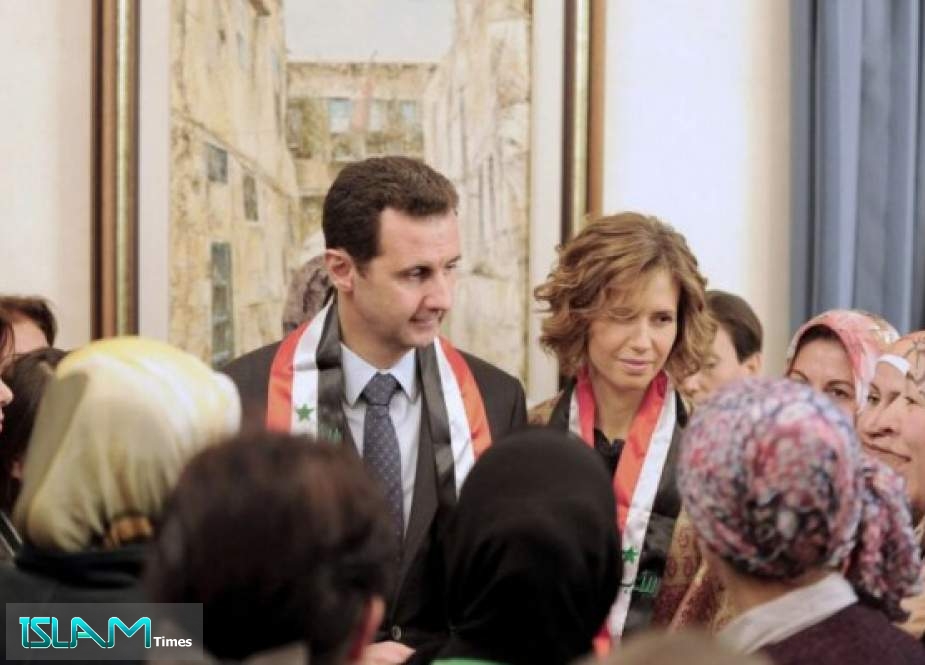
After taking the oath before the Syrian People’s Assembly, President Bashar al-Assad and his family visited the Al-Midan neighborhood in Damascus.
Syrian President Bashar al-Assad, his wife Asma, and their children toured yesterday evening, Saturday, the Al-Midan neighborhood in the capital, Damascus.
The Syrian president arrived in the Al-Midan neighborhood alongside his wife, Asmaa, and their children, to tour the place.
بعد حرب كونية استمرت لاكثر من 10 سنوات وحصار دولي على الجميلة #سوريا الرئيس بشار الأسد وعائلته أمس في حي الميدان بدمشق يتناولون الشاورما وسط حشود من المواطنين بعد أداء القسم الدستوري ليصبح رئيساً رسمياً للبلاد لولاية رابعة ولمدة 7 سنوات pic.twitter.com/LmUdvagXzz
— wafaa baydoun وفاء بيضون (@wafaa_baydoun23) July 18, 2021
The Syrian president was sworn in for a new term yesterday, Saturday, before the members of the People’s Assembly, where he called “on all those who were deceived, to return, because your homeland is your refuge and your haven.”
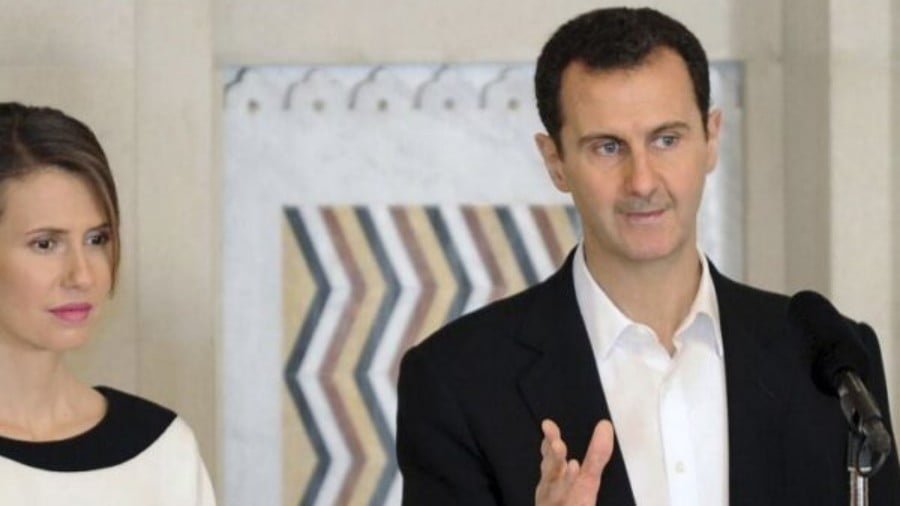
President Bashar Assad and First Lady Asmaa cast their votes in a voting center in the city of Douma (Duma), Ghouta, Damascus Countryside, in the presidential election race.
The Syrian president chose Douma to send messages with high significance to all the concerned parties, Douma was the main center for the NATO and Gulfies sponsored terrorists who they were relying on to take over Damascus, it was run by tens of thousands of terrorists and was liberated in the final days without any serious battle, the people of Douma were fighting on the side of their Syrian Arab Army against the terrorists who infested their city and wanted to turn it into an anti-Islamic Wahhabi and Muslim Brotherhood styled enclave.
President Assad after casting his vote addressed the people in a heart-touching short speech thanking them for their steadfastness in the worst years under the occupation of terrorist groups and thanked them for their very active contribution in the last parliamentary elections and in this current presidential election, an indication that President Assad saw as an adequate message to those who were working on destabilizing Syria and were pushing the Syrian people to fight each other.
Following is the video of his speech followed by the full transcript of President Assad translated into English
I am pleased when I visit and my wife today, the city of Douma, to meet its honorable people and its people, and to share with them this great national merit.
Since this is our first visit after liberation, we must begin by congratulating the people of this city on liberation from the yoke of terrorism, on returning to the embrace of the homeland, and on contributing with their brothers in the rest of the liberated areas and with the people of the country, in general, to restore life to normal, even gradually, and in participating in national entitlements, whether the last elections to the People’s Assembly (the Parliament) or the presidential elections today.
This city has several names, it is called the Capital of Ghouta, it is called Bride of Ghouta, the terrorists tried during their occupation of it to distort its image and defile its reputation, but in reality, at that time most of Douma’s people were inside the city and outside the city, and this is the case for the rest of the regions, whether Ghouta or Other areas that were under the occupation of terrorists, they used to communicate continuously with state institutions in one way or another, urging and exhorting the state to come, and the Syrian Arab Army to liberate, and the law to return, implementation and stability, that is, the rule of law; and some of the people of this city paid their lives just for this communication or simply for showing that desire.
There are people from Douma and Ghouta who fought with the Syrian Arab Army on the outskirts of this city and on the borders of these orchards and fields, and some of them martyred, some of them joined the army regularly and some fought as auxiliary forces; there’s no better indication about these facts from the great popular interaction that we saw in this city and in this region and its villages, orchards, and farms during the election period, the interaction was spontaneous and the interaction was completely clear, expressing a real national situation that is not fake.
Syria is not what they used to try to paint it as a region against a region, and a city against a city and a sect against a sect, a civil war, or a conflict between the Syrians, the truth is no, today we are proving from the city of Douma that the Syrian people are one people in one trench in the face of terrorism, treason, and betrayal.
The second point, this national occasion is also an occasion for us all to remember that this liberation and this merit today that we are practicing in this city and in other liberated areas would not have been possible without the thousands of martyrs who fell in defense of the land and the people in Douma and tens of thousands in other regions of Syria.
On the other side, this (elections) merit, and this popular reaction that we see is an affirmation that the Syrian citizen is free, the decision of the Syrian citizen is in that citizen’s hands, in the hands of the people, not in the hands of any other party, and therefore all the recent statements we hear from Western countries, most of which have a colonial history, (these statements) have begun before the campaign (the elections) and continued until the last few days and perhaps the past few hours that comment on these elections and give an evaluation of them and determine their legitimacy and illegality, of course, we as a state do not care about such statements, but the most important thing about what the state says or is silent about it is what the people say, I believe that the movement that we have seen during the past weeks was an adequate and clear response to all of these, and it tells them the value of your opinions is zero.
We greet all the people of Douma, all the people of Ghouta, and all the people of the liberated areas, and certainly, with each other together, we will work, we will build our cities, villages, and towns, and we will restore to our fields their splendor and fragrance, and greetings are all greetings to all the Syrian Arab people everywhere, inside the homeland and outside the homeland, in Syria, and in the diaspora, because he is the one who has the only credit for every achievement and any achievement, no matter how small and no matter how big, because he is the one who sacrificed and he is the one who persevered and he is the one who reaped.
Thank you.
End of the transcript.
The Judicial Constitutional Elections Committee extended the voting in the country for an additional five hours to accommodate the unprecedented large numbers of voters. Foreign observers from official delegates from a number of friendly countries and independent observers monitored the elections today.
Over 18 million Syrians are eligible for voting and despite attempts by terrorists and separatists working for the USA and its proxies, the turnout of the people for voting is overwhelming in numbers and feelings and messages in all fields to those concerned.
Syria has won and it’s a matter of days and few weeks before the western world starts to accept their defeat in their plot to destroy Syria and will start their u-turn in their policies and reestablish the diplomatic relations with Syria they severed when they joined the evil US war of terror and war of attrition against the Syrian people for an entire decade.
To help us continue please visit the Donate page to donate or learn how you can help us with no cost on you. Follow us on Telegram: http://t.me/syupdates link will open the Telegram app.
Former editor and writer for major news media organizations. He has written extensively on international affairs, with articles published in several languages
Threatening Syria’s First Lady – a national heroine – with prosecution for war crimes is NATO powers reaching into the gutter, Finian Cunningham writes.
This week marks the 10th anniversary since the United States and its NATO allies launched a devastating covert war of aggression for regime change in Syria. Ten years on, the Arab nation is struggling with war reconstruction, a struggle made all the more onerous because of economic sanctions imposed by the United States and the European Union.
Syria and allied forces from Russia, Iran, Iraq and Lebanon’s Hezbollah won the war, defeating legions of mercenary terrorist fighters who were armed and infiltrated into Syria by NATO. Nearly half a million Syrians were killed and half the pre-war population of 23 million was displaced.
But tragically the war is not over yet. It has moved to new hybrid phase of economic warfare in the form of Western sanctions and blockade on Syria.
The barbarity of Western sanctions on Syria have necessitated the cover of distractive media narratives.
This explains the sensation of British media reports that Asma al-Assad, the wife of Syrian President Bashar al-Assad, is being investigating by London’s Metropolitan police for war crimes. Asma (45) was born in London, was educated there and holds British nationality. Although she has Syrian heritage.
Now British authorities are mulling stripping her of nationality and seeking her extradition over charges that she aided and abetted war crimes, including preposterously, the use of chemical weapons against civilians. There is practically no chance of a prosecution, but that’s not the British aim. Rather it is all about smearing the Syrian leadership and distracting the world’s attention from the real issues: which are the criminality of NATO’s war on Syria and the ongoing economic warfare to destroy the nation into submission.
Irish peace activist and author Declan Hayes who has travelled extensively in Syria during the past decade commented: “Britain’s legally ludicrous accusations against Asma al-Assad have a number of objectives in mind. They are there to delegitimize Syria’s 2021 presidential elections; they are there to scare expatriate Syrians and British humanitarians; they are there to deflect from NATO’s well documented war crimes; and they are there to deflect from the mercenary collusion of a cast of media, political and NGO characters in NATO’s war crimes in Syria, Iraq, Libya and Yemen.”
Asma married Bashar in 2000. Before the war erupted in March 2011, she was eulogized in Western media as the “desert rose” owing to her feminine beauty and quietly spoken graceful persona. The daughter of a cardiologist and having had a career in investment banking before she become Syria’s First Lady, Asma al-Assad later showed herself to be no wilting flower. She refused to leave Damascus and go into comfortable exile with her children when the war was raging.
She remained loyally by her husband’s side and took on the role of consoling the nation, often visiting families of slain soldiers and civilian victims of NATO’s terror gangs.
No doubt the stress resulted in Asma suffering from breast cancer for which she was successfully treated in 2018.
President Assad and his wife stood by the Syrian nation when the jaws of defeat were looming during the early years of the war. When Russia intervened in support of its historic ally in October 2015, the tide of the war turned decisively against the NATO plan for regime change. Assad was singled out for regime change because of his anti-imperialist position against the U.S., Britain, France and Israel. His alliance with Russia, Iran and Lebanon’s Hezbollah put a target on his back for destruction, as former French foreign minister Roland Dumas disclosed. Dumas revealed that the British government had war plans on Syria two years before the violence erupted in March 2011. In this context, the so-called “uprising” was a carefully orchestrated false flag.
The mysterious shootings of police and protesters in the southern city of Daraa – which served to smear the Assad government internationally – were the same modus operandi used by NATO covert forces which carried out the sniper murders in Kiev’s Maidan Square triggering the February 2014 coup d’état in Ukraine.
Western media headlines this week marking the 10th anniversary since the beginning of NATO’s war on Syria have been ghoulish and nauseating.
There is a sense of gloating over the misery and hunger that the nation is facing.
A headline in Associated Press labels Syria as the “Republic of Queues”, reporting almost gleefully on how civilians are struggling with food and fuel shortages.
Nowhere in the media coverage is there a mention of how the American CIA and Britain’s MI6 ran Operation Timber Sycamore to arm and direct mercenaries to terrorize Syrians. Absurdly, Western media still claim that Syria’s war rose out of “pro-democracy uprisings” which were crushed by a “ruthless Assad regime”.
Barely acknowledged too is the fact that the United States, Britain and the European Union are strangling a war-torn nation with barbaric sanctions preventing reconstruction. The criminality of economic terrorism is the corollary of a failed criminal covert war of aggression.
The abominable reality of Western policy towards Syria has to be covered up. Threatening Syria’s First Lady – a national heroine – with prosecution for war crimes is NATO powers reaching into the gutter.
More sanctions, by all means. More grief and suffering and more people around the world wondering what exactly the United States is doing.
I am a recipient of regular, usual weekly, emails from the Department of the Treasury providing an “Update to OFAC’s list of Specially Designated Nationals (SDN) and Blocked Persons.” OFAC is the Office of Foreign Assets Control, which is tasked with both identifying and managing the financial punishments meted out to those individuals and groups that have been sanctioned by the United States government. A recent update, on November 10th, included “Non-Proliferation Designations; Iran-related Designations.” There were ten items on the list, names of Chinese and Iranian individuals and companies. Those who are “Specially Designated” on the list are subject to having their assets blocked if located in the United States and are also not allowed to engage in any financial transactions that go through U.S. banking channels. As many international banks respect U.S. Treasury “designations” lest they themselves be subjected to secondary sanctions that often means in effect that the individual or group cannot move money in a large part of the global financial marketplace.
The complete SDN list is hundreds of pages long. The Treasury Department defines and justifies OFAC’s mission “As part of its enforcement efforts, OFAC publishes a list of individuals and companies owned or controlled by, or acting for or on behalf of, targeted countries. It also lists individuals, groups, and entities, such as terrorists and narcotics traffickers designated under programs that are not country-specific. Collectively, such individuals and companies are called ‘Specially Designated Nationals’ or ‘SDNs.’ Their assets are blocked and U.S. persons are generally prohibited from dealing with them.”
In reality, of course, OFAC’s sanctions are highly political. They are clearly a form of economic warfare, particularly when entire sectors of a nation’s economy are blocked or a part of a government itself is listed as has been the case with the Iranian Revolutionary Guard Force. Wave after wave of “maximum pressure” sanctions on Iran have made it difficult for the country to sell its only major marketable resource, oil, and it has been locked out of most normal financial networks, making it difficult or even impossible to buy food and medicines.
In many cases sanctions have no practical effect but are rather intended to send a message. There have been new sanctions directed against Moscow and Russian government officials have been sanctioned due to their alleged involvement in activities that the United States does not approve of. The sanctions are imposed even though those “specially designated” have no assets in the U.S. and do not engage in any international financial transactions that could be blocked or disrupted. In those cases, the federal government is sending a message to whomever has been sanctioned to warn them that they are being watched and their behavior has become a matter of record. It is basically a form of intimidation.
Whether sanctions actually work is debatable. The example of Cuba, which was sanctioned by the U.S. for nearly sixty years, would suggest not. Some would argue that on the contrary countries with totalitarian regimes would actually improve their behavior if their citizens could travel freely and welcome visitors, providing evidence that foreigners do not pose a threat justifying a police state.
Within the United States government, it is largely accepted that the most powerful advocate of the sanctions regime is Secretary of State Michael Pompeo, who has been the driving force behind recent sanctions directed against both China and Iran. If that is so he might well be challenged on one of the most bizarre and basically pointless applications of sanctions in recent years, targeting Asma the wife of Syrian President Bashar al-Assad as well as her family that lives in London and are British citizens. Per Pompeo’s statement on the new sanctions “The Department of State today is imposing sanctions on Asma al-Assad, the wife of Bashar al-Assad, for impeding efforts to promote a political resolution of the Syrian conflict pursuant to Section 2(a)(i)(D) of Executive Order 13894… Asma al-Assad has spearheaded efforts on behalf of the regime to consolidate economic and political power, including by using her so-called charities and civil society organizations.”
But the real kicker is Pompeo’s condemnation of Asma, of Syrian origin but English born and raised, is how he involves her family. Her father-in-law Fawaz is a renowned cardiologist at Cromwell Hospital in South Kensington who was educated in England and has lived there for decades. “In addition, we are sanctioning several members of Asma al-Assad’s immediate family, including Fawaz Akhras, Sahar Otri Akhras, Firas al Akhras, and Eyad Akhras as per Section 2(a)(ii) of EO 13894. The Assad and Akhras families have accumulated their ill-gotten riches at the expense of the Syrian people through their control over an extensive, illicit network with links in Europe, the Gulf, and elsewhere.”
Inevitably, no evidence is provided to support any of the allegations about Asma al-Assad and her English family. Asma’s charities are for real in her war-torn country and she is highly respected and admired by those who know her and are not influenced by U.S. and Israeli propaganda.
In reality, the United States has been trying hard to overthrow the Syrian government since 2004 when the Syria Accountability Act was passed. Much of the heat in Congress behind the passage of the act was generated by the Israel Lobby, which wanted to weaken the regime and reduce its ability to represent a viable military force possibly capable of regaining the occupied Golan Heights. Be that as it may, the United States has been hostile to the country’s government and has frequently called for regime change. To bring that about, the U.S. supported al-Qaeda linked terrorist groups operating against Damascus and American soldiers continue to occupy Syrian oil fields in the southeast portion of the country. The Syrians have also been subjected to waves of sanctions that have done grave damage to their economy. American and Israeli concerns have sometimes been linked to the presence of Damascus’ allies Hezbollah and Iran, both of whom have military units based inside Syria, but the simple fact is that neither Iranians nor Lebanese in any way threaten the vastly superior American and Israeli forces present in the region.
One has to ask why, given the realpolitik playing out in the Middle East, Washington and Pompeo feel compelled to go after Asma al-Assad and her family, apparently to include absurdly blaming relatives living for many years outside of Syria for fueling the war. More sanctions, by all means. More grief and suffering and more people around the world wondering what exactly the United States is doing.
[ Ed. note – The article below was initially published in Vogue Magazine in early 2011. I am re-posting it here as it provides a striking look back at Syria as it was just prior to the outbreak of the neocon-instigated regime-change war which so devastated the country.
Asma Assad, the wife of President Bashar Assad, is a woman of grace and beauty, and it’s probably not surprising that a fashion magazine would have decided to publish an article on her. But after the article appeared, Vogue, along with Joan Juliet Buck, the writer of the piece, were attacked by certain mainstream media outlets, such as The Atlantic, presumably for not sufficiently demonizing the Syrian government.
“Asma al-Assad has British roots, wears designer fashion, worked for years in banking, and is married to the dictator Bashar al-Assad, whose regime has killed over 5,000 civilians and hundreds of children this year,” wrote Max Fisher in a sarcastically-worded lead paragraph for The Atlantic.
Fisher also criticized Vogue’s “fawning treatment of the Assad family and its portrayal of the regime as tolerant and peaceful,” noting that this treatment had “generated surprise and outrage in much of the Washington foreign policy community.”
The article by Buck had appeared in Vogue’s February 2011 issue. The Syrian regime-change operation got underway in March, a month later, when protests broke out in Daraa. And the timing of the two probably was nothing more than coincidental.
But of course the neocons in the State Department would have already begun executing their scheme, and a media vilification campaign would have been deemed necessary, or at any rate helpful, in greasing the wheels–and the sudden appearance of the Vogue article (the magazine reportedly has over 11 million readers) probably was looked upon as something of a monkey wrench in the plans. You could think of it as one of the rare moments that a mainstream media organ stepped out of bounds.
Fisher, who now holds a position with the New York Times, went on to kvetch that “the glowing article praised the Assads as a ‘wildly democratic’ family-focused couple who vacation in Europe, foster Christianity, are at ease with American celebrities, made theirs the ‘safest country in the Middle East,’ and want to give Syria a ‘brand essence.’”
It is of course true that the Assads “foster Christianity,” as Fisher contemptuously puts it (indeed–you can go here to see a video I posted two years ago of the first couple attending a Christmas service at a church in Damascus in 2015), but of course it would not do to have this kind of information put out in the mainstream just before the launch of a long-planned regime change operation.
Other mainstream media attacks upon Vogue came from Gawker, where writer John Cook also accused the publication of “fawning”; the New York Times, which published a piece headlined “The Balance of Charm and Reality“; and Slate, whose writer, Noreen Malone, damned Vogue for paying “besotted compliments” to the Assads and for “unwittingly exacerbating” a “modern day Marie Antoinette problem.”
Buck should now be proud of the mainstream media attacks upon her work–but aside from this, her article, as I say, is important also in that it provides a valuable glimpse into life in the country just before the outset of the war.
Syria, she notes, was known as “the safest country in the Middle East.” Buck was roundly excoriated for making this observation, but certainly at the time, in 2011, it was true in spades: Syria was eminently safer than either US-occupied Iraq or Israeli-occupied Palestine.
Buck also notes that Syria is “a place without bombings, unrest, or kidnappings”–which would have run completely counter to the narrative of Assad being the ubiquitous “brutal dictator who kills his own people” and who serves as a “magnet to jihadis”–but perhaps most noteworthy of all are Buck’s revelations about programs set up for children in the country.
When I visited Syria in 2014, one of the things I heard about were Asma Assad’s charity efforts on behalf of children, so it was not surprising for me, upon reading the Vogue article, to learn of Massar, an organization founded by the First Lady and “built around a series of discovery centers,” or to learn that at these centers children and young adults, ages five to twenty-one, were taught “creative, informal approaches to civic responsibility.”
Buck also tells of Asma’s jaunts around the country visiting local schools and interacting with children in what seems to have been a very life-fulfilling manner.
All of this, of course, would have come to a dramatic halt, or a dramatic curtailment at any rate, when the nightmare began and the country suddenly found itself invaded by armies of US-backed terrorists.
Another fascinating aspect of the article is what it reveals regarding Asma’s contributions toward safeguarding Syria’s cultural heritage. While in Syria I attended, along with several members of the staff of Veterans Today, an anti-terrorism conference held at the Dama Rose Hotel in Damascus. Among the subjects discussed at the conference were the ongoing attacks upon cultural heritage sites. It was disclosed that at the outset of the conflict, the country’s Directorate General of Antiquities and Museums (DGAM), in anticipation of terrorist looting of cultural heritage sites, had begun securing priceless artifacts by placing them in secure storage sites around the country.
The effort was a herculean one, involving DGAM’s 2500 employees spanning out across the country, and while most of the credit has gone to Dr. Maamoun Abdulkarim, the director of DGAM, it would appear, if Buck’s article is any indication, that Asma Assad played a role in the effort as well:
There are 500,000 important ancient works of art hidden in storage; Asma al-Assad has brought in the Louvre to create a network of museums and cultural attractions across Syria, and asked Italian experts to help create a database of the 5,000 archaeological sites in the desert. “Culture,” she says, “is like a financial asset. We have an abundance of it, thousands of years of history, but we can’t afford to be complacent.”
The reference to works of art being “hidden in storage” would suggest that already at that time–February of 2011–Syrian officials had begun to anticipate the hellfire that was about to be unleashed upon their country.
One other thing I might mention is a small criticism I have of Buck’s piece. She speaks of “minders” who she claims accompanied her throughout her visit, commenting as well that “on the rare occasions I am out alone, a random series of men in leather jackets seems to be keeping close tabs on what I am doing and where I am headed.”
All I can say in response to this is that I never experienced anything of the like during my own visit to Syria. I stayed at the Dama Rose Hotel–the location where the conference was held–and while I occasionally went out for strolls through the neighborhood, I never once was followed by any “random series of men in leather jackets.” Yes–there were Syrian soldiers in the streets. But they were stationed at certain locations, busy street corners for instance, and they did not begin tailing me suspiciously after I had passed them by. They remained at their posts. Moreover, their presence, rather than threatening, was a comforting assurance I would not be attacked or kidnapped by terrorists, at least while the soldiers were around.
Lastly, I would also mention that Vogue succumbed to the withering barrage of criticism and removed Buck’s article from their website. Less than a year later, the only trace of it that remained on the Internet was at a pro-Syrian site called PresidentAssad.net–something which was made note of in a January 3, 2012 article by Fisher at The Atlantic.
The PresidentAssad.net site is still around, but for some reason the Vogue article seems to have gotten dropped over the years. However, it has re-surfaced–at Gawker. There you may find it (at least for the time being) along with a link back to the attack piece I mentioned above, written by Cook and posted in February of 2011. ]
***
Asma al-Assad: A Rose in the Desert
By Joan Juliet Buck
Asma al-Assad is glamorous, young, and very chic—the freshest and most magnetic of first ladies. Her style is not the couture-and-bling dazzle of Middle Eastern power but a deliberate lack of adornment. She’s a rare combination: a thin, long-limbed beauty with a trained analytic mind who dresses with cunning understatement. Paris Match calls her “the element of light in a country full of shadow zones.” She is the first lady of Syria.
Syria is known as the safest country in the Middle East, possibly because, as the State Department’s Web site says, “the Syrian government conducts intense physical and electronic surveillance of both Syrian citizens and foreign visitors.” It’s a secular country where women earn as much as men and the Muslim veil is forbidden in universities, a place without bombings, unrest, or kidnappings, but its shadow zones are deep and dark. Asma’s husband, Bashar al-Assad, was elected president in 2000, after the death of his father, Hafez al-Assad, with a startling 97 percent of the vote. In Syria, power is hereditary. The country’s alliances are murky. How close are they to Iran, Hamas, and Hezbollah? There are souvenir Hezbollah ashtrays in the souk, and you can spot the Hamas leadership racing through the bar of the Four Seasons. Its number-one enmity is clear: Israel. But that might not always be the case. The United States has just posted its first ambassador there since 2005, Robert Ford.
Iraq is next door, Iran not far away. Lebanon’s capital, Beirut, is 90 minutes by car from Damascus. Jordan is south, and next to it the region that Syrian maps label Palestine. There are nearly one million refugees from Iraq in Syria, and another half-million displaced Palestinians.
“It’s a tough neighborhood,” admits Asma al-Assad.
It’s also a neighborhood intoxicatingly close to the dawn of civilization, where agriculture began some 10,000 years ago, where the wheel, writing, and musical notation were invented. Out in the desert are the magical remains of Palmyra, Apamea, and Ebla. In the National Museum you see small 4,000-year-old panels inlaid with mother-of-pearl that is echoed in the new mother-of-pearl furniture for sale in the souk. Christian Louboutin comes to buy the damask silk brocade they’ve been making here since the Middle Ages for his shoes and bags, and has incidentally purchased a small palace in Aleppo, which, like Damascus, has been inhabited for more than 5,000 years.
The first lady works out of a small white building in a hilly, modern residential neighborhood called Muhajireen, where houses and apartments are crammed together and neighbors peer and wave from balconies. The first impression of Asma al-Assad is movement—a determined swath cut through space with a flash of red soles. Dark-brown eyes, wavy chin-length brown hair, long neck, an energetic grace. No watch, no jewelry apart from Chanel agates around her neck, not even a wedding ring, but fingernails lacquered a dark blue-green. She’s breezy, conspiratorial, and fun. Her accent is English but not plummy. Despite what must be a killer IQ, she sometimes uses urban shorthand: “I was, like. . . .”
Asma Akhras was born in London in 1975, the eldest child and only daughter of a Syrian Harley Street cardiologist and his diplomat wife, both Sunni Muslims. They spoke Arabic at home. She grew up in Ealing, went to Queen’s College, and spent holidays with family in Syria. “I’ve dealt with the sense that people don’t expect Syria to be normal. I’d show my London friends my holiday snaps and they’d be—‘Where did you say you went?’ ”
She studied computer science at university, then went into banking. “It wasn’t a typical path for women,” she says, “but I had it all mapped out.” By the spring of 2000, she was closing a big biotech deal at JP Morgan in London and about to take up an MBA at Harvard. She started dating a family friend: the second son of president Hafez al-Assad, Bashar, who’d cut short his ophthalmology studies in London in 1994 and returned to Syria after his older brother, Basil, heir apparent to power, died in a car crash. They had known each other forever, but a ten-year age difference meant that nothing registered—until it did.
“I was always very serious at work, and suddenly I started to take weekends, or disappear, and people just couldn’t figure it out,” explains the first lady. “What do you say—‘I’m dating the son of a president’? You just don’t say that. Then he became president, so I tried to keep it low-key. Suddenly I was turning up in Syria every month, saying, ‘Granny, I miss you so much!’ I quit in October because by then we knew that we were going to get married at some stage. I couldn’t say why I was leaving. My boss thought I was having a nervous breakdown because nobody quits two months before bonus after closing a really big deal. He wouldn’t accept my resignation. I was, like, ‘Please, really, I just want to get out, I’ve had enough,’ and he was ‘Don’t worry, take time off, it happens to the best of us.’ ” She left without her bonus in November and married Bashar al-Assad in December.
“What I’ve been able to take away from banking was the transferable skills—the analytical thinking, understanding the business side of running a company—to run an NGO or to try and oversee a project.” She runs her office like a business, chairs meeting after meeting, starts work many days at six, never breaks for lunch, and runs home to her children at four. “It’s my time with them, and I get them fresh, unedited—I love that. I really do.” Her staff are used to eating when they can. “I have a rechargeable battery,” she says.
The 35-year-old first lady’s central mission is to change the mind-set of six million Syrians under eighteen, encourage them to engage in what she calls “active citizenship.” “It’s about everyone taking shared responsibility in moving this country forward, about empowerment in a civil society. We all have a stake in this country; it will be what we make it.”
In 2005 she founded Massar, built around a series of discovery centers where children and young adults from five to 21 engage in creative, informal approaches to civic responsibility. Massar’s mobile Green Team has touched 200,000 kids across Syria since 2005. The organization is privately funded through donations. The Syria Trust for Development, formed in 2007, oversees Massar as well as her first NGO, the rural micro-credit association FIRDOS, and SHABAB, which exists to give young people business skills they need for the future.
And then there’s her cultural mission: “People tend to see Syria as artifacts and history,” she says. “For us it’s about the accumulation of cultures, traditions, values, customs. It’s the difference between hardware and software: the artifacts are the hardware, but the software makes all the difference—the customs and the spirit of openness. We have to make sure that we don’t lose that. . . . ” Here she gives an apologetic grin. “You have to excuse me, but I’m a banker—that brand essence.”
That brand essence includes the distant past. There are 500,000 important ancient works of art hidden in storage; Asma al-Assad has brought in the Louvre to create a network of museums and cultural attractions across Syria, and asked Italian experts to help create a database of the 5,000 archaeological sites in the desert. “Culture,” she says, “is like a financial asset. We have an abundance of it, thousands of years of history, but we can’t afford to be complacent.”
In December, Asma al-Assad was in Paris to discuss her alliance with the Louvre. She dazzled a tough French audience at the International Diplomatic Institute, speaking without notes. “I’m not trying to disguise culture as anything more than it is,” she said, “and if I sound like I’m talking politics, it’s because we live in a politicized region, a politicized time, and we are affected by that.”
The French ambassador to Syria, Eric Chevallier, was there: “She managed to get people to consider the possibilities of a country that’s modernizing itself, that stands for a tolerant secularism in a powder-keg region, with extremists and radicals pushing in from all sides—and the driving force for that rests largely on the shoulders of one couple. I hope they’ll make the right choices for their country and the region. ”
Damascus evokes a dusty version of a Mediterranean hill town in an Eastern-bloc country. The courtyard of the Umayyad Mosque at night looks exactly like St. Mark’s square in Venice. When I first arrive, I’m met on the tarmac by a minder, who gives me a bouquet of white roses and lends me a Syrian cell phone; the head minder, a high-profile American PR, joins us the next day. The first lady’s office has provided drivers, so I shop and see sights in a bubble of comfort and hospitality. On the rare occasions I am out alone, a random series of men in leather jackets seems to be keeping close tabs on what I am doing and where I am headed.
“I like things I can touch. I like to get out and meet people and do things,” the first lady says as we set off for a meeting in a museum and a visit to an orphanage. “As a banker, you have to be so focused on the job at hand that you lose the experience of the world around you. My husband gave me back something I had lost.”
She slips behind the wheel of a plain SUV, a walkie-talkie and her cell thrown between the front seats and a Syrian-silk Louboutin tote on top. She does what the locals do—swerves to avoid crazy men who run across busy freeways, misses her turn, checks your seat belt, points out sights, and then can’t find a parking space. When a traffic cop pulls her over at a roundabout, she lowers the tinted window and dips her head with a playful smile. The cop’s eyes go from slits to saucers.
Her younger brother Feras, a surgeon who moved to Syria to start a private health-care group, says, “Her intelligence is both intellectual and emotional, and she’s a master at harmonizing when, and how much, to use of each one.”
In the Saint Paul orphanage, maintained by the Melkite–Greek Catholic patriarchate and run by the Basilian sisters of Aleppo, Asma sits at a long table with the children. Two little boys in new glasses and thick sweaters are called Yussuf. She asks them what kind of music they like. “Sad music,” says one. In the room where she’s had some twelve computers installed, the first lady tells a nun, “I hope you’re letting the younger children in here go crazy on the computers.” The nun winces: “The children are afraid to learn in case they don’t have access to computers when they leave here,” she says.
In the courtyard by the wall down which Saint Paul escaped in a basket 2,000 years ago, an old tree bears gigantic yellow fruit I have never seen before. Citrons. Cédrats in French.
Back in the car, I ask what religion the orphans are. “It’s not relevant,” says Asma al-Assad. “Let me try to explain it to you. That church is a part of my heritage because it’s a Syrian church. The Umayyad Mosque is the third-most-important holy Muslim site, but within the mosque is the tomb of Saint John the Baptist. We all kneel in the mosque in front of the tomb of Saint John the Baptist. That’s how religions live together in Syria—a way that I have never seen anywhere else in the world. We live side by side, and have historically. All the religions and cultures that have passed through these lands—the Armenians, Islam, Christianity, the Umayyads, the Ottomans—make up who I am.”
“Does that include the Jews?” I ask.
“And the Jews,” she answers. “There is a very big Jewish quarter in old Damascus.”
The Jewish quarter of Damascus spans a few abandoned blocks in the old city that emptied out in 1992, when most of the Syrian Jews left. Their houses are sealed up and have not been touched, because, as people like to tell you, Syrians don’t touch the property of others. The broken glass and sagging upper floors tell a story you don’t understand—are the owners coming back to claim them one day?
The presidential family lives surrounded by neighbors in a modern apartment in Malki. On Friday, the Muslim day of rest, Asma al-Assad opens the door herself in jeans and old suede stiletto boots, hair in a ponytail, the word happiness spelled out across the back of her T-shirt. At the bottom of the stairs stands the off-duty president in jeans—tall, long-necked, blue-eyed. A precise man who takes photographs and talks lovingly about his first computer, he says he was attracted to studying eye surgery “because it’s very precise, it’s almost never an emergency, and there is very little blood.”
The old al-Assad family apartment was remade into a child-friendly triple-decker playroom loft surrounded by immense windows on three sides. With neither shades nor curtains, it’s a fishbowl. Asma al-Assad likes to say, “You’re safe because you are surrounded by people who will keep you safe.” Neighbors peer in, drop by, visit, comment on the furniture. The president doesn’t mind: “This curiosity is good: They come to see you, they learn more about you. You don’t isolate yourself.”
There’s a decorated Christmas tree. Seven-year-old Zein watches Tim Burton’s Alice in Wonderland on the president’s iMac; her brother Karim, six, builds a shark out of Legos; and nine-year-old Hafez tries out his new electric violin. All three go to a Montessori school.
Asma al-Assad empties a box of fondue mix into a saucepan for lunch. The household is run on wildly democratic principles. “We all vote on what we want, and where,” she says. The chandelier over the dining table is made of cut-up comic books. “They outvoted us three to two on that.”
A grid is drawn on a blackboard, with ticks for each member of the family. “We were having trouble with politeness, so we made a chart: ticks for when they spoke as they should, and a cross if they didn’t.” There’s a cross next to Asma’s name. “I shouted,” she confesses. “I can’t talk about empowering young people, encouraging them to be creative and take responsibility, if I’m not like that with my own children.”
“The first challenge for us was, Who’s going to define our lives, us or the position?” says the president. “We wanted to live our identity honestly.”
They announced their marriage in January 2001, after the ceremony, which they kept private. There was deliberately no photograph of Asma. “The British media picked that up as: Now she’s moved into the presidential palace, never to be seen again!” says Asma, laughing.
They had a reason: “She spent three months incognito,” says the president. “Before I had any official engagement,” says the first lady, “I went to 300 villages, every governorate, hospitals, farms, schools, factories, you name it—I saw everything to find out where I could be effective. A lot of the time I was somebody’s ‘assistant’ carrying the bag, doing this and that, taking notes. Nobody asked me if I was the first lady; they had no idea.”
“That way,” adds the president, “she started her NGO before she was ever seen in public as my wife. Then she started to teach people that an NGO is not a charity.”
Neither of them believes in charity for the sake of charity. “We have the Iraqi refugees,” says the president. “Everybody is talking about it as a political problem or as welfare, charity. I say it’s neither—it’s about cultural philosophy. We have to help them. That’s why the first thing I did is to allow the Iraqis to go into schools. If they don’t have an education, they will go back as a bomb, in every way: terrorism, extremism, drug dealers, crime. If I have a secular and balanced neighbor, I will be safe.”
When Angelina Jolie came with Brad Pitt for the United Nations in 2009, she was impressed by the first lady’s efforts to encourage empowerment among Iraqi and Palestinian refugees but alarmed by the Assads’ idea of safety.
“My husband was driving us all to lunch,” says Asma al-Assad, “and out of the corner of my eye I could see Brad Pitt was fidgeting. I turned around and asked, ‘Is anything wrong?’ ”
“Where’s your security?” asked Pitt.
“So I started teasing him—‘See that old woman on the street? That’s one of them! And that old guy crossing the road?
That’s the other one!’ ” They both laugh.
The president joins in the punch line: “Brad Pitt wanted to send his security guards here to come and get some training!”
After lunch, Asma al-Assad drives to the airport, where a Falcon 900 is waiting to take her to Massar in Latakia, on the coast. When she lands, she jumps behind the wheel of another SUV waiting on the tarmac. This is the kind of surprise visit she specializes in, but she has no idea how many kids will turn up at the community center on a rainy Friday.
As it turns out, it’s full. Since the first musical notation was discovered nearby, at Ugarit, the immaculate Massar center in Latakia is built around music. Local kids are jamming in a sound booth; a group of refugee Palestinian girls is playing instruments. Others play chess on wall-mounted computers. These kids have started online blood banks, run marathons to raise money for dialysis machines, and are working on ways to rid Latakia of plastic bags. Apart from a few girls in scarves, you can’t tell Muslims from Christians.
Asma al-Assad stands to watch a laborious debate about how—and whether—to standardize the Arabic spelling of the word Syria. Then she throws out a curve ball. “I’ve been advised that we have to close down this center so as to open another one somewhere else,” she says. Kids’ mouths drop open. Some repress tears. Others are furious. One boy chooses altruism: “That’s OK. We know how to do it now; we’ll help them.”
Then the first lady announces, “That wasn’t true. I just wanted to see how much you care about Massar.”
As the pilot expertly avoids sheet lightning above the snow-flecked desert on the way back, she explains, “There was a little bit of formality in what they were saying to me; it wasn’t real. Tricks like this help—they became alive, they became passionate. We need to get past formalities if we are going to get anything done.”
Two nights later it’s the annual Christmas concert by the children of Al-Farah Choir, run by the Syrian Catholic Father Elias Zahlawi. Just before it begins, Bashar and Asma al-Assad slip down the aisle and take the two empty seats in the front row. People clap, and some call out his nickname:
Two hundred children dressed variously as elves, reindeers, or candy canes share the stage with members of the national orchestra, who are done up as elves. The show becomes a full-on songfest, with the elves and reindeer and candy canes giving their all to “Hallelujah” and “Joy to the World.” The carols slide into a more serpentine rhythm, an Arabic rap group takes over, and then it’s back to Broadway mode. The president whispers, “All of these styles belong to our culture. This is how you fight extremism—through art.”
Brass bells are handed out. Now we’re all singing “Jingle Bell Rock,” 1,331 audience members shaking their bells, singing, crying, and laughing.
“This is the diversity you want to see in the Middle East,” says the president, ringing his bell. “This is how you can have peace!”
The Damask Rose
It’s interesting that the title of the Vogue article would have contained the words “Rose of the Desert.” Syria, of course, is a major cultivation center of the Damask rose, a species of flower highly prized for its fragrance and used in the production of rose oil and rose water.
Below is a report on the rose harvest in Syria posted by China TV earlier this year. The reporter makes a good point: “Life and light are stronger than death and darkness.”
Deal is always nigh
-
The fucking ‘Canadian’ Jews are going apeshit about this article about
discrimination - btw, what do you call discrimination based on the fact the
person d...
Report on Beth Israel vigil 07-04-26
-
*1A Rights under combined attack from local government plus media*
Ann Arbor City Council is at it again. Right before the long 4th of July
weekend, they ...
-
Hello all,
It is with great sadness that I share with you the passing of our beloved
sister, Mother, and Grandmother, the individual that you all knew ...
Best Horror Podcast
-
Best Horror Podcast Introduction: Horror podcasts […]
The post Best Horror Podcast appeared first on Copper Shock Horror Podcast.
Ikhras Endorses Muntadhar Al-Zaidi
-
“Oh parties of banditry and sectarianism and corruption, we have come and
our goal is to destroy you.” Ikhras formally endorses Muntadhar al-Zaidi,
Iraqi j...
Prince Charles: Foreign Jews behind bloodshed in ME
-
In May, 2017, British Crown Prince Charles declined an invitation from
Zionist entity’s president Reuven Rivlin‘s to attend the 100th anniversary
of the no...
Palestinian Women – One for All, All for One
-
Honouring All Palestinian Women by Honouring Three: Hanin Zoabi, Ahed
Tamimi, Samah Sabawi Vacy Vlazna “Palestinian women have always stood side
by side ...
US’s Saudi Oil Deal from Win-Win to Mega-Lose
-
By F. William Engdahl Who would’ve thought it would come to this? Certainly
not the Obama Administration, and their brilliant geo-political think-tank
neo-...
-
*Mordechai Vanunu wins human rights prize of Brazilian Press Association *
* http://www.alternativenews.org/english/index.php/features/updates/7038-mordechai...
Abdul Aziz Rantissi:
"My ultimate wish, my God, is to attain martyrdom,"...God granted him his wish on April 17, 2004, at the hands of Israeli assassins.