Showing posts with label Christian Byzantine Empire. Show all posts

Saturday, 10 April 2021

Russia and the EU; The Ukraine Card

Russia and the EU; The Ukraine Card April 08, 2021

by Ghassan and Intibah Kadi for the Saker Blog

A tug-of-war game in Europe has been a strong feature of dramatic events in the region and further afield ever since the Roman Empire plus the Church split up. Which was the cause and which was the effect is subject to debate, but the split was much deeper than one that was political; the spiritual aspect of it is not to be overlooked.

The authors are not experts on this aspect of history and will therefore not dwell too much, but it suffices to say that Catholic Easter can come before Passover, even though Jesus celebrated Passover before His Crucifixion. But this anomaly does not happen in the Julian Calendar that the Orthodox Church adheres to till today; and the Orthodox community doesn’t shy away from presenting this contradiction in the Georgian Calendar that Catholicism follows.

But this article is not about the over millennium-and-a-half-old disagreement between the Western and Eastern Churches. It is about the current rift between Russia and Western Europe.

But to what extent does much of the current rift find its roots in religion? No region in the world has in recent times experienced the repercussions of this ancient divide as much as the Balkans when the former federation of Yugoslavia split, on Catholic/Orthodox religious lines, that ironically bear a huge resemblance to the borders between those of the Roman and the Byzantine Empires. The exploitation of potential cracks in the two main spheres of Islam by the Western power-block, along with its useful non-Western allies, is not to be discounted. It is easy to apply a simplistic view of the divide of the East and West upon such criteria alone, but religious difference always plays an important role, albeit psychologically. In Europe, historical factors also include that of the influence of the Ottoman Empire, the conversion of many East Europeans to Islam, divisions within the Western Church resulting in drastic conflicts and, fast forward to the much later phenomenon of the Soviet era and the lasting implications of its legacy in neighbouring countries, then the picture becomes more complex.

No matter what is said by those countries that Russia had influence over in the post-World War II period, there is no excuse for their denial of the fact that that it was Russia, albeit under the banner of the Red Army, that liberated all of Eastern Europe, including former East Germany and all of Berlin from the Nazis. Among the allies in WWII, Russia made the biggest sacrifices, more sacrifices than all of those of the allies combined, losing tens of millions of its people, with estimates reaching up to forty million. No other nation came close to this calamitous human loss; not even Germany itself.

Yet, Russia is denied all of the accolade in winning the fight against Nazi Germany. Was it its communist USSR status that turned it into the underdog in Western written history or, was it its Orthodox heritage juxtaposed to that of a powerful-global reaching Vatican and also a ‘Christian West’, intent on subduing and dominating, all with the trappings of grabbing resources and spoils?

Clearly, Western Europe, no matter what facts on the ground exist, seems intent on expressing, in public at least, an incurable sense of apprehension, mythology and propagation of fiction when it comes to Russia. Add to this a European obedience to the dictates of America and its power-brokers in attempts to cripple Russia with sanctions, an obedience mostly gained through threats of negative consequences and blackmail if not adhered to. Not only is this broad-spectrum demonization, at least publicly, expressed by European politicians and its so-called ‘elites’, but also among most of the population of Western Europe.

One of the authors often uses popular songs of the West and their lyrics to express specific mental mindsets in certain blocks of time and space. In 1980, British musician, Sting, wrote a song titled Russians. It was meant to be a message of peace in which Sting wondered, with obvious sympathetic sarcasm, about the state of anti-Russia propaganda, and whether some people in the West regarded Russians as robotic communist mindless machines and questioned if they loved their children like all other humans. The lyrics exemplify the popular perceptions in the West of the people and nation of Russia, even to the extent that they would ask such a bizarre question about the love of children.

And, despite the changes in Russia since the dismantling of the Soviet Union which is what the West planned for, and the emergence during the Yeltsin period of ‘bandit capitalism’ – as if that doesn’t exist elsewhere- the negative perceptions persisted, and to add to that, a palpable sense of glee at the chaos and collapse occurring in Russia. Some say, Yeltsin was wracked with guilt later on and ensured a leader who could pull the country out of this disaster; Vladimir Putin, tripping up the West’s plan with many future surprises in store. To this day, the eyes of the Western public are re-directed from any ills that their own powers may be involved in and sharply turned towards this convenient ‘bogey-man’. There was no Hollywood spin to show a ‘rehabilitated’ Russia as Putin quickly turned things around after the Yeltsin period, restoring the nation and the Federation to one of healthy self-esteem, pride, strength and a resolve to regain its place in the world, gradually rendering what the West had seen as a great ‘coup’ over Russia, to a victory that backfired.

Those in the West are at a loss to accurately elaborate on the actual cause of the current escalation with Russia and, that is because the facts don’t stack up in their favour in the honesty box when it comes to manufacturing conflict. Their exploitation of any religious divide has to an extent been successful, but more so about ensuring the encircling of Russia with hostile nations or turning around some governments of traditional Orthodox allies. There is no racial based explanation to the escalation and history of it other than Russian culture being generally one of inclusiveness and diversity, something the West has failed in and in fact abused. Russia, an old culture with at least one thousand years of existence in a paradigm of interdependence with diverse cultures and ethnicities, spanning a massive section of the largest continent that reaches the Black, Caspian, Baltic, Bering Seas, those to the north and east, and all the way to the North Pacific Ocean; how can modern day Europe and the West compare to that?

For the old West, Europe, now mostly gathered into the entity known as the EU, their animosity cannot be explained by unresolved issues with the old Soviet Union. Nor can it be based on beliefs of clear and present dangers and threats posed by the existence of Russia. EU leaders are surely cognisant of the fact that it was NATO that broke the agreement between Gorbachev and the West and that NATO incrementally has been intimidating and threatening Russia’s security by positioning missiles in former Warsaw Pact nations, encircling Russia, and long before Russia made any attempts to counteract such measures. EU leaders, for various reasons, put aside reality and rationality and the known fact that peace and stability in Europe can only exist or have any potentiality if it is based on a mutual European understanding that Russia must be included. EU leaders clearly know, but never state it, that it is the USA that is coercing them to make a stand against their own regional and economic interests and to take actions against Russia; not the other way around as stipulated by their national interests as they claim.

When it comes to the crunch, it is the manipulation by America, a power that aimed and succeeded for some decades in creating itself as a unipolar, all-reaching, global power, one which called the shots on anything and everything and had under its control the vanquished nations that lost out in WWII. When Europe organized itself into a union, it became far easier for America to have almost the entire sub-continent under its boot. It could not have achieved this without the demonization of Russia and re-writing of history for the consumption of the West and all under its tutelage. Just like we have witnessed over time with the ‘Empire Wars’, the strategy of co-opting into a hybrid war format Hollywood and all media has played a crucial role in building a world-wide narrative of America as the ‘world policeman’, ‘saviour’ and ‘leader of the free-world’, when in reality it played the role of raider, pirate and predator, sharing spoils with some of its more powerful ‘allies’ who in effect were nations with little sovereignty or ability to make any crucial decisions of their own.

Last but not least, from the unpragmatic military position, EU leaders know, but under duress ignore the fact that Russia has recently developed state-of-the-art hypersonic weapons that their NATO status and alliance with the USA cannot protect them against. They know that should an escalation materialize between NATO and Russia; such weapons can be used and the outcome possibly devastating for the EU itself. EU nations and, NATO as a whole, know for a fact that a war on European soil with Russia is totally and utterly unwinnable by them. Even without deploying any of the many weapons President Putin announced to the world during his famous speech of March the 1st 2018, a conventional war between the two sides gives Russia the benefit of depth of field and number of troops. Such is the hold on these nations that they act as if in denial of the obvious. What do they stand to gain? Or, is it about harm minimization under the yoke of America? And, what does Europe in particular, expect to gain from provoking or partaking in the provoking of war over Ukraine?

Again, in the usual twisting of facts, the Western media busy themselves in the post-Trump era in portraying Russia as the culprit that is escalating the crisis in Ukraine. If Russia is left with no alternative to act, deciding it must engage militarily, it is not going to be either influenced or intimidated by Western ‘fake news’. It will act based on the facts on the ground, and whatever Russia decides to do or not do, the Western media and leading figures will portray Russia as the transgressor and aggressor, and as we have recently witnessed from Biden himself, ramp up the rhetoric such as calling the President of a world power, President Putin, ‘a killer’.

Without the benefit of a crystal ball, either the situation will escalate to a level that leaves Russia with no other alternative than taking measures similar to those it took in Chechnya and Georgia, or that Ukraine will back off. The former scenario seems more likely unless the superior style of Russian diplomacy that specializes in win-win deals can find a solution. However, the current threat regarding Ukraine surely is for Russia where the line in the sand is to be drawn. Should matters descend to the irreconcilable, even though Russia is certain to score military victory, it will most definitely be subjected to more Western sanctions than the ones it is already under. No doubt, in such an event of ever more imaginative and diabolic sanctions imposed, it will draw Russia ever closer to allies the West does not approve of and new systems which the West has monopolized, will be overridden and rendered ineffective in bringing Russia to its knees.

As for the ever creeping ‘naughty puppy’ syndrome of NATO pushing its presence in Eastern Europe one inch at a time after the breakup of the USSR, all the way from feigning reasons for missiles stationed in Eastern Europe as safeguarding the EU from Iranian missiles, to inciting and coercing former Warsaw Pact nation members to join NATO, deploying more troops in the EU, blatant support for the Ukrainian Nazis, Russia has reciprocated in measured ways. Yes, it did retake Crimea from Ukraine, but this was done within a referendum-based democratic process. Russia may have to bite the dangerous bullet and offer the persecuted regions of Ukraine the same option. Afterall, Russia’s stand in Syria in 2015 at the request of the Syrian government, has clearly signaled that the unipolar 1990’s style ‘New World Order’ is over and that there cannot be any turning back.

Russia’s patience, perseverance and confidence in superior, win-win diplomacy in time will be widely regarded with respect by the rest of the world, even quietly by the EU leaders. It is the EU leaders who will not come to the party because they are hostage to many traps and hence, it is extremely unlikely, if not impossible, given the bind they find themselves in, that they will respond to reason, diplomacy or act in their best interests. Unlike the decades America in particular has had to install or hijack institutions and conjure up scams to place ‘rules’ on the world, Russia is not yet in a strong enough financial position to implement some of its own ‘rules’ to protect her interests. No nations should be able to do this in a manner that adversely affects other nations, whether through ‘rules’, sanctions, scams or monopoly and other tools that kill without a bullet being fired or bombed dropped. These and other strategies and tactics have come predominately from a nation in a general decline; one that boasts a huge fleet of ten aircraft carriers, countless world-wide bases and almost a trillion-dollar annual war budget; the American war machine nonetheless is a technological dinosaur in comparison to the slick and advanced Russian counter-part.

On the big geo-political level; (1) what keeps America in a position of power today is its power of the petro-dollar based global economy and all that comes with it, including control of the SWIFT-based monetary international transactions without which goods cannot be bought, sold and paid for on the international market; (2) in realistic economic sense however, it is China that is approaching the global lead if it hasn’t already at least in Purchasing Power Parity (PPP) terms, and (3) in terms of military hardware superiority, it is Russia that leads the world in this.

In regards to the current ‘crisis’ and a possible showdown over Ukraine, Russia surely cannot have concerns over its military capacity to deal with any action. However, unless Russia has been able to safe-guard its economy, quarantining it as much as possible from being affected by further Western sanctions, then any escalation should not leave Russia subject to any intimidatory Western repercussions. The further the West pushes, the closer Russia will co-operate with China, whether that is driven on a voluntary basis or has arisen out of necessity, and, in such a rapidly changing global environment, that decision of Russia is understandable and pragmatic, providing China stays solidly by the side of Russia.


River to Sea Uprooted Palestinian   
The views expressed in this article are the sole responsibility of the author and do not necessarily reflect those of the Blog!

Tuesday, 21 July 2020

The Pendulum Swings Again: the Desecration of Hagia Sophia

Source

The Pendulum Swings Again: the Desecration of Hagia Sophia ...

July 18, 2020
The Turkish President should have consulted the prophecies of St. Paisius of the Holy Mountain rather than whatever kitaps he was reading before embarking on his risky provocation. In plain Greek, several decades ago St. Paisius was educating Turkish leaders about the sequence of events that the reconversion of Hagia Sophia would set in motion: “When the cathedral of Hagia Sophia is turned into a mosque, Turkey will disintegrate”. He also added reassuringly, for the benefit of his audience, that “I will not see that happen, but you will.” The saint left us for better pastures in 1994. As a footnote to his vision, he also noted that in the ensuing turmoil Constantinople would remain under Russian control for some time before again being returned to Greece. When and if that happens, it does not exactly sound from the tenor of his prophesy that it will revert to just being a museum.
If Mr Erdogan was so keen on tinkering with the status of this major Orthodox holy place, instead of pursuing short-sighted electoral advantage in a state presumably without a future, he should have done better had he chosen – as Americans are fond of saying –to be on the right side of history. He could have done that simply by returning the temple to the religious community which erected it and to which it rightfully belongs.
But, of course, it would be fatuous to expect from a mere politician with declining ratings a gesture of such dazzling magnanimity.
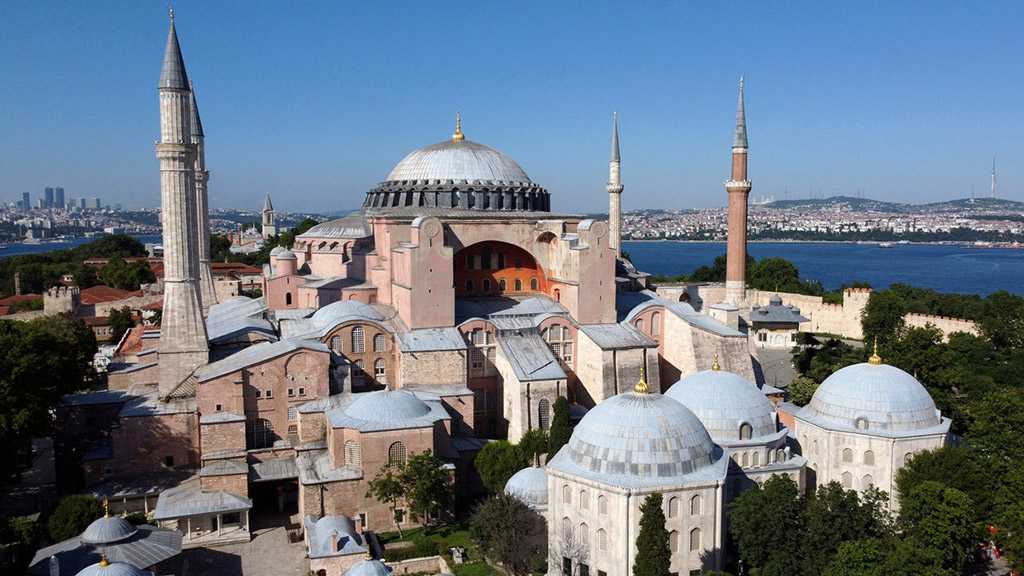
Hagia Sophia was built and consecrated as an Orthodox place of worship in the 6th century by the Eastern Roman Emperor Justinian I. It is a structure of great architectural beauty and even greater symbolic value for world Orthodoxy, as its prime cathedral. Upon the conquest of Constantinople and demise of the Byzantine empire in 1453, it was turned into a mosque by the commander of the conquering army, sultan Mehmed II, and functioned in that capacity until 1934, when the reformist President of the Turkish Republic, Kemal Ataturk, made it a museum. The magnificent structure is under the protection of UNESCO (for whatever that is worth) and is the most visited historical site in Turkey.
What is the significance of the second forced reconversion of the Orthodox cathedral of Hagia Sophia into a mosque? It has to do entirely with internal Turkish politics. It is part of a larger design of the current rulers to reconfigure Turkey back from a secular republic to a resurgent neo-Ottoman state, reinforced with a strong religious identity. Given that the local economy is in poor shape and that the government’s foreign policy initiatives have been generally unsuccessful across the board, descending to religious demagoguery is a more or less natural and predictable recourse. For Orthodox Christians and, hopefully, civilized people of all backgrounds this crude reassertion of the right of conquest, targeting not material goods suitable for pillage, but the spiritual patrimony of one of the great world religious traditions, is nothing short of an act which constitutes the fusion of vandalism and blasphemy.
Of course, it could also be said with some justice, this issue is larger than Erdogan and will outlive him. It is clothed in the garb of a regular court order invalidating Ataturk’s earlier decree, and it was confirmed by a cabinet decision after a meeting lasting all of 17 minutes. As far as provocations go, it could also be argued that in terms of bellicosity it is far less dangerous than shooting down a Russian fighter jet in Syria. Also, as worldly logic might have it, the Hagia Sophia ceased to function as a consecrated church and has not served as consecrated Orthodox Cathedral for more than 550 years. Even before the Ottomans arrived it was ransacked and desecrated during the Western Fourth Crusade, and was then turned into a Roman Catholic cathedral during the Latin occupation of the city. Its history has been long and harsh. A friend of mine has argued that “frankly at least as a mosque it will serve as place of worship and fulfil a spiritual and religious function and not be a tourist attraction, which is a greater desecration, literally speaking.”
“Buildings are buildings,” he has asserted, “they are monuments to faith but no substitute for living faith or a living church which is the Body of Christ. [In the large sense, he does have a point there.] This will only happen when Hagia Sophia is reconsecrated, Orthodox Liturgy is held, the sacred mysteries enacted, and of course when the Eucharist is served once again.”
All these, arguably, are good points. But they miss the emotions this symbolically charged act (going to its core, beyond short-term and short-sighted electoral consideration) evokes among the Balkan Orthodox who still have vivid collective memories of Ottomanism (never mind its neo- variety that is being reinvented today). Nor do they fully take into account the emotions of the Russian Orthodox believers whose faith goes back, in a direct historical line, to that very spot in Constantinople where Vladimir’s bedazzled emissaries, while observing the religious services and magnificent decorations, wondered whether they were on earth or in heaven.
So besides the purely practical and realpolitik aspects to this, there is also a much deeper dimension that challenges Orthodoxy to its core. Its chief representative in Constantinople, the “Ecumenical Patriarch” with a plethora of impressive titles but hardly any flock, a man who few would be so naïve as to regard as a designated vessel of the Holy Spirit, but who certainly is an agent and close collaborator of Western intelligence services to whom he owes his precarious position in an increasingly hostile environment, has been resoundingly silent. Shockingly, Patriarch Bartholomew has been hiding in his Fanar rabbit hole while controversy over what should be his main cathedral has been raging all around him. He is more concerned, one imagines, about avoiding a potential indictment for involvement in the Turkish coup attempt several years ago than in reclaiming the jewel of his ecclesiastical heritage or at least protesting for the record its renewed desecration. The setting up of a false and heretical “church” in the Ukraine under his patronage was apparently a matter he thought more pressing and deserving of his public attention that an outrage to his communion being perpetrated literally in his back yard.

River to Sea Uprooted Palestinian   
The views expressed in this article are the sole responsibility of the author and do not necessarily reflect those of the Blog!

Saturday, 18 July 2020

Clash of civilizations, revisited


Clash of civilizations, revisited

July 17, 2020
By Pepe Escobar – republished from Asia Times by permission of author
Late afternoon in May 29, 1453, Sultan Mehmet, the third son of Murad, born of a slave-girl – probably Christian – in the harem, fluent in Turkish, Arabic, Greek, Latin, Persian and Hebrew, followed by his top ministers, his imams and his bodyguard of Janissaries, rides slowly towards the Great Church of St Sophia in Constantinople.
It’s unlikely that Sultan Mehmet would be sparing a thought for Emperor Justinian, the last of quite a breed: a true Roman Emperor in the throne of Byzantium, a speaker of “barbarous” Greek (he was born in Macedonia) but with a Latin mind.
Much like Sultan Mehmet, Justinian was quite the geopolitician. Byzantium trade was geared towards Cathay and the Indies: silk, spices, precious stones. Yet Persia controlled all the caravan routes on the Ancient Silk Road. The sea route was also a problem; all cargo had to depart from the Persian Gulf.
So Justinian had to bypass Persia.
He came up with a two-pronged strategy: a new northern route via Crimea and the Caucasus, and a new southern route via the Red Sea, bypassing the Persian Gulf.
The first was a relative success; the second a mess. But Justinian finally got his break when a bunch of Orthodox monks offered him to bring back from Asia some precious few silkworm eggs. Soon there were factories not only in Constantinople but in Antioch, Tyre and Beirut. The imperial silk industry – a state monopoly, of course – was up and running.
A fantastic mosaic in Ravenna from the year 546 depicts a Justinian much younger than 64, his age at the time. He was a prodigy of energy – and embellished Constantinople non-stop. The apex was the Church of St. Sophia – the largest building in the world for centuries.
So here we have Sultan Mehmet silently proceeding with his slow ride all the way to the central bronze doors of St Sophia.
He dismounts and picks up a handful of dust and in a gesture of humility, sprinkles it over his turban.
Then he enters the Great Church. He walks towards the altar.
A barely perceptible command leads his top imam to escalate the pulpit and proclaim in the name of Allah, the All Merciful and Compassionate, there is no God but God and Muhammad is his Prophet.
The Sultan then touches the ground with his turbaned head – in a silent prayer. St Sophia was now a mosque.
Sultan Mehmet leaves the mosque and crosses the square to the old Palace of the Emperors, in ruins, founded by Constantine The Great 11 and ½ centuries before. He slowly wanders the ancient halls, his fine velvet slippers brushing the dust from the fabulous pebbled floor mosaics.
Then he murmurs two verses of a Persian poet:
“As the spider weaves the curtain over the palace of the Roman Caesars
The owl sings the time of the house of Afrasiab”
The Byzantine empire, founded by Constantine The Great on Monday, May 11, 330, was over on a Tuesday, May 29, 1453.
Sultan Mehmet is now the Lord of Constantinople and the Lord of the Ottoman Empire. He’s only 21 years old.
Back to the Magic Mountain
Last week, Turkish President Recep Tayyip Erdogan re-christened Hagia Sophia from a museum back into a mosque. He may have done it because his popularity is waning; his proxy wars are a disaster; his AKP party is shattered; and the economy is bleeding badly.
But what’s striking is that right at the beginning of his official televised speech, Erdogan quoted exactly the same verses by the Persian poet murmured by Sultan Mehmet in that fateful afternoon in 1453.
Erdogan’s latest move – which is part of his perennial master plan to claim leadership of global Islam over the decrepit House of Saud – was widely interpreted in myriad latitudes as yet another instance of clash of civilizations: not only Orthodox Christianity vs. Islam but once again East vs. West.
That reminded me of another East vs. West recent derivation: a revival of the Settembrini vs. Naphta debate in Thomas Mann’s The Magic Mountain, promoted by a Dutch think tank, the Nexus Institute, which aims to “keep the spirit of European humanism alive”. The debate pitted Aleksander Dugin against Bernard-Henri Levy (widely known in France as BHL). The full transcript of the debate is here.
Dugin is a leading Eurasianist and the conceptualizer of the – largely banned in the West – Fourth Political Theory . As a philosopher and political theorist, Dugin is cartoonishly demonized across the West as “Putin’s brain”, a closet fascist and “the most dangerous philosopher in the world”.
BHL, hailed as “one of the West’s leading intellectuals”, is a vain poseur who emerged as a “nouveau philosophe” in the mid-1970s and ritually regurgitates the usual Atlanticist mantras enveloped in flowery quotes. He managed, among other feats, to write a book about Pakistan without knowing anything whatsoever about Pakistan, as I thrashed it on Asia Times back in 2002.
Here are a few interesting talking points throughout the debate.
Dugin stresses the end of Western hegemony and global liberalism. He asks BHL, directly, how, “interestingly, in your book, you define the American empire or the global liberal system as a system of nihilism, based on nothing.” Dugin does define himself as a nihilist “in the sense that I refuse the universality of modern Western values (…) I just challenge that the only way to interpret democracy is as the rule of minorities against the majority, that the only way to interpret freedom is as individual freedom, and that the only way to interpret human rights is by projecting a modern, Western, individualistic version of what it means to be human on other cultures.”
BHL, which seems not to have read his own, dreary, book – this is something Dugin told me in person last year in Beirut, after the debate – prefers to resort to proverbial, infantile Putin bashing, picked up over and over again, stressing “there is a bad, dark wind of nihilism in its proper sense, which is a Nazi and a fascist sense, which is blowing in the great Russia.”
Later on in the debate, BHL adds, “I really believe that there is a link between, on the one side, your and Huntington’s way of thinking; and, on the other side, the occupation of Crimea, the 30,000 deaths in Ukraine and the war in Syria with its bloodbath, tragic and horrible.”
On racism, Dugin is adamant: he does not defend it. For him, “Racism is an Anglo-Saxon liberal construction based on a hierarchy between peoples. I think this is criminal.” Then he defines “a new Manichean division, a new racism. Those who are in favor of Western values, they are good. Everybody who challenges that, in the Islamic tradition, in the Russian tradition, in the Chinese tradition, in the Indian tradition, everywhere, they are populists, and they are classified as fascism. I think that is a new kind of racism.”
BHL prefers to concentrate on “the civilization of human rights, freedom, individual dignity, and so on. This deserves to be universalized. This should be conceived, except if you are a racist, as profitable for the entire humanity.” And then it’s Anti-Semitism all over again: “All the men who you quoted and from whom you draw your inspiration – Spengler, Heidegger, who is also a great philosopher of course, and others – are contaminated, corrupted, infected by this plague which is antisemitism. And alas – you too.”
In Paris circles, the joke is that the only thing BHL cares about is the promotion of BHL. And everyone who does not agree with one of the “leading Western intellectuals” is Anti-Semitic.
BHL insists he’s interested in building bridges. But it’s Dugin who frames the real heart of the matter: “When we try to build bridges too early, without knowing the structure of the Other – the problem is the Other. The West doesn’t understand the Other as something positive. It is all the same, and we immediately try to find bridges – they are illusions, and not bridges, because we are projecting ourselves. The Other is the same, the ideology of the same. We first need to understand otherness.”
BHL totally ignores Levi-Strauss. It’s Dugin who refers to Levi-Strauss when talking about The Other, describing him as one of his teachers:
“This anthropological pluralism, I agree, is precisely the American and French tradition. But it is not reflected in politics, or it is reflected in a very perverted way. So I think there is a big contradiction between this anthropological thought in American universities and French universities, and a kind of very aggressive colonial neo-imperialist form to promote American interests on the world scale with weapons.”
BHL is left with – what else – Putin demonization: “The real imperialism, the real one who is interfering and sowing disorder and interfering in the affairs of others, alas, is Putin. And I need not speak of America, where it is now proved that there has been a huge, crude, and evident Russian intervention in the electoral process of the last election.” BHL, who does not even qualify as a neophyte in geopolitics, is oblivious to the absolute debunking of Russiagate.
BHL is adamant “there is today a real clash of civilizations. But not the one you mention in your books, between the north and the east and the west and the south and all of that; there is a clash of civilizations all over the planet between those who believe in human rights, in liberty, in the right for a body not to be tortured and martyred, and those who are happy with illiberalism and the revival of authoritarianism and slavery.”
Dugin’s challenge for years has been to try to conceptualize what may come next, after the failure of Marxism, fascism and liberal democracy. As much as he thinks Eurasian, he’s inclusive – incorporating “Euro” with “Asia”. BHL for his part simplistically reduces every “evil” to “illiberalism”, where Russia, China, Iran and Turkey – no nuances – are thrown in the same dustbin alongside the vacuous and actually murderous House of Saud.
Mao returns
Now let’s attempt a light-hearted ending to our mini-triptych on the clash of civilizations. Inevitably, that has to do with the ongoing US-China Hybrid War.
Around two years ago, the following dialogue was a smash hit on Chinese Weibo. The Great Helmsman Mao Zedong – or his ghost – was back in town, and he wanted to know about everything that was goin’ on. Call it a – revisionist? – realpolitik version of the clash of civilizations.
Mao: “Can the people eat their fill?”
Answer: “There’s so much to eat they’re dieting.”
Mao: “Are there still any capitalists?”
Answer: “They’re all doing business overseas now!”
Mao: “Do we produce more steel than England?”
Answer: “Tangshan alone produces more than America.”
Mao: “Did we beat social imperialism (as in the former USSR)?”
Answer: “They dissolved it themselves!”
Mao: “Did we smash imperialism?”
Answer: “We’re the imperialists now!”
Mao: “And what about my Cultural Revolution?”
Answer: “It’s in America now!”

River to Sea Uprooted Palestinian   
The views expressed in this article are the sole responsibility of the author and do not necessarily reflect those of the Blog!

Sunday, 12 July 2020

Turkey’s Hagia Sophia to Be Reopened as Mosque after Court Decision


Turkey’s Hagia Sophia to Be Reopened as Mosque after Court Decision
A top Turkish court on Friday revoked the Byzantine-era Hagia Sophia’s status as a museum, clearing the way for it to be turned back into a mosque, the official Anadolu news agency reported.
President Recep Tayyip Erdogan hailed the court’s decision and announced that the site would be handed over to Turkey’s religious affairs directorate and reopened for Muslim worshipping.
Erdogan’s announcement comes shortly after a top Turkish court revoked the sixth-century Hagia Sophia’s status as a museum, clearing the way for it to be turned back into a mosque.
The Council of State, which was debating a case brought by a Turkish NGO, canceled a 1934 cabinet decision and ruled the site would be reopened to Muslim worshipping.
Earlier on Friday, UNESCO warned Turkey against converting the Hagia Sophia museum, a World Heritage site, in Istanbul into a mosque, urging dialogue before any decision is taken.
Hagia Sophia was first constructed as a cathedral in the Christian Byzantine Empire in 537 AD but was converted into a mosque after the Ottoman conquest of Constantinople in 1453.
Turning it into a museum was a key reform of the post-Ottoman authorities under the modern republic’s founder Mustafa Kemal Ataturk.
Calls for it to serve again as a mosque has sparked anger among Christians and tensions between the historic foes and uneasy NATO allies Turkey and Greece. Russia, which has become an increasingly important partner of Turkey in recent years, has also urged against altering its status.
Related Videos
Related Articles
River to Sea Uprooted Palestinian   
The views expressed in this article are the sole responsibility of the author and do not necessarily reflect those of the Blog!