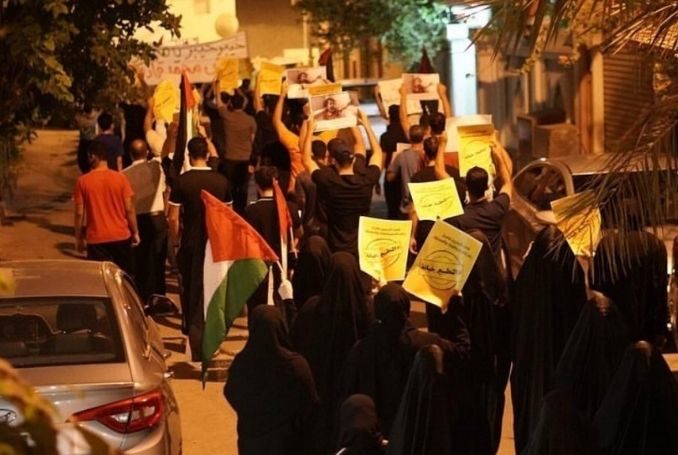
Uprooted Palestinians are at the heart of the conflict in the M.E Palestinians uprooted by force of arms. Yet faced immense difficulties have survived, kept alive their history and culture, passed keys of family homes in occupied Palestine from one generation to the next.
Angry Moroccans against the butchers of the Palestinian children and those normalizing the savagery in the garb of lucrative military deals on Monday took to the streets in several cities across the country to protest Rabat’s normalization of ties with the Zionist regime and recent military agreements signed between the two sides.
The protesters, including activists and ordinary people, took part in large-scale protests in the cities of Oujda, Berkane, Ben Slimane, Beni-Mellal and Oulad Teima on Monday.
The demonstrators chanted vociferous anti-‘Israel’ slogans, calling for an end to normalization of relations between Rabat and Tel Aviv and voicing their support for the Palestinian cause.
The Moroccan police, however, foiled a similar protest by pro-Palestinian groups in the capital Rabat on Monday, using brute force, according to reports.
The demonstrations protested under the banner of “The Moroccan Front to Support Palestine and against Normalization”, denouncing recent bonhomie between the ‘Israeli’ occupation regime and Morocco.
They also condemned the visit of Benny Gantz, the Zionist war minister, to Morocco and rejected any collaboration with “the enemies of the Palestinian people.”
The pro-Palestine demonstrators said any cooperation with the Tel Aviv regime constitutes a threat to Morocco and the whole region.
Gantz visited Rabat last week, his first known visit to one of the Arab states that normalized ties last year, during which the two sides signed a military agreement and a pact that would see the occupation regime sell drones and weapons to Morocco.
In a statement, Gantz said that the agreement was “very significant and will allow us to exchange ideas, enter joint projects and enable ‘Israeli’ military exports here.”
Morocco, the United Arab Emirates, Bahrain and Sudan signed agreements to normalize relations with Tel Aviv in 2020 as part of the so-called ‘Abraham Accords’, brokered by the previous US administration.
The normalization deals sparked widespread protests in these countries, pointing to the overwhelming divide between the rulers and the people, and have also been condemned by all Palestinian political factions, who have termed it a betrayal of their cause.
Monday’s protests coincided with the International Day of Solidarity with the Palestinian People, an annual day dedicated to expression of solidarity with the oppressed people of Palestine.
Former White House senior adviser Jared Kushner is seeking investors from the Gulf States for a new firm, according to a report in the New York Times.
The son-in-law of former US president Donald Trump established the Miami-based investment firm Affinity Partners after Trump lost his reelection bid to current president Joe Biden in November of last year.
Kushner has so far struggled to get financial backing from sovereign wealth funds, according to the Friday report, with Qatar and the United Arab Emirates declining. However, Kushner did have success in courting Saudi Arabia and the kingdom’s $450 billion Public Investment Fund, sources told the newspaper, and with negotiations over what could be a sizeable amount of money.
Over the summer it was reported that Kushner will also open an office in the apartheid “Israeli” entity that will promote trade ties between “Israel”, India, the Gulf States and North Africa.
Kushner was one of the architects of the so-called ‘Abraham Accords’ that normalized relations between ‘Israel’ and the UAE, Bahrain, Morocco and Sudan.
“When former White House officials start cashing in their time served with our government by cozying up to monarchs, it turns the stomach a bit. Is it illegal? No,” Nick Penniman, the head of Issue One, a good-government organization in Washington, told the Times. “Is it swampy and seemingly hypocritical? Yes.”
عبد الفتاح البرهان، القائد العسكري في السودان، يتردّد اسمه اليوم مع إعلانه حلَّ المجلس السيادي والحكومة، وفرضه حالة الطوارئ في البلاد. فمن هو؟ وما هي المناصب التي تقلّدها في حياته السياسية؟
عبد الفتاح البرهان
يجسّد الفريق أول ركن عبد الفتاح البرهان، الذي أعلن اليوم الإثنين حلّ المؤسسات الانتقالية وحالة الطوارئ في السودان، عودةَ الحكم العسكري، وسط ترحيب من البعض، ورفض مطلق من آخرين ندّدوا بما وصفوه بأنه “انقلاب”.
ظهر البرهان اليوم الإثنين، عبر شاشة التلفزيون، في بزّته العسكرية. وأعلن، في نبرة حازمة، أنه يريد “تصحيح الثورة” التي أطاحت عمر البشير عام 2019. وأكّد إعفاء الوزراء ووكلاء الوزراء من مهماتهم، علماً بأن جزءاً كبيراً من هؤلاء اعتُقلوا منذ الفجر على أيدي قوى عسكرية.
في الشارع، يهتف متظاهرون ضده منذ أيام، رافضين “حكم العسكر”، لكن آخرين يطالبون بحكومة عسكرية، ويعتبرون أن الجيش هو المنقذ الذي سيحل كل مشاكل البلاد الاقتصادية والسياسية.
قبل إطاحة البشير، أدّى البرهان دوراً رئيساً بعيداً عن الأضواء في مشاركة السودان في التحالف العسكري الذي تقوده السعودية ضد اليمن، ثم أصبح في دائرة الضوء حين تولى قيادة المجلس العسكريّ الانتقالي في أعقاب إطاحة الرئيس السابق عمر البشير على يد الجيش، في 11 نيسان/أبريل 2019، في إثر تظاهرات حاشدة استمرت خمسة أشهر.
في 12 نيسان/أبريل، أدّى البرهان اليمين رئيساً للمجلس العسكري، الذي تولّى السلطة بعد البشير. تقلّد البرهان منصبه بعد أن تنازل الفريق أول ركن عوض بن عوف عن رئاسة المجلس العسكري بعد أقل من 24 ساعة من تسلّمه السلطة، تحت ضغط الشارع الذي كان ينظر إلى ابن عوف على أنه من داخل النظام، وحليف مقرّب من الرئيس السابق.
من الظلّ إلى المنصب الأول
تحوّل البرهان من شخصية تعمل في الظل إلى رئيس للبلاد بحكم الأمر الواقع. وقال عنه في حينه ضابطٌ في الجيش، طلب عدم الكشف عن هويته، إنه “ضابط رفيع المستوى في القوات المسلحة.. لم يكن يوماً تحت الأضواء كما هي الحال بالنسبة إلى ابن عوف (الذي كان وزيراً للدفاع) والفريق أول ركن كمال عبد المعروف (الذي كان رئيس أركان الجيش)”.
في آب/أغسطس 2019، وبعد عنف في الشارع ومفاوضات مع “ائتلاف قوى الحرية والتغيير”، الذي قاد الاحتجاجات الشعبية، وقّع المجلس العسكري اتفاقاً مع الائتلاف عُرِف بـ”الوثيقة الدستورية”، نصّ على مرحلة انتقالية يتقاسم خلالها المدنيون والعسكريون السلطة لقيادة البلاد نحو انتخابات وحكم مدني.
ترأّس البرهان، بموجب هذا الاتفاق، مجلسَ السيادة الذي كُلِّف الإشرافَ على إدارة المرحلة الانتقالية. ويتكوّن مجلس السيادة من 11 شخصاً: خمسة عسكريين يختارهم المجلس الانتقالي، وخمسة مدنيين يختارهم “تحالف قوى التغيير”، بالإضافة إلى مدني يتفق الجانبان على اختياره.
بعد سنتين من المرحلة الانتقالية، بات البرهان معتاداً على الأضواء، وبات يتصرف ويعامَل على أنه رئيس دولة، فلقد تلقى، الأربعاء الماضي، دعوةً إلى المشاركة في قمة بشأن ليبيا ستُعقَد في باريس في منتصف تشرين الثاني/نوفمبر. وهو يستقبل بانتظام المسؤولين والمبعوثين الأجانب الذين يزورون السودان.
يظهر، بصورة عامة، في بزّته العسكرية مع أوسمته، وغالباً برفقة نائب رئيس مجلس السيادة محمد حمدان دقلو، المعروف بـ “حميدتي”، وهو قائد قوات الدعم السريع المتهمة بقمع انتفاضة عام 2019.
علاقات بالخارج
خلال المفاوضات بين الجيش والمحتجين بشأن تركيبة الحكم، قام البرهان بزيارات لمصر والإمارات والسعودية. والأخيرتان من أبرز المانحين للسودان.
أمضى البرهان فترة من حياته المهنية ملحقاً عسكرياً لدى بكين. ويقول الضابط السوداني عن البرهان إنه “ضابط كبير يعرف كيف يقود قواته”، مضيفاً “ليست لديه ميول سياسية، إنه عسكري”.
وُلد البرهان عام 1960 في قرية قندتو شماليّ الخرطوم، ودرس في الكلية الحربية، ولاحقاً في مصر والأردن. وهو متزوج وأب لثلاثة أبناء. وكان قائداً لسلاح البر، قبل أن يعيّنه البشير في منصب المفتّش العام للجيش.
حرب اليمن
يشير محلّلون ووسائل إعلام سودانية إلى أن البرهان تولّى عملية تنسيق إرسال جنود سودانيين إلى اليمن في إطار “التحالف السعودي” في الحرب ضدّه.
أرسل البشير قوات سودانية إلى اليمن عام 2015 في إطار تحوّل رئيسي في السياسة الخارجية، شهد تخلّي الخرطوم عن علاقاتها المستمرة منذ عقود بإيران، عبر الانضمام إلى “التحالف” الذي تقوده الرياض.
وتقول ويلو بيردج، مؤلفة كتاب “الانتفاضات المدنية في السودان الحديث”، وأستاذة التاريخ في جامعة نيوكاسل، إن البرهان عمل عن كثب مع قوات الدعم السريع، بموجب تولّيه الملف اليمني، من دون أن تستبعد أن يكون دعم هذه المجموعة ساهم في إيصاله إلى السلطة.
عبد الفتاح البرهان و”إسرائيل”
أشارت وسائل إعلام إسرائيلية اليوم إلى أن التطورات في السودان “تمثل سبباً في قلق إسرائيل وإدارة جو بايدن، على حدّ سواء”، معلِّلة ذلك بأنه يعود إلى ترسيخ اتفاق التطبيع مع الخرطوم.
وقالت إن “استمرار الاحتجاجات سيصعّب دفع عملية التطبيع قُدُماً في السودان، ويجب الأخذ في الحسبان أن رئيس حكومة السودان عبد الله حمدوك لم يكن هو من دفع إلى تطبيع العلاقات بإسرائيل، بل كانت القيادة العسكرية برئاسة عبد الفتاح البرهان”.
وفي السياق نفسه، انتقد مصدر إسرائيلي موقف واشنطن مما يجري في السودان، وقال لصحيفة “إسرائيل هيوم” إنه “في الوضع الحالي يفضّل دعم الجيش وقائده رئيس المجلس الانتقالي عبد الفتاح البرهان، لا رئيس الحكومة عبد الله حمدوك”.
وأرجع عبد الفتاح البرهان توقيع حكومته اتفاقات “أبراهام” مع الولايات المتحدة و”إسرائيل” إلى “اقتناع الحكومة بأهمية نشر قيم التسامح والتعايش بين الشعوب، في مختلف أديانهم وأعراقهم”، بحسب الإذاعة الإسرائيلية.
Pinning Palestinians down while applying harsh measures of violent repression accompanied by a fanatical settler movement of arch-racists given free rein to attack and plunder, is a notorious game Israel has elevated to a daily ritual.
In fact, the routine of inflicting war crimes has all the hallmarks of a rogue regime entirely caught up in a misplaced belief that to engage in ethnic cleansing is a religious obligation.
Conflating Judaism with a racist political ideology of Zionism has been part of a strategy designed to deceive, distort and divert. It has its roots in the First Zionist Congress held on the eve of the 19th century.
That this is well documented and widely known is not in dispute. Indeed, awareness of Zionism’s goal to dismember and dislodge Palestinians from their centuries-old homeland, and forcibly impose thereon a foreign entity known as Israel, has always been a bedrock for resistance.
Israel has thus always been considered an enemy thrust upon a native population through the most horrific forms of terrorism. The memories of Deir Yassin remind the world of bloody massacres committed by Zionist terrorists who didn’t spare hundreds of villages to colonize Palestine.
That more than seven decades later the expansionist goals of Zionism are still being pursued at a great human cost to successive generations of the indigenous Palestinian population, is reflected in daily atrocities.
None of these facts, as attested to by historians as well as organs of the United Nations, are contested, although Israel and its supporters seek to distort and malign commentators who speak truth to power as antisemitic.
Yet, against this background of terrorism and current conditions siege, occupation, killings and mass imprisonment – recorded and broadcast via mainstream media for all the world to witness – it is bizarre that a handful of Arab regimes have broken rank with Palestine’s freedom struggle.
And at a time when even Haaretz describes atrocities by Israel as a pogrom:
“Residents of the Palestinian communities in the southeastern West Bank have experience with settler attacks – when they graze their flocks, work their fields, or even have a picnic on their own land. But they cannot recall an attack like the one experienced Tuesday by the small communities of Khirbat al-Mufkara, al-Rakiz and al-Tuwani. On Simhat Torah, dozens of young Jews, most of them masked, conducted what can only be described as a pogrom.”
The treachery associated with what has become known as “normalization” is an outrageous manifestation of betrayal and collaboration. Limited to the UAE, Bahrain, Sudan and Morocco, these regimes have in effect confessed that the protection of their shaky thrones counts for more than legitimate rights of the Palestinians.
As unelected self-imposed despots fearful of democratic values, they have bargained that “normalization” with the usurper of Palestine will “guarantee” safety and protection for them. In other words, just as Egypt has done, these oligarchs have outsourced their intelligence networks and security apparatus to Israel, knowing full well that in doing so, they have abandoned Palestine.
Though the abnormality of implicit recognition of an illegal colonial enterprise has been in sharp contrast to countless Arab League resolutions, the deal of “normalization” pushed by Trump and vigorously backed by the Biden administration has exposed these leaders as surrogates of western imperialism.
The case of Bahrain’s role in the “Abraham Accords” reveals the soft underbelly of Arab dictatorships. Besides being financially dependent on its neighbors, especially the UAE and Saudi Arabia, Bahrain’s alliance with Israel is designed to entrench its power and crush any resistance to authoritarianism or efforts towards freedom and democracy.
In 2011, during the onset of the Arab Spring uprisings, Saudi Arabia sent troops to Bahrain to suppress anti-government protests. This trend continues today by Israel equally committed to maintaining the status quo and preventing the success of any popular uprisings.
In this context, one may justifiably condemn Bahrain’s gross insensitivity and abject abdication of Palestine’s freedom struggle as treacherous.
Showcasing Israeli war criminal Lapid’s visit to Manama, where he is set to open the embassy flying Israel’s flag, is utterly outrageous. This follows the opening of a Zionist embassy in Abu Dhabi; another embassy will likely be established in Rabat. Sudan thus far has reportedly said that it has no plans yet to open an embassy in Khartoum.
Not surprising therefore that the Arab street across these capitals have vowed to end “normalization”. The iron-fisted grip held by Arab despots notwithstanding, human rights movements (many banned and leaders exiled) have declared their outright rejection of America’s much-vaunted Abraham Accords.
Stirrings in Sudan are becoming more vocal despite Khartoum’s attempts to silence critics. In Bahrain the main opposition group, al-Wefaq National Islamic Society declared Lapid’s trip as a “threat”, saying, “This is provocative news and this trip is completely rejected, and he (Lapid) should not set foot on Bahraini soil.”
Their message is clear: “Any (Israeli) presence on Bahraini soil means incitement.”
– Iqbal Jassat is an Executive Member of the South Africa-based Media Review Network. He contributed this article to The Palestine Chronicle. Visit: www.mediareviewnet.com
David Hearst is co-founder and editor-in-chief of Middle East Eye.He says Middle East Eye is funded by “individual private donors” but he won’t name them. He said that his organisation is not funded by Qatar – or any other state or group – and is here to stay. He appears as a commentator on the Middle East for Al Jazeera English and Alaraby TV, TRT, Masr Al-Aan TV.
For years, Emirati foreign policy has been a disaster. Now, on the anniversary of the fundamentally flawed Abraham Accords, a rethink is underway
Abu Dhabi Crown Prince Mohammed bin Zayed is pictured in Berlin in June 2019 (Reuters)
The fall of Afghanistan to the Taliban has triggered an earthquake that has travelled across the Gulf. The tectonic plates that defined who did what to whom in the region are shifting.
Alliances that only a year ago seemed to be set in concrete are cracking. The vacuum created by the US withdrawal from Afghanistan has been felt just as keenly in Riyadh, Abu Dhabi and Tel Aviv as it has in Kabul.
The clearest sign of swaying buildings and buckling tarmac are the pledges and significant amounts of money being promised by the de facto leader of the UAE to Turkey, states that are vigorous competitors for regional influence.
It is pragmatism, not a fundamental change of heart, that is causing the latest handbrake turn in Abu Dhabi’s foreign policy
And Turkey has not been the only sign of the apparent U-turn in UAE policy. Shortly after his recent meeting with Turkish President Recep Tayyip Erdogan, Tahnoun bin Zayed, UAE Crown Prince Mohammed bin Zayed’s brother and security chief, flew to mend fences with Qatar.
Only a year ago, the UAE was urging Saudi Arabia not to lift the blockade of Qatar. This latest visit is a recognition that the blockade was a spectacular failure. Qatar has emerged as US President Joe Biden’s strongest partner in the Gulf, and the one on whom he depended for evacuating Afghans and communicating with the Taliban.
How different from the start of the blockade, when Qatar was painted as a refuge for terrorists and Islamists, and former US President Donald Trump tweeted his approval of the Saudi action.
Billions promised
Erdogan is keeping the transcript of his recent telephone conversation with MBZ close to his chest. Only a trusted few know what the crown prince promised. According to my sources, MBZ offered Erdogan more than $10bn in investments.
Unlike the military side of the government of Sudan, or indeed President Kais Saied in Tunisia, Erdogan is not being made to wait long for the money to arrive. The Dubai-based courier Aramex is reportedly in talks to buy the Turkish delivery company MNG Kargo.
There is much secrecy in Ankara, but one thing is clear: the momentum for this reset is coming from Abu Dhabi. Erdogan is wary, and the foreign policy establishment in Turkey is sceptical. Both have good reason for caution.
UAE National Security Adviser Sheikh Tahnoun bin Zayed and Turkish President Recep Tayyip Erdogan meet in Ankara on 18 August 2021 (Turkish Presidency)
This was the state that, according to Foreign Minister Mevlut Cavusoglu, spent $3bn attempting (and very nearly succeeding) to topple Erdogan on 15 July 2016. Cavusoglu did not name the UAE, but it was clear who he was referencing when he mentioned “a Muslim country”.
The same state funds neoconservative Washington think tanks that regularly debunk Erdogan and his ability to sustain the lira. It competes for influence with Turkey in Syria, Yemen, Libya, the Horn of Africa, Egypt and Tunisia. It was the brains behind, and one of the funders of, the counter-revolution that toppled former Egyptian President Mohamed Morsi – and it has tried repeatedly to rearrange the furniture in Tunisia, Sudan and Yemen. Emirati planes at one point provided air cover for renegade general Khalifa Haftar’s ill-fated attempt to recapture Tripoli.The UAE’s military interventions have led to disaster – not stabilityRead More »
It has also created armies of “electronic flies” to condition public opinion through social media. The UAE’s interventions far beyond the Gulf have wreaked havoc throughout the Middle East.
Turkey has long been on the receiving end of this. So why would a leopard on a mission to hunt down political Islam and render it extinct, change its spots? It is not a question that can be convincingly answered.
Nor is this the first attempt at a kiss and make up: the UAE made a similar overture to Ankara when it thought Hillary Clinton would become US president. When Trump won, this was instantly dropped. It is pragmatism, not a fundamental change of heart, that is causing the latest handbrake turn in Abu Dhabi’s foreign policy. The sceptics in Ankara are right to be cautious.
Nevertheless, it could still be happening. The flood of signals coming out of Abu Dhabi towards Erdogan and Turkey mostly take place in private forums, and the message is consistent, even if you don’t believe it.
‘Strategic reassessment’
According to people with knowledge of these conversations, top UAE officials claim to be conducting a “strategic reassessment” of foreign policy.
It starts with Biden. The UAE noted two features of its changed relationship with Washington since his administration came to power: the first was a consistent message from the new US administration to “de-escalate” tensions in the Middle East. The second was the unpredictability of US foreign policy.
The new policy, then, is apparently to spread influence through economic cooperation, rather than military intervention and political competition
This was surely already apparent under Trump, when he refused to bomb Tehran after Iran and its Iraqi proxies sent armed drones to cripple two Saudi oil facilities, temporarily halving crude production. If ever Saudi Arabia and the UAE felt unprotected by the US military umbrella, it was then.
Coupled with this, they claim, is a hard-headed assessment of what the UAE has actually achieved. Its interventions have indeed beaten the Muslim Brotherhood back as a political force in Egypt, Tunisia, Yemen, Syria, and partly in Libya. But the cost of the UAE’s secular jihad is enormous.
Three of these countries are in smoking ruins, and the other two, Egypt and Tunisia, are nearly bankrupt. What has MBZ gained for the billions of dollars he has invested in Egyptian President Abdel Fattah el-Sisi?
The new policy, then, is apparently to spread influence through economic cooperation, rather than military intervention and political competition.
Saudi-UAE rift
They don’t say it, but when questioned, there is clearly also coolness with Riyadh. One emissary claimed that the UAE delayed its pullout from Yemen for a year to allow Saudi Arabia to end the war with the Houthis, but it is clear that Yemen is a sore point between the two military allies.
Saudi Arabia recently announced a series of moves to weaken Abu Dhabi, the latest being the pullout of Al Arabiya and parent media company MBC from Dubai. It has clamped down on tax-free goods from an Emirati free trade zone, as well as insisting that foreign multinationals base their headquarters in Riyadh rather than Dubai. There is a lot more sibling rivalry to the brotherly relations between the two Gulf countries these days.
MBZ meets Saudi Crown Prince Mohammed bin Salman in Jeddah in 2018 (Bandar al-Jaloud/Saudi Royal Palace/AFP)
Publicly, the UAE’s licensed political analysts are hinting at a different set of regional priorities. Political scientist Abdulkhaleq Abudulla tweeted that the main message from Washington was that the US would not defend the Gulf. “And the Arab Gulf states are at a crossroads; how should they adapt to the post-America Gulf stage?”
Spot the notable absences from this list: Saudi Arabia and Egypt, its closest allies in 2013.
Abraham Accords lose value
Abu Dhabi is not the only signatory of the Abraham Accords which is reassessing the value of a pro-US bloc in the Gulf. One year on from the signing in Washington, the Abraham Accords are losing their shine. A year ago, they seemed to have so much going for them. It was a marriage of brains and brawn, the military might and technological superiority of Israel with the dollars of the Gulf.UAE-Israel deal: Abraham accord or Israeli colonialism?Read More »
It was a way of bypassing the Palestinian conflict, without the need for messy, time-wasting things like negotiations, elections or popular mandates. The accords were a solution imposed from above – a fait accompli, which the Arab masses would have to live with.
But like the megacities of Saudi Arabia, the accords were built on shifting sands.
They had two fundamental flaws. Firstly, they depended on individual leaders – not states – meeting at first in secret as their drivers. This means that when two key players were removed from the picture – Trump and former Israeli Prime Minister Benjamin Netanyahu – the project itself lost sponsorship and momentum.
The other problem was that they were all about the relationship between regional states and the US. They did not address the fundamental problems of relations between the key regional actors themselves.
The UAE’s motive for moving closer to Israel was to cement its relationship with Washington. Recognition of Israel was always a means to an end, not the end in itself.
Bahraini Foreign Minister Abdullatif al-Zayani, Israeli Prime Minister Benjamin Netanyahu, US President Donald Trump and UAE Foreign Minister Abdullah bin Zayed sign the Abraham Accords in 2020 (AFP)
For Israel, on the other hand, the Abraham Accords were all about cementing its own security by increasing its regional influence. It fundamentally misread Arab intentions by conceiving of normalisation as a military and diplomatic safety net for its own continued existence.
Zvi Barel, writing in Haaretz, observed: “The kaleidoscopic shifting of international relations will require Israel to examine its place in the newly-forming alignment. The idea that there’s a pro-U.S. bloc that provides Israel with a military and diplomatic safety net and acts alongside it as an informal coalition against Iran, is beginning to fall apart.”
Regional realignment
The US not only supplied the carrots and sticks necessary to coerce states such as Sudan to join the accords, by removing it from its list of terrorist states. It was the very reason for the accords themselves.
The Emiratis, being quick off the mark, have seen the future shape of the post-oil world. Saudi Crown Prince Mohammed bin Salman (MBS) has yet to reconcile himself to the US military absence. Maybe he will now that Biden has just withdrawn his Patriot missiles from the kingdom and lifted the bar imposed by two of his predecessors to confidential documents on allegations of Saudi government links to two of the 9/11 hijackers.
It has taken eight long years for the penny to drop. But if indeed it has, this realisation presents a genuine opportunity to reshape a post-American Middle East
Unlike MBZ, MBS harbours personal grudges. He cannot forgive Erdogan for the role he played in keeping the murder of Saudi journalist Jamal Khashoggi on the agenda in Washington. In so doing, Erdogan permanently damaged MBS’s international reputation, making a repeat trip to London and the US impossible for the future Saudi king.
MBS’s psychology – for all its modernist patina of posing as a reformer – is still rooted in his Bedouin past. Being the future king, he considers and treats his people as his property. He is their lord and master. Deals with other states are made by him alone. He decides whether his kingdom will recognise Israel or whether, as is now the case, he could turn to Israel to provide him with missile defence systems.
Although all of these moves are brittle and by nature reversible, given that they are triggered by events outside the region and not within it, there could be light at the end of this dark, dark tunnel of permanent intervention. If regional actors themselves can establish a working relationship with each other – and no more than that is required – stability will not depend on a small group of despots. How will US disengagement shape the Middle East?Read More »
Relations between regional powers are more likely to represent state interests, rather than the personal ones of their leaders. That in itself would be progress, if indeed any of this comes to fruition.
MBZ’s decision to reassess his foreign policy has to be genuine and not a temporary swerve. He is right to reassess his foreign policy. It has been a disaster, a complete waste of his money. It has weakened once strong states, such as Egypt, and caused massive refugee flows.
It has taken eight long years for the penny to drop. But if indeed it has, this realisation presents a genuine opportunity to reshape a post-American Middle East.
The views expressed in this article belong to the author and do not necessarily reflect the editorial policy of Middle East Eye.David HearstDavid Hearst is co-founder and editor-in-chief of Middle East Eye. He is a commentator and speaker on the region and analyst on Saudi Arabia. He was The Guardian’s foreign leader writer, and was correspondent in Russia, Europe, and Belfast. He joined the Guardian from The Scotsman, where he was education correspondent.
The Israeli prime minister is first since Golda Meir to propose the racist status quo as a political platform
In March 2015, then Israeli economy minister Naftali Bennett during an election campaign gathering in Kibbutz Kfar Etzion in the Gush Etzion settlement in the West Bank (AFP)
“There is no diplomatic process with the Palestinians, nor will there be one,” said a source close to Israeli Prime Minister Naftali Bennett last week after his defence minister, Benny Gantz, met with Palestinian President Mahmoud Abbas.Biden-Bennett summit a meeting of wishful thinkers who oppose NetanyahuRead More »
Thus is Bennett’s spiritual world revealed: a world in which Israel, and only Israel, exists, and where the Palestinians will never, under any circumstances, even if they change their positions, be able to attain equality with Israelis and negotiate with them as equals. There is a word for that: racism.
Nearly a decade ago, Bennett entered national politics after serving as director-general of the Yesha Council, the leading settler institution, although he himself was never a settler and doesn’t live beyond the Green Line. In a now-famous interview, he said: “The Palestinian problem is like shrapnel in the butt.”
Today, his approach has not changed, although as prime minister, he may express himself less bluntly, as he admitted just before taking office in early June.
Bennett expressed this approach in an interview he gave the New York Times ahead of his recent trip to Washington. “This government will not annex, nor establish a Palestinian state, everyone understands that,” he said. “Israel will continue the standard policy of natural growth [of West Bank settlements].”
In saying this, Bennett became the first Israeli prime minister, with the possible exception of Golda Meir in the years prior to the 1973 war, to propose what amounts to apartheid as a political platform.
Permanent status quo
It is true that the policy of “managing the occupation” is almost as old as the Israeli occupation itself. In February 1973, for example, then-Defence Minister Moshe Dayan said, “We must plan ahead for our actions in the territories [conquered by Israel in June 1967] … so that a situation of ‘no war and no peace’ will not be unbearable for us… Authority for deciding on what happens from Suez to the [Mt] Hermon is in the hands of the Israeli government. We will not idly delineate boundaries for our settlements nor be threatened by smouldering embers.”
But the philosophy Dayan articulated then still exists and every prime minister since, except perhaps Yitzhak Rabin – whose assassination makes it impossible to know whether he meant to break the mould – has adopted it with different variations: “No war, no peace” or, in other words, a continuation of the status quo. Seven months later, the “smouldering embers” that Dayan dismissed had become the firestorm of the October 1973 war, with thousands killed on both sides, forcing Israel to subsequently return the Sinai Peninsula to Egypt.
Bennett basically said that this status quo of ‘no war, no peace’ is not an interim situation, but rather the permanent situation
But Bennett has gone one step further. Even Dayan called the territories occupied by Israel a “deposit” to be returned in exchange for a peace agreement meeting Israel’s needs. Since the 1990s, Israeli prime ministers have been discussing, at least officially, support for the two-state solution, including Ariel Sharon and even Benjamin Netanyahu, who adopted the Palestinian state idea in his 2009 Bar-Ilan speech. In 2020, he also accepted former US President Donald Trump’s “deal of the century” which included the establishment of a Palestinian state, however crippled and fragmented.
In his New York Timesinterview, however, Bennett basically said that this status quo of “no war, no peace” is not an interim situation, but rather the permanent situation to which he aspires.
In this situation, Israel, on the one hand, will continue its military rule over the Palestinians in the West Bank and the Gaza Strip, and continue to accord Jewish citizens in the West Bank preferential rights as compared with Palestinians.
On the other hand, Israel will not accord Palestinians civil rights equal to those of their Jewish neighbours as would be necessitated by a partial or full annexation of the West Bank. This approach also has a name – apartheid – and Bennett believes it to be the only one possible.
‘Shrink the conflict’
We don’t know precisely what was said in Bennett’s discussions with President Joe Biden and Secretary of State Antony Blinken, but publicly at least no American reservations were heard about Bennett’s positions. Nor did the Jewish centre-left parties in Israel like Labor and Meretz, which are part of Bennett’s coalition, voice any protest. This is a dangerous precedent.
But it would be overly simplistic to say that the Bennett government will be more rightist or more violent toward the Palestinians. The opposite might be true.How Beita became a model of Palestinian resistance against IsraelRead More »
First of all, Bennett came into office from a position of political weakness. He heads a small party with six Knesset seats out of 120, and most of his coalition members are more leftist than he is – at least for Israel whose Labor Party positions toward the Palestinians would be considered right in Europe.
And there’s more. Bennett himself, along with his coalition partner, Gideon Saar, who had been a senior Likud figure and a leading candidate to replace Netanyahu, has changed his attitude considerably to the Palestinian question.
As the present government was being formed or immediately thereafter, both Bennett and Saar appeared to have relinquished the idea of Greater Israel and/or annexation, partially or wholly, embracing instead the new political concept of “shrinking the conflict”. The term originated with Micah Goodman, an Israeli of American extraction living in a West Bank settlement, whose books on the conflict have become bestsellers.
Goodman argues that the left in Israel has failed to bring an end to the occupation or to establish an independent Palestinian state, whereas the right failed with its idea of Greater Israel. Therefore, instead of talking about ending the conflict or continuing with the status quo, ways should be sought to “shrink the conflict”: to enable the Palestinians to manage their own affairs as independently as possible, while leaving “security” to Israel. After the conflict has been “shrunk,” says Goodman, it will be possible to discuss a permanent solution.
For a decade, Bennett pushed for annexation, but when the UAE and Bahrain signed the Abraham Accords in 2020, he realised it was impossible.
Goodman was an adviser to Saar and is considered to be close to Bennett. His influence was perceptible in an interview Bennett gave before taking office. “My approach is to shrink the conflict,” he said. “Where it is possible to have more crossings, better quality of life, more business, more industry, we will do it.”
For Bennett, this is a considerable shift. When he entered national politics in 2013, Bennett presented a detailed plan for the annexation of Area C, which is 60 percent of the West Bank. Over the years, he criticised Netanyahu and the Israeli army for not being aggressive enough toward the Palestinians and not “decisive” enough with Hamas.
For a decade, Bennett pushed for annexation, but when the UAE and Bahrain signed the Abraham Accords in 2020, he realised it was impossible. He also understood that a “final resolution” of the conflict by achieving a victory over the Palestinian so crushing that they would relinquish their national aspirations was also impossible. Thus, his adoption of the idea of “shrinking the conflict” is coming from failure and weakness, even if he refuses to admit it.
Israeli right in crisis
Bennett, then, reflects the situation of the Israeli right. On the one hand, he sanctifies the status quo and has no desire or intention of relinquishing the occupation or ending apartheid. On the other hand, the right is gradually losing its faith in its own power to shape the Israeli-Palestinian reality as it sees fit.
The fall of Netanyahu should be viewed in this context. Under Netanyahu, the right in Israel was united in a coherent, homogeneous bloc. The internal contradictions on the right, which Bennett represents, led to the fragmentation of this bloc and the establishment of a mixed government that contains elements of both right and left, including the United Arab List, an Palestinian-Islamist party headed by Mansour Abbas.Palestinian Authority losing control of West Bank, say insiders and activistsRead More »
Outwardly, all of these changes have not affected the situation on the ground. The occupation, and the settlements, continue. The political discourse in Israel remains stuck, in the best case, or else propounds Bennett’s thesis of “no peace, no war”. Israel is so strong – militarily and economically – that something significant would have to happen in order to threaten its control of the Palestinians and its power in the Middle East as a whole.
But at the same time, one cannot ignore the cracks. The ideological right in Israel is in trouble and the question is how and whether the radical left in Israel, or even more so the Palestinians, can turn that to advantage.
“Where there’s a crack, we have to make it a fissure, and where there’s a fissure, we have to make it a chasm,” a left-wing anti-occupation activist told me. Maybe that approach really will accomplish something.
So do they just have a draft system or something?
-
So do they just have a draft system or something? Is someone in charge of
determining where certain yids go in the system? Like Jeff over here goes
to Pizz...
Global Research Daily: The News Behind the News
-
*Dangerous Crossroads: Beijing Reacts to US/NATO “Nuclear Sharing”
Expansion. China is Described as a “Threat”*
*By Drago Bosnic, August 07, 2026*
NATO ...
Kabbalistic Balance
-
Kabbalistic Balance August 6 2026 ___________________________________ More
Vids! +BN Vids Archive! HERE! ___________________________________ Support
The Br...
Report on Beth Israel vigil 07-04-26
-
*1A Rights under combined attack from local government plus media*
Ann Arbor City Council is at it again. Right before the long 4th of July
weekend, they ...
-
Hello all,
It is with great sadness that I share with you the passing of our beloved
sister, Mother, and Grandmother, the individual that you all knew ...
Best Horror Podcast
-
Best Horror Podcast Introduction: Horror podcasts […]
The post Best Horror Podcast appeared first on Copper Shock Horror Podcast.
Ikhras Endorses Muntadhar Al-Zaidi
-
“Oh parties of banditry and sectarianism and corruption, we have come and
our goal is to destroy you.” Ikhras formally endorses Muntadhar al-Zaidi,
Iraqi j...
Prince Charles: Foreign Jews behind bloodshed in ME
-
In May, 2017, British Crown Prince Charles declined an invitation from
Zionist entity’s president Reuven Rivlin‘s to attend the 100th anniversary
of the no...
Palestinian Women – One for All, All for One
-
Honouring All Palestinian Women by Honouring Three: Hanin Zoabi, Ahed
Tamimi, Samah Sabawi Vacy Vlazna “Palestinian women have always stood side
by side ...
US’s Saudi Oil Deal from Win-Win to Mega-Lose
-
By F. William Engdahl Who would’ve thought it would come to this? Certainly
not the Obama Administration, and their brilliant geo-political think-tank
neo-...
-
*Mordechai Vanunu wins human rights prize of Brazilian Press Association *
* http://www.alternativenews.org/english/index.php/features/updates/7038-mordechai...
Abdul Aziz Rantissi:
"My ultimate wish, my God, is to attain martyrdom,"...God granted him his wish on April 17, 2004, at the hands of Israeli assassins.