Uprooted Palestinians are at the heart of the conflict in the M.E Palestinians uprooted by force of arms. Yet faced immense difficulties have survived, kept alive their history and culture, passed keys of family homes in occupied Palestine from one generation to the next.
The Jewish National Fund, established more than 100 years ago, is perhaps the most venerable of the international Zionist organisations. Its recent honorary patrons have included prime ministers, and it advises UN forums on forestry and conservation issues.
It is also recognised as a charity in dozens of western states. Generations of Jewish families, and others, have contributed to its fundraising programmes, learning as children to drop saved pennies into its trademark blue boxes to help plant a tree.
And yet its work over many decades has been driven by one main goal: to evict Palestinians from their homeland.
The JNF is a thriving relic of Europe’s colonial past, even if today it wears the garb of an environmental charity. As recent events show, ethnic cleansing is still what it excels at.
The organisation’s mission began before the state of Israel was even born. Under British protection, the JNF bought up tracts of fertile land in what was then historic Palestine. It typically used force to dispossess Palestinian sharecroppers whose families had worked the land for centuries.
But the JNF’s expulsion activities did not end in 1948, when Israel was established through a bloody war on the ruins of the Palestinians’ homeland – an event Palestinians call the Nakba, or catastrophe.
Israel hurriedly demolished more than 500 cleansed Palestinian villages, and the JNF was entrusted with the job of preventing some 750,000 refugees from returning. It did so by planting forests over both the ruined homes, making it impossible to rebuild them, and village lands to stop them being farmed.
These plantations were how the JNF earned its international reputation. Its forestry operations were lauded for stopping soil erosion, reclaiming land and now tackling the climate crisis.
But even this expertise – gained through enforcing war crimes – was undeserved. Environmentalists say the dark canopies of trees it has planted in arid regions such as the Negev, in Israel’s south, absorb heat unlike the unforested, light-coloured soil. Short of water, the slow-growing trees capture little carbon. Native species of brush and animals, meanwhile, have been harmed.
These pine forests – the JNF has planted some 250 million trees – have also turned into a major fire hazard. Most years hundreds of fires break out after summer droughts exacerbated by climate change.
Early on, the vulnerability of the JNF’s saplings was used as a pretext to outlaw the herding of native black goats. Recently the goats, which clear undergrowth, had to be reintroduced to prevent the fires. But the goats’ slaughter had already served its purpose, forcing Bedouin Palestinians to abandon their pastoral way of life.
Despite surviving the Nakba, thousands of Bedouin in the Negev were covertly expelled to Egypt or the West Bank in Israel’s early years.
It would be wrong, however, to imagine that the JNF’s troubling role in these evictions was of only historical interest. The charity, Israel’s largest private land owner, is actively expelling Palestinians to this day.
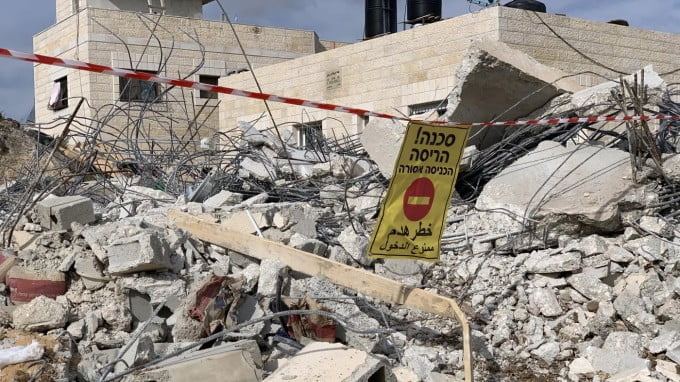
In recent weeks, solidarity activists have been desperately trying to prevent the eviction of a Palestinian family, the Sumarins, from their home in occupied East Jerusalem to make way for Jewish settlers.
Last month the Sumarins lost a 30-year legal battle waged by the JNF, which was secretly sold their home in the late 1980s by the Israeli state.
The family’s property was seized – in violation of international law – under a draconian 1950 piece of legislation declaring Palestinian refugees of the Nakba “absent”, so that they could not reclaim their land inside the new state of Israel.
The Israeli courts have decreed that the Absentee Property Law can be applied outside Israel’s recognised territory too, in occupied Jerusalem. In the Sumarins’ case, it appears not to matter that the family was never actually “absent”. The JNF is permitted to evict the 18 family members next month. To add insult to injury, they will have to pay damages to the JNF.
A former US board member, Seth Morrison, resigned in protest in 2011 at the JNF’s role in such evictions, accusing it of working with extreme settler groups. Last year the JNF ousted a family in similar circumstances near Bethlehem. Days later settlers moved on to the land.
Ir Amim, an Israeli human rights group focusing on Jerusalem, warned that these cases create a dangerous legal precedent if Israel carries out its promise to annex West Bank territory. It could rapidly expand the number of Palestinians classified as “absentees”.
But the JNF never lost its love of the humble tree as the most effective – and veiled – tool of ethnic cleansing. And it is once again using forests as a weapon against the fifth of Israel’s population who are Palestinian, survivors of the Nakba.
Earlier this year it unveiled its “Relocation Israel 2040” project. The plan is intended to “bring about an in-depth demographic change of an entire country” – what was once sinisterly called “Judaisation”. The aim is to attract 1.5 million Jews to Israel, especially to the Negev, over the next 20 years.
As in Israel’s first years, forests will be vital to success. The JNF is preparing to plant trees on an area of 40 sq km belonging to Bedouin communities that survived earlier expulsions. Under the cover of environmentalism, many thousands of Bedouin could be deemed “trespassers”.
The Bedouin have been in legal dispute with the Israeli state for decades over ownership of their lands. This month in an interview with the Jerusalem Post newspaper, Daniel Atar, the JNF’s global head, urged Jews once again to drop money into its boxes. He warned that Jews could be dissuaded from coming to the Negev by its reputation for “agricultural crimes” – coded reference to Bedouin who have tried to hold on to their pastoral way of life.
Trees promise both to turn the semi-arid region greener and to clear “unsightly” Bedouin off their ancestral lands. Using the JNF’s original colonial language of “making the desert bloom”, Atar said his organisation would make “the wilderness flourish”.
The Bedouin understand the fate likely to befall them. In a protest last month they carried banners: “No expulsions, no displacement.”
After all, Palestinians have suffered forced displacement at the JNF’s hands for more than a century, while watching it win plaudits from around the world for its work in improving the “environment”.
The man bankrupting America
-
“Go F*** Yourself, Scott: A Full Background Check on The Man Bankrupting
America, Human Skin Tag, Scott Bessent.“ (Blundell).In the same week,
different US...
Occult Utopia Of Jewish Golden Age
-
Occult Utopia Of Jewish Golden Age September 6 2026
___________________________________ More Vids! +BN Vids Archive! HERE!
________________________________...
And You Remain Impossible to Erase
-
There you are, the inspiring Imam, forever present in the conscience of the
honorable and the hearts of the loyal.
Father Dave Smith, Pray For (Mufti) Dr. Hassoun
-
Abducted by the terrorist regime in Syria in 2025, Sheikh Hassoun has been
sentenced to life in prison I spoke with Father Dave Smith, an Australian
Anglic...
Report on Beth Israel vigil 08-15-26
-
*Charlie Kirk and JFK*
John F. Kennedy was assassinated under questionable circumstances on
November 22, 1963, and Charlie Kirk fell on September 10 of la...
On The Road To International Anarchy
-
ON THE ROAD TO INTERNATIONAL ANARCHY— An Analysis (14 August 2026) by
Lawrence Davidson Part I — The Turn Toward […]
-
Hello all,
It is with great sadness that I share with you the passing of our beloved
sister, Mother, and Grandmother, the individual that you all knew ...
Best Horror Podcast
-
Best Horror Podcast Introduction: Horror podcasts […]
The post Best Horror Podcast appeared first on Copper Shock Horror Podcast.
Ikhras Endorses Muntadhar Al-Zaidi
-
“Oh parties of banditry and sectarianism and corruption, we have come and
our goal is to destroy you.” Ikhras formally endorses Muntadhar al-Zaidi,
Iraqi j...
Prince Charles: Foreign Jews behind bloodshed in ME
-
In May, 2017, British Crown Prince Charles declined an invitation from
Zionist entity’s president Reuven Rivlin‘s to attend the 100th anniversary
of the no...
Palestinian Women – One for All, All for One
-
Honouring All Palestinian Women by Honouring Three: Hanin Zoabi, Ahed
Tamimi, Samah Sabawi Vacy Vlazna “Palestinian women have always stood side
by side ...
US’s Saudi Oil Deal from Win-Win to Mega-Lose
-
By F. William Engdahl Who would’ve thought it would come to this? Certainly
not the Obama Administration, and their brilliant geo-political think-tank
neo-...
-
*Mordechai Vanunu wins human rights prize of Brazilian Press Association *
* http://www.alternativenews.org/english/index.php/features/updates/7038-mordechai...
Abdul Aziz Rantissi:
"My ultimate wish, my God, is to attain martyrdom,"...God granted him his wish on April 17, 2004, at the hands of Israeli assassins.
 Uprooted Palestinian
 Uprooted Palestinian


No comments:
Post a Comment