Uprooted Palestinians are at the heart of the conflict in the M.E Palestinians uprooted by force of arms. Yet faced immense difficulties have survived, kept alive their history and culture, passed keys of family homes in occupied Palestine from one generation to the next.
منذ اليوم الأول للأزمة التي افتتحها القرار السعودي بوقف العلاقات الدبلوماسية والإقتصادية مع لبنان، وضعنا استقالة الوزير جورج قرداحي خيارا في سياق المعالجة لا ينتقص من شجاعة وفروسية موقف الوزير قرداحي، فقلنا في مقالة 1-11-2021 “حل الأزمة ليس عند الوزير جورج قرداحي، فلا تلقوا بأحمال كل هذا التخلف على كاهله، ويكفيه فخراً أنه أضاء على مظلومية اليمن، وأضاء على معاني السيادة، وسواء استقال لمنع أن تستقيل الحكومة وندخل في الفراغ والفوضى ويتهدد سلمنا الأهلي، أو بقي لأن الموقف سلاح، فقد قدم المثال على ما يجب أن يكون عليه مفهوم السيادة والحرية والاستقلال، التي تختزنها الأزمة الراهنة، والتي يكثر الآخرون استعمالها كسلع لا كقيم أيضاً، حتى صارت ثلاثية حرية سيادة استقلال، تذكرنا بثلاثية الفوال، توم وحامض وزيت”. والسبب لجعل الاستقالة خياراً يعود لمعادلة وضعها الوزير قرداحي بنفسه، وهي لا لاستقالة الاذعان واستقالة العقاب، وشاركه الحلفاء بإضافة “لا للإقالة” إليها، وربط الاستقالة بضمانات توظيفها لحل الأزمة، كنقطة انطلاق بقيت بعيدة طالما أخفق رئيس الحكومة في تقديمها، وجاءت بها زيارة الرئيس الفرنسي إيمانويل ماكرون إلى الرياض وطلبه للاستقالة كرسالة حسن نية لبنانية للحل، تتيح له أن يطلب رسالة مقابلة لها، لتقدم التوقيت الذي وجد فيه قرداحي اللحظة المناسبة، فما هي الحسابات؟
–
تقف فرنسا خلف بقاء الحكومة، بينما تطلب السعودية استقالتها وهي تعلم أن الفراغ هو البديل، وبالاستناد إلى الموقف الفرنسي وبنسبة معينة الموقف الأميركي الرافضين لإستقالة الحكومة، صمد رئيس الحكومة امام الضغوط السعودية التي طالبته بالإستقالة، ثم دعته لإقالة الوزير قرداحي، وبالإستناد إلى إستحالة إستقالة الحكومة، تمكن حلفاء الوزير قرداحي من تثبيت رفض الإقالة، بعدما كان رئيس الحكومة يقول الإقالة او استقالة الحكومة، والحلفاء وقرداحي لا يريدون تحمل مسؤولية اخذ البلد إلى الفراغ ولا يريدون هذا الفراغ، وقد بذلوا جهودا وقدموا تنازلات كي تكون هناك حكومة لإدراكهم أن مبدأ وجود حكومة في لبنان يستحق التضحية، وهكذا تمت صياغة معادلة توافق عليها قدراحي والحلفاء وترك له تقدير فرص السير بها، وهي ترجمة الجمع بين التمسك ببقاء الحكومة، والتمسك برفض الإذعان للإملاءات، وفق عبارة أطلقها قرداحي عنوانها، الضمانات، أي لا استقالة مجانية للاسترضاء، ولا تمسك بالمقعد الوزاري إذا أتيحت فرص للحلول، وكانت الاستقالة نقطة انطلاقها، وبات التمسك بعدم الاستقالة إقفالاً لباب الحل وفتحاً لباب استقالة الحكومة.
–
قد لا ينجح الرئيس الفرنسي في فتح باب الحل مع السعودية، لكن تمسك الوزير قرداحي بعدم الاستقالة كان سيتم تحميله مسؤولية هذا الفشل، سواء من قبل الرئيس الفرنسي أو من قبل رئيس الحكومة، ومعهما جزء كبير من اللبنانيين في السياسة والمجتمع، سيخرجون جميعاً للقول إن حزب الله منع قرداحي من الإستقالة ودفع بلبنان إلى الخراب، وسيكون خيار لعب ورقة استقالة الحكومة تحت شعار تفادي المزيد من إجراءات الغضب السعودي وارداً، أما وأن الرئيس الفرنسي أخذ على عاتقه أن يجلب مقابل الاستقالة خطوة مشابهة على طريق حل الأزمة تفتح الباب لحوار حول الخلافات أو المشكلات العالقة، فما فعله قرداحي هو وضع الأمور بين فرضيتي، نجاح ماكرون، وبالتالي تكون الاستقالة قد أدت مهمتها في فتح الطريق لإنهاء الأزمة، وهذا هو مفهوم المسؤولية الوطنية الذي لم يحد عنه قرداحي، أو فشل ماكرون، وتكون الاستقالة قطعت الطريق على تحميل قرداحي وحلفائه مسؤولية هذا الفشل، وتظهير المسؤولية السعودية عن إفشال مساعي الرئيس الفرنسي، وما ينتج عن ذلك من تعزيز لعناصر بقاء الحكومة وقطع طريق استقالتها، وإسقاط منطق سحب الذرائع بدليل أن الذريعة الرئيسية تم سحبها ولم يتغير شيء.
–
الذين ينتقدون الوزير قرداحي وحلفائه في قرار الاستقالة الذي اتخذه ودعموه، ويحاسبونه بمعايير السيادة والكرامة والعنفوان، التي رافقت رفضه للاستقالة، عليهم أن يتخيلوا ما سيحدث لو لم تتم الاستقالة، وتم تصوير الأمور وفق صورة تقول إن كل شيء كان جاهزاً لعودة العلاقات واستئناف الصادرات اللبنانية ووقف أي إجراءات عدائية أخرى، لو جاء الرئيس الفرنسي وقد سبقته استقالة الوزير قرداحي كعلامة حسن نية لبنانية طلبتها السعودية، وأن عدم حدوث ذلك يؤكد نوايا لبنانية سلبية، ولذلك تتفهم فرنسا المزيد من الاجراءات السعودية وليس فقط البقاء على الاجراءات السابقة، وبالتوازي سحب الغطاء لبقاء الحكومة، وهو أمر كاف ليعود رئيس الحكومة لخيار استقالة حكومته، وتصعيد الوضع الداخلي على قاعدة استعصاء تشكيل حكومة جديدة، ورفع وتيرة التصعيد المذهبي، في ظل وضع صعب اقتصادياً وأمنياً تعيشه المناطق اللبنانية كافة، وعندها سيخرج الكثيرون يوجهون الإتهام إلى قرداحي والحلفاء بالتسبب بالخراب.
–
لم يخطئ الوزير قرداحي باستقالته أمس كما لم يخطئ من قبل برفضها، وترجم في المرتين مفهوم السيادة بصفتها القرار الوطني النابع من حساب المصلحة الوطنية لا الاستجابة لإملاءات خارجية.
يقول متابعون للاتصالات إن الاستقالة ستشكّل إرباكاً للسعودية لجهة التعامل معها (هيثم الموسوي)
مع تقديم وزير الإعلام جورج قرداحي استقالته من الحكومة، لا يمكن إغفال عدد من التطورات. قد لا تؤتي هدية لبنان إلى المملكة العربية السعودية أُكلها، لكنها في الداخل قد تؤمّن انطلاق مسار سياسي جديدالمبادرة الخاصة جدّاً التي قام بها وزير الإعلام جورج قرداحي، بالاستقالة من الحكومة لفتح الباب أمام معالجة للأزمة مع السعودية ودول خليجية، تنتظر أن يلاقيها الطرف الآخر، وسط تباين في التقديرات حول ما يمكن أن تقوم به الرياض ردّاً على هذه الخطوة، ووسط مخاوف من استمرار موقفها من دون أيّ تصعيد في الخطوات الإجرائية، مقابل أن تتراجع دول خليجية أخرى عن إجراءات اتخذتها بتجميد العلاقات مع لبنان.
لكن الأمر ظلّ يلقي بظلاله على غياب الاستراتيجية اللبنانية الموحّدة حيال ملفات حساسة أبسط من الاستراتيجية الدفاعية التي يطالب بها خصوم المقاومة. إذ إن «الانهيار» أصاب مواقع رئيسية في البلاد حيال المطالب السعودية والاستجابة الضمنية للضغوط التي جاءت من الأوروبيين أيضاً، علماً بأن الجميع يعرفون أن القدرة على إدخال تحوّلات كبيرة في الموقف السعودي من لبنان ليست في متناول اليد الآن، بل إن الرياض تبدو مستمرة في التصعيد ريثما تتمكّن من تحقيق توازن على أكثر من صعيد.
ومع ذلك، فإن الخروج «الطوْعي» لوزير الإعلام من الحكومة خلط الأوراق من جديد. تكاتف فرنسا مع رئيس الحكومة نجيب ميقاتي ترافق مع «قبّة باط» سياسية داخلية جاءت من معظم القوى والمرجعيات. وبينما حاول البعض رمي الكرة في ملعب حزب الله، فإن الجميع يعرفون حقيقة موقف الحزب الذي بقي مصرّاً على احترام قرار قرداحي، مع الاستعداد للوقوف إلى جانبه لو قرّر المضيّ في المعركة. لكنّ الآخرين، جميعاً وبلا أيّ استثناء، كانوا في مكان آخر، وعملوا، كل من جانبه، على ممارسة أشكال مختلفة من الضغط على قرداحي لأجل تنفيذ الاستقالة. ومع ذلك، يتصرّف الجميع على أن الاستقالة أمّنت انطلاق مسار جديد في البلد. استعان ميقاتي بـ«الصديق» الفرنسي على الداخِل، ونجح الرئيس إيمانويل ماكرون في انتزاع «هدية» يدخُل بها على مُضيفه في الرياض.
السؤال عن السبب الذي دفَع القوى السياسية إلى ترك قرداحي «على هواه» يتراجع أمام الاستفسار عن «الثمرة» التي سيجنيها لبنان، وخاصّة أن «المطلوب رضاه» لا «مسامح ولا كريم»، فهل حصل لبنان على ضمانات بأن تدفع هذه الخطوة السعودية إلى أن تُعيد النظر بتصعيدها؟
الإجابة عن هذا السؤال قد تكون في ما قاله قرداحي في مؤتمره الصحافي، ولعلّه المختصر الأهم: «نحن اليوم أمام تطوّرات جديدة، والرئيس الفرنسي ذاهب إلى السعودية بزيارة رسميّة، وفهمت من رئيس الحكومة أنّ الفرنسيّين يرغبون في أن تكون هناك استقالة لي تسبق زيارة ماكرون، وتساعد ربّما على فتح حوار مع المسؤولين السعوديّين حول لبنان»، أي أنها «يُمكن أن تصيب أو تخيب»، علماً بأن ما علّقت به قناة «العربية» السعودية كانَ علامة أولى، قائلة: «في خبر عاجل، غير مهمّ للغاية، وزير الإعلام اللبناني يُقدّم استقالته من الحكومة».
بمعزل عن ذلك، يقول متابعون للاتصالات إن الاستقالة، لا شك، ستشكّل إرباكاً للسعودية لجهة التعامل معها؛ إذا قبلت الرياض الهدية وتراجعت عن إجراءات التصعيد، فسيظهر بأن حجم ردة فعلها على تصريح وزير لا يتناسب وحجمها كدولة. أمّا في حال رفضت المبادرة اللبنانية تجاهها، فيتأكد حينها بأن للمملكة أجندة للانتقام من لبنان، وسيحرِج ذلك أصحاب حملة التهويل على وزير الإعلام والذين سعوا طوال الفترة الماضية إلى تحميله المسؤولية.
أمّا داخلياً، فإن الجميع يسعون في استثمار الخطوة، كل من وجهة نظره. رئيس الحكومة، الذي يتعرّض للضغط الفرنسي ويواجه الكراهية السعودية، يريد «فك العزلة» التي تواجه حكومته، وقد يسعى إلى استثمار الأمر من أجل إعادة تفعيل الحكومة، ولو أنه يحتاج إلى تسويات أخرى ذات طبيعة سياسية وأكثر تعقيداً ربطاً بمطالب الثنائي الشيعي وتيار المردة بما خص التحقيق في ملف المرفأ.
كذلك، ظهر أن سليمان فرنجية، نفسه، والمحطين به، ولا سيما نجله النائب طوني، يتصرّفون على قاعدة أنه «همّ وأزيح» ربطاً بالمسائل المتعلّقة بواقعهم الانتحابي، من جهة، وحتى بملف الانتخابات الرئاسية، من جهة ثانية، علماً بأن معركة انطلقت حول فرنجية الآن على من يخلف قرداحي، إذ يطمح مسؤولون في التيار نفسه إلى تولّي المهمّة بدلاً من اللجوء إلى صديق كما حصل مع قرداحي.
وتلفت مصادر مطّلعة إلى ضرورة مراقبة ما إذا كانت استقالة قرداحي مجرّدة عن التطورات التي تخصّ ملفات أخرى. وتوقفت المصادر عند تصريح ميقاتي لوكالة «أنباء الشرق الأوسط» في لبنان حول «إصرار الثنائي الشيعي على الفصل بين التحقيق القضائي بانفجار ميناء بيروت والتحقيق مع الرؤساء والوزراء»، وقول ميقاتي: «لدينا في الدستور المجلس الأعلى، وهو محكمة كاملة متكاملة مؤلفة من 8 قضاة من أعلى رتب قضائية، إضافة إلى 8 نواب»، في إشارة ضمنية إلى احتمال اللجوء إلى تسوية تقضي بفصل ملفات التحقيق الموجودة بين يدي المحقق العدلي في قضية انفجار مرفأ بيروت طارق البيطار، من دون الاضطرار إلى عزله أو تنحيته، علماً بأن ميقاتي كان دائم التأكيد على «عدم التدخّل في القضاء»، لكنه أعطى إشارة على استعداده للتراجع خطوة، إذ لفت إلى أن «ما يقوم به القضاء من دمج محاكمة الرؤساء والوزراء مع التحقيق القضائي أثار تباينات»، مؤكداً أن «الفصل بين التحقيقين ضروري حيث إن للعسكريين محكمة عسكرية وللقضاء هناك تفتيش قضائي، وأيضاً أوجد الدستور هذه المنظومة لمحاكمة الرؤساء والوزراء». وتساءلت المصادر عمّا إذا كان ميقاتي «يقول ذلك من عنديّاته، أو أنه استحصل على تراجع فرنسي عن الدعم المطلق لرئيس القضاء الأعلى القاضي سهيل عبود، والقاضي البيطار»، مشيرة إلى أن الأيام المقبلة ستؤكّد ذلك في حال «سجّل عبود خطوة لافتة وخرج حلّ ملف البيطار من القضاء بفتوى دستورية للفصل بين التحقيق وإعطاء صلاحية محاسبة الرؤساء والوزراء لمجلس النواب».
وكان رئيس الجمهورية العماد ميشال عون قد شكر قرداحي على مبادرته، مجدّداً التأكيد على حرص لبنان على إقامة أفضل العلاقات مع الدول العربية الشقيقة عموماً، ودول الخليج خصوصاً، متمنياً أن تضع الاستقالة حدّاً للخلل الذي اعترى العلاقات اللبنانية ــــ الخليجية. أمّا ميقاتي، فعلّق عليها بالتأكيد أنها «أتت ضرورية بعد الأزمة التي نشأت مع السعودية وعدد من دول مجلس التعاون الخليجي، ومن شأنها أن تفتح باباً لمعالجة إشكالية العلاقة مع الأشقاء في السعودية بعد تراكمات وتباينات حصلت في السنوات الماضية».
Kordahi’s resignation was made in the expectation that Macron’s visit with Saudi Arabia would help ease the economic pressure on Lebanon
(AP Photo/Bilal Hussein)
At noon on 3 December, Lebanese Minister of Information George Kordahi submitted his resignation to President Michel Aoun and to the government of Lebanon.
The now former information minister, who joined Prime Minister Najib Mikati’s newly assembled cabinet, resigned over the diplomatic row with Saudi Arabia when Kordahi’s comments against the war in Yemen caused Saudi Arabia to recall its ambassador from Lebanon and ban all Lebanese imports.
Months before assuming his post, Kordahi had said that the Yemenis were defending themselves against the Saudi-led siege on Yemen, calling the war against Yemen ‘futile.’
In a statement given upon his resignation at a press conference, Kordahi said: “An intentional campaign was launched against me in some Lebanese and Gulf media and communication sites,” and that “because of this massive and unjust pressure against Lebanon, I refused to resign.”
He also said that “all those who attacked me in Lebanon were the ones who raised slogans of freedom and independence.”
Kordahi’s resignation on Friday emerged out of the hope that French President Emmanuel Macron’s upcoming visit to Saudi Arabia would help ease the pressure on Lebanon.
Kordahi told AFP ahead of his resignation that he does “not want to cling to this position if it can be useful,” hoping instead his resignation will come ahead of a possible deal between Macron and Saudi Arabia that would alleviate the economic and political blows waged by the kingdom. “I want to give Lebanon a chance,” he said.
He added that “the interest of my country and family is above my personal interest, and the interest of the Lebanese is more important than my ministerial position.”
“I don’t accept being used as a tool to harm my Lebanese brothers in the Gulf. The war in Yemen will not last forever, and a day will come when the warring sides will sit at the table,” Kordahi said.
At the peak of the crisis, Saudi officials had said that Kordahi’s comments reflected ‘Iranian influence’ in Lebanese politics.
The diplomatic row between Saudi Arabia and Lebanon, however, reveals one of many examples of Saudi Arabia’s much more influential position in politics over Lebanon.
In banning Lebanese imports and breaking economic ties over a minor issue, Saudi Arabia demonstrated an aggressive ability to strike at Lebanon’s already struggling economy.
In 2017, Saudi Arabia kidnapped and tortured Saad al-Hariri, the then prime minister of Lebanon, releasing him three weeks later.
Lebanese Information Minister George Kordahi stressed that the Publications Court is the only one authorized to deal with media affairs.
In a statement, the Lebanese minister commented on the ruling issued by the military court against Al-Akhbar’s journalist Radwan Mortada.
“The Publications Court is the only one authorized to deal with media affairs, including what is related to the work of journalists under the constitution and the laws regulating freedom of opinion and expression,” read the statement, carried by National News Agency (NNA).
He expressed his hope that this issue would be settled under the Publications Law, while ensuring freedom of expression and the rights of institutions in accordance with regulations and laws.
In a recent talk show program on RT Arabic, Saudi Major General Abdullah Ghanem al-Qahtani and Lebanese journalist Khalil Nasrallah engaged in tense, back-and-forth exchanges over the roots of the current diplomatic crisis between their two countries.
Great Mr Kamal, the issue has gone beyond Kordahi, Kordahi’s resignation (from his position as Minister of Information) is not required – it won’t be enough (to fix Saudi-Lebanese ties), nor is it (manner) required (to resolve current issues), not even – clearly (saying) – not even the President (Michel Aoun), (Gebran) Bassil (Head of the FPM), or anyone (else’s apology would do), the issue (now) for Saudi Arabia (isn’t related to Kordahi anymore), (Saudi Arabia) very clearly says: ‘we wish (to deal with) Lebanon as a state, we do not wish (to deal with) a militia(-led) Lebanon’, meaning that Hezbollah is the one running Lebanon, hijacking (power) in Lebanon, and making peace and war decisions in Lebanon; the Kingdom of Saudi Arabia does not accept this.
Moreover, (speaking to) brother Khalil and others (as well), why are they upset? Saudi Arabia has done nothing more than withdraw its ambassador (to Lebanon) and told the (Lebanese ambassador to the kingdom) to leave, we do not want to import drugs from Lebanon, what’s wrong with that? What harm (does it cause)? If this issue concerns them a lot, why this nervousness and arrogance? Why (would they) speak in such a way and why (do they act) in such a pathetic and desperate way? Let me assure you something, Hezbollah is hated by Lebanese in Lebanon, the people of Lebanon – (Hezbollah) ignores – (and I’m saying this) to you (too Mr) Khalil, (Hezbollah) ignores millions (of Lebanese people) and says ‘we are Lebanon’, ignoring the people of Lebanon. All the Lebanese people, or most of them, want to get rid of Hezbollah. Look Mr –
Host:
– this means –
al-Qahtani:
– (Allow me) for a few (more) seconds, look at (the situation in) Lebanon –
Host:
Mr Ghanem, you wish to say to Lebanon: ‘form a government that excludes Hezbollah, we wish to see a Lebanese government in which (there is no representation) of Hezbollah’, through these words you’re telling the Lebanese people: ‘you must exclude Hezbollah from the government and the political scene’, although it (Hezbollah) gained many votes –
Al-Qahtani:
(I’m not speaking about) exclusion, (I didn’t mean) the exclusion (of Hezbollah), Mr Kamal, (it’s not a matter of) exclusion, we demand Lebanese sovereignty. Is it (not) reasonable for Hezbollah to be a political component among the Lebanese, (a component) that forms, leads, and takes part in the governance of Lebanon? Should (Sayyed) Hassan Nasrallah do this? Brother, a few days ago, the man (Sayyed Nasrallah) came out (on TV) and said ‘we have a 100,000 fighters, I will crush Lebanon and (everyone) in Lebanon…’, so how would you deal with it? How would you hope for (good and stable) relations with a militant leading a state, hijacking its power? This is out of the question!
In the end – just a few seconds – the Kingdom of Saudi Arabia, according to my analysis, I’m not an official, (it) has passed all the boundaries, the choice is now in the hands of the Lebanese, they have an opportunity, they have the elections, they have the international community; France will not do them any good, nor will the US, the IMF is the one telling them ‘I will not lend you a single dollar before the election (takes place)’. (Yet,) what will the elections do? Will it put Hassan Nasrallah (in power) again? Let the Lebanese do whatever they want to, (let them) put Hassan Nasrallah –
Host:
– Good –
Al-Qahtani:
– as a leader affiliated to Iran, and (after all,) this is their (own) affair.
Host:
What do you have to say about that Mr Khalil Nasrallah? He says if Hezbollah was elected (by the Lebanese), let the (ballot) box and citizens elect him again, and (then) let Hezbollah and the ones supporting it in Iran do them (any) good.
Khalil Nasrallah, Lebanese Journalist:
Firstly, I wish to take the whole time I need, because the game of time is somehow leaning in favour of the (other) guest.
Al-Qahtani:
– do not interrupt me next time –
Nasrallah:
– in favour of Abdallah from Saudi Arabia –
Al-Qahtani:
– or else I’ll interrupt you, please! –
Nasrallah:
– The first point, –
Host:
– Yes please –
Nasrallah:
– He hasn’t lived in Lebanon, he doesn’t know (how things are in) Lebanon, he doesn’t know (the reality of) Lebanon at all, he hasn’t read anything about Lebanon, he doesn’t know about the electoral equations, he knows nothing about these numbers. He speaks what he hears on some (TV) channels, or maybe according to what is dictated (to him) by (certain sides) in a certain place.
Secondly, regarding the issue of the Arabic language, I’ve learned the Arabic language very well in Sanaa, so until now, it seems that he hasn’t heard the words of his eminence Sayyed Hassan Nasrallah –
Al-Qahtani:
– where did you learn it? –
Nasrallah:
– (Nasrallah) the hero of the Arabs, he didn’t listen to him when he said –
Al-Qahtani:
– where did you and the Sayyed learn (Arabic)? –
Host:
– Mr Ghanem –
Nasrallah:
– Those 100,000 fighters are –
Al-Qahtani:
– Did you learn (Arabic) in Qom or Tehran? –
Host:
– (Just) a moment –
Nasrallah:
– (while another party) has a 15,000 fightesr in Lebanon and wants to ignite a civil war (in Lebanon), and is supported by the Saudi embassy, (and this man) is Samir Geagea (Head of the Lebanese Forces party). Sayyed Nasrallah said that day, (and he said it using) formal and eloquent Arabic, he clearly said: (I’ve mentioned the number of) these (fighters) to prevent a civil war in Lebanon, and we prepared them to defend Lebanon (against external aggression and threats); those (fighters) fought in Syria and are fighting against Israel. So, if this issue made Riyadh upset, it’s Riyadh’s problem to deal with –
Al-Qahtani:
– They fight in Syria against Israel? –
Nasrallah:
The third point, in everything Abdallah from Saudi Arabia has said – we (in fact) destroyed your (i.e., Saudi Arabia’s) scheme in Syria, we struck your scheme, we struck your (military) forces and the ‘Jaysh al-Islam’ –
Al-Qahtani:
– You fight Israel from Syria! –
Nasrallah:
– funded by Mohammed bin Nayef which was operated by Bandar bin Sultan in the beginning –
Al-Qahtani:
– Why don’t you fight Israel from Lebanon! –
Nasrallah:
– we know you (Saudis) very well. Thirdly, regarding the issue of –
Al-Qahtani:
– We too know you well –
Nasrallah:
– exporting of –
Al-Qahtani:
– we know you well, (we know) all of you militants –
Nasrallah:
– and accusing us of (exporting) Captagon (drugs), I wish that Saudi Arabia (understands) that Hezbollah does not export such substances. The second issue – and the most important point in this regard – is that they (Saudis) export suicide bombers to many Arab states. (The other) issue regarding the discourse of –
Al-Qahtani:
– How many (suicide bombers) have we exported to you in Lebanon? –
Nasrallah:
– Abdallah from Saudi Arabia, and the discourse of Saudis –
Al-Qahtani:
– how many Saudi (suicide bombers) have come to you, to Lebanon? –
Nasrallah:
– is that you have to do x, y, and z… what do you have to do with (Lebanon)? Whether Hezbollah is part of the (Lebanese) government or not? What do you have to do (with Lebanon’s internal affairs)? Mind your own problems, and mind your Yemen-related issues –
Al-Qahtani:
– and you, stay (concerned with the internal affairs of) Lebanon –
Nasrallah:
– Look (for solutions; what) should you do with the Yemen (issue) –
Al-Qahtani:
– Enjoy (having) Hezbollah (in Lebanon)! –
Nasrallah:
– the country which you have attacked in the first place. Above all –
Al-Qahtani:
– what do you have to do with Yemen?
Nasrallah:
More importantly, if you wish to see the extent of Saudi arrogance, the Saudi foreign minister said in his statement, very clearly – and clearly you’re free to jump in and talk over me, because they didn’t mute your microphone – if you go back to the Saudi foreign minister’s statement, (you’ll see) that he’s making impossible demands.
These impossible demands are the very same ones the Americans used to make, all US statements by the ambassador (to Lebanon), or David Hale used to speak of removing Hezbollah’s influence over the government, even though Hezbollah is not in control of the government…still they used to say that.
Host:
They also told you to form a technocratic government, and asked for everyone not to interfere, including Hezbollah…
Nasrallah:
When…when – the nature of the government is none of their business, neither the Americans’ nor anyone else’s, and the government turned out to be just as the Lebanese wanted it to be. This is very clear.
Host:
But that’s the French proposal. The proposal was to form a technocratic government…
The floor is yours Mr. Nasrallah…can you hear me?
Nasrallah:
Oh…no I didn’t hear you well…
Host:
What I said was that the French proposal was to form a technocratic government, a non-party government, and to keep all parties away from the government…and they later on said that it can be a technocratic government whose ministers are appointed by the different parties.
Nasrallah:
No, no, no…allow me to clarify. The French proposal, at first, was to form a national unity government that (espoused) a new political contract in Lebanon, which the Americans rejected. So, they proposed (a less effective solution of) forming a mission-driven government. “Mission-driven government” is somewhat an ambiguous term, and was part of what the Americans wanted, because at the time American pressure on Lebanon was at its highest. This led us to the formation of this government, not because a certain foreign power wanted this government to be formed, but because a certain party in Lebanon, Hezbollah, did not accept that the Lebanese people be humiliated, and brought in the fuel shipments, thereby forcing the Americans to accept the formation of a government in Lebanon, or at least to allow it to happen. By doing so, they overturned some previous objections, including (those of) the Saudis.
Not to stray too far off track, as for the Saudis, their main crisis is Yemen, that’s where their problem is. When they spoke with the Iranians, they made a few awkward suggestions…
Al-Qahtani:
Stick to Lebanon…(you have enough problems as it is)
Nasrallah:
…and the Iranians replied and told them that they should talk these things over with Hezbollah. This really irritated them (the Saudis). We understand how they deal with things, this mentality.
In Lebanon also, let me tell Abdallah something important, they (the Saudis) had some political forces whom they (encouraged) towards a civil war in 2017, and detained Lebanon’s Prime Minister (Saad Hariri), who also has Saudi citizenship.
Regardless of whether I agree with (Hariri) or not, the (Saudi) move was foiled.
Now, before the Tayouneh (massacre), and they (the Saudis) know full-well who they’re funding, the Lebanese Forces party, which is working for Saudi Arabia, has also failed in this task. They opened fire on civilians, and Hezbollah made a wise decision (to prevent any armed reaction).
Saudi options in Lebanon are now beginning to run out, and so they went toward this option (the diplomatic crisis over Kordahi)…and by the way, this business of cutting diplomatic relations has run counter to US wishes. The Americans did not agreed to the resignation of the Mikati government, they did not agree on a more severe embargo, and now the Saudis have begun to discover – and they will arrive to this conclusion in the near future – that they made a decision…just us the UN Secretary General says that the war on Yemen is foolish, this decision of theirs is also foolish. This is a decision that will have no favorable returns for them.
This show that they’ve put on, that the Bahraini government has followed in their stead, as well as the Hadi government in Riyadh, and the Abu Dhabi government…
Al-Qahtani:
What do we stand to lose?
Nasrallah:
…and so, in this next period, they’ll come to the realisation that they’ve made a wrong decision, and this decision will backfire. Let them go to Yemen, where they should talk to the government in Sana’a, peer to peer. This gamble of theirs will lose, and it has begun to lose, just as they’ve lost in other instances, they will also lose now.
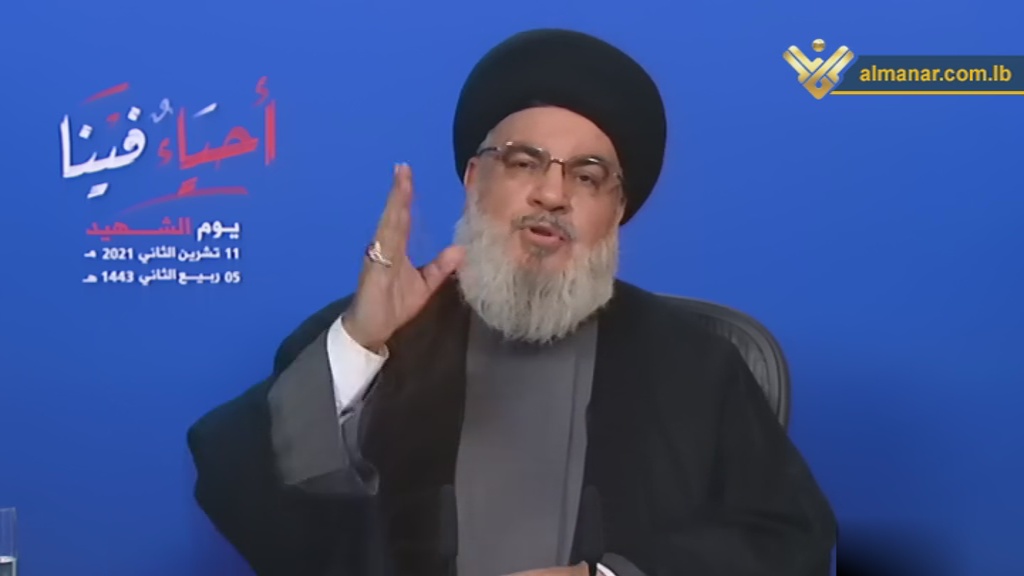
Sayyed Nasrallah highlighted the noble stance of the martyrs’ families who repeatedly affirm their readiness to make more sacrifices, hailing their steadfastness in this regard.
Hezbollah leader indicated that the martyrs’ blood has led to several important achievements, including the liberation of the prisoners and the occupied territories, ongoing deterrence of the Israeli aggression, prevention of the civil war in Lebanon, frustration of US schemes to control Lebanon completely, and preservation of the nation’s freedom and independence.
Sayyed Nasrallah highlighted also how the Resistance managed to defeat the takfiri war on Syria, adding that the visit of the UAE foreign minister to Damascus represents an Arab acknowledgement of defeat in the terrorist campaign which some Arab regimes paid billions of dollars to fund it.
‘Israel’ afraid of Hezbollah Infantry
His eminence maintained that, for the first time since 70 years, ‘Israel’ shows fear on Lebanon’s border, adding that the Zionist army is drilling periodically because it is concerned about Hezbollah military capabilities.
The Zionists have added the term ‘Galilee’ to the confrontation formula, according to Sayyed Nasrallah who added that the Zionists are afraid of Hezbollah invasion of Galilee settlements.
“Regardless of the liberated region’s area, the consequences of Hezbollah invasion will be strategic, according to Sayyed Nasrallah who added that the Israelis take the military preparations of the Islamic Resistance very seriously.
Sayyed Nasrallah pointed out that the Israelis are afraid of Hezbollah infantry and its ability to conquer Galilee and the entire northern area in occupied Palestine, adding that the Zionist enemy is also concerned about the Resistance precision-guided missiles.
Neither the normalization deals, nor occupation sites, nor fences, nor fortresses would be able to protect ‘Israel’ from the Resistance fighters in Lebanon, Palestine and the entire region, Sayyed Nasrallah said.
Sayyed Nasrallah cited a partial US influence in Lebanon, adding that the statesmen often obey the US orders.
Regarding the demarcation of the marine borders with the Israeli occupation entity, Sayyed Nasrallah indicated that the Lebanese state must take a sovereign decision to confront the US pressures and insist on all the national rights, regardless of all the wicked US offers (Hof Line).
Sayyed Nasrallah emphasized that Hezbollah is ready to defend every grain of sand and drop of water in order to protect the national sovereignty.
Sayyed Nasrallah maintained that there are several instances of the US domination over Lebanon in several domains, adding, however, Hezbollah looks for a sovereign state that maintains equality among its citizens.
One of the simplest forms of preserving the national sovereignty is the rejection of the foreign dictates and pressures, Sayyed Nasrallah said.
Fabricated Diplomatic Crisis with Saudi
Hezbollah stressed that the Saudi reaction to the remarks made by the information minister, George Kordahi, is extremely exaggerated, adding that the Saudis did not react at all to similar remarks made by US and UN officials.
Sayyed Nasrallah asked, “Why has not Saudi Arabia that claims to be following the Islamic ruling system and its king alleges to be the Custodian of the two Holy Mosques, react to figures, communities and governments which abused and insulted the Prophet?
“Were Kordahi’s remarks more abusive than the insults against Prophet Muhammad?”
Minister Koradahi did not use offensive terms while criticizing Saudi Arabia who stirred up the trouble in order to confront Hezbollah, according to Sayyed Nasrallah who recalled the Saudi role in inciting the Israelis against Lebanon during 2006 War.
Sayyed Nasrallah indicated that Saudi does not deal with Lebanon as a friend, citing the two instances of Iran and Syria which take positive attitudes toward Lebanon despite the involvement of some Lebanese parties in insulting them and conspiring against them.
Sayyed Nasralah stressed that Hezbollah rejects the resignation of the information minister, adding that the Saudis will pressure the Lebanese authorities to make more concessions.
Sayyed Nasrallah explained that when the former foreign minister, Charbel Wehbe, resigned under the Saudi pressures, the KSA authorities did not show any positive reaction.
The ongoing Saudi pressure on Lebanon is part of the ongoing battle with the Resistance, according to Sayyed Nasrallah who noted that Riyadh wants its allies in Lebanon to engage in a fight against Hezbollah and ignite a civil war.
Saudi War on Yemen
Hezbollah Secretary General stressed that the Iranians did not ask the Saudis during their recent negotiations to contact Hezbollah in order to end the crisis in Yemen, adding that Riyadh was advised to hold negotiations with Ansarullah Movement.
Sayyed Nasrallah reiterated that the end of the Yemeni crisis requires that Saudi halts the aggression and lift the blockade on Yemen, adding that the victories in Yemen were created by Yemeni leaders, brains, miracles and divine aids.
Sayyed Nasrallah also underscored that the Yemeni army and popular committees victory in Marib will be resounding, adding that the Saudi aggression will have completely failed after a 7-year costly war.
Hezbollah Reality in Lebanon
Sayyed Nasrallah indicated that Hezbollah is the largest political party in Lebanon, but that its influence in the Lebanese institutions is smaller than that of the other parties.
Sayyed Nasrallah refuted the claims about Hezbollah control of the Lebanese institutions by showing instances of the Party’s inability to change the official decision of the government, including the restoration of ties with Syria in order to sustain the economic cooperation in this regard, the approval of the Chinese, Russian and Iranian investments, and the recuse of the judicial investigator into Beirut Port blast as the Party sees he is politicizing the probe.
Sayyed Nasrallah also wondered how Iran, accused of occupying Lebanon, could not dock a diesel ship at a Lebanese port.
Tayouneh and Khaldeh Massacres
Regarding Tayouneh massacre, Sayyed Nasrallah stressed that its file is completely separated from that of the Beirut Port blast, denying any trade off in this context.
Sayyed Nasrallah stressed that what is required is the disclosure of truth and restoration of justice in both files, adding that Hezbollah wikll continue following up the investigations into the massacre committed deliberately by the “Lebanese Forces” till the criminal get punished.
Moreover, Sayyyed Nasrallah reaffirmed that criminals involved in Khaldeh massacre will be also punished, adding that Hezbollah will be then ready to hold any reconciliation in the town.
Voltaire, actualité internationale, n°186
-
Outre ce site internet gratuit, nous publions une lettre confidentielle en
PDF, Voltaire, actualité internationale. Chaque jeudi soir ou vendredi
matin, vo...
The man bankrupting America
-
“Go F*** Yourself, Scott: A Full Background Check on The Man Bankrupting
America, Human Skin Tag, Scott Bessent.“ (Blundell).In the same week,
different US...
Occult Utopia Of Jewish Golden Age
-
Occult Utopia Of Jewish Golden Age September 6 2026
___________________________________ More Vids! +BN Vids Archive! HERE!
________________________________...
And You Remain Impossible to Erase
-
There you are, the inspiring Imam, forever present in the conscience of the
honorable and the hearts of the loyal.
Father Dave Smith, Pray For (Mufti) Dr. Hassoun
-
Abducted by the terrorist regime in Syria in 2025, Sheikh Hassoun has been
sentenced to life in prison I spoke with Father Dave Smith, an Australian
Anglic...
Report on Beth Israel vigil 08-15-26
-
*Charlie Kirk and JFK*
John F. Kennedy was assassinated under questionable circumstances on
November 22, 1963, and Charlie Kirk fell on September 10 of la...
On The Road To International Anarchy
-
ON THE ROAD TO INTERNATIONAL ANARCHY— An Analysis (14 August 2026) by
Lawrence Davidson Part I — The Turn Toward […]
-
Hello all,
It is with great sadness that I share with you the passing of our beloved
sister, Mother, and Grandmother, the individual that you all knew ...
Best Horror Podcast
-
Best Horror Podcast Introduction: Horror podcasts […]
The post Best Horror Podcast appeared first on Copper Shock Horror Podcast.
Ikhras Endorses Muntadhar Al-Zaidi
-
“Oh parties of banditry and sectarianism and corruption, we have come and
our goal is to destroy you.” Ikhras formally endorses Muntadhar al-Zaidi,
Iraqi j...
Prince Charles: Foreign Jews behind bloodshed in ME
-
In May, 2017, British Crown Prince Charles declined an invitation from
Zionist entity’s president Reuven Rivlin‘s to attend the 100th anniversary
of the no...
Palestinian Women – One for All, All for One
-
Honouring All Palestinian Women by Honouring Three: Hanin Zoabi, Ahed
Tamimi, Samah Sabawi Vacy Vlazna “Palestinian women have always stood side
by side ...
US’s Saudi Oil Deal from Win-Win to Mega-Lose
-
By F. William Engdahl Who would’ve thought it would come to this? Certainly
not the Obama Administration, and their brilliant geo-political think-tank
neo-...
-
*Mordechai Vanunu wins human rights prize of Brazilian Press Association *
* http://www.alternativenews.org/english/index.php/features/updates/7038-mordechai...
Abdul Aziz Rantissi:
"My ultimate wish, my God, is to attain martyrdom,"...God granted him his wish on April 17, 2004, at the hands of Israeli assassins.