Uprooted Palestinians are at the heart of the conflict in the M.E Palestinians uprooted by force of arms. Yet faced immense difficulties have survived, kept alive their history and culture, passed keys of family homes in occupied Palestine from one generation to the next.
حسناً فعل وزير الخارجية السعودي فيصل بن فرحان بالكشف عن الأسباب الحقيقية للخطوة السعودية التصعيدية ضد لبنان، لنقل النقاش من المكان السخيف الذي وضعه البعض فيه في الأيام الأولى إلى السياسة، أي حيث هو فعلاً، وحيث يجب أن يكون، فالقضية ليست قضية تصريح وزير الإعلام، بل قضية موقف الدولة ومؤسساتها من حزب الله، باعتبار أنه وفقاً للوزير السعودي، يكفي أن لا تقوم الدولة بإعلان الحرب على حزب الله ليستنتج بأن حزب الله يهيمن على الدولة، ومفهوم ألا يستطيع الوزير أن يتخيل للبنان مصلحة بحجم استرضاء السعودية، وصندوق مالها، وهو في أزمة خطيرة، وعلى شفا انهيار شامل، والثمن لفتح صندوق المال أمامه هو مواجهة حزب الله، فماذا تنتظرون إن لم يكن حزب الله مهميناً عليكم، هكذا ببساطة هي النظرية السعودية، وهي بجوهرها تقول إنه ما دامت الدولة اللبنانية تتلكأ في القيام بالمهمة فقد قررت السعودية معاقبة لبنان وصولاً لإسقاطه، حتى يرضخ ويلبي الطلب.
–
ليس موضوعنا مناقشة تهافت نظرية هيمنة حزب الله على دولة، صاحب القرار المالي فيها حاكم المصرف المركزي صديق الرياض وواشنطن وصاحب القرار الأمني فيها مدير عام قوى الأمن الداخلي وفرع المعلومات، وصاحب القرار العسكري فيها قائد الجيش، وكلهم أصدقاء للرياض وواشنطن، وحزب الله يخوض مواجهة مع مسار قضائي ويعجز قضائياً وحكومياً، حيث يفترض أنه الحاكم، ووفقاً لوصف رئيس حزب القوات اللبنانية، أن حزب الله وصل إلى طريق مسدود قضائياً وحكومياً، ونعم الهيمنة إذا كانت كذلك، لكن بعيداً من هذا التهافت، السؤال هو هل أن المواجهة مع حزب الله هي أمر جديد يحدث الآن من دون تاريخ ومن دون ذاكرة، حتى ندخل في تحليل الفرضيات ونتساءل عن المسارات؟
–
في اجتماع وزراء المالية لدول قمة العشرين، في كانون الثاني 2020 وقف وزير المالية الفرنسية برونو لومير كاشفاً أن ما يتعرض له لبنان هو خطر انهيار مالي اقتصادي، داعياً إلى عدم استسهال دفع لبنان نحو السقوط لأن النتائج ستكون أشد قسوة من مساعدة لبنان على التعافي، مطالباً واشنطن والرياض بفك الارتباط بين مساعي مساعدة لبنان على التعافي، ومعاركهما مع طهران وحزب الله، وأسقط بيد فرنسا يومها وانضمت صاغرة إلى الصف الأميركي السعودي في الدفاع عن سياسة الإسقاط، تحت شعار، فليسقط لبنان على رأس حزب الله، وعندما وقع انفجار مرفأ بيروت أعادت فرنسا الكرة بمبادرة الرئيس إيمانويل ماكرون، لإقناع شريكيها السعودي والأميركي بنظرية فك الاشتباك وفشلت على مدار سنة ونيف، حتى اختبر الأميركي منهج التصعيد ومحاذيره ومخاطره، عندما أطلق حزب الله مسار سفن كسر الحصار، واستدار الأميركي تفادياً للتصعيد، وقرر الإفراج عن فرص لبنان بتشكيل الحكومة، وقرر الانتقال إلى منافسة حزب الله في تخفيف حدة الأزمة، فاستثنى استجرار الغاز المصري والكهرباء الأردنية عبر سورية من عقوبات قانون قيصر، وبقيت السعودية وحدها ترفض فك الاشتباك، تواكب النصف الثاني من السياسة الأميركية القائم على محاصرة حزب الله تحت سقف عدم الدفع بالأمور نحو الانفجار، كحال المسار القضائي للقاضي بيطار، والاشتغال لتحضير صيغ مناسبة للتأثير في مسار الانتخابات المقبلة، لكنها تستثمر على ما تعتقد أنه تعبير عن خيار المواجهة المفتوحة، وهذا هو مكان الرهان على حزب القوات اللبنانية، الذي فشل في تقديم ما كان يتوقعه منه السعوديون قبل أن يقرروا الدخول مباشرة على الخط، والسؤال هنا، أي ثقب أسود في ذاكرة الحاسوب السعودي لتراهن على أن تحقق منفردة ما عجزت عن تحقيقه وهي شريك في حلف تقوده واشنطن ويضم باريس معهما، وكيف ستتمكن من المضي بمواجهتها من دون أن تصطدم بالسقوف الأميركية الفرنسية للحفاظ على الحكومة وعلى الاستقرار من خلالها، بعدما كانت طليقة اليدين في الماضي ومعها كل زخم الشراكات الكبرى وفشلت؟
–
بعد عام 2006 وحرب تموز، التي لم تخف السعودية تغطيتها بشعار، مغامرون سيدفعون ثمن مغامرتهم، في توصيفها لحزب الله، لم تسلم السعودية بأن خسارة الحرب نهاية المطاف، فدفعت بالتناقضات اللبنانية التي كانت تتحكم بإدارتها عبر سيطرتها على حكومة الرئيس فؤاد السنيورة، نحو خطوات متسارعة للمواجهة، بدأت بتفجير الحكومة، مع إحراج وزراء ثنائي حركة أمل وحزب الله لإخراجهم، ثم استصدار قرارات عن الحكومة تترجم ما تريده السعودية من حكومة الرئيس نجيب ميقاتي اليوم، وهي تنسى أن هذا حصل سابقاً، واستجابت حكومة السنيورة التي قررت تفكيك شبكة الاتصالات العائدة للمقاومة في 5 أيار 2008، واتصل الملك السعودي بالحكومة متحدثاً مع أعضائها فرداً فرداً شاحذاً هممهم للمواجهة مؤكداً دعم السعودية لهم، وكانت أميركا والغرب كله مع الموقف السعودي، ويومها كانت العلاقات السعودية -السورية مقطوعة بالمناسبة، على خلفية الغضب السعودي من معادلة الرئيس السوري بشار الأسد في توصيف مواقف الحكام العرب من الحرب بأشباه الرجال، ولم تكن هناك حرب تغرق فيها السعودية كحرب اليمن اليوم، وتورطت أحزاب بتمويل سعودي لتنظيم مواجهة مسلحة مع حزب الله، فماذا كانت النتيجة، الفشل ثم الفشل، والانتقال لأول مرة إلى الدوحة بدلاً من الطائف أو الرياض لتحقيق المصالحة، واضطرار السعودية بعدها لمصالحة سورية، وإرسال الرئيس سعد الحريري إليها، ليعتذر عن اتهامها بقتل والده، فأي ثقب أسود في ذاكرة الحاسوب السعودي لتراهن أن دعوتها اليوم ستلقى أذناً تسمعها، ولسان حال الحكومة من جرب المجرب كان عقله مخرب، وقد تمت التجربة في ظروف أفضل بكثير وانتهت بالفشل الذريع، فكيف لعاقل أن يتوقع لها النجاح في ظروف زادت سوءاً وتعقيداً؟
–
الثقوب السوداء كثيرة، لكن ثمة ثقوباً بدأت تصيب الحملة السعودية، فسقف أميركي لحماية الاستقرار من جنون قد يتسبب بنتائج كارثية، كانت إشاراتها الأولى كافية لاستدارة الأميركي إلى منتصف الطريق، والأميركي يقول اليوم إنه لن يتدخل بالخلاف واضعاً الحكومتين اللبنانية والسعودية على مسافة واحدة، مؤكداً تمسكه بالاستقرار وبالحكومة اللبنانية بخطوط حمراء أمام المغامرة السعودية، فتبدأ وساطة قطرية، وأخرى فرنسية، وقد تورط السعوديون في مغامرة رسمها لهم بوم شؤم، والمثل يقول الحق البوم يدلك على الخراب!
Although the West has waged 10 years of war on Syria, and there is much destruction, the entire country isn’t in ruins and the pulse of life continues, albeit strangled by brutal Western sanctions.
After Eastern Ghouta’s liberation in 2018, the Western media predictably went silent on the return of internally displaced Syrians and the rebuilding that had occurred. Today, in towns in the region outside the capital Damascus, behind dusty, battered metal shop shutters, I saw glossy new windows and even more rebuilding than I had when I was here in 2018.
In Douma, I saw lovely, smiling children, excited to practise their English with me. Given that they were born during the war and lived under the horrifically savage rule of the rebel groups Jaysh al-Islam and Faylaq al-Rahman, and their co-terrorists, their exuberance was remarkable. The traumas they endured they have either deeply buried within or miraculously healed from.
Since both the media and leaders in the West made such a big deal over the Douma chemical hoax, it was particularly rewarding to see life in the streets again.
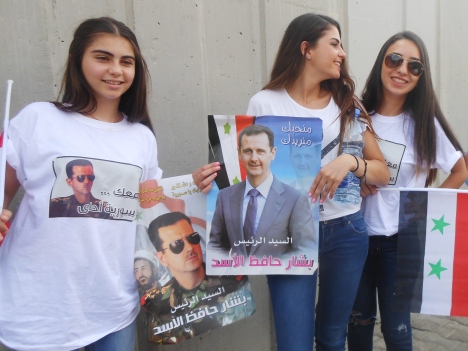
Lively times in Irbeen and Douma, Eastern Ghouta, today, where Syrians exercised their right to vote in Presidential elections.
Western media mocks the elections.
Syrians voting, sing, dancing, is a massive F.U. to the West’s ambitions of regime change in Syria. pic.twitter.com/nNwIhDzWJ1— Eva Karene Bartlett (@EvaKBartlett) May 26, 2021
Syrians in Eastern Ghouta were put through a hell that most of us, living safely far from war, cannot begin to fathom. I had seen their tortured faces shortly after their liberation in 2018. That made seeing them smiling, dancing, and celebrating the presidential elections today incredibly moving. The difference between then and now was like night and day.
Some were surprised when I posted videos on social media of a Syrian singer and orchestra performing at the Damascus Opera House two nights ago. Many assume the country has been completely destroyed, others are just unaware that it has a rich culture that hasn’t died, in spite of a decade-long war waged by the West.
Until the liberation, however, Syrians in Damascus risked being maimed or killed every time they went to work, to school, to the market, or even while they remained at home, when terrorist mortars and missiles rained down from Eastern Ghouta.
Back in 2014, leaving behind the hospitality of the small hotel I was staying in near the gate of Bab Sharqi, the Old City’s East Gate, I drifted over to a cluster of tables across from the beautiful Zaitoun Greek Orthodox cathedral and beside a closed restaurant. But instead of working on my laptop, as I’d intended, I ended up getting into a conversation with the owner of that restaurant, now called the Abu Zolouf bar.
As Abu Shadi and I spoke, terrorist-fired mortars fell in nearby districts. I wrote at the time: “As it happened, I got two of four mortars on audio. The first occurred around 7:05 pm, which Abu Shadi estimated to be 200 metres away. His friend corrected him saying it was only 50 metres away (also about 20 metres from my hotel). Roughly 10 minutes later, the second mortar. There were two other mortars within half an hour. SANA news reported the injury of 17 civilians.”
Our conversation became about the incessant shelling, where the latest mortar had fallen, and his near-death experience with one.
“Two times mortars landed outside my restaurant. One would have killed me, but I went inside just before,” he said, pointing to a spot on the ground next to the door. He lamented the loss of business as much as the threat posed by the mortars.
The other night, I visited the restaurant with a friend. Seeing Abu Shadi, we sat down with him and chatted about those days. Now, his restaurant is open and well frequented, guests sitting under light-strung olive trees enjoying the early summer evenings.
very early in the evening; in a few hours, the place will be packed
Also in 2014, one afternoon, wishing to escape the blazing sun, I leaned against the wall encircling the Old City, looking towards Jobar, then occupied by terrorist factions, roughly a kilometer away. As I wrote at the time, while I chatted with a friend, “bullets whizzed past me, half a meter to my right, to my left. Everyone in the vicinity jumped up and ran, most looking panicked. We ran for about 50 meters, to a point which was apparently out of the terrorists’ range. One woman, hyperventilating and unable to stand, took a good 10 minutes to calm down, repeatedly making the sign of the cross as she wheezed. Later, I chatted with a man selling spinach patties, mentioning that I was surprised the bullets had reached the point where I’d been sitting. ‘They reach as far as here,’ he said, from his hole-in-the-wall bakery another 200 metres from where I’d been sitting.”
My encounters with mortars and their victims were many over the years, including seeing numerous children maimed and with critical injuries from the terrorists’ shelling, many ancient Damascene houses partially destroyed by it.
n 2018, I interviewed the supremely talented violinist and composer, Raad Khalaf, who is also a founder of the all-women Mari Orchestra. Afterwards, we chatted and he mentioned that the shelling had reached the Higher Institute of Dramatic Arts where he taught, near the Opera House.
He told me that the year prior, terrorists had attacked the area with some 37 bombs in one day.
“The students had to stay inside for eight hours – you couldn’t go outside because we didn’t know when or where the next bomb would fall. One student went outside and was killed. Here we lived five difficult years.”
On Monday this week, I went to the Opera House to hear Syrian singer Carmen Tockmaji and the orchestra accompanying her perform. The auditorium was only half-full but lively, everyone evidently enjoying the singer’s talents.
I was surprised to learn later that a front-row ticket cost just 2,000 Syrian pounds (80 US cents), a second-class ticket 1,500 (60 US cents), and a third class ticket 1,000 (40 US cents). Nonetheless, despite the low price, Syria’s poorest can’t afford this, largely because of the brutal sanctions on the country that decisively affected the currency, causing hyperinflation – an intended consequence of the cruel and immoral sanctions leveled against the Syrian people.
I wrote last year (and before) about how these sanctions directly affect civilians: “On June 17, the US implemented the Caesar Act, America’s latest round of draconian sanctions against the Syrian people, to ‘protect’ them, it claims. This, after years of bombing civilians and providing support to anti-government militants, leading to the proliferation of terrorists who kidnap, imprison, torture, maim, and murder the same civilians. Sanctions have impacted Syria’s ability to import medicines or the raw materials needed to manufacture them, medical equipment, and the machines and materials needed to manufacture prosthetic limbs, among other things.”
But sanctions have yet another brutal effect: they wreak havoc on the economy. A May 3, 2021 opinion piece by Abbey Makoe on the website of the South African Broadcasting Corporation noted: “Electricity rationing in Syria has reached its highest levels due to the government’s inability to secure the fuel needed to generate electricity. This is mainly due to the damaging international economic sanctions led by the Western powers, including the IIT [Investigation and Identification Team of the Organisation for the Prohibition of Chemical Weapons] protagonists France, UK and the US. The value of the Syrian pound has crumbled to almost nothing. The Caesar Syria Civilian Protection Act of 2019 … is credited with bringing about starvation, darkness, plague, misery, robbery, kidnappings, increased mortality rate and the certain destruction of a nation that was once a beacon of hope across the Middle East.”
The misery is real, and Syrians are indeed suffering, many unable even to feed their families properly.
Speaking of Opera House performances may seem trite in light of the economic suffering, but the fact that productions such as this do still occur in Syria is another indication that the West’s change-of-government project has failed, despite its 10 years of waging war in Syria.
Seeing this concert just before the presidential elections was moving and poignant. As Carlos Tebecherani Haddad, a Syrian-Brazilian friend I met in 2014 when mortars were raining down around us, wrote: “Celebrating life, victory over foreign aggression, rebuilding, the strength of Syrian roots, presidential elections and the bright future of the Syrian nation.”
That indeed is what I’ve seen in Syria, including today in Douma, where Syrians amassed to vote. Yet there is much to be done, particularly when it comes to rebuilding the infrastructure – especially as oh-so-benevolent America and its allies, in sanctioning the Syrian people, are directly preventing this.
So, if you’re still pointing a finger at the president and the army, turn that finger back at your governments, ye in the West. They are the cause of the destruction and death in Syria, and they hinder an otherwise achievable return to peace and normality.
This week, Syrians around the world will vote in the 2021 Presidential elections (those in Syria will vote on May 26). That is, if Western nations re-open the embassies they so democratically shut years ago.
Western leaders hypocritically claimed concern for Syrians and wanted to ensure they live democratically – by funding and arming terrorists from around the world to slaughter them and destroy their homes, governmental buildings, and historic and cultural places–but continue to do everything in their power to make it difficult-to-impossible for Syrians to exercise their rights to vote for their president.
Around 2012, most embassies in Western (and Gulf) countries closed, claiming they no longer recognized the Syrian government, claiming also the Syrian government was brutally attacking peaceful, democratically-minded, protesters. Those lies convinced many that this narrative was the truthful one (unbelievably, after the lies of WMDs in Iraq and the myriad other lies that sold wars, which I wrote about on the anniversary of the war on Syria).
But it is 2021, and by now we know that this was a premeditated and cruel war on the people of Syria, spurred forth by the media who truly do not care about the lives of Syrians.
Canada was one such country to self-righteously cut ties with the Syrian government (while covertly supporting terrorism in Syria, and later supporting neo-Nazis in Ukraine) and shutter Syrian embassies.
Canada closed Syrian embassies in 2012, cutting diplomatic ties with Syria and expelling Syrian diplomats. but allowed consuls to remain, as their positions were administrative, not diplomatic.
In 2016, Canada terminated the Montreal honorary consul position which had served not only Syrians in eastern Canada but also eastern US.
A Toronto friend and Syrian Canadian, Lulwa Kassawat, told me that this year she again won’t be able to vote, thanks to Canada’s embassy closures.
“With elections coming up in Syria, no diplomatic representation in Canada for Syrian Canadians to vote, with more sanctions on Syria killing civilians, with illegal accusations of chemical attacks that were staged, what better way to reinforce our commitment than to stand by Syria and its people and President.
You may stop us from an election, but you cannot stop us from endorsing our President.”
Kevork Almassian, a Syrian living in Germany, has for years been relentlessly hounded by German media for his stance in support of his army and president, even lobbying for his deportation back to Syria.
“If they succeed in deporting me before even deporting those who pose a security threat to Germany, including Islamist radicals who committed crimes in Germany, it’s a dangerous precedent. It’s essentially telling Syrians: shut up, don’t speak positively about your government. My case is very well known in Germany. Most pro-govt Syrians in Germany know me, because of the media campaign against me. Because of what has happened to me, many Syrians are afraid to go to demonstrations or to vote.”
In the past two years, Almassian was chased, smeared, harassed and even physically attacked multiple times by the sympathizers of the Free Syrian Army (FSA) and other terrorist groups. These attacks came after a smear campaign by the German media and Turkish-Qatari funded outlets.
“The media is against patriotic Syrians, as is the government and most political parties. They portray the people who are with Assad as fascists.”
For Syrian refugees in Germany, there are more factors than potential smears or assaults that could deter them from voting. Not having official refugee status (they have subsidiary protection), according to German law, if the war stops (or the German government changes its mind), they risk being deported back to Syria–even if they have a work permit or are studying at university.
In 2014, although the Syrian embassy was open, the German government banned Syrians in Germany from voting. Police at embassies blocked people from entering to vote. Syrians did come to the embassy to vote, but police wouldn’t allow them in.
This year, the German government also banned the Syrian community from voting.
Syrian American Johnny Achi, told me:
“Just as in 2014, the closure of Syrian embassies makes it very hard for many millions of Syrians around the world to express their voices in what most countries around the world consider not just a right, but a duty. This year, as in 2014, many Syrians who can afford to must endure travel costs and travel to Syria if they wish to exercise their voting rights.”
The US closed diplomatic ties and pulled their ambassadors sooner than 2014, but still had a nominal Charge d’affaires. But then, according to Achi, just prior to the 2014 election, embassies were shuttered fully.
“We had made a Facebook page announcing a rendezvous in DC, to show the world how wrong they were about Syria.
To save themselves the embarrassments of having thousands of Syrian patriots show up from all across the US with Syrian flags, signs and posters in support of the Syrian government and army, the Obama administration ordered the Syrian Embassy closed, just days before the election, and so did The UAE and many other capitals around the world.”
2014 Elections
Indeed, in 2014, Syrians flew from around the world to Damascus simply to vote, as the countries they reside in had closed their embassies.
In Lebanon, where I was at the time, the voter turnout was astonishing, with the embassy opening an unscheduled second day, to accommodate all the Syrians who came to vote.
As I wrote then, “Syrians crammed in one of an endless stream of buses, exited and continued on foot. The masses opted to walk the remaining few kilometres rather than sit in a traffic jam generated by the tens of thousands flocking to vote.”
I walked with them and spent the better part of the afternoon speaking with Syrians about why they’d come to vote.
An older woman from Aleppo sitting on the pavement off to the side of the road said her family had told her to stay home. “I’m ill, they were worried about me. But I will vote even if I die trying to do so.”
Her son, like most in the crowd, was emphatic in his support for President Assad. “The terrorist rebels are in my city. God bless Dr. Bashar al-Assad and the army. We don’t want anyone else.”
“Syria will get back its dignity,” said an engineering student from Tartous. “The ‘revolution’ is a lie, it’s a farce engineered by the West and Saudi Arabia, Qatar,” he said.
“We don’t want anyone else, we love him,” said another man nearby.
Others vied for their chance to praise how Syria was before the manufactured crisis began. “We had free health care, safety, our bread was subsidised. We were happy. We want Syria to be like it was,” was a widely shared sentiment.
The chorus of cheers and chanting was punctuated by the thud of the helicopter circling above, tight security to ensure that the elections were not derailed.
“We love him. I’m Sunni, not Alawi,” Walid, from Raqqa, noted. “They’re afraid our voices will be heard,” he said, regarding the many countries which will not allow Syrians to vote.
“I’m from Deir Ezzor,” said a voter. “ISIS (Islamic State of Iraq and Syria) is in our area. We want Bashar al-Assad. The guy walks straight,” he said, with a gesture of his hand.
Another man, from Aleppo, reiterated what many already said. “There’s no revolution, absolutely not. People from around the world have pounced on Syria. People who cut off heads … what kind of revolution is that?”
Emphatically pro-Assad, he did say that the two other candidates were respected. “Maher al-Hajjar and Hassan al-Nouri, they are good. But not like Bashar, our hero.”
Formerly a teacher in Aleppo, he now works construction in Lebanon. “In another month or two, I’m returning to Syria, to stay.”
In Beirut’s Hamra, Syrians spoke of their failed attempts to reach the embassy.
“I tried to go earlier, but I couldn’t reach the embassy, the streets were packed from far away,” said Mona, a young hotel employee. “I’ll try again tomorrow. I’m not Alawi, by the way,” she said, laughing.
In a Hamra mini-mart, Abu Mohammed, from Sweida, commented on Ahmad Jarba, reportedly charged with drug trafficking, the candidate backed by Western countries.
“We don’t know him nor where he came from. We want one of us, a Syrian in Syria. People in Syria aren’t blind, we know this has been planned for years. They want to do to Syria what they did to Libya. Today, thousands went to the embassy. Why? Because we know Bashar is the right person. Be sure, if we didn’t want him, he wouldn’t have lasted three years.”
In spite of the second day of voting, there were still many Syrians in Lebanon who, because they hadn’t been able to vote, headed for the border crossing to try to vote in Syria.
Days later in Damascus, voting stations were also kept open later than planned, to accommodate the high turnout.
What many may not be aware of is that at the time of the 2014 presidential elections, Syrians in Syria braved terrorist bombings while going to the voting stations.
“Syria’s official news agency SANA reported on Saturday that at least 39 people had lost their lives in the mortar attack on the election campaign rally in Syria’s southern city of Dara’a late on Thursday.
“According to the report, some 205 people were also wounded in the attack, while 14 of the injured are in critical condition.”
Even before voting day, terrorists heavily shelled cities around the country in areas not under their control, in an attempt to intimidate Syrians from casting votes the following week.
“Twenty people have been killed in mortar attacks carried out by foreign-backed militants on Syria’s northwestern city of Aleppo.
“Takfiri groups have stepped up their attacks against Syrians in several cities and towns as the country prepares for the presidential election on June 3.”
And, as I wrote a month later, in increased shelling, largely seen as vindictive attacks on Inauguration Day, July 16, terrorists fired 23 shells on Damascus. Syrian State media reported that four were killed and 30 injured by the mortars which targeted Shaalan district, Umayyad Square, and a park near the Sheraton Hotel.
2021 Elections
After 14 visits to Syria over the years, some for months at a time, I can say in all honesty that Syrians overwhelmingly stand with their president and army. Western and Gulf corporate and state-owned media would have people believe differently, but that is because they want to overthrow the president and install a puppet government favourable to their, and Israel’s, interests.
But the polls show it as well. In the 2014 election, President Assad, “won with 88.7 percent, garnering 10,319,723 votes. According to Syria’s supreme constitutional court, 73.42 percent of some 15.8 million eligible voters took part in the elections.”
Journalist Sharmine Narwani at the time noted the cynicism of Western nations and media regarding this outcome, writing:
“Syria’s foes will go to the wall with claims of fraudulent votes, but they can hardly contest the visuals of millions of Syrians casting them.
“Which is why Western ‘democracies’ and many Arab allies have sought to inhibit the democratic process by obstructing Syrians from voting at their embassies. It is embarrassing for them then that thousands of Syrian refugees have crossed the Lebanese border to vote (Lebanon initially threatened they would not be able to return), and that Syrians from the United States, Kuwait, UAE, France, the Netherlands and elsewhere have chartered flights to Damascus so their votes can be counted.”
Likewise, I foresee more of such Western cynicism if, as expected, Assad wins this year’s elections.
But, that is just a case of sour grapes. The West lost their regime-change project.
It gives me consolation that, unlike in 2014, this year terrorists won’t be able to bomb most Syrian cities as they have been forced out in the intervening years, and peace has returned to areas they once occupied.
While Syrians struggle unbearably under the cruel and sadistic Western sanctions that strangle them, there is at least hope that in the future, more nations will normalize relations with the country. Perhaps then, America and Co will toss in the hat and retreat to lick their wounds, letting Syrians finally live in peace.
After his recent visit to Syria, Johnny Achi told me, “When I was in Syria I met with some high ranking officials that assured me that by next year, around this time, dozens of embassies will re-open in Syria and full diplomatic ties will be restored between Syria and many of the boycotting nations including many Europeans.”
Syrians voting in the upcoming elections will be, as in 2014, voting in defiance of the attempts of America and her allies to overthrow their government. And it will be a momentous occasion marking Syria’s victory in the brutal and completely unnecessary 10-year war.
Celebrations in Homs, Syria (dubbed “capitol of the revolution” by the delusional crowd) 6 days after the 2014 elections in Syria.
Les risques de l'IA, par Thierry Meyssan
-
L'Intelligence artificielle fait très vite ce qui nous demande beaucoup de
temps. Son impact est celui de la robotisation des processus intellectuels.
Alor...
Another Epstein Class whistleblower ‘suicide’
-
“How US commerce secretary’s Epstein links were uncovered by British
whistleblower“ (Verity/Byrne/Milne):Andriesz suspected there was yet more
to find in t...
The Legendary Golem
-
The Legendary Golem October 3 2026 ___________________________________ More
Vids! +BN Vids Archive! HERE! ___________________________________ Support
The B...
The United States At A Crossroad
-
The United States At A Crossroad—An Analysis (16 Sept 2026) by Lawrence
Davidson Part I—Texas vs Minnesota Back in mid-May […]
Report on Beth Israel vigil 09-12-26
-
*Eat-a-Cheeseburger Day Approaches*
This year, EAC Day appears on Monday, September 21st. The date coincides
with the Jewish holiday called Yom Kippur. Cl...
-
Hello all,
It is with great sadness that I share with you the passing of our beloved
sister, Mother, and Grandmother, the individual that you all knew ...
Best Horror Podcast
-
Best Horror Podcast Introduction: Horror podcasts […]
The post Best Horror Podcast appeared first on Copper Shock Horror Podcast.
Ikhras Endorses Muntadhar Al-Zaidi
-
“Oh parties of banditry and sectarianism and corruption, we have come and
our goal is to destroy you.” Ikhras formally endorses Muntadhar al-Zaidi,
Iraqi j...
Prince Charles: Foreign Jews behind bloodshed in ME
-
In May, 2017, British Crown Prince Charles declined an invitation from
Zionist entity’s president Reuven Rivlin‘s to attend the 100th anniversary
of the no...
Palestinian Women – One for All, All for One
-
Honouring All Palestinian Women by Honouring Three: Hanin Zoabi, Ahed
Tamimi, Samah Sabawi Vacy Vlazna “Palestinian women have always stood side
by side ...
US’s Saudi Oil Deal from Win-Win to Mega-Lose
-
By F. William Engdahl Who would’ve thought it would come to this? Certainly
not the Obama Administration, and their brilliant geo-political think-tank
neo-...
-
*Mordechai Vanunu wins human rights prize of Brazilian Press Association *
* http://www.alternativenews.org/english/index.php/features/updates/7038-mordechai...
Abdul Aziz Rantissi:
"My ultimate wish, my God, is to attain martyrdom,"...God granted him his wish on April 17, 2004, at the hands of Israeli assassins.