Wednesday, 18 July 2012

At least 7 killed in Bulgaria attack against Israelis. Witnesses report 20 people wounded

While Israeli media and Islamists rejoicing killing Syrian Defense Minister General Daoud Rajha along with his deputy General Assef Shawkat, who is President Bashar al-Assad’s brother in law, the bad news hit Isreal and brothers of America.

Accordind to Haartz, at least 7 killed in  Bulgaria attack against Israelis. Witnesses report 20 people wounded; Israeli rescue services en route to country.
 A screenshot of Burgas airport, Bulgaria taken from Google Maps.

Haaretz brings you minute-by-minute updates on the deadly attack;

Explosion tears through Israeli tour bus in terminal at Sarafovo Airport in Burgas; over 20 people injured. Israeli mission en route to area to assist authorities

At least seven people were killed and over 20 others injured Wednesday, in a terror attack on a bus carrying Israelis in Burgas, some 400 kilometers east of the Bulgarian capital of Sofia.

Bulgarian media reported that the explosion took place while the bus was still in the terminal of Sarafovo Airport.
 Foreign Minister Avigdor Lieberman has called for a situation assessment following the attack. He was also briefed on the available details by Bulgarian FM Nikolay Mladenov.

Israel confirms attack on citizens in Bulgaria

JERUSALEM — Israeli officials on Wednesday confirmed that Israeli citizens were targeted in an attack on tourists at Bulgaria's Burgas airport, which Bulgarian ministry sources said left three people dead.

"What we know is that sometime close to 5:00 pm there was a flight that landed in Burgas, the passengers went onto a bus and then there was an explosion that we don't know the source of," said Ilana Stein, deputy spokeswoman for the Israeli foreign ministry.

"What we know is that there are casualties and probably not only injured but also dead. We know that some were Israelis but we don't know if all of them were," she told AFP.

Ofir Gendelman, a spokesman for Israeli Prime Minister Benjamin Netanyahu, also confirmed the incident.

"Apparently there was an attack on a bus carrying Israelis at Burgas airport in Bulgaria. A bus carrying Israeli citizens was shot at and an explosive device was thrown," he told AFP.

"The number of people injured is unknown," he added.

The Bulgarian interior ministry said three people were killed and more than 20 injured in a blast on a bus at Bulgaria's Black Sea airport.

"Three people were killed and over 20 injured," an interior ministry press officer told AFP, adding that "their nationality is yet to be determined."

State BNR radio reported that an explosion hit a bus carrying Israelis at the Black Sea airport, adding that two more buses also caught fire.
River to Sea Uprooted Palestinian  
The views expressed in this article are the sole responsibility of the author and do not necessarily reflect those of this Blog!

Egypt: Policing Vice and Virtue


Egyptian guards try to close the gate of presidential palace to the people willing to give their demands personally to President Mohamed Morsi in Cairo on 8 July 2012. (Photo: AFP - Khaled Desouki)
Published Wednesday, July 18, 2012

Cairo - It seems that the recent murder of university student Ahmad Hussein Eid by "bearded men" in Suez City in eastern Egypt is merely the tip of the iceberg.

After dispatching a fact-finding mission to the city, the Egyptian Initiative for Personal Rights indicated in a report that the site of the killing – a park for Suez's residents – has frequently been a place for harassment of couples.

It said that "several individuals have repeatedly stopped men and women together, questioning them about the nature of their relationship and reprimanding them for what they deem as a violation of Islamic law (sharia) and morals. This caused several scuffles and fights."

The probe into the killing of Eid – which resulted from an altercation with an “advice and guidance” squad – did not uncover an actual “promotion of virtue and prevention of vice” organization. But the three involved suspects confessed that they roam the streets to "guide citizens toward Islamic virtues."

Political Islamist forces denounced the so-called "Promotion of Virtue and Prevention of Vice Commission," which claimed responsibility for the Suez murder in an anonymous statement posted on Facebook.

But the incident quickly recalled a series of post-revolution events claimed by Islamist and Salafi extremists, linking them with the political rise of Islamist forces and the presidential victory of the Muslim Brotherhood’s (MB) Mohammed Mursi.
At first, these incidents drew Egyptians’ ridicule of Salafis: al-Nour (Salafi) Party members covered statues of nude mermaids in Alexandria; Salafi Hazem Shoman tried to prevent singer Hisham Abbas from performing at a student concert in al-Mansoura (northern Egypt); and destroying shrines of revered religious figures.

There were also violent incidents that could not be ridiculed, such as Islamist extremists cutting off the ear of a Coptic man in Qena (southern Egypt) last year after rumors spread that he was involved in a relationship with a Muslim girl.

"Bearded men" also recently killed two musical band members in the northern al-Sharqiya province before fleeing.

Former Culture Minister Imad Abu-Ghazi tells Al-Akhbar that these incidents are not new, as many would believe.

"There were a series of incidents in the 1970s and 1980s, like forcibly preventing a musical band from performing at Cairo University's Faculty of Medicine," he says.

Abu-Ghazi notes that in his memoirs, Abdul-Moneim Abul-Fotouh, former presidential candidate and MB defector, admitted his involvement as a medical student in that incident.

The former minister says that there were also incidents of extremist groups attacking young men and women in Helwan Gardens (west of Cairo) and preventing them from celebrating Sham al-Nessim, an ancient Egyptian spring festival.

Abu-Ghazi suggests that something in the nature of Egyptians may have changed during those years: "Maybe they stopped condemning interference in their personal liberties and the freedoms of others, no longer giving importance to respecting public freedoms."

Perhaps that is what transpired from the interrogations of the three suspects in the Suez murder, as they did not seem to be directly affiliated to any political Islamist group.

But they could very well be among those affected by the culture hardline Islamist organizations had gradually spread over the years, even after they renounced violence.

Mustafa al-Ghoneimi, a member of the MB's guidance bureau, says that his group does not see benefit in any party assuming the responsibility for promotion of virtue and prevention of vice.
"This does not suit the tendencies and orientations of the Egyptian people, or even human nature that refuses others to interfere in people's behavior, even if they don't entail violence (contrary to what happened in Suez)," says Ghoneimi.

He adds that the MB believes that the "promotion of virtue and prevention of vice must be conducted by media and educational institutions, for example, and the people are free to choose."
Ghoneimi says that if a person "does not monitor himself out of fear from God, there is no point in trying to force him into acts of obedience and worship."

Meanwhile, Yasser al-Borhami, a prominent Salafi preacher, contradicts himself on the issue. He is quoted as saying in Al-Ahram Online that the so-called “Promotion of Virtue Commission” is a group seeking to harm Islamist currents.

But in a book he authored, titled Promotion of Virtue and Prevention of Vice, Borhami writes: "Promotion of virtue and prevention of vice in our current conditions is needed for everyone, by word in many cases, and with the hand sometimes."

Lawyer Noura al-Farra filed a lawsuit against the interior ministry and attorney general, demanding they prosecute the creators of the Promotion of Virtue and Prevention of Vice Commission's Facebook page, which was set up by unidentified people last January.

Farra says that she filed a complaint to the internet regulation authority against the creators of the page and demanded that they be investigated. But the complaint was shelved due to lack of evidence against them.

She interpreted the decision as part of police laxity and failure to acknowledge the seriousness of the matter.

The Egyptian Initiative for Personal Rights reached the same conclusion in its report on the incident, condemning what it called "police negligence in intervening and protecting citizens from such attempts."

Farra explains that the Egyptian Penal Code allows self-defense from attacks on a person's honor, possessions, or person, even if it leads to the killing of the attacker.

"We fear an outbreak of violence if the page's creators make good on their threats to use electric taser batons against those they view as breaching the teachings of Islam."

In January, the commission's page threatened to use these batons "in response to what happened to the young men in al-Qalyoubia."

It was in reference to some of its members who were severely beaten up by women in a hair salon in the city of Benha in al-Qalyoubia (north of Cairo) after these men tried to shut it down by force.
The women fighting back in Benha may have been an example of what Abu-Ghazi said regarding "hope that many Egyptian segments will continue to resist; otherwise, the young man in Suez would not have been killed. He strongly resisted attempts of interference in his personal liberty and that's why they killed him."

This article is an edited translation from the Arabic Edition.
River to Sea Uprooted Palestinian  
The views expressed in this article are the sole responsibility of the author and do not necessarily reflect those of this Blog!

Saad Haddad’s Daughter Charged of Collaborating with Zionist Entity

Local Editor

Government Commissioner to the Military Court Judge Saqr Saqr brings a suit against a Lebanese, accusing her of being an Israeli collaborator.
arza haddad
Lebanese daily al-Akhbar cited judicial sources as saying that Judge Saqr charged Arza Haddad of spying in favor of the Zionist entity.

Arza is the daughter of Saad Haddad, founder of the Lebanese militia which fought alongside the Zionist entity during its occupation of south Lebanon 1982 to 2000.

The daily said that Haddad has been living in the occupied territories, and has the Israeli nationality.
The sources added that the accusation was based on judicial legislations with penalty that could reach 15 years in prison.

“Based on articles 285 and 278 of the Penal Code, Saqr accused Haddad of collaborating with Israel and entering it,” Lebanese daily The Daily Star said on Monday, adding that the case has been transferred to an investigative judge.

Arza had earlier graduated from a prestigious Israeli university with a master’s degree in aeronautics, having developed a rocket engine that enables speedier and longer-range missile fire, according to the Israeli newspaper “The Times of Israel”.
Source: Newspapers
16-07-2012 - 18:11 Last updated 16-07-2012 - 18:11

River to Sea Uprooted Palestinian  
The views expressed in this article are the sole responsibility of the author and do not necessarily reflect those of this Blog!

What Really Lies behind Israel’s ‘No Occupation’ Report

By Jonathan Cook
Middle East Online  July 18, 2012

The recently published report by an Israeli judge concluding that Israel is not in fact occupying the Palestinian territories – despite a well-established international consensus to the contrary – has provoked mostly incredulity or mirth in Israel and abroad.

Leftwing websites in Israel used comically captioned photographs to highlight Justice Edmond Levy’s preposterous finding. One shows an Israeli soldier pressing the barrel of a rifle to the forehead of a Palestinian pinned to the ground, saying: “You see – I told you there’s no occupation.”

Even Binyamin Netanyahu, Israel’s prime minister, seemed a little discomfited by the coverage last week. He was handed the report more than a fortnight earlier but was apparently reluctant to make it public.
Downplaying the Levy report’s significance may prove unwise, however. If Netanyahu is embarrassed, it is only because of the timing of the report’s publication rather than its substance.
It was, after all, the Israeli prime minister himself who established the committee earlier this year to assess the legality of the Jewish settlers’ “outposts”, ostensibly unauthorised by the government, that have spread like wild seeds across the West Bank.
He hand-picked its three members, all diehard supporters of the settlements, and received the verdict he expected – that the settlements are legal. Certainly, Levy’s opinion should have come as no surprise. In 2005 he was the only Supreme Court judge to oppose the government’s decision to withdraw the settlers from Gaza.
Legal commentators too have been dismissive of the report. They have concentrated more on Levy’s dubious reasoning than on the report’s political significance.
They have noted that Theodor Meron, the foreign ministry’s legal adviser in 1967, expressly warned the government in the wake of the Six-Day War that settling civilians in the newly seized territory was a violation of the Fourth Geneva Convention.
Experts have also pointed to the difficulties Israel will face if it adopts Levy’s position.
Under international law, Israel’s rule in the West Bank and Gaza is considered “belligerent occupation” and, therefore, its actions must be justified by military necessity only. If there is no occupation, Israel has no military grounds to hold on to the territories. In that case, it must either return the land to the Palestinians, and move out the settlers, or defy international law by annexing the territories, as it did earlier with East Jerusalem, and establish a state of Greater Israel.
Annexation, however, poses its own dangers. Israel must either offer the Palestinians citizenship and wait for a non-Jewish majority to emerge in Greater Israel; or deny them citizenship and face pariah status as an apartheid state.
Just such concerns were raised on Sunday by 40 Jewish leaders in the United States, who called on Netanyahu to reject Levy’s “legal maneuverings” that, they said, threatened Israel’s “future as a Jewish and democratic state”.
But from Israel’s point of view, there may, in fact, be a way out of this conundrum.
In a 2003 interview, one of the other Levy committee members, Alan Baker, a settler who advised the foreign ministry for many years, explained Israel’s heterodox interpretation of the Oslo accords, signed a decade earlier.
The agreements were not, as most assumed, the basis for the creation of a Palestinian state in the territories, but a route to establish the legitimacy of the settlements. “We are no longer an occupying power, but we are instead present in the territories with their [the Palestinians’] consent and subject to the outcome of negotiations.”
On this view, the Oslo accords redesignated the 62 per cent of the West Bank assigned to Israel’s control – so-called Area C – from “occupied” to “disputed” territory. That explains why every Israeli administration since the mid-1990s has indulged in an orgy of settlement-building there.
According to Jeff Halper, head of the Israeli Committee Against House Demolitions, the Levy report is preparing the legal ground for Israel’s annexation of Area C. His disquiet is shared by others.
Recent European Union reports have used unprecedented language to criticise Israel for the “forced transfer” – diplomat-speak for ethnic cleansing – of Palestinians out of Area C into the West Bank’s cities, which fall under Palestinian control.
The EU notes that the numbers of Palestinians in Area C has shrunk dramatically under Israeli rule to fewer than 150,000, or no more than 6 per cent of the Palestinian population of the West Bank. Settlers now outnumber Palestinians more than two-to-one in Area C.
Israel could annex nearly two-thirds of the West Bank and still safely confer citizenship on Palestinians there. Adding 150,000 to the existing 1.5 million Palestinian citizens of Israel, a fifth of the population, would not erode the Jewish majority’s dominance.
If Netanyahu is hesitant, it is only because the time is not yet ripe for implementation. But over the weekend, there were indications of Israel’s next moves to strengthen its hold on Area C.
It was reported that Israel’s immigration police, which have been traditionally restricted to operating inside Israel, have been authorised to enter the West Bank and expel foreign activists. The new powers were on show the same day as foreigners, including a New York Times reporter, were arrested at one of the regular protests against the separation wall being built on Palestinian land. Such demonstrations are the chief expression of resistance to Israel’s takeover of Palestinian territory in Area C.
And on Sunday it emerged that Israel had begun a campaign against OCHA, the UN agency that focuses on humanitarian harm done to Palestinians from Israeli military and settlement activity, most of it in Area C. Israel has demanded details of where OCHA’s staff work and what projects it is planning, and is threatening to withdraw staff visas, apparently in the hope of limiting its activities in Area C.
There is a problem, nonetheless. If Israel takes Area C, it needs someone else responsible for the other 38 per cent of the West Bank – little more than 8 per cent of historic Palestine – to “fill the vacuum”, as Israeli commentators phrased it last week.
The obvious candidate is the Palestinian Authority, the Ramallah government-in-waiting led by Mahmoud Abbas. Its police forces already act as a security contractor for Israel, keeping in check Palestinians in the parts of the West Bank outside Area C. Also, as a recipient of endless international aid, the PA usefully removes the financial burden of the occupation from Israel.
But the PA’s weakness is evident on all fronts: it has lost credibility with ordinary Palestinians, it is impotent in international forums, and it is mired in financial crisis. In the long term, it looks doomed.
For the time being, though, Israel seems keen to keep the PA in place. Last month, for example, it was revealed that Israel had tried – even if unsuccessfully – to bail out the PA by requesting a $100 million loan from the International Monetary Fund on the PA’s behalf.
If the PA refuses to, or cannot, take on these remaining fragments of the West Bank, Israel may simply opt to turn back the clock and once again cultivate weak and isolated local leaders for each Palestinian city.
The question is whether the international community can first be made to swallow Levy’s absurd conclusion.~
Jonathan Cook won the Martha Gellhorn Special Prize for Journalism. His website is www.jkcook.net.

River to Sea Uprooted Palestinian  
The views expressed in this article are the sole responsibility of the author and do not necessarily reflect those of this Blog!

Of course, you heard of the plane that was shot down by “the FSA” in Damascus

FSA TERRORISTS,SYRIA REBELS AND WESTERN MEDIA CLAIM OF DOWNED PLANE DEBUNKED AS LIE More Fake Evidence

Posted by

Of course, you heard of the plane that was shot down by “the FSA”in Damascus, Al-Kaboun.
After searching the net, the Syrians have found that this picture of the plane was nothing but a NATO plane being shot in Afghanistan in 2011.Thanks to Homs News Network.

 
River to Sea Uprooted Palestinian  
The views expressed in this article are the sole responsibility of the author and do not necessarily reflect those of this Blog!

Al-Jazeera Broadcasts New Video Showing Lebanese Pilgrims

Local Editor

Doha-based channel al-Jazeera broadcast on Tuesday a new video, showing Lebanese abductees who were kidnapped two months ago.
lebanese pilgrims
The abductors described the video as the Statement number 3, saying they would release two of the pilgrims.

“In response to the appeal of the Muslim Scholars Committee in Lebanon, we will hand over two of the guests in our custody to their families under the supervision of the Muslim Scholars Committee in Lebanon and the state of Qatar,” the statement said.
“We have informed the Turkish government in order to confirm our good intentions.”

However any official figure in Lebanon could not confirm the abductees would be freed.

Interior minister Marwan Charbel said the Lebanese government had not received any official decision concerning the issue.

The pilgrims were kidnapped on May 22 in Syrian province of Aleppo as they were returning to Lebanon by bus from Iran.
Source: Al-Jazeera
18-07-2012 - 10:34 Last updated 18-07-2012 - 10:34

River to Sea Uprooted Palestinian  
The views expressed in this article are the sole responsibility of the author and do not necessarily reflect those of this Blog!

Tuesday, 17 July 2012

The Foundation Of The Islamic Resistance In Lebanon – Sayyed Abbas

by Daniel Mabsout
Monday, July 16th, 2012
     
The founder of the Islamic Resistance in Lebanon, late leader, Sayyed Abbas al Moussawi (birth 1952-martyrdom1992) is the person to whom Imam Khomeini (May he rest in peace) said when he met him in Iran in 1982: I see victory written on your forehead. The Imam probably knew what he was talking about when he saw, the commitment and the determination and the deep conviction of Sayyed Abbas who was visiting him with other Muslim ‘ulemas to ask how to deal with the Israeli occupation of Lebanese villages and towns that took place in 1982. The Imam Khomeini asked Sayyed Abbas and his friends to start from zero and to rely on their own self and to leave for the coming generations to reap the fruits of their work.

No commitment and determination were equal to that of Sayyed Abbas who planted the little fruitful seed of the Resistance in the deep fertile soil of the Lebanese villages and towns and in the devout souls of the Lebanese committed youths who opted to join the Resistance and defend the dignity of the land and that of the people.

Laying the foundation of the Resistance was a giant task that only a giant like Sayyed Abbas could have undertaken. Starting from zero- as Imam Khomeini advised – meant working alone with the companions that Sayyed Abbas had gathered around him and who had taken the same vow. Of course they were not many, but they were convinced and,from this conviction, they drew all the strength they needed.

The task was huge; the Arabs had suffered many defeats, Lebanon had endured civil war and was invaded not only by Israelis but by many foreign armies among them the US marines and the French army, the Palestinian Resistance was ousted from Lebanon and the Sabra and Shatila massacre had caused hundreds of deaths among them. There was nothing around but utter defeat coming from all sides. But the little spark that Sayyed Abbas had found in his own heart nourished by the great achievements of the victorious Islamic revolution in Iran that overthrew the Shah and ousted the imperialists was enough to dispel the darkness.

Out of this little spark grew the Hizbullah of Lebanon of committed men and women devoted to God and who have become aware of the duty befallen to them and ordained by their religion and by nature itself that they are to defend themselves against the intruders by whatever means available and at any cost they might have to pay.

When this simple reality found its way to their hearts and minds the other things were but details. The freedom fighters who made this righteous choice received adequate training, they got help from Iran material help and full mental support, they were trained not only to fight, but to fight in the way to defeat the fifth army in strength world wide that is the Israeli army. They fought bravely and succeeded in infiltrating the enemy’s line and getting to know his ways and modes and patterns of thinking and behaving, they collected so much data that enabled them to undertake the right actions at the right moments, military actions and other actions, they got to know the greed, the immorality the cowardice and also the shortcomings of their enemy and acted knowing what kind of psyche they had to deal with, they were no more in unknown land..

Thus they achieved one victory after the other, slowly and surely, when they failed or were met with obstacles their determination and will grew stronger, this is how they became invincible, this is how they defeated the enemy and threw the Israelis out of Lebanon in year 2000, this is how they won victory in summer 2006 as well. All this started with the little dream dreamt of Sayyed Abbas and his companions watered by the determination of the Lebanese freedom fighters.

Sayyed Abbas- as Imam Khomeini said – would have to leave the fruits of his hard work to be reaped by his companions and the Lebanese generations. Sayyed Abbas fell martyr on the 16th of February 1992 by an Israeli missile dropped from an Israeli air fighter that targeted his car, his wife fell martyr with him as he had promised her and with them their little son Hussein, the leader is gone to another abode, remains the Resistance that has filled the place.

How the sanctions fuel hatred of U.S. among Iranians

by Kourosh Ziabari
Wednesday, July 18th, 2012
     
Less than a week ago, the European Union put into effect its comprehensive oil embargo against Iran upon which the member states had reached an agreement on January 23.

The EU’s unilateral sanctions come after the United States targeted Iran with a set of sanctions against the country’s Central Bank and a number of individuals and companies and threatened to penalize the foreign firms and banks which have financial transactions with Iranian counterparts.

The sanctions are not unprecedented and unexpected for the Iranians, as the United States began to cut off its economic deals with Iran since the Islamic Revolution of 1979 which toppled the Washington-backed Shah; however, what is new and surprising is that the United States and its European allies are extraordinarily intensifying the sanctions, tightening the noose around the ordinary Iranians who are unquestionably the innocent and silent victims of the West’s vitriolic animosity with Iran.
Perhaps what the majority of people in different countries think about Iran’s nuclear program which is the main cause of the West’s hostility with Iran is inspired by the mainstream media’s coverage of the developments in the country. After the painful 9/11 attacks which was followed by George W. Bush’s initiation of the War on Terror plan, the corporate media began to disseminate and foster anti-Iranian sentiments as part of their agenda for demonizing the Muslims and Muslim-majority countries. Iran was dubbed as one of the elements of the so-called Axis of Evil by President Bush during his 2002 State of the Union address and a venomous media campaign against Iran was set in motion afterwards.
Aggrandizing the shortcomings and internal problems, frequently accusing the country of violating human rights, propagating the idea that Iran has become an isolated and reclusive country and portraying a distorted and falsified image of Iranian people and their lifestyle constituted the core of Western mainstream media’s coverage of Iran over the past years. Such a biased coverage laid the groundwork for the United States and its allies to put an excessive pressure on Iran, work to further isolate the country, adopt crippling sanctions against her and even drum-beat for a possible military invasion with the final objective of a regime change in Tehran.
President Bush and his successor who came to power with the flaunting and pompous slogan of “change” identically pursued a policy of antagonism with Iran and although the latter had vowed to take up reconciliation and détente with Iran, he exactly imitated what his predecessor has done.
On September 30, 2006, the U.S. Congress ratified the Iran Freedom and Support Act which allocated $10 million to anti-Iranian groups both inside and outside the country who were seeking to overthrow the Iranian government.
On May 27, 2007, Daily Telegraph quoted intelligence sources as reporting that President Bush had given the CIA approval to launch covert “black” operations to achieve regime change in Iran. According to the British paper, Bush had signed an official document endorsing CIA plans for a campaign of propaganda and disinformation intended to destabilize and eventually topple the Islamic Republic government.
Bush’s plan also included covert support for notorious terrorist gangs such as Jundallah and MKO which over the past years have carried out several terrorist operations across Iran, claiming the lives of tens of innocent civilians. The main goal of these cults is to sabotage Iran’s security and pave the way for the United States and its allies to invade Iran and implement their perilous plans for the country.
According to an ABC News report published on May 22, 2007, some former officials in the Bush administration who spoke on the condition of anonymity revealed that the U.S. government had designed plans for manipulating the value of Iran’s currency and damaging its international financial transactions.
They also unveiled that the U.S. government which has been involved in several regime change operations in such countries as Syria, Guatemala, Indonesia, Cuba, Dominican Republic, Greece, Chile, Argentina, Afghanistan, Turkey, Poland and Nicaragua since the World War I had authorized a $400 million covert operation to create unrest in Iran, especially following the 2009 presidential election in which the defeated candidates claimed that the results had been rigged.
At the same time, however, the leaders of the United States and the European states who imposed upon Iran a set of relentless biting sanctions hypocritically talk of friendship with the Iranian nation and state that they seek rapprochement and camaraderie with Iran.
In his March 2009 videotaped message to the Iranian people on the occasion of Persian New Year (Nowrouz), the U.S. President Obama adored Persian culture, civilization, arts and literature and overtly cajoled Iranians with the aim of persuading them to confide in the United States and its policies vis-à-vis Iran: ” In particular, I would like to speak directly to the people and leaders of the Islamic Republic of Iran. Nowruz is just one part of your great and celebrated culture. Over many centuries your art, your music, literature and innovation have made the world a better and more beautiful place… Here in the United States our own communities have been enhanced by the contributions of Iranian Americans. We know that you are a great civilization, and your accomplishments have earned the respect of the United States and the world.”
Thereafter, he turned to the leaders of Iran to reach out to them directly: “we have serious differences that have grown over time. My administration is now committed to diplomacy that addresses the full range of issues before us, and to pursuing constructive ties among the United States, Iran and the international community. This process will not be advanced by threats. We seek instead engagement that is honest and grounded in mutual respect.”
President Obama appreciated Iranian culture and talked of his commitment to diplomacy and negotiations with Iran; however, by the end of the same year, he authorized the renewal of the long-standing U.S. financial sanctions against Iran, provoking a wave of anger and disappointment among Iranians.
In the following years, President Obama recorded similar videotaped messages on the occasion of Nowrouz, and despite the fact that his tone got unsympathetic over time, he still insisted on his being concerned for the Iranians and their “rights.”

With regards to Iran, the Western politicians, including President Obama, seemingly follow a modus operandi of “divide and rule.” They want to separate the Iranian government and people and pretend that they care for the interests of the Iranians, and at the same time, oppose the policies of the government; a government which they say has long repressed its own people, while the reality proves otherwise.

Now, the gist of Iran-West standoff can be expressed this way: the United States and its allies demand that Iran should give up its nuclear rights and make other concessions. Iran doesn’t accept these demands, calling them illegitimate and beyond its liability. The West doesn’t spare any effort to punish Iran: sanctions, assassination of its nuclear scientists, passing resolutions in the UN Security Council, psychological operations and other punitive measures. Iranians have firmly tolerated the pressures to show that they don’t give in to bullying. The future is unclear and blurred; however, what is certain is that the ones who bear the burden of West’s hostility toward Iran are the ordinary people.
The sanctions have targeted Iran’s medical sector. Aside from the official data which show that many European countries have banned the shipment of different medicines to Iran, my personal observations prove that Iran is direly running out of sensitive medical products, including medicine for the psychological patients, those who suffer from various types of cancer, diabetes, hemophilia, thalassemia, multiple sclerosis and heart diseases. I’ve personally encountered patients who needed medicine from countries such as Canada and Belgium, but as a result of the sanctions, they couldn’t find them. Aren’t such diabolical sanctions contrary to the principles of human rights? Why don’t those who preach human rights and democracy take the fact into consideration that banning the export of medicine to a country whose people are in dire need of such products is simply a collective punishment of the innocent civilians?
Every year, tens of Iranian citizens are killed in painful air accidents, which is a direct result of the U.S.-engineered sanctions against Iran. According to the U.S. sanctions which were implemented almost 30 years ago, the European aviation companies are not allowed to sell aircrafts to Iran and the aging fleet of Iranian airlines cannot accommodate the growing demand of the people for safe and secure air travels. According to the chancellor of Amir Kabir University of Iran, the country needs at least 600 civilian aircrafts, but no country sells Iran such a huge number of aircrafts and the people always travel via Iranian airliners in an atmosphere of trepidation and anxiety.
Overall, what is clear is that the sanctions game started by the U.S. and its European allies has no winner. It simply blackens the image of the Western superpowers in the eye of Iranian people and makes them believe that the United States and its cronies cannot be ever trusted in.

River to Sea Uprooted Palestinian  
The views expressed in this article are the sole responsibility of the author and do not necessarily reflect those of this Blog!

Zawahiri Orders Assassination of Speaker Berri, Gen. Qahwaji

Local Editor

Al-Qaeda strongman Ayman al-Zawahiri has zawahiriordered the assassination of the Lebanese Speaker Nabih Berri, and the army commander Jean Qahwaji.

In a report published by the Lebanese daily, al-Akhbar, on Tuesday the daily cited well informed sources as saying that the information, which has been circulated within Lebanese media over the assassination of prominent religious and political figures, has been more credible.

“two weeks ago the credibility rate of this information started to the extent that there is a belief within specialist sources that there is an actual moves by al-Qaeda to target Parliament Speaker Nabih Berri and the army commander Jean Qahwaji.”
The daily also observed some facts as saying:.

First: The daily said that specialist sources noticed that after Berri was on the top of the assassinaspeaker berrition list, Qahwaji has been in this time in an equal degree to the Speaker regarding the importance of being targeted by al-Qaeda.
Second: al-Akhbar said that the organization has offered its members in Lebanon $150,000 for killing Berri and another $150,000 for assassinating Qahwaji.

Third: the newspaper reported that the most possible assassination scenario , which talks about targeting these figures’ motorcades through a missile ambush.

Fourth: according to the daily, the sources which have been pursuing this file, assured that the assassination were ordered by al-Qaeda strongman Zawahiri.

ORGANIZATIONAL STRUCTURE IN LEBANON
The daily also said that al-Qaeda was lanning to build its organizational structure for its network in Lebanon.

gen. qahwajiAn al-Qaeda member, identified by his initials as S.K., was arrested in Lebanon a month ago and admitted to security forces that Zawahiri has been implementing a new agenda in the country by tasking his brother, a Lebanese residing in Pakistan, with building an organizational structure for the terrorist network, according to the daily.
Al-Akhbar added that Zawahiri informed these militants through a letter he sent with his envoys A.J., who is al-Qaeda’s foreign operations official, and his aide A.H. that they should take Lebanon as their base in the Orient and back affiliated cells in Syria through money and weapons.
The letter also considered Lebanon a land for carrying out assassinations against Lebanese political and religious officials and said that Zawahiri would appoint officials for al-Qaeda cells spread throughout the country under the command of Saudi national Majed al-Majed, the daily reported said.
Source: Newspapers
17-07-2012 - 12:48 Last updated 17-07-2012 - 13:34

River to Sea Uprooted Palestinian  
The views expressed in this article are the sole responsibility of the author and do not necessarily reflect those of this Blog!

Telling the truth about Israel

DateMonday, July 16, 2012 at 4:25PM AuthorGilad Atzmon

"The add is antisemitic" says Jewish journalist David Efune
"It paints the Jews as aggresors, imperialists, people who are stilling or taking land from others"
David should get A Star, he clearly grasped the message on the wall

Why Turkey won’t go to war with Syria

by Pepe Escobar
JPEG - 22.9 kb
Turkish Prime Minister Recep Tayyip Erdogan never saw it coming.
The tension and likelihood of a world war because of the conflict in Syria is currently on the cards because certain countries are behaving like arsonists, especially Turkey, in continuing to offer a logistical base for mercenaries from "liberated" Libya. Saudi Arabia’s ruling House of Saud will keep providing the money to buy them weapons. As for Washington, London and Paris, they will continue to calibrate their tactics in the protracted anticipation of a NATO attack against Damascus.


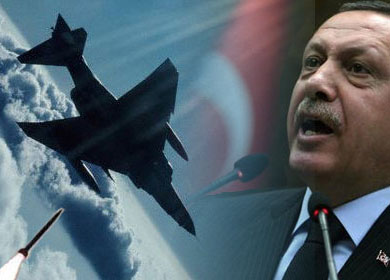
He knew he was in trouble when the Pentagon leaked that the Turkish Phantom RF-4E shot down last week by Syrian anti-aircraft artillery happened off the Syrian coastline, directly contradicting Erdogan’s account, who claimed it happened in international air space.

And it got worse; Moscow, via Foreign Minister Sergei Lavrov, offered "objective radar data" as proof.
There was not much to do except change the subject. That’s when Ankara introduced a de facto buffer zone of four miles (6.4km) along the Syrian-Turkish border - now enforced by F-16s taking off from NATO’s Incirlik base at regular intervals.

Ankara also dispatched tanks, missile batteries and heavy artillery to the 500 mile (800km) border, right after Erdogan effectively branded Syria "a hostile state".

What next? Shock and awe? Hold your (neo-Ottoman) horses.

Lord Balfour, I presume?

The immediate future of Syria was designed in Geneva recently, in one more of those absurdist "international community" plays when the US, Britain, France, Turkey and the Gulf Cooperation Council’s Qatar and Kuwait sat down to devise a "peaceful solution" for the Syrian drama, even though most of them are reportedly weaponising the opposition to Damascus.

GIF - 27.8 kbOne would be excused to believe it was all back to the Balfour Declaration days, when foreign powers would decide the fate of a country without the merest consultation of its people, who, by the way, never asked them to do it on their behalf.

Anyway, in a nutshell: there won’t be a NATO war on Syria - at least for now. Beyond the fact that Lavrov routinely eats US Secretary of State Hillary Clinton for breakfast, Russia wins - for now.

Predictably, Moscow won’t force regime change on Assad; it fears the follow-up to be the absolute collapse of Syrian state machinery, with cataclysmic consequences. Washington’s position boils down to accepting a very weak, but not necessarily out, Assad.

The problem is the interpretation of "mutual consent", on which a "transitional government" in Syria would be based - the vague formulation that emerged in Geneva. For the Obama administration, this means Assad has to go. For Moscow - and, crucially, for Beijing - this means the transition must include Assad.

Expect major fireworks dancing around the interpretation. Because a case can be made that the new "no-fly zone" over Libya - turned by NATO into a 30,000-sortie bombing campaign - will become Syria’s "transitional government", based on "mutual consent".

One thing is certain: nothing happens before the US presidential election in November. This means that for the next five months or so Moscow will be trying to extract some sort of "transitional government" from the bickering Syrian players. Afterwards, all bets are off. A Washington under Mitt Romney may well order NATO to attack in early 2013.

A case can be made that a Putin-Obama or US-Russia deal may have been reached even before Geneva.

Russia has eased up on NATO in Afghanistan. Then there was the highly choreographed move of the US offering a formal apology and Pakistan duly accepting it - thus reopening NATO’s supply routes to Afghanistan.

It’s crucial to keep in mind that Pakistan is an observer and inevitable future full member of the Shanghai Cooperation Organisation (SCO) - run by China and Russia, both BRICS members highly interested in seeing the US and NATO out of Afghanistan for good.

The "price" paid by Washington is, of course, to go easy on Damascus - at least for now. There is not much Erdogan can do about it; he really was not in the loop.

Keep the division of labour intact

So here’s the perverse essence of Geneva: the (foreign) players agreed to disagree - and to hell with Syrian civilians caught in the civil war crossfire.

In the absence of a NATO attack, the question is how the Assad system may be able to contain or win what is, by all practical purposes, a foreign-sponsored civil war.

Yes, because the division of labour will remain intact. Turkey will keep offering the logistical base for mercenaries coming from "liberated" Libya, Saudi Arabia, Iraq and Lebanon. The House of Saud will keep coming up with the cash to weaponise them. And Washington, London and Paris will keep fine-tuning the tactics in what remains the long, simmering foreplay for a NATO attack on Damascus.

Even though the armed Syrian opposition does not control anything remotely significant inside Syria, expect the mercenaries reportedly weaponised by the House of Saud and Qatar to become even more ruthless. Expect the not-exactly-Free Syrian Army to keep mounting operations for months, if not years. A key point is whether enough supply lines will remain in place - if not from Jordan, certainly from Turkey and Lebanon.

Damascus may not have the power to strike the top Western actors in this drama. But it can certainly wreak havoc among the supporting actors - as in Jordan, Qatar, Saudi Arabia, and, of course, Turkey.
Jordan, the weak link, a wobbly regime at best, has already closed off supply lines. Hezbollah sooner or later will do something about the Lebanese routes. Erdogan sooner or later will have to get real about what was decided in Geneva.

Moreover, one can’t forget that Saudi Arabia would be willing to fight only to the last dead American; it won’t risk Saudis to fight Syrians.

As for red alerts about Saudi troops getting closer to southern Syria through Jordan, that’s a joke. The House of Saud military couldn’t even defeat the ragtag Houthi rebels in neighbouring Yemen.
A final juicy point. The Russian naval base at Tartus - approximately a mere 55 miles (90km) away from where the Panthom RF-4E was shot down - now has its radar on 24/7. And it takes just a single Russian warship anchored in Syrian waters to send the message; if anyone comes up with funny ideas, just look at what happened to Georgia in 2008.

Time to shuffle those cards

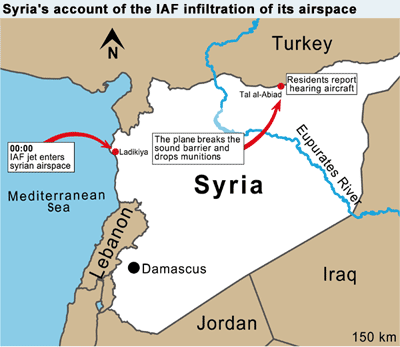
Erdogan has very few cards left to play, if any. Assad, in an interview with Turkey’s Cumhuriyet newspaper, regretted "100 per cent" the downing of the RF-4E, and argued, "the plane was flying in an area previously used by Israel’s air force".

The fact remains that impulsive Erdogan got an apology from wily Assad. By contrast, after the Mavi Marmara disaster, Erdogan didn’t even get an unpeeled banana from Israel.

The real suicidal scenario would be for Erdogan to order another F4-style provocation and then declare war on Damascus on behalf of the not-exactly-Free Syrian Army. It won’t happen. Damascus has already proved it is deploying a decent air defence network.

Every self-respecting military analyst knows that war on Syria will be light years away from previous "piece of cake" Iraq and Libya operations. NATO commanders, for all their ineptitude, know they could easily collect full armouries of bloody noses.

As for the Turkish military, their supreme obsession is the Kurds in Anatolia, not Assad. They do receive some US military assistance. But what they really crave is an army of US drones to be unleashed over Anatolia.

Turkey routinely crosses into Northern Iraq targeting Kurdish PKK guerrillas accused of killing Turkish security forces. Now, guerrillas based in Turkey are reportedly crossing the border into Syria and killing Syrian security forces, and even civilians. It would be too much to force Ankara to admit its hypocrisy.

Erdogan, anyway, should proceed with extreme caution. His rough tactics are isolating him; more than two-thirds of Turkish public opinion is against an attack on Syria.

It’s come to the point that Turkish magazine Radikal asked their readers whether Turkey should be a model for the new Middle East. Turkey used to be "the sick man of Europe"; now Turkey is "becoming the lonely man of the Middle East", says the article.

It’s a gas, gas, gas

Most of all, Erdogan simply cannot afford to antagonise Russia. There are at least 100,000 Russians in Syria - doing everything from building dams to advising on the operation of those defence systems.
And then there’s the inescapable Pipelineistan angle. Turkey happens to be Gazprom’s second-largest customer. Erdogan can’t afford to antagonise Gazprom. The whole Turkish energy security architecture depends on gas from Russia - and Iran. Crucially, one year ago a $10bn Pipelineistan deal was clinched between Iran, Iraq and Syria for a natural gas pipeline from Iran’s giant South Pars field to Iraq, Syria and further on towards Turkey and eventually connecting to Europe.

During the past 12 months, with Syria plunging into civil war, key players stopped talking about it. Not anymore. Any self-respecting analyst in Brussels admits that the EU’s supreme paranoia is to be a hostage of Gazprom. The Iran-Iraq-Syria gas pipeline would be essential to diversify Europe’s energy supplies away from Russia.

For the US and the EU, this is the real game, and if it takes two or more years of Assad in power, so be it. And it must be done in a way that does not fully antagonise Russia. That’s where reassurances in Geneva to Russia keeping its interests intact in a post-Assad Syria come in.

No eyebrows should be raised. This is how ultra-hardcore geopolitics is played behind closed doors. It remains to be seen whether Erdogan will get the message.

Syria and Turkey’s phantom war

Once upon a time, not too long ago, Turkish Foreign Minister Ahmet Davutoglu was the prime proponent of a foreign policy dubbed "zero problems with our neighbors" - derided by many in the West as "new-Ottomanism".

The North Atlantic Treaty Organization (NATO) meets this Tuesday in Brussels not only to craft its response to a Turkish F-4 Phantom jet shot being down by Syria’s anti-aircraft artillery but to seal what sort of "new Ottomanism" is emerging from what actually turned into a "big problem with one of our neighbors" policy.

Davutoglu insists the F-4 was shot in international air space - although conceding it had briefly entered Syrian air space. Contradicting Syria’s official explanation, he said the jet was clearly marked as Turkish; was on a "training flight" to test Turkey’s "national radar system"; and most of all had "no covert mission related to Syria".

Previously, Syrian Foreign Ministry spokesman Jihad Makdissi had stressed this was an "accident, not an attack". According to Makdissi, "an unidentified object entered our air space and unfortunately as a result it was brought down. It was understood only later that it was a Turkish plane."

Davutoglu, in a Turkish media blitzkrieg, as reported by Today’s Zaman, reiterated this was a "solo flight"; the jet was "unarmed"; there was no warning before it was shot down; and as for Syria trying to connect the "not ill-intentioned violation" of its airspace to the shooting of the F-4, that was "irrelevant".

Violation of another country’s air space, trying to avoid its defenses by flying at low altitude, is as normal to Davutoglu as a sheesh kebab for lunch; "There were many violations of Syrian air space by other countries before. But Syria shot down our unarmed plane."

But then the foreign minister started deviating (or not) from the script. He stressed, "No matter how the downed Turkish jet saga unfolds, we will always stand by [the] Syrian people". And this; "We will always stand by Syrian people until the advent of a democratic regime there." Forget about the F-4 Phantom; the "Syrian people" may sleep soundly because the heart of the matter remains regime change.

Everything else is irrelevant

NATO will consider Turkey’s case under Article Four of its charter - which allows consultations whenever "the territorial integrity, political independence or security of any of the parties is threatened". We’re not - yet - at Article Five, which is all about armed response. But we could be, depending how NATO interprets Turkey’s assertion that the F-4 Phantom was "hit 13 miles off the Syrian coast, in international air space".

So according to Davutoglu’s story the F-4 was briefly deviated to Syrian airspace by some irresistible force (Thor?); soon realized its mistake; left in a hurry; but then was shot down. By the way, it was not a "solo flight"; witnesses told Turkish TV they saw two low-flying fighter jets speed by in the direction of Syrian waters, but only one return.

As predictably as England being kicked out of Euro 2012, the usual European warmongering poodles of the William Hague kind have already stepped in, blaming Syria because Turkey violated Syrian airspace. Yet there’s no evidence - so far - that Ankara warned the Syrian government and military they would be conducting some sort of reconnaissance very close to a by now very explosive border.

Whether the F-4 (or the pair of F-4s) was armed or not is, to quote Davutoglu, "irrelevant"; try telling the Pentagon, for instance, that an unknown, low-flying, fast-moving, unidentified object entering your air space is not a threat. If this was a military reconnaissance mission, as Davutoglu himself argues, the F-4 had to be armed.

And imagine if this was a Syrian jet flying over Turkish or Israeli territory.

Burn, Anatolia, burn

Ankara will certainly ask Damascus for a formal apology and payment of reparations. Tehran - which until virtually yesterday, that is, before the Syrian uprising, was part of an Ankara-Damascus-Tehran axis - is calling for cool heads to prevail.

As much as professional warmongers are encouraging a Gulf of Tonkin remix, that remains pure folly. Still, Asia Times Online has learned from a local source about "frantic" movement at NATO’s sprawling Incirlik base in Turkey for days.

Everyone knows - but nobody talks about - NATO’s command and control center in Iskenderun, in Turkey’s Hatay province, near the Syrian border, set up months ago to organize, train and weaponize the motley crew known as the Free Syrian Army. Everyone knows Qatar, Saudi Arabia and the CIA are advising and weaponizing these Syrian NATOGCC "rebels" with essential Turkish help in the logistics/safe haven front.

Everyone knows Washington will settle for nothing less than regime change in Syria - to the benefit of a pliable, sub-imperial puppet (certainly not an Islamist). Everyone knows every provocation advances the not so hidden agenda of an all-out NATOGCC attack on Syria without a UN Security Council resolution, bypassing both Russia and China.

If "neo-Ottomanism" persists with its regime change obsession in Syria - to a large extent tied to the Turkish dream of finding a solution to the Kurdish "problem" - it had better start evaluating how Damascus could shower the Kurdish PKK with funds and logistics so they may unleash hell in Turkish Anatolia.

No doubt this will get much uglier. But in Wag the Dog terms - and that’s what this is all about - no one knows for sure; is Turkey trying to wag the NATO dog into a war, or is it the other way around?
 

River to Sea Uprooted Palestinian  
The views expressed in this article are the sole responsibility of the author and do not necessarily reflect those of this Blog!

Egypt’s National Press: Fuloul With Twist of Brotherhood


A protester reads a newspaper bearing a photo of President-elect Mohamed Mursi (L) during a sit in at Tahrir square in Cairo 25 June 2012. (Photo: Reuters - Asmaa Waguih)
Published Monday, July 16, 2012
Egyptian state-controlled newspapers al-Ahram, al-Akhbar and al-Gomhuria are locked in a battle over choosing their new editors by a Shura Council that is dominated by the Freedom and Justice Party and Salafis.

In the film The Newspaper Vendor (1963) by Hassan al-Imam, the three female stars Magida, Naima Akef and Sanaa Mazhar sing a song to grab their neighbor Rushdie Abaza’s attention. In keeping with the film’s title and story, they shout – between one scene and another – the most recognizable newspaper vendors’ chant in 20th Century Egypt: “Ahram! Akhbar! Gomhuria!”

Of the three famous newspapers, the first, al-Ahram, was established at the end of the 19th century. The second, al-Akhbar (no relation to Beirut’s Al-Akhbar), was established at the end of the first half of the 20th Century. While al-Gomhuria was established by the officers of the 1952 July Revolution. But the three newspaper shared a largely similar fate.

The Egyptian state, under Gamal Abdul-Nasser, nationalized al-Ahram and al-Akhbar which joined al-Gomhuria and a long list of newspapers and magazines, creating what came to be known as the “national press” that is today on the verge of changing its “identity.”

It is hard for people today to remember the song by the three beautiful actresses from the film in light of the Islamists dominance of the Egyptian political landscape. The national press, meanwhile, is locked today in a battle over choosing new editors by the Egyptian Shura Council, which in turn is dominated by the Muslim Brotherhood and Salafis.

There has been multiple protests on the famous stairs of the Egyptian Journalists Syndicate either in support of or against the new criteria set for choosing the new occupants of the top positions in the national press.

The national press is state-run but it is not state-owned. It is “public” but not independent. It consists of quasi-governmental and quasi-public institutions that pay taxes or are supposed to. It is heavily indebted and weighed down by losses and includes an army of journalists, staff and workers that number 31,000. Its journalists dominate the membership of the Press Syndicate.

To sum up, the national press consists of institutions that are independent in theory, but that were always subject to indirect control by the state through one method or another. The last of these methods was the appointment of its top echelon for 30 years by the Shura Council. But even this appointment was a facade because the Shura Council, like the parliament, was subject to the control of the former ruling National Democratic Party (NDP) which means that appointments came from the president.
Today the situation is still the same. The only difference is that the NDP is gone and the Freedom and Justice Party (FJP) - the political wing of the Muslim Brotherhood - has replaced it. Due to its parliamentary majority, the FJP will name the figures that will be in charge of the national newspapers in the coming period.

The fact that a committee formed by the Shura Council, in an unprecedented move, put together a list of criteria for choosing editors does not change this reality.

These criteria require, for example, that the editor be less than 60 years old and to have spent the last 10 years doing work connected to the same institution. There are also political criteria such as “not being an advocate of normalization with the Zionist entity.”

Some journalists considered the criteria “offensive” and “degrading to journalists and to the profession.” So they sued to stop the Shura Council committee from playing a role, demanding instead that the leaders of the media institutions be chosen through their general assemblies.

Protests and lawsuits notwithstanding, more than 80 journalists have applied through the Shura Council for the leadership positions in the institutions of the national press. Even though the Press Syndicate council unanimously rejected the measures taken by the Shura Council, the head of the syndicate, Mamdouh al-Wali, who won the election with the support of the Brotherhood, rejected the decisions of the syndicate council.

The only demand he had of the Shura Council was to include in the committee that chooses editors more journalists, because as it stands, the committee has only four journalists out of 14 members.

Meanwhile, parliamentarians say that “the journalists who are remnants of the old regime are resisting change.” The journalists say that “the Islamists want to kidnap the national press.” In reality, both claims are partly true and partly political propaganda but the basic problem remains legal/administrative.

Regardless of the dominant political identity of the new leadership, the laws organizing institutions do not permit real independence which would allow them to get rid of their debt and perhaps be able to really compete – without government support – with private press which is on the rise.

It is hard to imagine that this gargantuan bureaucratic body (eight national institutions that issue 55 publications) would be able to continue without direct patronage by the state as was the case under the previous regime which subsidized the institutions’ debt to guarantee political loyalty.

The new regime should let go of some of these institutions, otherwise the national press will remain as another copy of that of the old regime but with an Islamist twist.

This article is an edited translation from the Arabic Edition.
River to Sea Uprooted Palestinian  
The views expressed in this article are the sole responsibility of the author and do not necessarily reflect those of this Blog!

The Disintegration of The Jewish State Has Begun

by Gilad Atzmon
Tuesday, July 17th, 2012      

Gilad Atzmon
Israeli Generals expressed dismay yesterday over a violent assault on a senior Air Force officer perpetrated by a gang of soldiers.

Ynet reported yesterday that Maj. A., deputy commander of a squadron at the northern Ramat David Airbase was attacked near his home within the airbase.

An Israeli military source confirmed yesterday that three soldiers, who serve in a technical support unit, assaulted the officer over the weekend after he issued a complaint over their reckless driving on base premises, in violation of strict military regulations.

The three soldiers, apparently outraged by the pilot’s decision to lodge a complaint with their commanding officer, initially threatened to kill him at the presence of his children. They later attacked him outside his home, located on base, with wooden clubs until he nearly lost consciousness.


Ynet reported that Israeli army elite are in shock. “No one can believe that soldiers dared to strike a senior officer”

According to Global Times Senior IAF officers have previously complained about having to deal with soldiers from harsh socioeconomic backgrounds. “With all due respect to the notion of the people’s army, my feeling is that the balance has been violated.”

Earlier this week we learned about an Israeli who set himself on fire during Tel Aviv social protest. Israel, so it seems, is on the verge of disintegration. The images of social protests and violence towards top commanders within the military are clear signs of collapse of the Israeli national, cultural and ideological bond. It is not the Palestinians or the BDS who are going to bring down the Jewish State, it is actually the Israelis themselves. It is the supremacist and chauvinist ideology embedded within the Israeli philosophy and culture that make the Jewish State into an unbearable concept for its citizens let alone the indigenous people of the land i.e. the Palestinians.

River to Sea Uprooted Palestinian  
The views expressed in this article are the sole responsibility of the author and do not necessarily reflect those of this Blog!

Syria: Russia Rejects Western Blackmail

The false reporting on the Tremseh "massacre" was supposed to put pressure on Russia and China to agree to a Chapter 7 UN Security Council resolution. Chapter 7 allows the use of force and such a resolution could be used as an excuse for armed intervention.

Kofi Annan took that position when, after Tremseh, he urged the UNSC to threaten Syria with "consequences" for not retreating from cities and villages. Annan and Ban Ki Moon were dispatched to Russia and China to further press the issue.

But the Tremseh information operation fell apart when the UN observers confirmed the Syrian government version of the story. Writes the Wall Street Journal:
New evidence on last week's killings in a village in central Syria suggests the bloodshed followed a raid by government forces to arrest male rebels, rather than a deliberate massacre of around 200 civilians as some Syrian opposition leaders and their Western allies first reported.
...
The findings could ease the pressure on Russia and China to back tougher measures against Bashar al-Assad's government, underscoring how competing narratives and interpretations of events in Syria continue to divide world powers over how to end a conflict now recognized by most as a civil war.
The Foreign Minister of the Russian Federation Sergey Lavrov is scheduled to meet with Kofi Annan tomorrow. He just held a press conference in which he laid out the Russian and Chinese position. From my notes:
  • Lavrov rejected demands of unilateral withdrawal of Syrian armed forces from cities. He insisted on simultaneous withdrawal by the army and the insurgents after local negotiations and under supervision of the UN observers.
  • He accused the west of "blackmailing" by threatening to not renew the mandate of the UN observers unless Russia agrees to a Chapter 7 resolution.
  • He asked how Russia could trust anyone with Chapter 7 when existing UNSC resolutions and the recent Geneva decisions are not followed by others as they continue to arm and support the insurgency.
  • He expressed concern about the increasing sectarian dimension of the conflict and the fate of minorities like the Christians in Syria.
  • He expressed concern about a radical "third force" in the Syrian conflict and emphasized that such AlQaeda forces are a common enemy of everyone involved in the crisis.
  • He regretted that the Syrian National Council does not relent from its "radical demands", is not helpful in creating an inner-Syrian dialog and has not named a negotiator like the Syrian government has done.
  • He emphasized that the solution of the crisis in Syria will be an example for other global crises and should be seen under that perspective.
  • Inner-Syrian negotiation on a transition as agreed upon in Geneva is the way to go and Russia will not go with any UN resolution that does not confirm with the Geneva document.
  • Russia will not permit any Chapter 7 resolution on Syria to pass the UNSC.
The attempt to use Tremseh to blackmail the Russians has obviously failed.

Will there be another trick the U.S. will try to get its will? Could the unconfirmed allegation by anonymous western officials about the movement of chemical arms within Syria be used to create another fake event that the Syrian government can then be accused of? What other malicious ideas will Hillary Clinton come up with?
River to Sea Uprooted Palestinian  
The views expressed in this article are the sole responsibility of the author and do not necessarily reflect those of this Blog!
huge brewing up, which Mrs. Clinton was not informed with, awaited her arrival”

Dr. Ashraf Ezzat

When president Obama visited Egypt in June 2009, and gave his famous and good for nothing speech for the Muslim world from the big reception hall at Cairo University, he and his team must have felt that Cairo was the quietest and most peaceful place on earth second only to the Seychelles islands.

The reason for that was so simple, but rather dictatorial; the deposed President Mubarak was so careful nothing and no one would bother the American delegation, he simply ordered the day off for all Cairenes whom were also told to stay home and not venture to go out until Mr. Obama had already boarded his flight back to the States.

Mrs. Hillary Clinton, who have been lately engaged in a diplomatic drone attacks on the Russians and the Chinese over the Syrian issue, must have thought nothing would be rewarding and relaxing like winding up her latest world tour with a visit to the historic city of Cairo, where she would only have to do the hand shake-routine and smile back at few of the Muslim Brotherhood (MB) faces, but at the end of the day she would have all the time to enjoy sightseeing, may be the pyramids, and indulge in the Cairene serenity, she still recalls from the 2009 visit.

Prior to Mrs. Clinton’s visit to Cairo, the usual security arrangements were meticulously gone over time and again and a full week weather forecast was submitted to help the state secretary to decide on her wardrobe during the visit. … and yes, a couple of young American tourists were kidnapped in Sinai close to the borders with Israel, to highlight the Sinai loose security issue, just in case Mrs. Clinton forgot to bring it up.

President Morsi meets secretary Clinton in Cairo
But that was not all. Something was missing. There was more to this visit than just the usual speeches, the TV interviews and the expected tranquil royal suite with the majestic view of the pyramids.
There was something huge brewing up, which Mrs. Clinton was not informed with, awaited her arrival.

In her brief and careful remarks after meeting with the newly elected president, Mr. Mohamed Morsi of the MB, and Instead of calling for an immediate handover of power as American officials have in the past, Mrs. Clinton instead emphasized only the need for “building consensus across the Egyptian political spectrum.”
What Mrs. Clinton did is simply add more gray to the current vague picture, whereas what most Egyptians longed for is black and white.
The White House’s struggle to deliver a satisfactory message here, for all parties involved including Israel, reflects its dilemma with how to deal with a rapidly evolving contest for power whose outcome remains yet unclear.

The American diplomacy is trying to balance a public push for a democratic Egypt against a deeply seated desire to maintain long-term ties with both factions, the generals and the Islamists, in a context where the United States seems to have virtually zero influence in post-Mubarak Egypt, and almost any American statement is sure to provoke a backlash. And provoke a backlash it did.

More shoes and tomatoes


One of the Coptic community protesting Clinton’s visit to Egypt
Thousands of anti-MB rallied outside Mrs. Clinton’s hotel, The Four Seasons, at downtown Cairo to protest what they called the American plot to help the MB to outweigh the generals and take full control of the country.

According to the protesters, the American administration unable to curb down the post-Mubarak Islamist tide, decided to use the MB to discipline Hamas and may be make it come to terms with Israel.

By nightfall Saturday, thousands of protesters, who practically surrounded Mrs. Clinton’s Hotel, kept chanting anti-American and anti-MB slogans all night long.

One of the protest leaders chanted “If you like the MB so much, why you don’t take them back with you”

General Tantawi meets Clinton
In the following morning, without a good night sleep I presume, Mrs. Clinton went on to meet General. Houssein Tantawy, the head of the supreme council of armed forces (SCAF) behind closed doors.
The meeting with general Tantawy was seen by some of the liberal parties as a provocative move that added to the polarization of the political scene in Egypt.

As if this was not enough of a disappointment for Mrs. Clinton, her invitation to convene with the Coptic heads was unexpectedly turned down by most of the leaders of the Christian community in Egypt.
“We kind of hoped Mrs. Hillary Clinton had transparently met with all parties and factions of the Egyptian political spectrum in the same room, and not to divide and aggravate the already volatile situation by meeting with the Salafists and the MB first and in private and then ask to meet with some of the Coptic community heads” said Emad Gad, a prominent Coptic activist.
On Sunday, and after inaugurating the new American consulate in Alexandria, all of Mrs. Clinton’s appointments and her expected visit and speech at the library of Alexandria, an event I planned to attend, were cancelled for security reasons.

The road to the library of Alexandria was practically blocked by anti-American protesters who raised shoes, a sign of disrespect, and showered Mrs. Clinton’s car with a descent quantity of Egyptian tomatoes forcing her car to turn around and head for the airport.

After almost one year and a half of the so called Arab Spring, I think it’s only fair to admit that the Europeans and the Americans were outpaced and taken by surprise by the uprisings in both Tunisia and Egypt and it was not before Gaddafi took up arms did they sober up and sent in the NATO planes.
After that they were ready, and in full gear, for Syria, where the Arab spring turned into a nightmare and a theater for all the local and international powers to play out their ugliest plans.

Till this moment, the American administration is trying to make head or tail of the post-Mubarak Egypt and May be that’s why we don’t hear the Obama’s campaign Bragging about how they got rid of Mubarak. Because, frankly, they didn’t.


As the American plane was taking off the Cairo airport and heading for Tel Aviv, I guess Mrs. Clinton started typing down the report on her two-day visit to Egypt, and her lines went as follows …
“Egyptians are not happy with our current stance, the MB are wary of our moves, and I don’t trust them as well. I’m Afraid we don’t have an influence over the generals … not even by threatening to withhold the American annual aide; anyway we’ve done it before and didn’t work. Dealing with the Islamists will cost us; it has already turned the seculars and Copts against us. As for the peace treaty with Israel, no robust commitment detected, and there are too many possible scenarios. … I don’t know, but I liked Egypt 2009 better. Cairo is not tranquil nor friendly as it used to be”