 There is something quite unique about the Middle East’s “Resistance Axis” which includes Iran, Hezbollah, Syria, Hamas and a smattering of smaller groups opposed to western imperialism and zionism.
It is the only major grouping or alliance in the region that includes 1) Arab and Iranian, 2) Sunni and Shia, 3) Islamist and Secularist.
This emotional link to community has often been exploited as a useful political tool to split people across national, political and religious lines. I have written before about these three “Mideast Stink Bombs,” cleverly wielded by dictators, religious extremists and western hegemonists to “divide-and-rule” the region’s populations to advantage.
The Resistance Axis poses an existential threat to these antagonists, whose very authority depends on vilifying the “Other:” the longterm Saudi project to demonize the Shia/Iran; pro-US autocrats and monarchies using “radical Islam” as an excuse to exclude moderate Islamists from the political process; manufacturing an Iranian “nuclear threat” to isolate a foe and justify weapons sales and military build-ups.
Instead, the rather successful alliance of Iran, Syria, Hamas and Hezbollah annihilates the argument that these “differences” are unbreachable fault lines in the Middle East. We can see with our own eyes, that here - standing strong and supportive in the face of common external foes - are Shiite, Sunni, Islamist, Secularist, Arab and Iranian.
Wrenching Away Our Sunni
So it is not at all surprising that the moment the Arab Spring touched a member of this Axis – Syria –all hands came on board to exploit any vulnerabilities and crow about the imminent break-up of the Resistance.
I recall the Wall Street Journal first breaking the Hamas-defecting-from-Axis story – it was called: Hamas Removing Staff From Syria – that bit was true. The next two paragraphs, however, greedily projected on the storyline: “The Islamic militant group's parting of ways with Mr. Assad…” and the even more ambitious “Leaving Syria also distances Hamas from Iran…”
 Plenty of Hamas officials went on the record denying a break with Syria and Iran, but the WSJ story grew legs, arms and heads. Not many western journalists rushed to cover the visit of Hamas’ top official in Gaza travelling to Iran afterward. But they went full-court press when the very same Ismail Hanniyeh addressed a select crowd inside Cairo’s Al Azhar Mosque, saying: “I salute all people of the Arab Spring, or Islamic winter, and I salute the Syrian people who seek freedom, democracy and reform.”
 The New York Times’ unabashed interpretation of that solitary quote leads its breaking story: “A leader of Hamas spoke out against President Bashar al-Assad of Syria on Friday, throwing its support behind the opposition…”
Actually, no. Assad and Iran and Russia and China also claim to support freedom, democracy and reform for the Syrian people. They are just as vague about from whence this freedom, democracy and reform will come as was Hanniyeh during his Friday Prayer sermon.
So where exactly does Hamas stand on Resistance? And what does this mean for the future of the group and the geopolitics of the region?
 The Arab Spring has made way for the “established opposition” in various countries to unseat autocratic governments. The most entrenched opponents of secular, pro-US regimes in the Mideast happen to be Islamists – most of which are of Muslim Brotherhood (Ikhwan) origin, like Hamas.
But while Hamas was marked as an early “winner” of the Arab Spring – their co-religionists in Egypt were, after all, meant to sweep away the previous regime’s oppressive actions against Gaza – they instead found themselves stuck between a rock and a hard place in Syria.
Hamas: Islamist or Resistance?
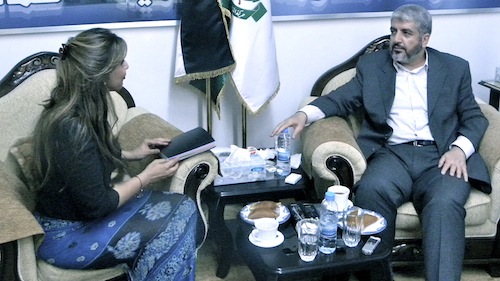
It is a difficult challenge for the group. The fact is that Hamas is both Islamist and Resistance. The question of whether one prevails over the other is an interesting one, and has been with me since my August 2010 interview with Hamas Chief Khaled Meshaal, at which time I concluded: “Hamas is clearly a national liberation movement that has at it roots a "resistance" outlook. It's focus is the liberation of Palestine from Israeli occupation, and the group's Islamist character complements rather than competes with Hamas' political objectives.”
Meshaal even took a crack at explaining the roots of the Resistance Bloc, which has long been an area of interest for me: “The forming of this bloc is a natural consequence of events in the region - firstly, the presence of Israel and its atrocities against the region, and then the failure of the negotiation process to achieve something substantial… So there is a vacuum. There is a fiasco. There is a frustration. There is an increasing fury and anger among the masses. And now, embarrassment at the official level in the region. Resistance has therefore become an attractive model for states in the region.”
Prescient statement. The Arab Awakening, of course, kicked off a few short months later in Tunisia.
But then Meshaal said something very interesting, which
In other words, the Resistance Axis is not an ideological grouping –
,+Syria's+President+Bashar+al-Assad+(C)+and+Iran's+President+Mahmoud+Ahmadinejad+(L)+attend+official+dinner+Damascus+February+25,+2010_.jpg) |
| Where is Mishaal??? |
When Saudi Prince Faisal famously quizzed Meshaal about his alliance with Iran, the Hamas chief explained: "Yes, we have relations with Iran and will do so with whomever supports us. We will say thank you to them, but this is not at the expense of our Arab relations. We are a resistance movement, open to the Arabs, to the Muslims and to all countries in the world, and we are not part of any agenda for regional forces."
[If I am in Hamas chiefs shoes, I would say to the Saudi prince, you should have asked about Iran's alliance with Hamas (the resistance movement), however, the last year proved that Hamas is not as said a liberation resistance movement, that Hamas is an Ikhwan offset who jumped to fill the vacuum]
Does Hamas know where Hamas is going?
Which brings us to today. In my view, Hamas is exploring its options right now. I have confirmation from both Hamas and Iran that financial assistance continues as before. And it seems that every time speculation about worsening relations hits a peak, a senior Hamas official pops up in Tehran to dispel rumors.
| "We promised them with every revolution to rejoice their defeat and our next gloat will be soon from free Damascus, God willing, that's a promise!" |

 Syria is a much harder problem. Hamas officials tell me that the reason for vacating their political office in Damascus is because other nationals were refusing to meet them in Syria. But let’s be honest, the sectarian undercurrents in both Syria and the region – fanned heavily by Saudis, Qataris, Salafists and the western cabal hyper-focused on Iran – are putting the screws on Hamas.
The group is under tremendous pressure from these parties to break from the Resistance Axis, which many have disparagingly dubbed the “Shiite Cresecnt.” They have offered money, incentives, sanctuary to Hamas. They have used threats. They have invoked the “Brotherhood” of the Sunni. But then consider this: why, a year later, are we are still uncertain of Hamas’ position regarding its alliance with Iran, Hezbollah and Syria. [because opportunist Hamas is not as stupid as its Mother, to burn its ships with Resistance Axis]
A rather observant pro-Resistance source remarked the other day: “Hamas is under tremendous pressure to criticize Syria, and that’s all they came up with? It’s not very convincing. Hamas is not giving opinions voluntarily about Syria, I can assure you.”
 |
| "Is it a pre-condition to recognize Israel in order to govern?" |
As Hamas looks to the future and finds many natural co-religionist allies in the various Ikhwan groups emerging on the Arab political landscape, it will be faced with the same dilemma – this time from a different direction. The Islamist character of Hamas may be more fulfilled, but will there be a big gaping hole in their resistance outlook?
Can the Ikhwan get them Palestine? Or can Iran, Syria and Hezbollah fulfill that long-held ambition? Part of the problem with the emerging Ikhwan political parties is that Saudi Arabia, Qatar – even the United States – are trying to guide their direction. If successful, that will not be a comfortable home for Hamas. These new "mentors" will not allow them much breathing space – these are the Old Regimes that actively support the regional Old Order and encourage “flexibility” with Israel.
 The big horse-and-pony show of a Hamas-Fatah reconciliation led to Fatah's Mahmoud Abbas taking the lead. What became of Hamas' awkward Jordanian visit that was only possible because of Qatari hand-holding?
Fatah and Jordan are the last places to look for a Palestinian solution - they are too beholden to western interests.
The new mentors will bang away at Hamas; demand political blood from the group; push them toward unpalatable concessions. A wise colleague points out: “Hamas will be finished when it becomes Fatah.”
 In a 2009 interview with Usama Hamdan, Hamas’ foreign relations chief, told me: “In the West, they try to shape you before dealing with you. This is the Palestinian experience. They've done this with Fatah. Hamas' position is to say what we are, what we stand for - clearly - and we can defend our rights best that way.”
An equally-senior Hamas official told me recently in a lengthy off-the-record conversation that there were “good changes” taking place in the region, but “real dangers” ahead: “The international community does not care about the people of the region…the conflict still is between real independence and being under occupation – or the influence of outsiders.”
He also refuses the notion that Islamist trends in the region will end up hostile to the Resistance: "You can't say the Ikhwan is against Resistance - they have been real supporters of Hamas."
There are two main priorities for Hamas these days, he says: “The needs of the people in the region and dealing with Israel and its supporters.” |
| Rats desert a sinking ship, fools ride |
Hamas may evolve in the next few years, but if it cleaves to its core values – somewhere in the middle of the current leadership’s political spectrum - I think you will find a group that will not commit itself to concepts or allies outside of those parameters. The group will talk to all players, consider all options, test the new waters of this fast-changing region – as it should. In the final analysis, it is the liberation of Palestine that bestows popular legitimacy on this group, and Hamas will need to choose the path that best serves that goal.
 And Resistance itself might change, as one Hamas official hinted to me. If sectarianism can be contained, when this ferocious geopolitical Battle of the Blocs is over, we might perhaps even see a clean sweep from the Persian Gulf to North Africa of people rejecting foreign hegemony and zionism. This is what the Old Guard fears most – and the vast majority of Arabs, Iranians, Sunni, Shia, Islamists and Secularists support whole-heartedly. [ until the if, when, perhaps is realized Hamas is "not part of any agenda for regional forces"]
It will take some time, but I will have my Sunni back.
Sharmine Narwani is a commentary writer and political analyst covering the Middle East. You can follow Sharmine on twitter @snarwani.
 Uprooted Palestinian
The views expressed in this article are the sole responsibility of the author and do not necessarily reflect those of this Blog!


No comments:
Post a Comment